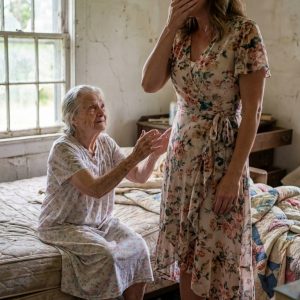
They called it an “intervention.” My in-laws, my husband’s beloved family, sat on my plush beige sectional, wringing their hands and looking at me with the pity one reserves for the mentally unwell. They told me I was suffering from Postpartum Anxiety. They told me I was seeing monsters where there were only shadows. They told me I was ruining the family.
And while they lectured me about my “paranoia” in the living room, my sister-in-law was upstairs, quietly pushing my two-month-old daughter toward an open window.
But I am getting ahead of myself. To understand the horror of that afternoon, you have to understand Bridget.
My sister-in-law, Bridget, had been trying to conceive for seven years. Her journey was a tragedy of failed IVF rounds, chemical pregnancies, and a silent, growing bitterness that seemed to hollow her out from the inside. When I married her brother, Keith, I was sympathetic. I walked on eggshells. But when I fell pregnant three months after our wedding, the atmosphere shifted.
She pretended to be happy, but her eyes told a different story. They were cold, flat stones. “Some people get everything so easily,” she would whisper to anyone who would listen at the baby shower, clutching her wine glass a little too tightly. “Must be nice to not even have to try.”
The moment my daughter, Lily, was born, the dynamic changed from resentment to possession. Bridget swept into the hospital room, bypassing me entirely to hover over the bassinet.
“I’m going to be her second mother,” she announced, her voice trembling with a manic sort of reverence. “Since I can’t have my own, I’ll pour all my love into this baby. I am the most important aunt.”
Everyone in the room—Keith, his parents, the nurses—cooed. They thought it was a sweet, healing gesture. I felt a chill run down my spine that had nothing to do with the hospital air conditioning. It felt predatory.
The “accidents” began almost immediately. Bridget started visiting every single day, arriving unannounced, snatching Lily from my arms the moment she walked through the door.
“Mommy needs a break,” she would insist, even if I had just woken up from a full night’s sleep and was happily nursing. If I tried to take my baby back, she would physically turn her body away, tightening her grip. “Don’t be selfish. Lily needs to bond with her aunt, too.”
Then, the danger began to creep in.
When Lily was only three weeks old, I walked into the kitchen to find Bridget holding a bottle of water to my newborn’s lips. I screamed, slapping the bottle away.
“Babies get thirsty, too!” Bridget snapped, looking at me like I was the deranged one.
“Water can kill a newborn, Bridget! It messes up their electrolytes!” My hands were shaking.
She rolled her eyes. “That’s just paranoid internet nonsense. Babies in my generation drank water and survived. You’re being dramatic.”
A week later, during nap time, I found my baby’s face pressed hard against a massive, fluffy teddy bear Bridget had stuffed into the crib. Lily was barely breathing, her tiny nose obscured by synthetic fur.
“I was just making it cozy,” Bridget defended herself when I pulled the bear out, gasping. “You keep her in that cold, empty box like she’s in a prison.”
When I showed her the Safe Sleep Guidelines, the pediatrician’s pamphlets, and the terrifying statistics about SIDS, she waved a hand dismissively. “Modern mothers are too anxious about everything. We survived without all these rules.”
She would leave Lily on the changing table and walk out of the room. She would prop bottles in Lily’s mouth and leave her alone to choke. She would strap Lily into her car seat with the buckles so loose the baby would have become a projectile in a fender bender.
Every time I caught her, the refrain was the same: I’ve babysat dozens of kids. I know what I’m doing. You’re overreacting.
The worst part wasn’t just Bridget; it was Keith. My husband, usually rational and protective, was blind.
“She’s trying to help, honey,” he would say, rubbing my back while I hyperventilated. “She’s just not up to date on current safety stuff. Be patient with her. She’s grieving her own infertility.”
His parents were worse. “Bridget loves that baby more than life itself,” my mother-in-law, Martha, would scold me. “She would never hurt her. You’re being a paranoid new mother. You’re pushing family away.”
The breaking point—or what I thought was the breaking point—came when Lily was two months old. I left Lily with Bridget for exactly three minutes to use the bathroom. When I returned, Bridget was feeding my infant honey from a spoon.
“It’s good for her immune system,” Bridget said brightly as I knocked the spoon across the room. “And it helps them sleep.”
We spent that night in the Emergency Room, terrified of infant botulism. The doctor was horrified. Bridget told everyone I was hysterical over “a tiny drop of honey.”
When we got home, I banned her. “She is not allowed in this house,” I told Keith. “She is dangerous.”
The next day, she showed up anyway. But she brought backup. Keith’s parents, Martha and Robert, marched in with her.
“This has gone too far,” Martha declared. “You are keeping Bridget from her niece over accidents. She is devastated. We are having an intervention about your behavior.”
Keith sat there, head in his hands, letting them attack me.
“Maybe you have Postpartum Anxiety,” Bridget suggested, her voice dripping with fake concern. She wasn’t sitting with the others; she was wandering around the room. “It makes mothers see danger everywhere.”
While Martha and Robert listed my “crimes”—my strict rules, my refusal to let Bridget babysit, my “cruelty”—Bridget quietly slipped away.
I was defending myself, tears streaming down my face, when we heard it.
CRASH.
It came from upstairs. From the nursery.
The silence that followed was heavier than the noise. Then, the screaming started.
We all ran. I reached the nursery first. The scene is burned into my retinas like a photograph from a nightmare.
Bridget was standing by the window seat. She was holding her phone, the camera app still open.
Lily was on the floor, screaming a sound I didn’t know a human could make.
But that wasn’t the horror. The horror was the window. It was wide open. The window seat was pushed right up against the sill. My two-month-old daughter had been placed on a slick cushion for a “natural light” photo, and she had rolled.
She had rolled inward, onto the carpet. If she had rolled six inches to the left, she would have fallen two stories onto the concrete patio below.
“I just wanted some photos with natural light,” Bridget said, staring at her phone. She didn’t move to help the baby. “Babies are tougher than you think.”
I collapsed onto the floor, gathering Lily against my chest, checking her head, her limbs.
Keith finally—finally—broke.
He stood over his sister, his face a mask of pure, unadulterated rage. “What the hell were you thinking?” he screamed, his hands shaking so hard he had to clench them into fists. “You could have killed her! She could have fallen out the window!”
Bridget actually rolled her eyes. “Oh, stop it. She didn’t fall. You’re all so dramatic.”
The paramedics arrived in a blur of static and heavy boots. A woman with short gray hair knelt beside me.
“I need to check her, honey,” she said gently.
I didn’t want to let go. I felt that if I let go, Bridget would snatch her again. But I handed Lily over.
While the medic examined the bump on Lily’s head, Keith was explaining the situation to the police officer who had followed the ambulance. When he pointed to the open window, the color drained from the officer’s face.
“She put the baby there?” the officer asked, looking at the two-story drop. “With the window open?”
“Yes,” Keith sobbed.
Martha, standing in the doorway, tried to intervene. “She only fell a short distance onto the carpet! She’s fine! Babies fall all the time!”
I stood up, trembling with adrenaline. “Get out.”
Martha blinked. “Excuse me?”
“Get out of my house. Now.”
Robert bristled. “Now listen here, you’re being dramatic. Bridget made a mistake—”
Keith turned on his father. “Get out,” he roared. “You came here to lecture my wife about being paranoid while your daughter almost killed my child. Get out and don’t come back until I say so.”
He physically guided his parents to the stairs. When Bridget tried to follow, whimpering about how we were being “cruel,” Keith blocked her path.
“You are never setting foot in this house again,” he spat.
The ER was freezing. We were ushered into a trauma room immediately—a sign that the doctors took a fall like this seriously.
Dr. Elena Richardson was a tall woman with a ponytail and eyes that missed nothing. She examined Lily, checked her reflexes, and then listened to my story. When I got to the part about the open window, she stopped writing.
“Is this the first incident?” she asked.
I broke. I told her everything. The water. The blankets. The honey.
Dr. Elena’s face hardened. She sat down on her stool and looked at us. “I need to involve a social worker. This is not normal. This is a pattern of endangerment.”
The social worker, Cormack, was kind but thorough. He asked Keith the hard question: “Does your sister have a history of mental health issues?”
Keith, holding Lily like a lifeline, admitted the truth about the seven years of infertility.
“What you’re describing,” Cormack said, typing into his laptop, “sounds like someone who is either deliberately creating dangerous situations or is so obsessively fixated on the baby that they cannot recognize risk. Either way, this is a Child Protective Services matter. We are recommending no unsupervised contact. Actually, given the severity, I’d recommend no contact at all.”
We stayed overnight for observation. At 1:00 AM, Keith’s phone began to buzz.
It was an onslaught. Texts from Martha saying Bridget was suicidal. Texts from Robert accusing us of tearing the family apart. Texts from cousins I hadn’t seen in years saying we were being harsh.
Keith looked at the phone, then at me, then at our sleeping daughter. He turned the phone off and put it in his pocket.
“The only people who matter are in this room,” he whispered. It was the first time since Lily was born that I truly believed him.
We brought Lily home the next day. The relief was short-lived.
As we pulled into the driveway, Keith slammed on the brakes. Bridget was sitting on our porch. She had a massive bouquet of flowers and a giant teddy bear.
Keith got out of the car. “Leave. Now.”
“I just want to apologize!” Bridget wailed, standing up. “I brought flowers! I love her! How can you treat me like a monster?”
“You almost killed her!” Keith shouted. “Go!”
She refused. she crossed her arms and sat back down. “I have rights! I’m her aunt!”
I called 911.
Watching the police officer issue a formal trespass warning to my sister-in-law on my front lawn was surreal. Bridget was sobbing, screaming that I had poisoned Keith against his family. Keith stood like a statue, watching the officer hand her the citation.
But Bridget didn’t stop.
A week later, I saw her at the grocery store. I was three aisles over, and she was just standing there, staring at me and the stroller. I abandoned a full cart of groceries and ran to the car, my heart hammering against my ribs.
Then, she appeared at the park. Just sitting on a bench, fifty feet away, watching.
Then, outside the pediatrician’s office.
We were living in a state of siege. I developed a safety plan. We varied our routes. We shopped in the next town over. Keith took two weeks of family leave because I was too terrified to be home alone.
Three months later, the letter arrived.
It was from Martha and Robert. It started with an apology that felt more like a justification—”We know accidents happen”—and ended with a threat. They wanted visitation. If we didn’t grant it, they would “explore their legal rights as grandparents.”
We hired Garrett, a family law attorney who smelled like old coffee and knew the law inside and out.
“Grandparent rights are tricky,” Garrett said. “But you have something most people don’t. You have documentation of endangerment.”
We spent days compiling the “File.” The ER records from the honey incident. The police report from the window incident. The social worker’s assessment. My detailed journal of the water and the unsafe sleep.
When Keith sent a response email stating we needed three months of no contact to heal, his parents exploded. They sent back a vitriolic email accusing us of using Lily as a weapon.
“Good,” Garrett said when we showed him. “This proves they care more about their control than the child’s safety. Keep documenting.”
Then came the second blow. A cease-and-desist letter from a lawyer representing Bridget. She was claiming “defamation.” She said we were spreading lies about her endangering the baby and ruining her reputation.
Garrett actually laughed. “Truth is an absolute defense to defamation. If she sues, we get to present all the evidence of her negligence in open court. It will become a public record.”
He wrote a response that was four pages of clinical, brutal facts. He attached the medical records. He listed the police report number. He concluded by saying that if she continued to harass us, we would file for a permanent restraining order.
We never heard from her lawyer again.
The family began to fracture. It started with Keith’s Aunt Sarah. She called Keith and asked to meet for coffee.
“I saw how she was at the hospital,” Sarah told him, tears in her eyes. “I saw her snatch that baby. I thought I was crazy. But hearing Bridget’s version of events… it doesn’t add up. She says you’re keeping Lily away because you don’t like her buying gifts.”
Keith showed her the file. He showed her the photo of the open window.
Sarah went back to the family and told the truth.
Suddenly, the text messages stopped being attacks and started being questions. Cousins called to apologize. Keith’s Uncle Ben, a retired pediatrician, reviewed our file and was horrified. “This isn’t a mistake,” he told us. “This is pathology.”
The family split down the middle. On one side, Martha, Robert, and Bridget, clinging to their denial. On the other, the relatives who valued a child’s life over family secrets.
Six months after the window incident, I received a letter from Martha. It was different. The handwriting was shaky.
She admitted that she had enabled Bridget. She admitted that her guilt over Bridget’s infertility had blinded her. She asked for one chance to see Lily, under any conditions we set.
We consulted Dr. Elena. “Proceed with caution,” she advised. “Set hard boundaries. If they cross them, you leave immediately.”
We met at a restaurant. Martha and Robert were waiting. They looked ten years older.
The visit was stiff. Martha held Lily like she was made of glass. She didn’t mention Bridget.
But on the second visit, she slipped. She pulled out a gift box. “It’s from Bridget,” she whispered. “She misses her so much.”
Keith didn’t hesitate. He stood up. “We have a rule. No contact means no gifts. You are acting as a conduit for a person who endangered our child.”
“It’s just a onesie!” Martha cried. “You’re being so cruel!”
“We’re leaving,” Keith said. And we did. We walked out while his parents shouted that we were unforgiving.
We didn’t speak to them for another two months. When they reached out again, there were no gifts. No mentions of Bridget. They had finally learned that we were not bluffing.
It has been a year since Lily almost rolled out that window.
Bridget moved to Arizona. Keith’s grandmother told us. She packed up in the middle of the night and left. I felt a weight lift off my chest that I hadn’t realized I was carrying.
Lily’s first birthday party was last week.
It wasn’t the party Keith had imagined when we got married. His parents were there, but they were guests, not hosts. They stayed for an hour, ate a polite slice of cake, and left early. There was a sadness in Keith’s eyes as he watched them go, but no regret.
The room was filled with the people who actually protected us. Aunt Sarah, holding Lily on her hip. Uncle Ben, taking photos. Garrett sent a card. Dr. Elena stopped by.
My daughter sat in her high chair, smashing a blue cake into her face, laughing with pure, unburdened joy. She is safe. She is loved.
I looked at Keith, who was wiping frosting off Lily’s cheek. He caught my eye and smiled—a real, genuine smile.
We lost a lot of people to get here. We burned bridges we thought were made of stone. But as I watched my daughter clap her hands, alive and whole, I knew the truth.
Some bridges need to burn so you can see the way forward.
And as for Bridget? Keith’s grandmother mentioned she’s joined a church group in Phoenix. She’s volunteering in the nursery.
I’m already writing the letter to the church leadership. Because a mother’s job is never done.