The Architecture of a Cage
Some people wear a smile like a theater mask, molded from porcelain and painted with perpetual joy. You learn to sleep in it, breathe in it, and eventually, you forget what your real face looks like beneath the ceramic. For three agonizing years, I was the lead actress in a play I desperately wanted to escape.
My name is Quinn. I am twenty-five years old, and to the affluent neighbors peering through the wrought-iron gates of our exclusive Sedona community, I was the portrait of a flawless life. Our estate was framed by the iconic crimson rocks, bathed in perpetual Arizona sunshine. Yet, while other women wore sundresses, I remained buried beneath thick, long-sleeved cashmere and heavy cardigans, even when the desert heat pushed past a hundred degrees. I was hiding a tapestry of overlapping, ugly secrets painted across my skin.
What none of us anticipated—not my captors, and certainly not me—was that the one man equipped to dismantle this nightmare was flying home after a twenty-one-year military deployment, walking directly into the crosshairs of my hidden war.
It started the moment the heavy mahogany doors of the Sedona villa closed behind me after my honeymoon. My husband, Mitchell, did not lock me in a cell; he built a prison out of concern. He softly suggested that commuting was taking a toll on my glow. He insisted I transition to working remotely, arguing that our sprawling property required a dedicated manager. Blinded by the remnants of newlywed trust, I agreed.
The velvet glove quickly slipped off to reveal the iron fist beneath. Within months, Mitchell began calling my corporate office on my behalf, feeding them a fabricated narrative of my supposedly failing mental health and severe chronic fatigue. The pressure became an invisible vice around my neck. It culminated on a Tuesday afternoon. Mitchell stood directly behind my ergonomic mesh chair, his heavy hands resting on my shoulders, anchoring me in place. He dictated every single syllable of my resignation email. He watched my trembling fingers strike the keys, refusing to move until my mouse hovered over the send button.
“Click it, Quinn,” he whispered, his breath hot against my ear. “It’s for the best. You’re simply too fragile for that world.”
With one click, my independent income, my daily interactions with colleagues, and my anchor to the outside world vanished. My entire universe shrank to the property line.
Shortly after my resignation, my mother-in-law, Joyce, moved into the guest wing under the guise of “helping out.” In reality, Mitchell had hired a warden. Joyce didn’t bother locking every door—that would look too obvious to the pool cleaner or the landscapers. Instead, she took absolute possession of the master keychain. The heavy brass keys jingled at her hip like a prison guard’s. She locked the garage bays, severing my access to our vehicles. She secured the walk-in pantry, the combination safe, and Mitchell’s private study.
If I needed a bottle of surface cleaner or a specific spice for dinner, I had to request a temporary pardon. Joyce would silently march over, unlock the door, stand inches behind my back while I retrieved the item, and then slam the door shut, turning the deadbolt with a satisfying click.
Joyce instituted a draconian schedule. I was allotted exactly thirty minutes of oven usage per day. She stood over the granite countertops, measuring the exact grams of rice and ounces of chicken I was permitted to consume. “Electricity is expensive, Quinn,” she would scold, her eyes narrowing. “You have no concept of budgeting, seeing as you contribute nothing to this household.”
It was a cruel irony, considering Mitchell had already confiscated my credit cards, wiped my phone, and changed every password to my personal bank accounts. I was a ghost haunting my own home.
The psychological warfare peaked the evening I finally broke. I had packed a small nylon duffel bag with a few sweaters, determined to walk the seven miles to the highway. Mitchell intercepted me in the grand foyer. He didn’t yell. Instead, he pulled out his smartphone and turned the screen toward me.
He pressed play on a meticulously edited video compilation. The footage showed me screaming, sobbing on the floor, and tearing at my own hair. What the video conveniently omitted was the audio of his endless, hours-long verbal abuse, or the fact that he had kept me awake for three consecutive nights just prior to the recordings. On the silent screen, I looked completely unhinged.
“If you touch that doorknob,” Mitchell said, his voice dripping with faux sympathy, “I will send this to the police and the psychiatric board. They will institutionalize you, Quinn. And everyone will believe me.”
The bag slipped from my fingers, hitting the marble floor with a dull thud. He had weaponized my own trauma against me. Without money, a vehicle, or a phone that wasn’t monitored, I had no way to prove the context of his digital torture. The paralyzing fear of being locked in a sterile white ward stripped away the last ounce of my courage.
Weeks later, Joyce granted me a rare forty-five-minute window to walk to a nearby organic market. As I stood in the cereal aisle, frantically counting the exact pocket change I’d been given, a familiar voice shattered my concentration.
“Quinn?”
I froze. It was Sarah, my closest friend from my former corporate life. She stopped dead in her tracks, her eyes widening as they scanned my hollowed cheeks, my exhausted posture, and the faded, yellowish edge of a bruise peeking out from beneath my oversized collar.
Sarah didn’t ask questions. She lunged forward, grabbing my wrist. “Leave the basket. You’re coming to my apartment right now. I don’t care what he’s done, you cannot go back there.”
A violent tremor shook my entire body. I desperately wanted to melt into her arms, to let her drag me to safety. But deep in the pocket of my coat, my phone began to vibrate violently. It was the Life360 tracking application Mitchell had installed. A text message flashed on the screen: Why has your location dot been stationary in aisle four for exactly four minutes?
Panic clawed at my throat. I yanked my arm away from Sarah so hard I nearly lost my balance. “I can’t,” I choked out, backing away. “Leave me alone, Sarah. Please.”
I grabbed my plastic bags and practically sprinted out the sliding glass doors, abandoning the only lifeline I had seen in years, running blindly back into the jaws of my cage.
But the walls of that cage were about to crack, not from my strength, but from the sheer weight of Mitchell’s own greed.
The Paper Trail of Betrayal
By the autumn of my third year in captivity, the Sedona villa felt less like a pristine estate and more like a sinking ship. The mailbox overflowed with crimson-stamped late notices. Mitchell’s logistics company, once his pride and joy, was teetering on the absolute edge of catastrophic bankruptcy.
The nights became unbearable. He paced the hardwood floors for hours, a tumbler of whiskey in hand, screaming obscenities at creditors through his earpiece. The stress radiated off him like heat from a furnace.
One evening in late November, Mitchell marched into the dining room and slammed a massive, three-inch-thick stack of legal documents onto the oak table. He pointed a trembling finger at a blue ballpoint pen resting on top of the pile.
“Sit down,” he commanded, his eyes bloodshot and erratic. “Sign them.”
I stared at the paperwork. “What is this?”
“It’s a commercial loan application. A massive one,” he snapped, wiping sweat from his forehead. “My business credit is shot. But your personal credit score is spotless. You are going to act as the primary guarantor. It’s the only way I can secure the capital to keep the company afloat.”
A rare surge of defiance flared in my chest. I looked at the pen, then up at his desperate face. “No.”
Mitchell blinked, seemingly unable to process the refusal. “Excuse me?”
“I said no. I am not attaching my pristine name to your failing debts. I will not sign.”
I pushed the heavy stack of papers back across the table. For a second, I thought he was going to strike me. Instead, he let out a guttural roar, spun around, and drove his fist straight through the drywall, leaving a gaping, jagged hole. He stormed out of the house, the roar of his sports car echoing into the desert night.
The next morning, Mitchell left the property in a chaotic rush, his clothes disheveled. I was assigned to clean the west wing. As I walked into his private, usually locked office to gather the empty espresso cups littering his mahogany desk, my eyes caught a glow.
In his haste, he had forgotten to close his laptop. The screen was awake, the password protection bypassed.
My heart hammered against my ribs like a trapped bird. I set the cups down and slid into his leather chair. My hand trembled as I touched the computer mouse. I minimized his email browser and found a digital folder sitting dead center on the desktop, labeled with the acronyms of four major national banks.
I double-clicked. A cascade of PDF files populated the screen. I opened the first one and felt the blood drain entirely from my face.
It was an approved line of credit for fifty thousand dollars. I scrolled frantically to the final page. There, sitting perfectly on the guarantor line, was my signature. It wasn’t a clumsy forgery; it was a masterful, digital replication of my handwriting.
I opened the next file. A platinum corporate credit card, maxed out to thirty thousand dollars. Again, my forged signature authorized the debt.
I clicked through file after file. The total debt he had illegally chained to my identity amounted to well over one hundred and fifty thousand dollars. He hadn’t just stolen my life; he had financially buried me alive without my knowledge or consent.
A cold, mechanical clarity washed over me. The fear evaporated, replaced by a crystalline determination. I quietly reached under the desk, grabbed the USB cable, and connected the laptop to the heavy-duty laser printer. I hit ‘Print All’.
I stood in absolute silence, listening to the rhythmic, mechanical whir of the machine as it spat out fifty pages of undeniable, physical evidence. I gathered the warm papers, aligned the edges perfectly, and waited.
When the front door opened that evening, I was already standing in the center of the living room. I didn’t cower. I didn’t avert my eyes. As Mitchell walked in, loosening his tie, I raised my hand and threw the thick stack of forged contracts directly onto the glass coffee table. The papers fanned out, a sea of undeniable guilt scattered across the transparent surface.
“Explain this,” I demanded, my voice startlingly steady. “You stole my identity. You forged my name on over a hundred thousand dollars of debt. Give me one reason why I shouldn’t walk out that door and hand these straight to the federal authorities.”
The color vanished from Mitchell’s face. Before he could formulate a lie, the hallway floorboards creaked. Joyce stepped out of the shadows. She looked down at the scattered banking documents, her face hardening into a mask of pure malice. She didn’t look at me. She looked directly at her son.
“She has become a liability,” Joyce said, her voice devoid of any maternal warmth. “She needs to be reminded of the consequences of going through your things. Show this ungrateful girl who makes the decisions in this house.”
That was the exact moment the psychological war turned into a physical bloodbath.
The Descent into the Dark
The moment Joyce’s words hung in the air, Mitchell lunged.
There was no hesitation, no flicker of remorse in his eyes. He closed the distance between us in a fraction of a second. Both of his large hands wrapped violently around my throat, instantly crushing my windpipe. I couldn’t even manage a scream.
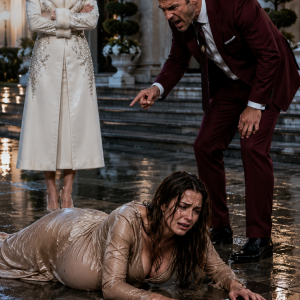
He lifted me slightly off the floor, his face contorted in rage, and shoved me backward with a terrifying amount of kinetic force. My feet left the ground. I flew backward, the world spinning, until my body collided violently with the sharp, unyielding marble edge of the kitchen island.
The sickening crack of my ribs taking the impact echoed through the kitchen. I collapsed onto the cold hardwood, gasping like a drowning woman. A blinding, sharp pain radiated across my entire torso, stealing the oxygen from my lungs. I curled into a fetal position, clutching my side.
As I lay there, struggling to draw a single breath, the heavy front door swung open. My sister-in-law, Clara, a high-powered executive in a sleek pencil skirt, walked in.
She paused, looking down at me writhing on the floor. She didn’t gasp. She didn’t ask if I was okay. She calmly stepped over my trembling legs as if stepping over a spilled glass of water. She reached into her designer handbag, pulled out her cell phone, and stared down at me with eyes as cold as absolute zero.
“I have Dr. Hansen’s private number dialed in,” Clara stated, her tone strictly business. “You know he owes our family a favor. One word from me, one button press, and the authorities will arrive. We will tell them you had a violent, schizophrenic break and threw yourself against the counter. They will strap you to a gurney, inject you with sedatives, and you will wake up in a locked psychiatric ward. Your choice, Quinn.”
I lay paralyzed on the floor, looking up at the three of them forming a triangle of absolute malice. Mitchell was casually rubbing his knuckles. Joyce nodded in grim satisfaction. Clara held the phone, her thumb hovering over the green call button.
It was a masterfully engineered trap. If I somehow dragged myself to the landline and dialed 911, the police would arrive to find three affluent, well-dressed citizens calmly explaining that I had lost my mind. My bruised ribs would be framed as self-inflicted injuries. I realized, with a sickening drop in my stomach, that logic and truth had no power in this house. I had to survive the night to fight another day. I closed my eyes and remained completely silent.
Five days before my father’s naval deployment was scheduled to end, the family decided my mere presence was too great a risk.
Mitchell walked into the living room, a fresh, single-page legal document in his hand. He dropped it on the coffee table. It was a Power of Attorney agreement, explicitly mandating the immediate transfer of my half of the estate’s ownership directly to him, waiving all my rights to the property.
“Sign it,” he ordered, tossing a pen onto my lap. “I need the equity to clear the corporate debt. Do it, and maybe things will go back to normal.”
I looked at the thick, linen paper. The pain in my ribs pulsed. I slowly reached out, picked up the document, and looked him dead in the eye. With one swift, aggressive motion, I ripped the legal paper directly down the middle, letting the torn halves flutter to the floor.
Mitchell’s eyes went black. He stepped forward and struck the side of my face with a closed fist. The impact sent me crashing back to the floor, my vision exploding into white stars.
Before I could regain my bearings, he grabbed the back collar of my sweater. Joyce scrambled out of the kitchen and seized both of my wrists. Together, they dragged me across the Persian rug. The friction burned my skin. They pulled me toward the basement door and hauled me violently down the wooden stairs. My spine slammed against the edge of the steps with every downward jerk.
They threw me into the small, unfinished concrete bathroom at the darkest corner of the basement.
“You will rot down here until you beg me for a pen!” Mitchell spat.
The heavy steel door slammed shut. The exterior deadbolt slid into place with a definitive, metallic echo. Total darkness consumed me.
They left me with the barest mathematics of survival: a half-empty plastic jug of filtered water and a paper plate holding three stale slices of bread. The plumbing to the toilet was broken. There was no electricity. For three days and nights, I sat in the pitch black, listening to the violent rainstorm pummeling the foundation of the house, shivering uncontrollably on the concrete floor.
On the third night, a sound cut through the darkness. The heavy rumble of Mitchell’s sports car engine starting in the garage. I pressed my ear against the cold steel door. The tires squealed as he sped out of the driveway, likely heading to appease another desperate creditor. Joyce and Clara were heavily asleep upstairs.
This was my only window.
I limped toward the opposite wall, feeling my way through the dark until my hands brushed against the small, rectangular ventilation grate positioned near the ceiling. The torrential rain of the past week had flooded the window well outside, and water was seeping through.
I patted the walls and found a rusted, metallic storage rack leaning against the corner. Suppressing a scream as my broken ribs protested, I dragged the heavy rack and wedged it against the tiled wall. I climbed onto the unstable metal frame, balancing precariously, and reached for the grate.
The heavy weather exposure had severely corroded the iron screws holding the grate to the concrete. I gripped the thick iron bars, planted my feet on the rack, and threw my entire body weight backward.
The pain in my chest was blinding, but the rusted screws bent, shrieked, and finally snapped. The heavy metal grate tore free, crashing onto the basement floor.
I hoisted myself up, squeezing my shoulders through the narrow, jagged opening. Concrete tore through my sweater, shredding the skin on my back and knees. I wormed my way through, tumbling forward out of the window well, and collapsed face-first into the freezing, flooded mud of the backyard.
I didn’t stop to breathe. I scrambled barefoot over the sharp gravel, sprinting through the thorny desert brush that separated the estate from the main highway. Blood poured from the bottom of my feet, but adrenaline masked the pain.
I reached the slick asphalt just as a pair of headlights pierced the heavy rain. I threw myself onto the shoulder of the road, waving my arms like a madwoman.
A yellow taxi slammed on its brakes, hydroplaning slightly before skidding to a halt inches from me. I ripped open the rear door and threw my soaked, bruised body into the backseat.
“The naval base,” I gasped, choking on rainwater and tears. “Drive to the naval base. I will pay you triple whatever the meter says when we are inside the gates.”
The driver, an older man with kind, tired eyes, looked in the rearview mirror. He saw the blood on my face, the mud caked into my hair, and the absolute, raw terror radiating from my shaking frame. He didn’t ask for a deposit. He didn’t ask what happened. He just gave a single, firm nod, slammed his foot on the accelerator, and launched the cab into the black of the night.
I was heading toward the only man who knew how to fight a war.
The War Room
The taxi breached the perimeter of the military zone just after 2:00 AM. I borrowed cash from a sympathetic guard at the gate to pay the driver, then stumbled toward the main reunion facility.
The cavernous hall was bathed in warm, yellow light, packed with hundreds of uniformed personnel and their weeping, joyous families. The air was thick with the smell of cheap coffee, floor wax, and overwhelming relief.
Despite twenty-one years of deployments, my father and I had maintained an unbreakable bond through encrypted weekly video calls. I scanned the sea of digital camouflage and dress uniforms. Finally, I spotted him near a podium, speaking with a lieutenant.
“Dad.”
My voice was a raspy whisper, but he heard it. He turned.
The proud, smiling face of a returning hero vanished the instant his eyes locked onto me. Thirty years of elite military instinct overrode his paternal joy. He didn’t see a daughter coming for a hug; he saw a casualty of war stumbling into base camp. He registered the lack of shoes, the torn and bloody sweater, the defensive hunch of my shoulders, and the frantic darting of my eyes.
He closed the distance in three massive strides. He bypassed any greeting. Without a word, he reached out and plucked my cell phone directly from my tightly clenched fist.
He stared at the screen for a millisecond, then pressed his thumb brutally onto the power button, holding it until the device died. He then popped the SIM card tray, extracted the tiny plastic chip, snapped it cleanly in half between his fingers, and dropped the pieces into the pocket of his dress uniform. The digital leash Mitchell held on me was severed.
He stood inches from me, his eyes scanning the crowd to see if I had been followed. Down the hall, a janitor accidentally let a heavy wooden door slam shut.
BANG.
I flinched so violently I nearly tripped over my own feet, crying out and instinctively crossing my arms tight against my chest, pulling the ruined, wet sleeves down to hide my wrists.
My father’s jaw tightened into a block of granite. “Why do you cower when a door closes, Quinn? And why are you aggressively hiding your arms?”
He didn’t wait for an answer in front of an audience. He placed a massive, warm hand on the small of my back and steered me away from the celebration. We navigated a labyrinth of restricted corridors until he pushed open the door to an empty tactical briefing room. He flipped the fluorescent lights on, pulled the heavy steel door shut, and threw the deadbolt.
He turned to me, gently took my right arm, and deliberately rolled the soaked cashmere sleeve up to my elbow.
The harsh overhead lights illuminated the horror. A overlapping map of dark purple, sickly yellow, and deep blue finger-shaped bruises wrapped entirely around my forearm.
I didn’t weep. I didn’t waste his time with emotional hysterics. I mirrored his stoicism and laid out the intelligence report. I detailed the isolation, the control of the keys, the thirty minutes of oven time. I explained the physical assault, the cracked ribs, and the three-day sensory deprivation in the basement.
Then, I reached inside the lining of my ruined coat. I pulled out a heavily folded, waterproof zip-lock bag. I tore it open and placed the fifty printed pages of fraudulent loan applications and maxed-out credit card statements flat onto the center of the metal briefing table.
“He forged my signature,” I said, pointing to the digital ink. “He took out over a hundred and fifty thousand in my name to save his company. I have the proof.”
My father did not scream. He did not punch a wall. He pulled out a steel folding chair, sat down, and meticulously read through every single page of the banking documents. His face was a mask of terrifying, arctic calm.
When he finished, he aligned the papers perfectly. He placed his hands flat on the table.
“We are not going to yell, Quinn,” my father said, his voice a low, vibrating hum of pure authority. “We are going to employ maximum legal violence. We are going to dismantle every pillar of his life, seize his assets, and put him in a cage where he belongs. Tomorrow, we play their game. But we play it by my rules.”
He stood up, reached into his pocket, and handed me a brass key. “This is for the officer’s guest quarters on base. Go there. Lock the door. Do not contact anyone in Sedona. Sleep. At zero-six-hundred, the war begins.”
The hunters were about to become the hunted.
The Siege and the Subpoena
By 6:00 AM the following morning, the tactical strike force was assembled in the private, mahogany-paneled office of Mr. Miller, a ruthless litigation attorney and an old friend of my father’s.
Lawyer Miller didn’t deal in threats; he dealt in paper and federal mandates. While we drank bitter black coffee, Miller had already bypassed standard requests. He had woken up a district judge at dawn and secured an emergency, binding subpoena compelling the four major financial institutions to release all transaction histories related to my name and Mitchell’s accounts.
By 10:00 AM, a bonded courier delivered a sealed, steel lockbox directly to the law office.
Miller cracked the seal and dumped hundreds of pages of raw transaction logs onto the massive conference table. “Let’s follow the blood trail,” he muttered.
We spent hours cross-referencing routing numbers. Suddenly, my father paused, his finger pressing hard against a specific column of numbers.
“Look at this,” my father said, his voice tight.
Every month for the past three years, my father had deposited a substantial sum from his military combat allowance into a private account he set up for my future. I had never seen a dime of it. The banking logs revealed a sinister truth: an automated script was instantly transferring those funds out of my account the moment they landed.
Lawyer Miller traced the receiving routing numbers. “The money didn’t go to his failing logistics company. It was funneled directly into an offshore cryptocurrency wallet and a high-yield private stock portfolio. Both registered exclusively under Mitchell’s name.”
“How did he authorize that?” I asked, feeling sick.
Miller dug into the supplementary files provided by the bank and pulled out a scanned authorization form. He tossed it across the table. It was a comprehensive Financial Power of Attorney document, granting Mitchell absolute, unrestricted control over my incoming assets.
“He forged this, too,” Miller stated grimly. “He didn’t just put you in debt; he actively embezzled a federal military officer’s combat pay.”
Just as we digested this massive escalation, Miller’s computer pinged. He had executed a secondary legal maneuver earlier that morning—serving a preservation order to the Sedona Homeowner’s Association regarding the exterior security cameras of our property. The HOA, terrified of a federal lawsuit, had instantly complied, emailing the raw video files.
Miller projected the footage onto the wall screen. The timestamp displayed the exact date and time, three days prior.
The high-definition, infrared camera had perfectly captured the front porch. The room fell dead silent as we watched Mitchell strike me across the face. We watched, in horrifying clarity, as Joyce grabbed my wrists, and the two of them violently dragged my struggling body across the threshold and into the house.
“Timestamped, undeniable proof of felony assault and false imprisonment,” Miller said softly.
The office door swung open. The receptionist stepped aside as Sarah—my friend from the grocery store—walked in. She didn’t offer a pitying smile or try to hug me. She walked straight to the table and placed a heavy, fireproof metal lockbox down. She handed me a tiny silver key, nodded respectfully to my father, and immediately walked out to give us privacy.
I unlocked the box. Inside sat my original passport, my certified birth certificate, and my social security card. Sarah had secretly snuck into the house during one of Joyce’s rare absences months ago and stolen them back for me, waiting for the day I finally left.
My father stood up. He looked at the forged Power of Attorney, the bank logs, the USB drive with the assault footage, and my recovered identity documents.
He began sorting the evidence into two distinct, separate piles.
“We divide and conquer,” my father commanded, pointing to the first stack. “Miller, file the assault, battery, and false imprisonment charges with the State Police immediately. That puts the physical cuffs on him.”
He pointed to the second, thicker stack of financial documents. “Take the identity theft, the wire fraud, and the embezzlement of military funds directly to the FBI Field Office. Let the federal government crush his finances before he can mount a defense.”
Lawyer Miller nodded, a predatory smile crossing his face. “I’ll draft the emergency protective order right now. By this afternoon, Mitchell won’t even be able to buy a cup of coffee.”
The trap was set, the tripwire pulled. Now, we just had to watch the explosion.
The Collapse of an Empire
Two weeks later, the pristine, quiet atmosphere of the Sedona gated community was shattered by the wail of sirens. Three marked county sheriff cruisers bypassed the security gate and parked aggressively on the manicured lawn of the villa.
The head sheriff, a giant of a man, marched up the stone steps and hammered his fist against the heavy mahogany door.
Mitchell opened it, looking irritated, with Joyce hovering over his shoulder. The sheriff didn’t offer a polite morning greeting. He thrust a thick, heavily stamped packet of legal documents directly into Mitchell’s chest. He handed a second identical packet to Joyce.
“You are being served with an Emergency Judicial Protective Order,” the sheriff barked. “You are stripped of any right to contact, approach, or communicate with your wife. You cannot be within five hundred feet of her, her family, or her legal counsel.”
Mitchell scoffed, puffing out his chest and taking an aggressive step forward onto the porch. “This is a misunderstanding, officer, my wife is mentally unwell—”
The sheriff instantly rested his hand on his holstered firearm, his eyes turning to steel. “Step back into the residence, sir. If you violate a single letter of this mandate, I will drag you off this porch in chains. Do you understand me?”
Mitchell stepped back, the color draining from his face as the sheriff turned and walked away.
But the protective order was merely the opening salvo.
As Mitchell retreated into his office and angrily flipped open his laptop to hire a defense attorney, he logged into his corporate banking portal. A glaring red banner flashed across the screen: ACCOUNT FROZEN – FEDERAL COURT ORDER.
Panic setting in, he tried his private investment accounts. Frozen. He tried to access the offshore cryptocurrency wallets where he had hidden my father’s money. Access denied by federal mandate. The judge had signed a sweeping asset freeze.
The financial asphyxiation was instantaneous. Without the stolen capital to artificially inflate his failing business, Mitchell’s logistical empire imploded in a matter of days. His personal cell phone became a nightmare of ringing, clogged with voicemails from furious creditors threatening civil litigation.
The following Monday, a county process server nailed a bright yellow document directly to the front door of the villa. It was a formal Notice of Foreclosure and Eviction due to massive, defaulted mortgage payments.
Mitchell, pacing the living room like a trapped rat, dialed his high-priced lawyer. “They froze everything! The house is being repossessed! You have to file an injunction and get my money back!”
“I can’t,” the lawyer replied coldly. “The FBI just raided your corporate office. They aren’t looking at civil debt, Mitchell. They are looking at federal wire fraud.”
The shockwave of our counterattack didn’t just hit Mitchell; it decimated the entire network of complicity.
Three months into the federal investigation, forensic accountants traced the approval signatures of the fraudulent loans back to their exact origin point. The digital trail led directly to Clara’s terminal at her prestigious financial firm. She had used her executive override codes to bypass the credit verification process, knowingly approving the forged documents her brother submitted.
It was a Tuesday afternoon when two armed federal agents in windbreakers strode into Clara’s gleaming corporate office building. They didn’t stop at reception. They walked straight onto the trading floor, approached her glass-walled office, and presented a federal indictment for aiding and abetting aggravated credit fraud.
“Stand up, ma’am,” the agent ordered.
In front of dozens of her stunned colleagues, they pulled Clara’s hands behind her back and locked her wrists in heavy steel handcuffs. The click of the metal echoed across the silent floor. They marched her out of the building, instantly and permanently annihilating her reputation and career.
Out of money, out of allies, and facing imminent eviction, Mitchell agreed to a mediation meeting at the downtown courthouse.
He sat across from Lawyer Miller, looking utterly destroyed. His designer suit hung loosely on his shrinking frame; his eyes were ringed with dark, sleepless shadows. Sitting on the table in front of him were the final divorce decrees, demanding his absolute, unconditional surrender of all remaining marital property and a complete waiver of any financial claims.
His hands shook uncontrollably as he picked up the pen. He looked up at Miller, his eyes pleading for mercy, silently begging to keep just a fraction of the assets to hire a criminal defense team.
Lawyer Miller leaned forward, resting his elbows on the table, his expression merciless. “Sign the paper, Mitchell. But understand this: your signature on this civil divorce settlement does not erase the federal criminal indictments waiting for you in the next room. This just strips you of your armor.”
Mitchell’s shoulders collapsed. He was totally, utterly broken. He pressed the pen to the paper and signed his empire away, knowing full well that the prison gates were already opening for him.
But the justice system wasn’t finished with the rest of the family.
The Final Judgment
Six months later, the heavy oak doors of the federal courtroom swung shut, sealing Mitchell’s fate.
The judge, a stern woman with zero tolerance for white-collar abuse, looked down from the bench. The jury had deliberated for less than four hours.
“Mitchell,” the judge’s voice boomed through the silent room. “This court finds you guilty of Aggravated Identity Theft, Felony Wire Fraud, and False Imprisonment. Given the calculated, predatory nature of these crimes against your own wife, I reject the defense’s plea for a minimum-security facility.”
She struck the gavel. “I sentence you to fifteen years in federal prison, without the possibility of early parole.”
Two massive federal marshals immediately flanked the defense table. They hauled Mitchell to his feet, yanked his arms behind his back, and locked him in thick, heavy chains. They confiscated his tie and belt, and marched him through the side detention door. He didn’t look back. His life, as he knew it, was permanently erased.
The dominoes continued to fall.
The judge signed a brutal civil restitution order aimed directly at Joyce. To compensate for the emotional and physical damages, and to repay the embezzled military funds, the court authorized the seizure of Joyce’s hidden assets. They drained her retirement accounts and liquidated her investment portfolios.
Simultaneously, the bank finalized the foreclosure on the Sedona estate. A county sheriff stood on the front lawn as Joyce, stripped of her stolen wealth and her arrogant pride, was forced to pack her remaining clothes into cheap, taped-up cardboard boxes. She hauled them into a rented hatchback. The locksmith changed the deadbolts on the grand mahogany doors, permanently locking her out of the luxury she had ruthlessly guarded. She drove off toward a cramped, rundown studio apartment in a forgotten suburb, destined to live out her days in poverty.
Clara faced her own reckoning. While she avoided a lengthy prison sentence by cooperating and pleading guilty, the judge sentenced her to five years of strict federal probation. Furthermore, the State Regulatory Commission permanently revoked all her financial licenses. She was escorted back to her office one last time by security guards, forced to surrender her badge and clear her desk into a plastic bin. With a felony conviction anchored to her name, she was rendered entirely unemployable in the corporate sector, her high-society friends abandoning her overnight.
With the criminal trials concluded and the abusers reduced to ash, I turned my attention to the final phase: resurrection.
I spent weeks sitting beside Lawyer Miller, mailing the certified court judgments and forensic accounting reports to the fraud departments of every bank Mitchell had defrauded. One by one, the official letters returned in the mail. Fraudulent debt cleared. Default status removed. My personal credit score was entirely restored to its pristine condition.
I packed my recovered identity documents and the few belongings I actually cared about. I left the scorching desert of Sedona behind forever, relocating to a quiet, breezy coastal city to build a new life with my father.
Stepping out of that three-year nightmare taught me the most brutal, expensive lessons a person can learn. You must never, under any circumstances, hand over the architecture of your personal finances to another human being. You must never allow someone to sign debt obligations in your name, no matter how much they claim to love you. Financial independence is the most impenetrable shield you have to protect your dignity and your freedom.
I also learned that abusers do not change after the first strike. Your silence, your endurance, and your forgiveness do not heal them; they only serve as a green light for them to become infinitely crueler the next time.
But above all, I learned that true family remains your safest harbor. Authentic love does not require conditions, and it will mobilize an army to pull you out of the deepest, darkest basements.
Thank you for walking alongside me through the dark and standing with me in the light at the end of this story. Your continued support carries immense meaning as I rebuild my foundation today.
What are your thoughts on the tactical, emotionless legal strategy my father used to dismantle their empire? Have you ever had to fight back against financial or emotional manipulation? Please share your personal perspectives and stories in the comment section below. Like and share this post if you found it empowering—I am always here, and I read every single comment.