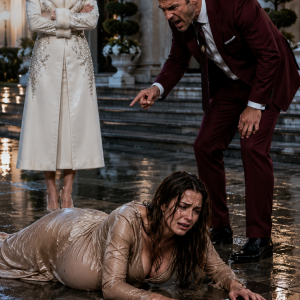
The Echoes of Silence: A Sister’s Vow
Chapter 1: The Anatomy of a Lie
Grant Mercer did not merely rule our household; he governed it through a meticulously crafted regime of terror, feeding off the quiet dread that suffocated my twin sister and me. He was a man who found a perverse, intoxicating entertainment in our trembling. The culmination of his unrelenting cruelty led us to the blinding fluorescent glare of Memorial Hospital’s emergency ward on a freezing Tuesday night.
The world had faded into a dark, ringing void, my last tether to reality being Lily’s faint, agonized whisper of my name through bruised, trembling lips. When my vision finally cleared, the harsh antiseptic smell of the clinic burned my lungs. Above me, our stepfather was already orchestrating his masterpiece of deception. He leaned casually against the medical cart, flashing a charismatic, practiced smile at the attending physician.
“It was a terrible tumble down the oak staircase,” he lied effortlessly, his voice dripping with faux parental concern.
Grant had conditioned us to fear silence far more than his shouting. A raised voice meant the torment had officially begun, a predictable storm we could brace for. But silence? Silence was a canvas for his malice. It meant he was lingering in the hallway, calculating exactly how much suffering would adequately entertain him for the evening.
My mother stood rigidly beside him, her knuckles bone-white as she obsessively twisted her gold wedding ring. “They’re incredibly clumsy,” she whispered, her eyes firmly fixed on the linoleum floor. “Always have been.”
But Dr. Elena Ruiz was not a woman easily swayed by charming smiles and rehearsed alibis. She moved with clinical precision, her keen eyes shifting from the deep, mottled bruising along Lily’s fragile ribs to the corresponding purple marks circling my own upper arms. I watched the doctor’s expression harden. The veneer of a routine emergency room visit shattered in her mind. The injuries were far too deliberate—nearly identical in height, mimicking the exact same angle, leaving behind narrow, unmistakable belt-shaped impressions.
“Exactly how many stairs did they fall down?” Dr. Ruiz asked, her voice dropping an octave, devoid of any warmth.
Grant offered a dismissive, arrogant chuckle. “Doctor, you know how teenagers are. Kids exaggerate everything.”
I forced my parched throat to work, my voice cracking through the sterile air. “We’re seventeen.”
Grant’s smile vanished instantly. His eyes darted toward me, flashing a silent, venomous promise of retribution.
Without breaking eye contact with my stepfather, Dr. Ruiz took a slow, deliberate step backward into the bustling hallway. With a swift motion, she pulled the heavy clinic door shut and locked it from the outside. Through the reinforced glass pane, we watched her march directly up to the armed hospital security guard. Her lips moved in sharp, commanding syllables: “Call 911. Immediately.”
Inside the room, the atmosphere shifted from tense to suffocating. An observant nurse entered quietly through a side door, wielding a medical camera to document every contusion, every scrape, and every shadow of abuse. Another nurse gently placed our torn, ruined clothing into sealed, chain-of-custody evidence bags. Dr. Ruiz, returning with an air of absolute authority, ordered immediate full-body skeletal scans.
When the local police officers finally breached the ward, the doctor wasted no time. She slapped the fresh X-rays onto the light board, pointing a sterile pen at the ghostly white images of our bones. She revealed the older, jagged fractures that had been forced to heal improperly without an ounce of medical intervention. Lily had two older cracked ribs forming calcified ridges. I had a left wrist that had been fractured eight months prior, now set crookedly beneath my skin.
Through the observation glass, Grant watched the proceedings. He did not look frightened; he looked wildly annoyed. He tapped the crystal face of his expensive watch, complaining loudly to an officer that he had an early morning board meeting and couldn’t be delayed by “administrative misunderstandings.”
His cold, sociopathic impatience was so jarring that even the seasoned security guard stared at him in quiet disbelief. Realizing the tide was turning against him, Grant suddenly lunged for the door handle to retrieve us. The guard’s hand instantly dropped to his utility belt, stepping squarely in Grant’s path, a silent warning that further movement would result in a physical takedown.
My mother finally broke down, tears streaming down her pale face. But she wasn’t weeping for her battered daughters. She looked at me with pure resentment and wailed, “You’re ruining this family!”
I slowly turned my bruised face toward the stark white wall and embraced the silence. Grant believed my silence meant utter surrender. He believed he had broken the wild horses.
He had no idea that I had spent the last two hundred and forty days meticulously building his cage.
Chapter 2: The Architecture of Vengeance
The nightmare had truly begun shortly after our biological father passed away from a sudden cardiac arrest. The ink on the death certificate was barely dry before Grant moved in, taking absolute control of our lives. His first act as the new patriarch was a digital purge. He confiscated our smartphones, ruthlessly searched our bedrooms for contraband, and installed high-definition security cameras at both ends of the upstairs hallway. We were prisoners in our own home, monitored day and night.
But arrogance is often the architect of a tyrant’s downfall. Grant never bothered to inspect the frayed, hidden lining at the bottom of my battered navy-blue school backpack. Concealed within that ripped seam was an obsolete, chunky MP3 player from the early 2000s. Its storage capacity was meager, but its built-in microphone worked flawlessly. For eight grueling months, that tiny device had been my closest confidant. Every vicious threat hissed in the dark, every sickening slap, and every frantic order my mother issued demanding we lie to our teachers had been captured in crisp digital audio.
Lily and I had forged a desperate, unspoken pact in the shadows of that house: Survive the night, remember everything in the morning.
While Grant mocked us, we worked in tandem. I began keeping a meticulous log of dates, times, and specific incidents, camouflaging the data within complex chemistry formulas scribbled into the margins of my advanced placement notebooks. A casual observer would see
H2Oand covalent bonds; I saw the exact hour Grant threw a glass across the kitchen.
Lily, despite her trembling hands, became our archivist. She utilized an old, school-issued library tablet to photograph our fading bruises in the brief windows of time we had in the school bathrooms. She then uploaded the encrypted files to a secure, private cloud folder masked under the title of a fictitious biology project: Cellular Degeneration.
Grant loved to call us stupid. He derived immense pleasure from mocking Lily for her nervous stutter, a stammer that only appeared when she was terrified. He affectionately dubbed me “the quiet one,” fundamentally misunderstanding my nature. He assumed my quietness equated to emptiness, a vacant space he could easily dominate.
He was catastrophically wrong. My quietness was observation. My silence was strategy.
Back in the hospital, the two responding police officers finally stepped into the clinic. Grant’s entire demeanor shifted in a nanosecond. The annoyance vanished, replaced by the soft, weary tone of a long-suffering parent trying his best.
“Officers, please, you have to understand. These girls are deeply troubled,” Grant murmured, offering a sympathetic shake of his head. “Their biological father passed away abruptly, and they’ve directed all their unresolved grief and anger at me. It’s a tragic psychological projection.”
Dr. Ruiz didn’t say a word. She simply reached down and gently rolled up Lily’s hospital gown sleeve, exposing a fresh, violently purple handprint stamped into my sister’s bicep. “Then perhaps you can medically explain this psychological projection, Mr. Mercer?”
Grant stared at the undeniable physical evidence. To the utter revulsion of everyone in the room, the corners of his mouth twitched upward. He smiled anyway.
Watching that smirk, a profound realization washed over me, chilling my blood but sharpening my resolve.
He still thought he had won.
Chapter 3: The First Blade
The transition from the sterile hospital to the gritty, fluorescent-lit precinct of the local police station was a blur of police cruisers and heavy blankets. Upon arrival, Detective Mara Chen, a seasoned investigator with sharp, unforgiving eyes, immediately separated us. Grant protested loudly, demanding his rights, while my mother shrilly demanded their high-priced defense attorney. Lily was trembling so violently in the holding area that a compassionate triage nurse had to wrap both her hands tightly around my sister’s to keep her grounded.
When Detective Chen sat across from me in the cramped, gray interrogation room, I had only one request.
“I need my backpack.”
Grant’s legal counsel arrived swiftly. He was a silver-haired, impeccably tailored man who strolled into the precinct as if his name was on the building’s lease. He leaned against the doorframe of the interrogation room, projecting supreme confidence.
“Let’s wrap this up, Detective,” the lawyer drawled, checking his gold cufflinks. “We have two highly emotional teenagers, one unfortunate, tragic accident on a staircase, and absolutely zero reliable witnesses. This entire misunderstanding will disappear by morning.”
Sitting just outside the open door in the hallway, Grant leaned back in his plastic chair, caught my eye, and actually winked at me.
I didn’t blink. I reached into the fraying lining of my backpack, pulled out the scratched, silver MP3 player, and placed it squarely in the center of the scarred metal table.
Detective Chen looked at me, her eyebrows raised in silent question. I nodded. She reached out and pressed play.
The tinny speaker crackled, and then Grant’s vicious, unrestrained voice filled the small room, freezing the air in the precinct.
“Cry louder. Your sister needs to learn exactly what happens when one of you ungrateful brats disobeys my rules.”
The audio captured a sickening thud, followed immediately by Lily’s piercing, breathless scream. Then, my mother’s voice cut through the chaos, not to stop the abuse, but to manage the optics: “Grant, please, stop! Not above the collars! The teachers will see!”
The recording ended with the bone-chilling sound of Grant laughing—a deep, resonant sound of pure, unadulterated enjoyment.
The silver-haired attorney stopped smiling. The arrogant slouch vanished from his posture.
Recovering his composure quickly, the lawyer cleared his throat. “That is an antiquated, unverified digital device, Detective. It could easily be manipulated, edited, or deep-faked by any tech-savvy teenager.”
“Then check the cloud folder,” I replied, my voice steady, finally unleashing the words I had held onto for nearly a year. “The recordings on this device automatically copied to a secure, encrypted account created on the public library’s mainframe. The timestamps are embedded in the metadata. The login credentials and decryption instructions are currently sealed in a tamper-proof envelope sitting in my high school counselor’s locked filing cabinet. If I don’t show up to school tomorrow, she has instructions to hand it directly to the authorities.”
Out in the hallway, Grant surged to his feet, his chair clattering loudly against the linoleum. The mask of the grieving father completely disintegrated. “You vicious little liar!” he roared, lunging toward the interrogation room before two burly officers shoved him hard against the wall.
Detective Chen tapped the official police recording device sitting on the table, her eyes glinting with predatory satisfaction. “And the precinct recorder just captured that outburst, too, Mr. Mercer.”
But as devastating as the audio evidence was, it was merely the first blade in my arsenal. I wasn’t just aiming for his freedom; I was aiming for his empire.
Chapter 4: The Paper Trail
Three months prior to the hospital incident, I had finally solved the enduring mystery of why Grant vehemently forbade us from checking the mailbox, specifically hoarding any correspondence addressed to our late father’s estate.
My father had been a brilliant, forward-thinking man. He had left our sprawling family home, a substantial life-insurance policy, and controlling shares in his highly lucrative commercial construction company entirely to Lily and me. He protected these assets through an ironclad, irrevocable trust. The stipulations were clear: until my sister and I reached our eighteenth birthdays, our mother was only authorized to withdraw highly regulated, limited funds strictly for our basic care and education.
Grant, however, had found a backdoor. He had been systematically draining our inheritance through a labyrinth of forged documents. He created a shell company—a phantom medical supply vendor—and began billing the trust for exorbitant, fictional medical treatments, surgeries, and physical therapies Lily and I had supposedly received.
Using my father’s old camera, I had meticulously photographed every forged bank statement, every fake invoice, and every wire transfer I found hidden in Grant’s locked mahogany desk while he slept.
Detective Chen, realizing the scope of the situation, immediately brought in Assistant District Attorney Priya Shah. ADA Shah was a formidable force who specialized in the dark intersection of child abuse and complex financial crimes.
She spread my printed photographs across the table, her eyes scanning the complex web of offshore transfers and shell company routing numbers. After a long silence, she looked up at me, her expression a complex mixture of profound sorrow and deep, undeniable respect.
“Nora… you are seventeen,” ADA Shah said softly. “How did you possibly understand the routing structure of these fraudulent transfers?”
“My father didn’t believe in allowances,” I answered, feeling a phantom ache in my chest at his memory. “He taught me corporate bookkeeping when I was twelve. When Grant saw me staring at spreadsheets late at night, he just assumed I was struggling with my math homework.”
By sunrise, a judge had signed a stack of aggressive search warrants. SWAT units and forensic accountants descended simultaneously on our family home, Grant’s downtown corporate office, and the registered address of his shell company.
The physical evidence was damning. Crime scene technicians found the specific leather belt matching our welts, drops of Lily’s blood embedded deep in the basement carpet fibers, stacks of forged medical invoices, and a heavy, fireproof safe containing our confiscated passports and birth certificates—proof of his intent to keep us trapped.
Before noon, ADA Shah successfully obtained an emergency injunction, entirely freezing the irrevocable trust and formally stripping my mother of her temporary custodial rights. Dr. Ruiz, acting as a fierce advocate, signed the necessary medical orders to keep Lily and me safely hospitalized under police protection until a secure, vetted placement could be arranged.
Grant’s towering confidence finally began to crack under the weight of the federal and state charges stacking up against him. My mother, however, remained delusionally smug, clinging to the belief that she could charm her way out of complicity.
“She planned this entire charade,” she hissed to the investigators, pointing a shaking, manicured finger at me through the glass. “Nora has always been a bitter, hateful child. She hates Grant. And Lily is weak; she just copies everything her sister does.”
In the corner of the room, Lily, who had spent the last eight months trying to disappear, finally raised her head. She looked directly at the woman who had birthed us, her eyes clear and unblinking.
“No,” Lily said, her voice shaking slightly but carrying the weight of a stone dropping into a quiet pond. “She didn’t force me. We survived him. And we survived you. Together.”
The next afternoon, due to a severe clerical backlog and their attorney’s aggressive arguments regarding flight risks, Grant and my mother were temporarily released on bail pending formal grand jury indictments.
As they walked out of the precinct, Grant paused. He stepped close enough to me that I could smell the expensive cologne masking his nervous sweat. He leaned in, his voice a dangerous, raspy murmur meant only for my ears.
“You think a few illegally obtained recordings make you powerful, little girl?” he sneered. “That house is mine. The construction company is mine. I have the best lawyers in the state. When this is over, I’ll be back in my home, and you will have absolutely nothing.”
I didn’t step back. I met his furious, frantic eyes and held his gaze.
“You really should have read the bylaws of the trust, Grant.”
For the first time since the day he walked into our lives, the color completely drained from his face. He looked genuinely, utterly terrified.
Chapter 5: The Reckoning
The six weeks leading up to the preliminary hearing were a masterclass in manipulation. Grant hired a crisis PR firm, flooding social media platforms with curated, smiling photographs of our past “family vacations.” He penned lengthy, pseudo-philosophical captions about the agonizing pain of false accusations and the heartbreak of dealing with “rebellious, troubled teenagers.” People in our community who barely knew us flooded the comment sections, calling him a devoted, persecuted patriarch.
He fatally mistook the fickle nature of public sympathy for legal innocence, and his temporary, bail-funded freedom for a lasting victory.
When the day of the hearing arrived, Grant strolled into the courthouse wearing a bespoke, navy-blue tailored suit, pausing to offer somber, confident smiles for the gathered local reporters. My mother trailed a step behind him, draped in conservative pearls, playing the part of a fragile, frightened wife tragically trapped between a loving husband and severely unstable daughters.
Inside the mahogany-paneled courtroom, their expensive attorney launched his offensive, attacking the digital evidence right out of the gate.
“Your Honor, we live in an era where teenagers can manipulate and edit video and audio on their cellphones while waiting for the school bus,” the lawyer argued passionately, gesturing toward us. “These recordings lack structural integrity.”
ADA Shah didn’t argue. She simply called her witnesses.
First, the state’s elite forensic cyber-analyst took the stand, methodically testifying that the audio files were pristine, continuous, cryptographically time-stamped, and automatically uploaded to a secure server within seconds of their creation. There was zero evidence of tampering.
Next, the head librarian from the county archive authenticated the creation of the secure cloud account, proving it was established months before the hospital incident. My AP chemistry teacher was subpoenaed to decode the margins of my notebooks, explaining with widening eyes how the formulas perfectly aligned with the dates and times of the abuse.
Then, Dr. Ruiz took the stand. The courtroom fell dead silent as she projected high-definition anatomical diagrams onto the monitor, overlaying the photographs of our bruised bodies with the exact dimensions of the heavy leather belt recovered from Grant’s basement. The match was irrefutable.
Grant’s practiced, media-ready smile melted into a mask of pure, trapped panic.
But it was when ADA Priya Shah opened the financial dossier that the final nail was driven into the coffin.
She presented certified, subpoenaed bank records proving that Grant had successfully embezzled more than $680,000 from our father’s trust. She walked the judge through the fictitious shell company, the phantom surgeries, and the offshore routing numbers. Then, she displayed the ultimate betrayal on the overhead projector: Grant’s signature appeared directly beside my mother’s on every single fraudulent wire transfer.
My mother gasped, twisting in her chair to stare at her husband. “You… you promised me those documents were just legal tax shelters!” she hissed loudly enough for the court reporter to transcribe.
ADA Shah simply tapped her laptop. A new audio file echoed through the cavernous courtroom.
It was my mother’s own voice, recorded three months prior, cutting through the silence: “Take what you need for the new car, Grant, but just leave enough in their accounts so the girls don’t start asking questions about the balance.”
My mother let out a strangled sob and collapsed forward into her hands, the pearls clattering against the defense table.
Realizing his empire was burning to ash, Grant snapped. He stood up, knocking his chair backward, his face purple with rage. He shouted at the judge that our biological father had been a pathetic, weak man, that the multi-million-dollar company rightfully belonged to a “real man” who knew how to run it, and that he had only used the belt to instill discipline in two ungrateful, spoiled children.
His attorney frantically grabbed his sleeve, begging him to sit down, but Grant tore away, his true, violent nature fully exposed under the fluorescent lights of the courtroom.
From the witness stand, I looked down at him. I did not flinch. I did not break eye contact.
“You enjoyed making us afraid in the dark,” I said, my voice steady, carrying over his shouting. “Now everyone in the world gets to see who you are when the doors aren’t locked.”
The judge slammed his gavel down, immediately revoking their bail.
Chapter 6: A Legacy of Light
The justice system, when fueled by irrefutable evidence, can move with devastating efficiency. Grant Mercer was convicted on multiple felony counts of aggravated assault, child abuse, unlawful imprisonment, evidence tampering, wire fraud, and grand theft. The judge showed zero leniency, sentencing him to twenty-two years in a maximum-security state penitentiary.
Furthermore, the court issued aggressive restitution orders. The state seized his personal bank accounts, his luxury vehicles, and his private investment properties. The board of directors at the construction company removed him as CEO within twenty-four hours of his arrest. A ruthless, court-appointed trustee managed to recover the vast majority of the stolen funds, liquidated the family house that had served as our prison, and placed every cent back into the ironclad protection of our trust.
My mother, finally realizing her charm could not save her, pleaded guilty to child endangerment, criminal conspiracy, fraud, and obstruction of justice. Her late cooperation with the district attorney slightly reduced her sentence, but she could not escape the consequences of her complicity. She received seven years in a state facility.
At her sentencing hearing, she turned to look at Lily and me one last time before the bailiffs took her away. Her face was hollow, stripped of its arrogance.
“I was scared of him too,” she cried, reaching a trembling hand out toward the gallery. “You have to believe me, girls. I was terrified of him.”
Lily, sitting beside me, didn’t shrink away. She reached out and squeezed my hand, her grip remarkably strong.
“So were we, Mom,” I answered quietly, ensuring she heard every word before the heavy courtroom doors closed. “The difference is that you were the one who kept handing him the belt.”
One year later, the crisp autumn wind swept through the city as Lily and I stood on the sidewalk, looking up at a beautifully renovated, two-story brick building. Above the reinforced glass doors, fresh white letters gleamed in the sunlight: THE RUIZ HOUSE—A SAFE CENTER FOR YOUTH.
We had funded the entire project using a significant portion of the recovered restitution money. Dr. Elena Ruiz, who had saved our lives that night in the ER, proudly served as the chairman of the board. Lily, her stutter completely gone, was in her first year of university, studying advanced clinical social work with a focus on trauma recovery. I was enrolled in the same university, majoring in forensic accounting, learning how to hunt monsters who hid in spreadsheets.
Sometimes, when reporters caught wind of our story, they called what we did a tale of brilliant revenge.
But it was never about revenge.
True revenge would have been finding a way to make Grant Mercer feel afraid for a single, terrifying night. That would have been too fleeting. Too small.
Instead, we gave him twenty-two years in an eight-by-ten cell to deeply contemplate exactly what his particular brand of fear had cost us. And with the empire he tried to steal, we built a fortress of light—a sanctuary where no child would ever have to whisper a lie in the dark just to survive until morning.
Like and share this post if you find it interesting.