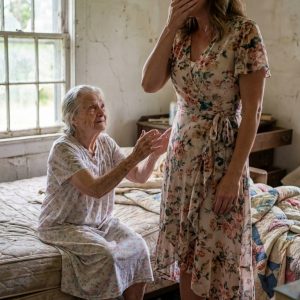
The Architect of Her Own Escape
Chapter 1: The Blood Price of Brotherhood
Chicago, in the bitter throes of late December, was a city defined by its cruelty. A relentless, freezing drizzle slicked the ancient cobblestones of Evanston, turning the fallen leaves of the massive sycamore in the front yard into a rotting, sodden carpet. The air, heavy with the scent of wet earth, damp wood, and the mournful wail of a distant commuter train, felt suffocatingly nostalgic.
My name is Allara Vance. I was thirty-four, a senior forensic accountant for a downtown medical distributor. I had been married for six years to Julian Croft.
To the untrained eye, Julian was the youngest son of a dynasty that perfectly encapsulated dignified, old-money Midwestern success. The Croft estate, an imposing, ivy-choked brick mansion, sat like a fortress at the end of a private, tree-lined cul-de-sac. Two meticulously pruned junipers flanked the wrought-iron security gates. A sprawling, terra-cotta patio, treacherous as black ice in the winter damp, led to a heavy, custom oak door.
Local whispers painted the Crofts as blessed. Three prosperous sons, a patriarch, Arthur Croft, who had ruthlessly dominated local commercial real estate for decades, and a matriarch, Eleanor Croft, who glided through society in a cloud of bespoke tweed, Hermès leather, and intoxicatingly expensive perfume.
Arthur, at sixty-eight, was a man of terrifying stillness. He spoke sparingly, but when he did, the air in the room seemed to thin. Eleanor, sixty-four, possessed a voice as smooth and rich as aged bourbon, yet it was a sweetness often laced with arsenic. She never raised her voice; she didn’t need to. A single, sweeping glance from my sensible heels to my un-styled hair was enough to make me feel I had committed a cardinal sin just by breathing her air.
There were three Croft heirs. The eldest, Donovan, forty-three, was the golden calf. He operated a lucrative chain of high-end boutiques importing luxury Australian wellness brands. He was perpetually accessorized with a gleaming Patek Philippe, his vocabulary a relentless stream of capital allocation, market capture, and leverage.
The middle son, Preston, thirty-nine, was a chameleon. His words were pliable, designed to flatter and agree, slipping away before they could ever be held accountable.
And then there was my husband, Julian, thirty-seven.
In the Croft mansion, being the youngest did not equate to being cherished. To Arthur and Eleanor, Julian was a genetic misfire, a stubborn flaw in the flawless portrait they demanded the world see. As a young man, he had vehemently rejected the sterile, nepotistic corporate desk Arthur had prepared for him. Instead, he pursued trade school, mastering industrial refrigeration. Through grueling labor, he had built a highly respected logistics company that maintained commercial cold-storage facilities across the tri-state area.
I vividly remember a family dinner where Arthur had publicly eviscerated him. “This family possesses an abundance of intellect,” Arthur had drawled, his voice tight with disdain, slicing into a rare steak. “What it lacks is basic obedience. You insist on wallowing in grease and embarrassing this name.”
Julian had simply stared at his plate, offering no defense.
Eleanor had sighed theatrically, ensuring her voice carried down the long mahogany table. “Other mothers count their youngest sons as blessings. Ours merely provides insomnia.”
The first time I witnessed this ritual humiliation, a hot flash of indignation burned my cheeks. I had opened my mouth to speak, but beneath the heavy linen tablecloth, Julian had firmly grasped my knee. Don’t, his touch pleaded. He was so conditioned to the abuse that I often couldn’t distinguish his patience from profound, crushing exhaustion.
It was two nights before Christmas. The formal dining room was a suffocating tableau of wealth. The chandelier cast a harsh, brilliant light over a feast of glazed ham, roasted root vegetables, and a braised pot roast I had spent six hours perfecting. Outside, the wind rattled the antique windowpanes.
Eleanor deftly carved the ham, placing a massive slice onto Donovan’s gilded plate. “Eat up, darling,” she cooed, her eyes shining. “You’ve been driving yourself so hard with the expansion. You look positively gaunt.”
Donovan flashed a predatory smile, adjusting his silk cuffs. “Just staying lean for the fight, Mother. The new Australian shipment hits port just in time for the Q1 rush. It’s going to be a bloodbath for our competitors.”
Arthur nodded, a rare gleam of pride in his cold eyes. “Vision. That is how you command respect in this world.”
Preston, ever the echo chamber, chimed in immediately. “Donovan’s playing chess while everyone else is playing checkers, Dad. If you aren’t dominating the supply chain, you’re dead in the water.”
Eleanor beamed, then slowly rotated her gaze toward me. Her voice dropped an octave, dripping with manufactured concern. “You see, Allara, a man must possess ambition. What sort of legacy is built tinkering with broken motors in a freezing warehouse?”
I kept my eyes fixed on my water glass. Julian continued eating methodically. He reached over, placing a tender cut of the pot roast onto my plate. “You should eat,” he murmured, his voice a low, steady rumble. “The reduction turned out perfectly.”
That single, quiet sentence, spoken amidst a chorus of arrogant self-congratulation, lodged a heavy lump in my throat. A man might lack a vocabulary of praise, but a warm meal offered in a cold room was a currency far more valuable than gold.
Arthur set his crystal wine glass down with a sharp clink. He pinned Julian with a stare. “Julian. How is the balance sheet looking for your little operation?”
The table went dead silent. Arthur never inquired about Julian’s business unless he intended to dissect it.
Julian met his father’s eyes. “It’s steady, Dad. We secured three major maintenance contracts for agricultural distributors out in Joliet. It’ll cover Q1 payroll and upcoming equipment upgrades.”
Donovan let out a short, grating laugh. “Steady. Right. Little brother is playing it close to the vest. Probably hoarding cash and playing the martyr.”
“It’s a blue-collar operation, Donovan,” Julian replied, his tone miraculously even. “The revenue goes to technician salaries, fleet maintenance, and taxes. There are no Cayman accounts to brag about.”
Eleanor placed her silver fork down. “I must ask, darling… the main warehouse property. Is the deed registered under the LLC, or is it in your personal name? I only ask for tax purposes. We are family; transparency is key.”
My hand, poised over my plate, froze. The inquiry was disguised as maternal concern, but it felt remarkably like an audit. In four years of marriage, Eleanor had never once asked if Julian was tired, or if his back ached from the physical labor. Now, she was probing for deeds and legal structures.
Julian’s jaw tightened infinitesimally. “I have a CPA who handles the structural filing, Mom. I don’t carry the articles of incorporation in my head at the dinner table.”
Arthur’s face darkened instantly. “Is that the tone you take with your mother?”
Before Julian could absorb the blow, I forced a bright, hollow laugh, desperate to diffuse the escalating tension. “Please forgive him, Arthur. Julian has been working fourteen-hour days at the site. He can pull the files and review them with you when he’s less exhausted.”
Eleanor’s gaze slid toward me. It was a fleeting, microscopic assessment, but it carried the distinct chill of a morgue. “A wife who defends her husband is a quaint thing, Allara. But a wise woman advises her husband to remember his duty to his bloodline. Blood is an asset; water is just water.”
“Yes, Eleanor,” I murmured, bowing my head. But if that blood is only valued by its liquidity, I thought bitterly, how is it any different from the mud on my shoes?
Later that night, wrapped in the heavy duvet of our guest suite, I turned to Julian. He was staring at the ceiling, his face shadowed.
“Did you notice how intensely your mother was pressing about the company structure tonight?” I asked softly.
Julian reached over, clicking off the bedside lamp. The room plunged into darkness. “Allara, listen to me,” he said, his voice stripped of all warmth. “If anyone in this house asks you about the company’s operating accounts, the warehouse deed, or my digital signatures, you give them one answer.”
“Which is?”
“You tell them you don’t know.”
A cold dread coiled in my gut. “Julian… what is happening?”
“In this house,” he whispered, the sound barely carrying over the rattling windowpanes, “when they suddenly show an interest in you, it means they are pricing you out.”
But what exactly was the price of a son?
Chapter 2: The Two Million Dollar Request
The next morning, the sky was the color of a bruised plum. The groundskeeper was aggressively scraping black ice from the patio, the harsh shck-shck sound echoing like fingernails on a chalkboard.
I was in the kitchen before dawn, brewing dark roast coffee and packing Julian a heavy lunch. He rarely ate breakfast with the family; every meal was an opportunity for them to chip away at his dignity.
I handed him the insulated thermos. “You’re leaving before the sun is even up.”
He zipped his heavy canvas jacket, his breath pluming in the frigid air of the mudroom. “A massive compressor array failed at the Joliet facility. If we don’t get the refrigeration back online before noon, they lose millions in perishable inventory. I have to be on-site.”
I looked at his hands. They lacked the manicured softness of Donovan’s or Preston’s. His knuckles were permanently scarred, the skin rough, his fingernails trimmed to the quick to avoid catching in fan belts. Yet, those calloused hands had built an empire from a single, rusted service truck. I had visited his main warehouse once. Amidst the deafening roar of generators and the smell of freon, his eyes had blazed with a fierce, independent pride.
“Be careful,” I said, adjusting his collar.
“Always, Miss Accountant,” he offered a tired, genuine smile, kissing my forehead before slipping out into the freezing dawn.
Around 1:00 PM, while I was buried in quarter-end reconciliations at my office, my cell phone vibrated. The caller ID flashed Eleanor Croft. My stomach executed a slow, sickening roll. She never called me during business hours.
“Allara,” her voice was a smooth purr. “I need you to leave the office early today.”
“Is everything alright, Eleanor?”
“Arthur wishes to have an early supper. Donovan has some pressing business matters to discuss. I require your assistance in the kitchen.”
Assistance in the kitchen. It was Croft-speak for I need you present as a prop.
When I pulled into the circular driveway, Donovan’s gleaming Mercedes S-Class was already parked. Preston was pacing the front portico, a phone pressed aggressively to his ear.
“I know the margin calls are hitting!” Preston hissed into the receiver, his face pale. “But if they don’t give us a three-day extension on the collateral, they’ll freeze the entire maritime shipment! Just stall them. Do not let the old man find out.”
I shut my car door a bit harder than necessary. Preston whipped around, nearly dropping his phone. The panic on his face vanished, replaced by a slick, practiced grin.
“Allara! Home early?”
“Eleanor requested my help with dinner,” I said, walking up the steps. “Client troubles?”
He waved a dismissive hand, though a bead of sweat tracked down his temple despite the cold. “Just the usual end-of-year logistics nightmare. Everyone wants their money yesterday.” He forced a laugh that sounded like dry leaves crushing underfoot.
I didn’t press. Forensic accounting had taught me that people who over-explain are usually trying to hide the math.
In the kitchen, Eleanor was meticulously arranging endive leaves on a silver platter. Instead of handing me a paring knife, she pulled out a barstool.
“Sit, Allara. Let’s chat.”
I sat, my posture rigid.
“Tell me candidly,” she began, not looking up from her garnishes. “Is Julian’s little enterprise remaining solvent through the winter?”
“Julian keeps his business and our home life separate, Eleanor,” I replied smoothly, echoing the script Julian had given me. “He just mentions that Q4 is demanding.”
She stopped moving. Her eyes locked onto mine, shedding the maternal warmth entirely. “A wife should not be ignorant of her husband’s ledger. The woman of the estate must know the liabilities, the assets, and exactly whose name controls the equity.”
I forced a polite, vacant smile. “I wouldn’t want to interfere and make a mess of things I don’t understand.”
Eleanor’s face hardened, the skin pulling tight over her cheekbones. “Ignorance is a luxury, Allara. One day, when the auditors or the lawyers start asking questions, your silence will look remarkably like complicity.”
It was a blatant warning shot across the bow.
Dinner that evening was a suffocating affair. Arthur presided at the head of the table, flanked by his two golden sons. Julian arrived late, his boots leaving faint, damp tracks on the marble foyer. He had barely washed his hands when Arthur’s voice boomed from the study.
“Julian. In here. Now.”
I stood in the shadows of the butler’s pantry, holding a tray of roasted asparagus, watching my husband’s broad back disappear behind the heavy oak door. The door remained cracked just a fraction of an inch. I didn’t intend to eavesdrop, but desperation breeds opportunism.
“Family is the only currency that matters,” Arthur’s voice resonated, heavy with absolute authority. “When the seas are calm, you sail your own ship. But in a storm, you tie the fleet together. Donovan and Preston are facing a liquidity crisis regarding the Australian import contracts. We need to leverage your company’s assets to secure a bridge loan.”
Julian’s response was slow, measured, and dangerously calm. “Dad. My operating capital is not a slush fund. If they require a cash injection, I need a formal promissory note, a detailed use-of-funds breakdown, and secured collateral.”
Donovan let out a sharp, incredulous bark of laughter. “Listen to the grease monkey playing investment banker! We are your brothers, and you’re demanding a credit check?”
“Because we are family, the terms must be absolute,” Julian countered. “Blurred lines with money destroy bloodlines.”
Preston’s voice was reedy, frantic. “Julian, please. It’s a ninety-day bridge. Once the inventory clears customs and hits the boutiques, we’ll buy out the note with interest. Just sign the guarantor forms.”
“What is the principle amount?” Julian asked.
The study went graveyard silent.
“Two million dollars,” Donovan finally stated, his voice flat, completely devoid of shame.
I pressed my back against the pantry wall, the tray trembling in my hands. Two million dollars. They were asking to gut Julian’s company to plug a gaping hole in their own sinking ship.
Julian’s silence stretched. Then, “I can’t do it.”
“Can’t, or won’t?” Arthur demanded, his tone dropping to a dangerous rumble.
“My company has outstanding equipment loans, union payroll, and tax liabilities,” Julian stated firmly. “I will not bankrupt my employees to subsidize Donovan’s failed supply chain logistics.”
Donovan’s voice turned venomous. “You ungrateful prick. When this family paid for your life, did we demand a repayment schedule?”
“I am grateful for my upbringing,” Julian replied, his voice rising in defiance. “But gratitude is not a blank check to liquidate my life’s work.”
The study door violently swung open. Donovan stormed out, his face a mask of aristocratic rage. He spotted me lingering by the pantry, the tray in my hands. His eyes dropped to the food, then snapped up to my face. A terrifying, dead-eyed smirk crawled across his lips.
“Our little accountant has big ears,” Donovan hissed, stepping into my personal space, the scent of expensive gin radiating off him.
“I was just bringing the sides to the table,” I whispered, my heart hammering against my ribs.
Donovan leaned in so close I could see the red veins in his eyes. “Since you heard the pitch, I suggest you pillow-talk some sense into your husband. Tell him to stop being so stingy when his blood is bleeding out. In the business world, Allara… being too stubborn can drastically shorten your life expectancy.”
He patted my cheek—a hard, condescending slap—and sauntered into the dining room.
That night, Julian sat on the edge of our bed, rubbing his temples. I placed a glass of water on the nightstand.
“Two million dollars, Julian?” I asked, my voice trembling.
He didn’t look surprised that I knew. “It’s not just two million, Allara. That’s just the tourniquet. The wound is fatal.”
“What are they going to do?”
He looked up at me, his eyes dark with a terrifying realization. “I told you to feign ignorance. I need you to promise me something. If Mom, or Donovan, or anyone asks you for my digital security token, or tries to get you to sign anything regarding my insurance… you refuse. You run.”
I grabbed his hand; it was ice cold. “Julian, are you in danger?”
He stared out the window into the pitch-black night. “I’m not afraid that they asked for the money. I’m afraid that they didn’t push harder when I said no. It means they’ve already found another way to take it.”
And how exactly does a family take everything from a man who refuses to give it?
Chapter 3: The Fatal Smoothie
December twenty-second. The sky was weeping a slow, freezing drizzle. I was buried under a mountain of year-end ledger reconciliations when my phone buzzed. A text from Julian:
“Heading out to the main warehouse to recalibrate the industrial dryers. Home by 6. Save me a plate of the pot roast. I love you.”
I smiled, a brief moment of warmth cutting through the chill of the past few days. Julian wasn’t a man of grandiose, cinematic romance. His devotion was practical—a quiet text, a remembered preference, a steady presence.
At 4:15 PM, my office phone rang. It was Mike, Julian’s fiercely loyal floor manager.
“Allara,” Mike’s voice was chaotic, drowned out by the scream of sirens in the background. “You need to get to Evanston Memorial. Now.”
I shot up from my ergonomic chair, knocking over my coffee cup. The brown liquid stained the quarterly reports, but I didn’t care. “Mike, what happened? Is Julian hurt?”
“He fell,” Mike shouted over the noise. “He was inspecting the mezzanine level grating. He just… collapsed. Missed a step and pitched over the rail. He hit the concrete floor hard. He was trying to say your name, and then he just seized up and went dark. We’re in the ambulance.”
My vision tunneled. The world reduced to a pinpoint. “I’m on my way.”
The cab ride felt like swimming through molasses. The holiday traffic was a nightmare of red tail lights and honking horns. I relentlessly redialed Mike’s number.
“Did he hit his head? Was he wearing his harness?” I demanded, panic fraying my voice.
“He wasn’t on the high rigging, he was just on the stairs,” Mike stammered. “Allara, something was wrong before he fell. He was slurring his words. He said he felt dizzy.”
“Dizzy? Did he eat something bad?”
Mike hesitated, the silence screaming over the line. “Rick came by earlier.”
“Rick? Donovan’s driver?”
“Yeah. He brought a deli sandwich and a massive green smoothie. Said your mother-in-law had it specially blended for him. Julian never takes food from his family, but he drank half the smoothie before he went up the stairs.”
My blood turned to Freon. Eleanor sent a smoothie.
When I burst through the sliding doors of the emergency room, my clothes were soaked, my hair plastered to my face. Mike was pacing outside Trauma Room 3, his heavy canvas jacket stained with dark patches of blood.
“Where is he?” I grabbed Mike by the lapels.
“The neuro team is with him,” Mike whispered, looking terrified. “He’s unresponsive, Allara.”
I peered through the narrow wire-mesh window of the trauma door. Julian was surrounded by a swarm of blue scrubs. His head was wrapped in stark white gauze, his skin the color of old parchment. A tube snaked down his throat.
A resident stepped out, pulling off bloody gloves. “Are you the spouse for Croft?”
“Yes! I’m his wife. Please, is he going to live?”
“He suffered a severe cranial impact resulting in a contusion,” the doctor stated, his voice clinical and detached. “He is currently suffering from acute post-traumatic impairment of consciousness. His Glasgow Coma Scale is very low. We are stabilizing his vitals, but the next twenty-four hours are critical. He needs to remain in the ICU for strict observation.”
I nodded frantically, tears finally spilling over my freezing cheeks.
I pulled out my phone and dialed Eleanor. She answered on the second ring.
“Julian has been in an accident,” I sobbed. “He fell at the warehouse. He’s in a coma.”
There was a microsecond of absolute, dead silence on the line. Then, an ear-piercing wail. “My boy! Oh, dear God! Allara, where were you?! Why weren’t you protecting him?!”
The accusation slapped me across the face. Where was I? I was at work, trying to survive the family she controlled.
“We are at Evanston Memorial,” I choked out.
Less than twenty minutes later, Donovan strutted through the ER doors. He wasn’t running. He wasn’t crying. He looked impeccably groomed in a cashmere overcoat, his Bluetooth earpiece blinking a sinister blue.
He didn’t walk to me. He walked straight to the triage desk. “I need the intake paperwork for Julian Croft. What is the preliminary diagnosis code? I need to initiate the medical and accident insurance claims immediately.”
I stood paralyzed, ten feet away. Insurance claims? His brother was currently having a breathing tube shoved down his trachea, and Donovan was securing the payout paperwork.
“Donovan!” I yelled, my voice cracking. “He is fighting for his life in there!”
Donovan turned slowly. He offered me a look of such profound, reptilian emptiness that I physically recoiled. “Sister-in-law, hysterics will not pay the surgical bills. Someone has to remain rational and secure the estate’s interests.”
Arthur and Eleanor arrived moments later. Eleanor threw her arms around me, sobbing hysterically for the benefit of the ER waiting room. But as she pulled me close, her manicured fingers dug brutally into my bicep.
“Allara,” she hissed directly into my ear, dropping the crying act instantly. “What exactly did he consume before he fell? Did the workers say?”
I looked at the side of her perfectly powdered face. “Mike said Rick Dalton delivered a smoothie. He said you sent it, Eleanor.”
Her grip tightened until I almost cried out in pain. She didn’t deny it. She just released me and pivoted to Donovan. “Where is Rick?”
Donovan checked his phone, his face impassive. “He’s off the clock. Unreachable.”
I glanced down the long, sterile corridor. Standing near the vending machines, half-hidden by a structural pillar, was Rick Dalton. He was wearing his gray chauffeur jacket. The moment I made eye contact with him, he ducked his head, pulled his baseball cap low, and sprinted for the exit staircase.
“Rick is right there!” I pointed.
Donovan smoothly stepped directly into my line of sight, blocking my view. “You’re exhausted, Allara. Seeing things. Let’s focus on the doctors.”
I looked at my mother-in-law, weeping crocodile tears, and my brother-in-law, functioning as a grim reaper with a spreadsheet. The fear that had gripped my heart when Julian fell began to mutate. It hardened into a jagged, glacial terror.
They weren’t grieving. They were managing a project.
The next morning, I awoke in a plastic chair outside the ICU. I was jolted from a nightmare by the sound of Arthur’s commanding voice. He was standing with the Chief of Neurology, brandishing a thick legal document.
“The family has convened, Doctor,” Arthur barked. “We are withdrawing him from this facility. We are transferring him to the estate for private hospice-level care.”
I shot up. “What? No! The doctors said he needs ICU monitoring!”
Eleanor glided over, dabbing her dry eyes. “Hospitals are breeding grounds for infection, darling. We have retained top-tier private physicians and round-the-clock nursing staff. He will be treated like a king at home.”
“I am his wife!” I shouted, turning to the doctor. “I do not consent to this transfer!”
Arthur stepped forward, his presence suffocating. He thrust the legal document into the doctor’s hands. “Julian signed a comprehensive Medical Power of Attorney two years ago, granting me absolute proxy over his healthcare decisions in the event of incapacitation. My daughter-in-law is emotionally compromised. Prepare him for transport.”
I stared at the document. The signature looked like Julian’s, but the ink was flat, perfectly uniform—a high-resolution scan printed onto legal paper. I opened my mouth to scream fraud, but Donovan’s hand clamped down hard on my shoulder.
“Don’t cause a scene, Allara,” he whispered, his breath hot against my neck. “You have no power here. Play the devoted wife, or you won’t even be allowed in the house to hold his hand.”
By noon, Julian was loaded into a private medical transport. I rode in silence, watching the monitor track my husband’s fragile heartbeat. They had stolen his voice, his agency, and now, they were locking him inside their fortress.
The trap had snapped shut. But they had made one fatal miscalculation. They had locked me inside with him.
Chapter 4: The Black Ledger
The Croft mansion had been ruthlessly transformed. The opulent living room was stripped of its Persian rugs and velvet armchairs. In the center of the vast space sat a sterile, mechanical hospital bed, flanked by IV poles, a heart-rate monitor, and a towering, locked medicine cabinet.
It didn’t look like a room designed for healing. It looked like a very expensive tomb.
That afternoon, Donovan arrived with a man he introduced as Dr. Marcus Thorne. Thorne was a short, severe man with gold-rimmed spectacles and a demeanor colder than a mortician’s slab.
“I will be managing your husband’s palliative care,” Dr. Thorne stated, barely making eye contact with me as he reviewed Julian’s charts.
“Palliative?” I snapped. “He suffered a concussion. He’s not terminal.”
Dr. Thorne peered over his glasses. “Mrs. Croft. The trauma to his frontal lobe is severe. He is exhibiting profound impairment of consciousness. He is essentially vegetative. We must prepare for a prolonged, irreversible decline.”
Irreversible decline. The words hung in the air, a verbal death sentence delivered before the jury had even convened.
The next morning, Eleanor ushered a young woman into the house. “This is Khloe Grant,” Eleanor announced, her tone dripping with false benevolence. “She is a registered nurse. She will assist you with Julian’s daily needs. We want everything documented perfectly.”
Khloe was petite, her hair scraped back into a severe ponytail, her eyes darting nervously around the cavernous room. She carried a medical bag and a thick, black leather-bound ledger. She immediately set the ledger on the bedside table and began ruling harsh, straight columns with a fountain pen.
Time. Action. Administered By. Patient Status. Signature.
“From now on,” Eleanor instructed, her eyes locking onto mine with terrifying intensity, “every single interaction with Julian is recorded in that book. If you feed him, you sign. If you bathe him, you sign. If he takes a turn for the worse, I want the timeline airtight.”
Over the next forty-eight hours, the scratching of Khloe’s pen became the soundtrack of my nightmare.
I would wipe a bead of sweat from Julian’s brow. Scratch, scratch, scratch.
I would adjust his blanket. Scratch, scratch.
On the third day, I caught Khloe writing an entry before the event had even occurred.
19:00 – Allara Croft directly administered evening sedative via oral syringe. No complications.
I snatched the pen from her hand. It was only 5:30 PM.
“What is this, Khloe?” I demanded, my voice low and dangerous. “Why are you pre-filling the medication log, and why does it explicitly state that I administered the sedative? You prep the meds.”
Khloe flushed a deep, ugly crimson. She tried to snatch the book back. “I was just getting ahead! You’re his wife, you’re the primary caregiver. It’s just standard procedure.”
“Standard procedure is writing the truth,” I shot back, slamming the book onto the table. “Cross it out.”
Donovan strolled into the living room, a crystal tumbler of scotch in his hand. “Is there a problem, sister-in-law?”
“Khloe is falsifying medical logs, Donovan,” I said, my heart hammering against my ribs.
Donovan took a slow sip of his drink, his eyes devoid of any warmth. “She’s just being thorough. If you are innocent, Allara, you shouldn’t fear black-and-white documentation. Unless, of course, you plan on making a mistake that might harm my brother?”
The implication was a blade to the throat. They were constructing a paper trail. If Julian’s heart stopped, the black ledger would clearly show that I was the sole person administering his care and his medication. They were framing me for medical negligence, or worse.
That night, after Khloe had retreated to her basement quarters, Eleanor brought me a steaming mug of chamomile tea and a small amber pill bottle.
“Dr. Thorne prescribed these for you,” Eleanor smiled, a terrifying, maternal grimace. “Potent sleep aids. You look like a corpse, Allara. You must sleep tonight. Drink the tea, take the pill. I insist.”
I stared at the capsule in her palm. It looked identical to the ones Khloe had been crushing into Julian’s feeding tube.
“Thank you, Eleanor,” I said, palming the pill. “I’ll take it right before I lie down.”
She lingered for a moment, waiting for me to swallow it. I feigned a yawn and took a sip of the tea, keeping the pill hidden in my curled fingers. She finally turned and walked away, the click of her heels echoing like a countdown.
I waited until the house was entombed in silence. I poured the tea down the drain and flushed the pill down the toilet. I returned to the living room, dragging a heavy armchair directly next to Julian’s bed.
The security camera in the corner of the ceiling blinked its relentless red eye.
I draped my body over Julian’s chest, hiding his face from the lens, pretending to weep into his hospital gown.
Around 2:00 AM, I felt a tremor. It wasn’t a spasm. It was a deliberate, rhythmic tap against my forearm.
I held my breath, lifting my head mere inches.
Julian’s eyes were open.
They were bloodshot, unfocused, and swimming in pain, but the intelligence behind them was undeniable. He was fighting through a chemical fog of epic proportions.
I clamped my hand over my mouth to stifle the scream of shock.
“Camera,” he mouthed, his vocal cords paralyzed by the drugs.
I nodded frantically, keeping my back angled to obscure his face. I leaned my ear against his cracked lips.
“They are… overdosing me,” he breathed, the sound barely a rasp. “The smoothie… Rick spiked it. When I wake up… Dr. Thorne injects more. They want me… dead on paper.”
Tears, hot and furious, cascaded down my cheeks. “I know. They’re framing me with the log book. They tried to drug me tonight.”
His eyes widened in raw panic. His hand weakly gripped my shirt. “Don’t sign… anything. The study… Arthur’s study. The safe behind the bookshelf.”
“What’s in there?” I whispered, stroking his hair, playing the role of the grieving wife for the camera.
“The insurance… they forged the beneficiaries. Three million. And a transfer order… for my company assets. They need my digital token.”
“I won’t let them have it,” I vowed, my voice hardening into steel.
Julian closed his eyes, his strength rapidly depleting. “Camera reboots… at 3:00 AM. Three minutes of dead air. Get the files. Save yourself, Allara.”
“I’m saving us both,” I promised.
He slipped back into the drug-induced darkness, leaving me alone in the silent room. I glanced at the grandfather clock. It was 2:45 AM.
I had fifteen minutes to commit treason against the Croft empire.
Chapter 5: The Midnight Audit
At exactly 2:59 AM, I stood in the darkened hallway, staring at the blinking red light of the security camera above Arthur’s study door.
3:00 AM. The red LED flickered, died, and the camera lens whirred as the system initiated its automated, three-minute firmware reboot.
I didn’t breathe. I dropped to my knees, reaching under the ornate hallway credenza. Julian had once told me his father hid a master key taped to the underside of the mahogany trim for emergencies. My fingers brushed against a strip of electrical tape. I ripped it free, feeling the cold, jagged teeth of a brass key.
I slipped the key into the heavy oak door of the study. It turned with a terrifyingly loud click.
I slipped inside, shutting the door behind me. The room smelled of expensive cigars and old leather. I didn’t dare turn on the desk lamp. Using the faint, blue glow of my cell phone screen, I navigated to the massive built-in bookshelf on the far wall.
The safe behind the bookshelf.
I felt along the wooden paneling, searching for a seam. At the base of the third shelf, my thumb caught a slight indentation. I pushed hard. A false panel popped open, revealing a digital keypad and a small, heavy steel door.
I panicked. Julian didn’t give me the code.
I stared at the glowing numbers. Arthur was a narcissist of epic proportions. He believed his legacy was the center of the universe. I typed in the date of the Croft company’s founding—a date etched in brass above the fireplace.
0-8-1-4-8-2.
The light flashed green. The heavy bolts retracted.
I pulled the safe open. Inside were stacks of banded cash, velvet jewelry boxes, and a thick manila folder labeled Julian Croft – Estate Contingency.
I snatched the folder and opened it on the desk. My hands shook so violently the papers rattled.
The first document was Julian’s $3 million life insurance policy. Attached was a freshly notarized addendum, dated two days after his fall, revoking my status as primary beneficiary and reassigning 100% of the payout to an irrevocable trust controlled by Arthur, Donovan, and Preston. The signature was a flawless forgery.
The next document was a terrifyingly clinical petition to the state probate court, requesting immediate guardianship over Julian’s person and estate, citing “irreversible neurological decay.”
But the final document made my blood run cold. It was a pre-written death certificate. The cause of death was typed out: Cardiac arrest secondary to complications from traumatic brain injury. The attending physician’s signature block was already stamped with Dr. Thorne’s credentials.
The only thing missing was the time of death.
They weren’t just waiting for him to die. They were scheduling it.
I pulled out my phone and activated the camera. I photographed every single page, ensuring the timestamps, forged signatures, and notary stamps were in crystal-clear focus. I photographed the safe, the keypad, and the folder itself.
3:02 AM.
I shoved the papers back into the folder, tossed it into the safe, and slammed the steel door shut. I popped the wooden panel back into place just as the hallway camera outside whirred back to life.
I slipped out of the study, locked the door, and replaced the key under the credenza. I made it back to the armchair beside Julian’s bed right as Khloe’s alarm went off in the basement.
The next day was a masterclass in psychological warfare.
At breakfast, Arthur announced the family was flying to Melbourne immediately to deal with the delayed Australian shipments in person.
“We must mitigate the fallout,” Arthur declared, buttoning his bespoke suit. “Donovan and Preston will negotiate the contract extensions. Eleanor and I will handle the bankers.”
He turned to me, his eyes dead and flat. “You will remain here. Khloe will assist you. Dr. Thorne will visit daily. You will not leave this house. You will not contact Julian’s company. Do you understand?”
“Yes, Arthur,” I murmured, playing the broken, obedient wife.
Eleanor approached, enveloping me in a suffocating hug. “I left another week’s worth of those sleeping pills on the counter, darling. You must take them. Promise me you won’t let yourself suffer.”
“I promise, Eleanor.”
As they loaded their Rimowa luggage into the waiting Escalade, Preston lagged behind. He looked pale, sweating profusely despite the freezing rain. He paused by the front door, looking at me with eyes full of a frantic, cowardly guilt.
“Allara,” he whispered, his voice cracking. “If something… if something happens while we are gone. Just know, I didn’t want it to go this far.”
Before I could demand an explanation, Donovan barked his name from the SUV. Preston flinched and practically sprinted to the car.
The moment the heavy iron gates closed behind them, I moved.
I didn’t take the sleeping pills. I didn’t sign the ledger. I walked straight to the kitchen, grabbed a heavy meat mallet, and smashed the hallway router, killing the internal wifi and blinding the security cameras.
Khloe rushed up from the basement, panicked. “What are you doing?! The cameras went down!”
I turned to face her, the meat mallet still in my hand. I dropped the façade of the weeping widow entirely.
“Sit down, Khloe,” I commanded, my voice echoing in the cavernous kitchen.
She froze, terrified. “I have to call Donovan.”
“If you call Donovan, you go to prison as an accessory to attempted murder,” I stated coldly.
I pulled out my phone and threw it onto the marble island. I hit play on a voice memo I had secretly recorded the day before. It was Khloe, whispering on the phone to Donovan.
“I’m doing what you said. I’m forcing her to back-sign the medication logs. But I’m scared. If he dies, my name is on the charts too.”
Khloe collapsed onto a barstool, sobbing uncontrollably. “Please. My brother owes Donovan a hundred thousand dollars in gambling debts. He said if I didn’t help build the paper trail against you, he would have my brother’s legs broken. I didn’t want to hurt Mr. Croft!”
“Your tears don’t buy your innocence,” I snapped. “You are drugging my husband to death. But right now, you have one chance to avoid a twenty-year sentence. You are going to give me your phone, you are going to tell me exactly what Dr. Thorne has been injecting into his IV, and you are going to sit quietly while I dismantle this family.”
She surrendered her phone instantly, shaking like a leaf.
I dialed a number Julian had given me from a burner phone he kept hidden in his workshop toolbox.
“Elias Cole, Attorney at Law,” a sharp, gravelly voice answered.
“Mr. Cole. My name is Allara Vance. Julian Croft’s wife.”
“I’ve been waiting for your call, Mrs. Croft. Is Julian alive?”
“Barely. They are chemically inducing a coma. They forged his life insurance and a medical proxy. They are planning to kill him and frame me for medical negligence.”
There was a heavy pause on the line. “Do you have proof?”
“I have photos of the forged documents from the patriarch’s safe. I have a confession recorded from the compromised nurse. And I have audio of Donovan Croft ordering the falsification of medical records.”
“Don’t move,” Elias commanded. “I am contacting a private medical extraction team and a federal prosecutor I trust. We are breaching the house in twenty minutes.”
The war had officially begun.
Chapter 6: The Resurrection
When the Croft family returned from Melbourne five days later, the mansion was eerily silent. The iron gates were open, and the freezing Chicago rain lashed against the stone façade.
Eleanor burst through the front doors, her designer coat dripping wet. “Allara! Why isn’t the driveway cleared? Where is the nurse?”
Arthur, Donovan, and Preston followed, exhausted and agitated from a brutal, failing negotiation in Australia.
They strode into the living room and stopped dead in their tracks.
The mechanical hospital bed was completely empty. The IV poles were gone. The locked medicine cabinet hung open, stripped bare.
I was sitting in a leather armchair in the center of the room, sipping a cup of Earl Grey tea.
“Where is my brother?” Donovan demanded, dropping his briefcase, a flash of genuine panic crossing his arrogant features.
“Where is the nurse?!” Eleanor shrieked, looking at the empty bed. “What have you done?!”
“I transferred him to a secure, private medical facility,” I said calmly, taking a slow sip of tea.
Arthur’s face turned a mottled, furious purple. He raised his cane, pointing it directly at my face. “You have no legal authority! I hold the Medical Power of Attorney! I will have you arrested for kidnapping!”
“You hold a forgery, Arthur,” I replied, my voice echoing off the vaulted ceiling.
From the shadows of the formal dining room, three men stepped into the light.
The first was Elias Cole, armed with a briefcase thicker than a phonebook. The second was a highly decorated detective from the Chicago Police Department’s financial crimes division. The third was Dr. Daniel Evans, a toxicologist.
“Arthur Croft,” Elias began, his voice booming with legal authority. “I am representing Julian Croft. We have submitted your ‘Power of Attorney’ to a forensic document examiner. The signature is a high-resolution digital composite. It is a fraudulent document.”
Donovan stepped back, his eyes darting toward the front door. “This is absurd. She’s hysterical. We have medical records proving Julian was vegetative!”
“You have a black ledger filled with falsified entries,” the Detective interrupted, stepping forward, handcuffs gleaming on his belt. “We also have the full cooperation of Nurse Khloe Grant, who provided text messages from you, Donovan, explicitly ordering her to overdose your brother with unregulated sedatives to induce a coma, and to frame Mrs. Croft for the eventual fatality.”
Eleanor let out a blood-curdling scream and collapsed onto the hardwood floor, clutching her chest. “Lies! She’s trying to steal our money!”
“The only people stealing money are standing in this room,” Elias continued ruthlessly. “We have obtained a warrant and opened your wall safe, Arthur. We have the forged insurance addendums, the draft death certificate pre-signed by Dr. Thorne, and the emails proving you attempted to liquidate Julian’s company assets to cover Donovan’s five-million-dollar maritime debt.”
Preston fell to his knees, openly sobbing, his hands covering his face. “I told you we went too far! I told you he was our brother!”
Donovan lunged toward the door, but two uniformed officers stepped out from the hallway, blocking his exit.
Arthur stood frozen, the patriarch of a dying empire, realizing his kingdom had just burned to ash. He looked at me, pure venom in his eyes. “You arrogant little bitch. You think you’ve won? I will bury you in litigation for the next decade.”
“You won’t have the funds for a lawyer, Dad,” a voice rasped from the doorway.
The room went graveyard silent.
Julian stood leaning heavily against the doorframe, supported by a private paramedic. He was gaunt, pale, and trembling from the effort, but he was standing on his own two feet. His eyes, clear of the toxic sedatives, burned with a righteous, terrifying fury.
Eleanor gasped, scrambling backward like a cornered rat.
Julian looked at the family that had tried to bury him alive. “The forensic audit on Donovan’s shell companies is complete. I triggered the fraud clauses on the commercial loans. The banks are seizing your boutiques tomorrow morning. The estate is going into receivership.”
He looked at his father, his voice dripping with absolute contempt. “You wanted my life to pay your debts. Now, you’ll spend the rest of yours paying for my life.”
The detective moved forward, reciting the Miranda rights. The sound of steel handcuffs clicking shut around Donovan’s and Arthur’s wrists echoed like the final tolling of a bell.
As they were marched out of the mansion, into the freezing Chicago rain, Julian didn’t watch them leave. He limped across the room and collapsed into the armchair beside me.
I took his scarred, calloused hand in mine. It was warm.
“You look terrible, Miss Accountant,” he whispered, a faint, exhausted smile touching his lips.
“You look worse, Mr. CEO,” I replied, tears finally slipping down my cheeks. Not tears of fear, but tears of profound, hard-won victory.
Six months later, the Croft mansion was sold at a government auction to satisfy the mountains of debt and restitution Arthur and Donovan owed. They were both serving lengthy federal sentences for conspiracy, wire fraud, and attempted murder. Eleanor was living in a bleak, rent-controlled apartment, entirely ostracized from the society she once ruled.
Julian and I stood on the loading dock of his newly expanded logistics warehouse. The sun was shining, burning away the last of the morning mist. The roar of the massive refrigeration units was deafening, but to us, it was the sound of total freedom.
We had survived the ultimate betrayal. We had learned that blood does not guarantee loyalty, and that true family is built on respect, not leverage.
Julian wrapped his arm around my shoulders, pulling me close. “Ready to go home?”
I looked at the man who had fought his way out of the grave, and then I looked forward into the brilliant light of our future.
“Yes,” I said. “Let’s go home.”
If you found this story of survival, strategy, and ultimate vindication inspiring, please Like and Share this post to help others recognize toxic manipulation and find the strength to fight back!