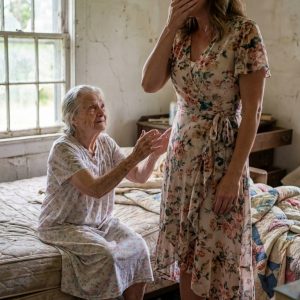
Three days after my mother-in-law made my eight-year-old son cry in front of all his friends, I walked into her house while she was hosting her church group.
Twelve women sat in her living room, sipping coffee from delicate china and discussing charity work with the kind of performative empathy that only exists in suburban enclaves. They all looked up when I came through the door. The air in the room shifted instantly, heavy with the scent of lavender potpourri and unspoken judgment.
My mother-in-law’s face went completely white when she saw what I was carrying.
And I need you to understand something before I tell you what happened next. I would do it again. I would do it a hundred times. Because some people don’t understand words. They only understand consequences.
My name is Karen. I’m thirty-four years old, and I work as a pediatric occupational therapist. I spend my days helping children with developmental delays learn how to hold pencils, button their shirts, and navigate a world that wasn’t built for them. I am patient by nature. I was raised to be polite, to keep the peace, to smile through discomfort because making a scene was considered a cardinal sin.
My aunt Greta, the woman who raised me after my parents died when I was twelve, used to tell me that my kindness was both my greatest strength and my greatest weakness.
“Karen,” she said, smoothing my hair back from my forehead, “one day you’re going to have to decide whether you want to be nice or whether you want to be respected. Because sometimes, you can’t be both.”
I didn’t understand what she meant until I married into the Bellamy family.
My husband’s name is Declan. He’s thirty-six, a civil engineer who builds bridges for a living. He’s a good man in a lot of ways. He coaches our son’s Little League team. He makes pancakes every Saturday morning. He tells me he loves me before he falls asleep every single night.
But Declan has a blind spot. A massive, gaping structural flaw in his character. And that blind spot is his mother.
Her name is Vivien Bellamy. She’s sixty-seven years old, a retired insurance claims adjuster who spent thirty years finding reasons to deny people the help they desperately needed. I should have seen that as a warning sign—a billboard flashing in neon red. Vivien is the kind of woman who walks into a room and expects the atmosphere to adjust to her temperature. She rules the family through guilt, manipulation, and the silent, terrifying threat of disapproval.
From the moment Declan introduced me to her, she made one thing clear: I was not good enough for her son. I was a nobody from Ohio, raised by an aunt, with no pedigree and no money.
On our second date, Vivien called Declan’s phone while he was in the bathroom. I answered. When she heard my voice, she hung up without a word. At our wedding, she wore a cream-colored dress that was close enough to white to be an act of war. She told guests, loudly enough for me to hear, “I just hope he doesn’t regret this in five years.”
I smiled. I said nothing. I wanted peace.
Then came my son. Theo.
Theo is beautiful, sensitive, and imaginative. He notices when someone is sad. He notices when a friend is left out. And he noticed, from the age of five, that his grandmother hugged his cousins but only patted him on the head.
When Theo was born, Vivien looked at him in my arms and said, “He has your nose. That’s unfortunate.”
Declan squeezed my hand and whispered the mantra that would become the soundtrack of our marriage: “That’s just how she is.”
I heard that phrase when she gave my niece an iPad and handed Theo a used book with a torn cover. I heard it when she forgot to set a place for him at Thanksgiving. I heard it when she told Declan that Theo was “too soft” and we were “coddling him into weakness.”
I kept the peace for eight years. I bit my tongue until it bled. I told myself that family was worth fighting for.
I was wrong.
Three days before Theo’s eighth birthday, Declan told me his mother wanted to bring a cake.
“I already ordered one,” I said, my stomach tightening. “A T-Rex cake from Henderson’s Bakery. Theo picked it out.”
“She knows,” Declan said, avoiding my eyes. “But she wants to bring one too. She said it would make her feel included.”
I wanted to say no. I wanted to scream. But I was tired. “Fine,” I said. “But tell her it needs to say ‘Happy Birthday Theo’ and nothing else. No commentary.”
“I promise,” Declan said. “It’ll be fine.”
The morning of the party, Theo came downstairs in his favorite dinosaur t-shirt. It was green with a T-Rex on the front and the words “Roar Means I Love You” printed underneath. I knelt down and straightened his collar.
“This is going to be the best birthday ever,” I told him.
He smiled at me with his whole face. “I know, Mom. Because you planned it.”
Twelve children arrived. The backyard was filled with laughter. Theo ran from friend to friend, showing off the fossil dig I had set up in the sandbox. For the first time in his life, my son felt like he belonged.
Vivien arrived forty-five minutes late. She walked through the side gate carrying a large, white cake box. She didn’t say hello to me. She walked straight to the dessert table, set her box down next to the T-Rex cake, and turned to face the party.
“Everyone gather around!” she called out. “I brought a special cake for the birthday boy!”
The children stopped. Parents looked up. Theo ran over, his face lit up with curiosity.
Vivien lifted the lid with a flourish.
The cake was white with pale blue frosting. Simple. Elegant. But it was the writing in neat, cursive letters across the top that made my blood turn into ice.
Sorry You Exist.
For a moment, the world stopped. The birds stopped singing. The wind died. There was just twelve children staring at a cake they didn’t understand, and a grandmother smiling like she had just delivered a blessing.
Theo stepped closer. He moved his lips, sounding out the words.
I watched his expression crumble. The smile vanished. His lower lip trembled. It was confusion, hurt, and shame, all twisted together in a way an eight-year-old should never have to feel.
“I believe honesty is important,” Vivien announced loudly. “Someone had to say what we’re all thinking.”
Theo didn’t say a word. He turned and ran into the house. I heard his bedroom door slam.
One mother, Deborah, walked past me. “I am so sorry, Karen,” she whispered, her hand on her son’s shoulder. Then she left. Within five minutes, the party was over. The backyard was empty.
I looked at Declan. He was standing by the grill, mouth open, useless.
I looked at Vivien. She picked up a carrot stick and bit into it.
“What?” she asked, seeing my face. “The boy needs toughening up. You’ve coddled him. I did you a favor.”
“A favor?” I whispered. “You call that a favor?”
“It’s a joke, Karen. If you had raised him properly, a little joke wouldn’t send him running to his room.”
I walked upstairs to Theo’s room. He had locked the door.
“Theo, sweetheart, please open up.”
“Go away, Mom,” he sobbed. “I don’t want to talk.”
I sat outside his door for ten minutes, listening to my son cry because his grandmother told him the world would be better if he wasn’t in it.
And in that hallway, the part of me that kept the peace died.
Theo didn’t come out of his room for two days. He only left to use the bathroom. He refused to eat.
On the second night, at 2:00 a.m., I sat in the living room scrolling through photos of Theo smiling before the cake arrived. I called Aunt Greta the next morning.
“I’ve been waiting for this call,” she said. “What are you going to do?”
“I’m going to make sure everyone knows who she really is.”
“Good,” Greta said. “People like Vivien don’t change because you ask them nicely. They change when their reputation is on the line.”
I texted Lorraine, Declan’s sister. We weren’t close, but I knew she had suffered too.
I have videos of Theo crying. I have texts from parents. I’m going to expose her. Stand with me or stay out of my way.
An hour later, she replied with a list. Two pages of every cruel comment Vivien had made to her own grandchildren. Every manipulation. Every insult.
I typed it all up into a single document. I titled it: The Truth About Vivien Bellamy: A Grandmother’s Legacy.
I printed twelve copies.
On Thursday morning, I picked up the cake box—I had saved it—and drove to Vivien’s house.
I didn’t knock. I walked straight into the living room where her church group was meeting. Twelve women. Coffee. Pastries.
Vivien sat in her armchair, looking like the queen of England. When she saw me, her eyes narrowed.
“Karen, this is a private meeting. Whatever drama you’re here to create can wait.”
“Actually, it can’t wait,” I said, my voice steady. “I’m here to return something that belongs to you.”
I set the cake box on the coffee table. Every woman leaned forward. I lifted the lid.
The cake was still there. The blue frosting had hardened, but the message was clear.
Sorry You Exist.
The room gasped. Vivien’s face drained of color.
“What is the meaning of this?” she demanded, her voice shaking.
I reached into my bag and handed out the documents. One to each woman.
“This is a summary of how Vivien has treated her grandchildren for the past decade,” I said. “Direct quotes. Dates. Incidents confirmed by her own daughter.”
“You told your eight-year-old grandson you wished he had never been born?” one woman asked, horrified.
“That is out of context!” Vivien sputtered. “Karen is twisting my words!”
I pulled out my phone. “Let me provide context.”
I played a video Lorraine had sent me. Christmas, two years ago. Vivien looking at Theo and saying, “You’re the reason your parents never had more children. They couldn’t risk another one like you.”
The silence in the room was deafening.
Dorothy, Vivien’s oldest friend, stood up. She looked at Vivien with pure betrayal.
“Vivien,” she said quietly. “Please tell me this isn’t true.”
Vivien opened her mouth, but nothing came out. No excuse. No spin.
“You wanted to teach my son that honesty is important,” I said to Vivien. “So here’s some honesty. You are no longer welcome in his life. Not at birthdays. Not at holidays. Not ever. If you try to contact him, I will send this document to everyone you know.”
I placed the cake box in her lap.
“Keep the cake. Consider it a gift.”
I walked out. I heard Vivien call my name, her voice small and broken, but I didn’t turn back.
I sat in my car for five minutes, shaking. I called Aunt Greta.
“Did you do it?”
“I did it.”
“Good girl. Now go home and take care of that boy.”
When I got home, Theo was at the kitchen table eating cereal. It was the first time he’d left his room.
“Mom, where did you go?” he asked.
I sat down next to him. “I went to Grandma Vivien’s house. I told her that what she did was wrong. And I told her she’s not allowed to treat you like that ever again.”
Theo stirred his cereal. “Is she going to say sorry?”
I took a breath. “I don’t know, sweetheart. Some people never learn how to say sorry. But that doesn’t mean there’s anything wrong with you. What she said on that cake was a lie. You are the best thing that ever happened to me.”
He looked at me with his big brown eyes. “Do you promise?”
“I promise.”
“Mom,” he asked softly. “Can we still have cake? A real one?”
That afternoon, we baked a chocolate cake from scratch. We wrote Happy Birthday Theo in messy frosting. When he blew out the candles, he smiled. A real smile.
Declan came home that night looking exhausted. Vivien had called him six times. Half her church group had stopped speaking to her. Dorothy had left without saying goodbye.
“Are you happy now?” Declan asked me in the kitchen.
“No,” I said. “I’m relieved. There’s a difference.”
He looked at me for a long time. Then he said the words I had waited eight years to hear.
“I should have protected him. I should have protected both of you. I’m sorry.”
We started counseling. It was hard. But slowly, things changed.
Theo is nine now. He still loves dinosaurs. He has friends who love him. He doesn’t see Vivien anymore. She tries to reach out, but I hold the line.
Some cakes are meant to be thrown away. Some people are too.
If you are reading this, and you see yourself in my story, know this: You are not alone. It is never too late to stand up for the people who matter most.
Silence does not keep the peace. It just lets the cruelty grow.
Be brave. You deserve to be respected. Don’t let anyone tell you otherwise.