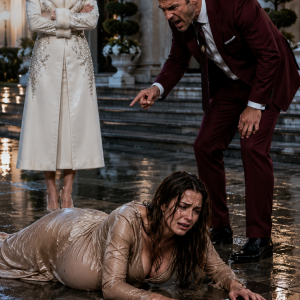
“That’s how she learns to behave.”
Those words. They didn’t just hang in the air; they made the blood in my veins turn to ice. Three years have passed since that scene, yet I can still hear the echo of that applause. The dry, rhythmic clapping of a mother watching her son strike my daughter.
My name is Audrey Vance. I am fifty-seven years old. For thirty-two of those years, I have been a family lawyer specializing in domestic violence cases. I have spent decades standing as a shield for women who had forgotten how to defend themselves. I have stared down corrupt judges, maneuvered around violent husbands, and dismantled entire families that protected abusers. I thought I had seen the darkest corners of the human heart. But nothing—absolutely nothing in my career—prepared me to see my own daughter struck right in front of me.
This is the story I never thought I would have to tell. It is the story of how one Sunday dinner incinerated a family, and how thirty seconds of silence changed the destiny of four people forever. Because, you see, they didn’t know who they were messing with.
Let me take you back to that night. It was Sunday, March 20th. I remember the date with painful clarity because it would have been my late husband Robert’s birthday. He had died two years earlier of a massive heart attack, leaving me alone in our big Georgetown house—a home once filled with laughter, now echoing with memory.
Adrienne, my only daughter, had insisted. “Mom, you can’t be alone on Dad’s birthday. Come on over. I’ll make his favorite dish. Turkey with mashed potatoes and gravy.”
My daughter, my Adrienne. Thirty-two years old, a chemical engineer, a brilliant mind who had inherited her father’s quiet intelligence and my tenacity. Or so I thought.
I arrived at 7:00 PM at her house in Beverly Hills. It was a gorgeous residence they had purchased just a year prior with the inheritance Robert had left us. I had given her the full share against my accountant’s advice. “Just in case,” he had warned. Just in case of what? Just in case she married a monster? I should have listened.
When I walked in, the table was already set with military precision. Fine china, crystal glasses, scented candles that smelled of vanilla and pretense. Adrienne had been cooking for hours; the aroma of roast turkey and green bean casserole transported me instantly back to our kitchen in Georgetown, to Robert stealing a taste of gravy from the pot.
But something was wrong. Adrienne was… diminished. Her hair was shorter, almost severe. She wore a long-sleeved blouse despite the stifling March heat. When she hugged me, her body was rigid, vibrating with a frequency of terror I hadn’t felt in her before.
“Honey, are you all right?” I whispered.
“Sure, Mom, just tired from work.”
I should have pushed. I should have screamed. But her husband was right there. Michael. Smiling that smile I had always found too perfect, too rehearsed.
“Mother-in-law! Great to see you. Come in, come in.”
And behind him, looming like a dark storm cloud, was his mother, Helen. Sixty-four years old, a widow like me, but of a very different breed. Her husband had died ten years earlier in a “fall down the stairs.” An accident. Case closed. With my experience, I had sensed something reptilian about her since the wedding, but Adrienne was so in love that I swallowed my suspicions. A mistake that haunts me every night.
“Audrey, dear,” Helen said, her voice dripping with saccharine poison. “What a joy. Adrienne prepared a delicious dinner. My son is lucky to have such a devoted wife.”
Devoted. She said it as if Adrienne were a servant earning her keep in a house she had paid for.
We sat. Michael at the head, naturally. Helen to his right. Me across from her. Adrienne trapped in the middle. The dinner was quiet. Too quiet. Helen dominated the airspace, talking about her country club, her decorating projects, and how wonderful it was to have her son so close.
I ate in silence, engaging my lawyer’s eye. I watched Adrienne serve the food with trembling hands. I watched Michael accept the plate without a thank you. I watched Helen criticize every bite.
“The mashed potatoes are a little salty, don’t you think, son?” she sniffed. “Back in my day, wives got up earlier to ensure perfection.”
And I watched my brilliant, strong daughter shrink with every syllable.
Then, the moment arrived. Adrienne reached over to pour more water into Michael’s crystal goblet. Her hand gave a microscopic tremor. A single drop—barely a tear’s worth of water—fell onto the pristine white tablecloth.
The silence that followed was deafening. It sucked the air out of the room.
Michael slowly placed his fork on his plate. The clink of metal against porcelain echoed like a gunshot.
“Do you see what you did?” he said. His voice was dangerously calm.
Adrienne opened her mouth to apologize, but he didn’t give her the dignity of a breath. He rose from his chair. One. Two. Three.
He slapped her three times. Open palm, brutal force. The sound of flesh striking flesh filled the dining room. My daughter fell from her chair, hitting the marble floor with a sickening thud.
And then… the applause.
Helen was clapping. A slow, satisfied rhythm. “That’s how she learns to behave,” she said, smiling. “A clumsy wife needs correction. I had to educate my husband this way, too. It’s for her own good.”
For thirty seconds, I couldn’t move. Thirty-two years of defending victims, and I was paralyzed when it was my own flesh and blood. But those thirty seconds were not inaction; they were calculation. The lawyer in me woke up. I saw the condensation on the glass. The force of the blow. The normalized violence. The complicit mother.
I stood up. Slowly.
Michael looked at me with that arrogant smirk, expecting the hysterical mother. Expecting tears.
I didn’t scream. I pulled my phone from my purse. My hands were steady as granite. I dialed a number I had kept on speed dial for twenty years.
“Commander Vance,” I said, my voice so cold it surprised even me. “This is Audrey. I need an Immediate Response Unit at 345 Park Avenue, Apartment 802. Domestic violence in progress. Witnesses present. I am activating my recording now.”
I put the phone on speaker and set it on the table.
“Repeat what you just did,” I commanded, staring into Michael’s eyes. “Repeat what your mother just said. Please. I have all night.”
Michael’s face went from arrogant red to ghostly white. “You… you can’t.”
“I am a lawyer specializing in gender violence,” I enunciated every syllable. “I have prosecuted 218 men like you. You just committed a felony in front of a direct witness and a legal accomplice. Helen, if you say one more word, you add obstruction of justice to your charge sheet.”
“This is a family matter!” Helen shrieked, her smile finally vanishing.
“It is a crime punishable by three to six years in prison under Article 201,” I replied. “And you, as an active accomplice who justified the violence, are looking at four years.”
Sirens wailed in the distance. Commander Vance doesn’t waste time.
Michael tried to step toward me. “If you touch me,” I said, “that’s assault on a witness. Do you want to die in prison, Michael?”
The police arrived in seventeen minutes. What followed was pure protocol. Michael in handcuffs. Helen in handcuffs. Before they shoved him into the patrol car, Michael looked at me with pure, distilled hatred.
“This isn’t over,” he spat. “My family has connections.”
“Your connections are worth nothing against evidence,” I interrupted. “And if you try to approach my daughter, I will personally ensure you spend your sentence in the darkest hole the penal system has to offer.”
I took Adrienne back to Georgetown that night. I couldn’t leave her in that house of horrors. We sat in her old bedroom, surrounded by the ghosts of her childhood—her science fair trophies, the twin bed with the blue quilt, the photos of a life before Michael.
“Why didn’t you tell me?” I asked, handing her a cup of chamomile tea.
“I was ashamed,” she whispered, staring at the steam. “Mom, you defend women who are trapped. You’re unbreakable. How could I tell you that I became one of them? How could I admit I married a monster?”
“We are going to fix this,” I promised. But I knew the battle was just beginning. Michael and Helen weren’t going to go quietly.
The counter-attack began four days later.
It started with a call from Christine Douglas, a “friend” of Helen’s and a pillar of society.
“Attorney Vance,” she purred. “I understand there was a misunderstanding between the young couple. Surely we don’t need to ruin a successful man’s life over a… domestic tiff.”
“He hit her three times,” I said. “There is no misunderstanding.”
“Michael’s uncle is a Magistrate on the Superior Court,” she dropped the threat casually. “It would be a shame if your practice suffered.”
I hung up and saved the recording.
Then came the lawsuit. Michael’s lawyer filed for defamation, false accusation, and emotional distress. They demanded five million dollars. Simultaneously, Magistrate Eric Matthews—Michael’s uncle—signed an emergency order suspending the restraining order.
“They’re playing dirty,” I told Adrienne, showing her the paperwork.
“Five million dollars?” Adrienne paled. “Mom, maybe we should stop. Maybe I should just…”
“Just what? Go back?”
“He’s texting me,” she confessed, tears spilling over. “From different numbers. He says he’s sorry. He says he’s sick. He says it’s his mother’s fault.”
“It is the manipulator’s handbook, Adrienne. Chapter one: Play the victim. Chapter two: Blame the parents. Chapter three: Isolate the target.”
I showed her the statistics. The 1,200 women who died last year in New York alone. “Zero is the only acceptable number of times a husband hits his wife.”
We stood firm. I appealed the magistrate’s order. I counter-sued for eight million. But they escalated the war to the public sphere.
A blog appeared: The Truth Behind the False Accusations. It painted Michael as a saint and Adrienne as a gold-digging hysteric. It went viral in their social circles. Adrienne lost friends. Her boss at the pharmaceutical company placed her on “indefinite leave.” The IRS announced a sudden audit of my firm.
We were drowning. My daughter was crumbling under the weight of the smear campaign, and I was running out of fingers to plug the holes in the dam.
“I’m so tired, Mom,” Adrienne said one night, standing in the garden where Robert used to grow rosemary. “I have nothing left. No job, no friends, no reputation.”
“You have the truth,” I said, gripping her shoulders. “And you have me.”
But I was terrified. We were losing the war of attrition.
Then, the package arrived.
It was an anonymous cardboard box left at the police station. Commander Vance called me at 4:00 AM.
“You need to see this, Audrey.”
Inside were USB drives, old photographs, and forensic reports.
We played the first audio file. It was Helen’s voice, unmistakable.
“Don’t be naive, Michael. That little girl and her mother won’t stop. You have to do what is necessary. Just like I did with your father.”
Michael’s voice on the recording: “Mom, don’t…”
“He tried to defy me, too. He thought he could leave. I taught him. I pushed him, Michael. And if Audrey Vance doesn’t back down, she might have an accident too.”
The room went silent. We weren’t just dealing with domestic abuse. We were dealing with murder.
The box contained the original autopsy report of Ray Matthews, Helen’s husband. The notes from the medical examiner—suppressed by the family—noted injuries inconsistent with a fall. Blunt force trauma. Defensive wounds.
There were photos of Michael as a child, his arms in casts. Helen had beaten him for years, molding him into a weapon, teaching him that pain was a language of love.
“Who sent this?” Adrienne asked, trembling.
I looked at the note at the bottom of the box. For Ray. Better late than never.
“It was Ray’s cousin,” I realized. “Albert. The one witness they silenced a decade ago.”
We had the smoking gun. But Helen and Michael had one last move.
The next morning, my phone rang. Commander Vance again.
“He broke the order. Michael is at the Beverly Hills house.”
“Is he…”
“He’s destroying it, Audrey.”
The house was a carcass. Michael had taken a knife—Robert’s prized Japanese chef knife—and slashed every piece of furniture. He had spray-painted LIAR and DEATH on the walls in red paint that looked too much like blood. The knife was stabbed deep into the kitchen counter.
He was arrested on site, screaming like a man possessed.
“I need to see him,” Adrienne said, standing amidst the ruins of her marriage.
“Adrienne, no.”
“I need to, Mom. One last time. To close the door.”
We went to the jail. I watched from the glass. Michael looked small in his orange jumpsuit, stripped of his expensive suits and his mother’s protection.
“Adrienne,” he wept when she entered. “I can fix this. I love you. Please, I’m sick. My mother…”
“Stop,” Adrienne said. Her voice was steady, resonating with a strength I hadn’t seen in years. “I didn’t come here to forgive you. I came to tell you the truth.”
“I love you!” he sobbed.
“Did you love me when you hit me for spilling water? Did you love me when you wrote death threats on our walls?” She leaned in, her palms flat on the table. “Your mother taught you that control is love. She murdered your father, Michael. And she turned you into her accomplice. You are a tragedy, but you are not my tragedy anymore.”
She stood up and walked to the door.
“Adrienne!” he screamed. “I love you!”
She didn’t turn back. “Love doesn’t hurt, Michael.”
The trials were brutal, but the evidence was insurmountable.
Michael was sentenced to five years in prison for aggravated assault, destruction of property, and violation of a restraining order. The jury didn’t buy the “misunderstood husband” act when they saw the photos of the house.
Helen’s trial was the main event. With the recordings and the reopened investigation into Ray’s death, her web of lies disintegrated. She was convicted of being an accomplice to Michael’s violence and, more importantly, for the second-degree murder of Ray Matthews.
“You destroyed my family!” she screamed at me as the judge read the twelve-year sentence.
“You destroyed it yourself, Helen,” I replied calmly. “I just turned on the lights.”
Six months later, karma delivered its final verdict. Helen suffered a massive stroke in prison. The woman who had needed to control every aspect of the people around her was left paralyzed, unable to feed herself, dependent on the mercy of strangers.
It wasn’t revenge. It was balance.
Five years have passed.
I am sitting in my garden in Georgetown. The rosemary is blooming. Robert’s herbs are thriving.
Adrienne is here. She looks different now. Her hair is long again, loose and wavy. She is laughing. Beside her is Daniel, a doctor she met two years ago. He is gentle. He asks for her opinion. He respects her silence. When he looks at her, there is no possession in his eyes, only awe.
“Mom,” Adrienne calls out. “Daniel wants to know the secret to your barbecue sauce.”
“It’s Robert’s secret,” I smile. “I’ll take it to the grave.”
Adrienne walks over and takes my hand. “Thank you,” she whispers.
“For what?”
“For not letting me give up. For saving my life.”
“You saved yourself, honey.”
We won. We lost friends, we lost money, and for a while, we lost our peace. But we gained our dignity.
I open my laptop. The manuscript is finished. The Echo of Applause. It’s not just a memoir; it’s a manual for survival.
If you are reading this, and you recognize the silence at your dinner table, or the fear in your own heart, know this: You are not crazy. You are not alone. And zero is the only acceptable number.
Justice is slow. It is imperfect. But if you stand your ground, if you refuse to applaud the violence, the truth will find its way to the light.
My name is Audrey Vance. I am a survivor. And my daughter is free. That is the only verdict that matters.