Title: The Echoes of a Shattered Dynasty
Chapter 1: The Gilded Cage
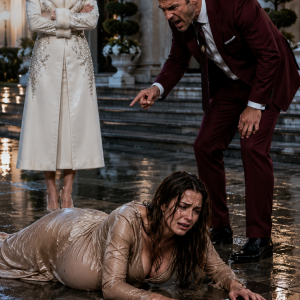
On the afternoon my world fractured, I learned a profound truth about power: the people who believe they possess it are usually the most blind to their own ruin. When the time came, and my physical vulnerability was at its absolute peak, my husband struck out at me in a moment of blinding cruelty, causing me to collapse to the floor in agony. Simultaneously, his mother grabbed my hair with vicious force, pulling my head back until a raw, primal cry tore from my throat.
What neither of them realized, in that chaotic climax of their arrogance, was that a solitary document, resting silently inside my brother’s fireproof safe, was about to erase them from every glorious future they thought they owned.
My name isCamille Reyes. Three years prior, I had married into the formidableReyes family, foolishly believing I had anchored myself in a harbor of genuine love. For the first twelve months, my mother-in-law,Diane, tolerated my existence the way one tolerates an unseasonable frost—something incredibly inconvenient, yet temporary. To the outside world, she was a paragon of high-society grace. Behind the heavy oak doors of their sprawling estate, her gaze swept over me like a frigid wind.
Yet,Marcuswas my shield. Or so I thought. He still opened car doors, still called his mother every Sunday to keep the peace, still kissed my forehead, and made it feel as though I genuinely belonged in his orbit. What I failed to comprehend during those honeymoon days was that theReyesname carried far more than legacy; it came tethered to a labyrinth of country club memberships and generational wealth.
Diane’slate husband, a titan of local industry, had left behind a formidable family trust valued at several million dollars. The explicit design of this fortune was to bypass his immediate heirs and pass directly down through his biological grandchildren. Until those hypothetical children came of age,Dianecontrolled the vast accounts as the sole trustee. It funded her opulent lifestyle, her charity board seats, and her unquestioned authority.
The very week I announced my pregnancy, the subtle atmospheric pressure in the house shifted. I ceased being a mother inconvenience toDiane. I became an existential threat.
A grandchild equated to a legitimate legal claim. A legitimate legal claim meantDiane’siron-fisted grip on the family treasury suddenly possessed an expiration date.
Her campaign of sabotage began with microscopic cuts. Over elaborate dinners, she would make fleeting, poisoned comments to her affluent friends, loud enough for me to hear.“It’s simply fascinating how some women manage to marry into legacies they haven’t lifted a finger to build,”she would muse, sipping her vintage Pinot Noir.
Soon after, she began taking clandestine, closed-door meetings with the family’s estate attorney. When I questionedMarcusabout these whispering sessions, he waved away my concerns with a laugh.
“Don’t worry about it,Camille,” he’d say, loosening his silk tie. “It’s just Mom being Mom. She likes to review the portfolios. She’s protective, that’s all.”
I was painfully naive. I did not understand what I was observing until the shadows grew too long.Dianewasn’t merely acting cold; she was methodically constructing a narrative. She was planting seeds among their social circle that I was unstable, that I didn’t fit in, so that when the time eventually came to legally sever my unborn child from the trust, it wouldn’t raise a single manicured eyebrow.
AimDiane’splanning was only half the tragedy.Marcus, the man I trusted with my life, harbored his own dark secret, sitting practically an arm’s length away from me most evenings. Her name wasVanessa, a junior executive at his real estate firm. He had been entangled with her since before I even conceived our child.
I stumbled upon the digital breadcrumbs purely by accident. It was two weeks before my due date. My ankles were swollen, my back ached relentlessly, and I was searching for a contact on his unlocked iPad. Instead, a message preview glowed on the screen, a sordid exchange of promises and hotel reservations.
When I confronted him in our dimly lit kitchen, the air thick with tension, he didn’t even possess the grace to deny it.
“You’re being overly emotional,” he scoffed, leaning against the marble counter, his eyes void of empathy. “Pregnancy has made you paranoid,Camille. You should be grateful I’m still coming home to this suffocating environment at all.”
A cold dread coiled in my gut. The man I loved was a phantom. As I stood there, heavily pregnant and trembling, a sudden, sharp pain radiated across my lower abdomen. The physical agony of labor was beginning, perfectly synchronized with the death of my marriage.
But the nightmare was only just unfolding.
Chapter 2: The Night of the Fracture
By the time the contractions intensified, coming in tight, breathless waves, I was nine months pregnant and already grieving a life that hadn’t technically been pronounced dead.
I collapsed onto the living room rug, clutching my swollen belly. The house was cavernous, echoing with the silence of my isolation. I called out desperately forMarcus. Despite the shattered remains of our vows, I clung to the desperate certainty that he would, at the very least, summon an ambulance or drive me to the maternity ward.
He emerged from his study, but he didn’t rush to my side. He stood over me, a towering figure of resentment, his face twisted in a venomous scowl.
“You ruined everything,” he spat, his voice trembling with misdirected rage. “This baby… you… it’s the only reasonVanessawon’t leave her husband for me yet. Every single thing wrong in my world traces directly back to you!”
The room spun.Help me,I tried to whisper, but another contraction stole my breath.
Then, the unthinkable happened. In a frantic, cruel outburst of frustration, he drew his leg back and struck me. The impact sent a shockwave of terror through my fragile state, dropping me fully to the floor. I curled into a protective sphere around my unborn daughter, tears blurring my vision.
The front door clicked open.Dianehad let herself in, as she often did. I looked up, praying for a mother’s mercy.
Instead, she didn’t scream at her son to stop. She didn’t rush to my help.Dianecrossed the room, her designer heels clicking sharply against the hardwood, grabbed a fistful of my tangled hair, and yanked my head backward. Her heavy diamond rings scraped agonizingly against my scalp.
“This is exactly what happens,” she hissed, her breath smelling of expensive perfume and malice, “to little girls who think a pregnancy makes them untouchable in this family.”
She looked down at me as if I were finally being disciplined for a crime only she could understand.
Mercifully, the thin walls of our upscale townhouse proved to be my salvation. A neighbor, hearing the harrowing sounds of distress, had immediately dialed 911. The shrill wail of sirens pierced the night air, bringing paramedics to our door beforeMarcusgoldDianecould invent a way to hide me.
When the emergency responders burst through the entryway,Marcusinstantly pivoted into the role of a terrified husband. “She slipped!” he stammered, his face a mask of manufactured panic. “She fell so hard, I don’t know what happened!”
But the blooming discoloration across my midsection, and the clumps of my hair scattered on the rug, narrated an entirely different horror story. One seasoned paramedic, a woman with sharp, observing eyes, knelt beside me. She took my vitals, her expression hardening as she assessed the scene.
Under the guise of retrieving a stretcher, she quietly stepped out onto the porch and requested immediate police presence before we even reached the hospital doors.
As they loaded me into the sterile, brightly lit back of the ambulance, my entire body shook—not just from the impending childbirth, but from the adrenaline of pure survival. The paramedic strapped a monitor to my chest. “You’re safe now, honey,” she whispered.
I nodded, my hands slick with cold sweat, and fumbled for my phone. There was only one person I could call.
I dialed my older brother,Nathaniel.
WhatMarcusandDianehad never bothered to learn about my background—because I was so exhausted by being labeled as the “girl who married up” that I rarely spoke of my past—was thatNathanielwas not just a sibling. He was the senior partner at one of the city’s most ruthless, respected estate and corporate law firms.
He didn’t just know how to wage a war in a courtroom. He knew exactly where theReyes familykept its darkest weaknesses buried on paper.
As the ambulance sped toward the hospital, I heard my brother’s voice on the line, calm but immediately alert.And in that moment, the power dynamic in the Reyes family irrevocably shifted.
Chapter 3: The Unseen Architect
The hospital was a blur of antiseptic smells, blinding lights, and agonizing pain, culminating in the miraculous, crying arrival of my daughter,Elena. I held her tiny, fragile body against my chest, a fierce, protective fire igniting within my soul.
Within forty-eight hours of my admission,Nathanielhad descended upon the situation with surgical precision.
He didn’t yell. He didn’t make threats. He simply moved the machinery of the law. High-resolution hospital photographs of the blunt-force trauma to my body, the paramedic’s official report documenting the scalp trauma and forced hair loss, and the neighbor’s sworn affidavit regarding the screaming were rapidly compiled.
By the time I was moved to a recovery suite, an emergency protective order had been successfully filed and signed by a judge.
Diane, blinded by her own hubris, attempted to waltz into the maternity ward the following morning, carrying a bouquet of white lilies as if she were playing a part in a daytime soap opera. I watched through the glass window of my door as hospital security intercepted her. She shrieked indignantly, demanding to see “her property,” before two burly guards physically escorted her out of the building.
I heldElenacloser, the rhythmic thumping of her tiny heart soothing my frayed nerves.
AimNathaniel’sretaliation was barely beginning. Years prior, long before I had even metMarcus, my brother had operated as a junior associate on a complex corporate restructuring case. He had quietly assistedDiane’slate husband in organizing the sprawling branches of his estate.
It was a professional relationship thatDianehad either completely forgotten about or had deemed too insignificant to remember.
Sitting by my hospital bed,Nathanielpulled a crisp, manila folder from his leather briefcase. “How much do you know about the grandfather’s trust,Camille? ” he asked, his voice low, his eyes glinting with a predatory intelligence.
“I know she controls it,” I replied, my voice raspy. “I know she wants to cut my baby out of it.”
Nathanielsmiled, a cold, sharp expression. “She’s been spending the last two years quietly drafting the legal framework to have your child excluded. She was absolutely certain that the only existing copy of a very specific amendment had been shredded shortly after her husband passed away.”
He tapped the folder. “She was wrong.”
My breath hitsched. “What is it?”
“An irrevocable amendment,” he explained gently, savoring the words. “Signed and notarized by the old man himself, explicitly naminganybiological grandchild as a protected, unremovable beneficiary. It strips the trustee of the power to exclude them for any reason.”
She thought she had burned the only bridge.
“I still have the original document, heavily guarded in our firm’s archival vault,”Nathanielcontinued. “I didn’t sue her for it this morning. Lawsuits take time. I did something much faster.”
He leaned closer. “I simply hand-delivered a formal notification to the trust’s banking administrator, proving that a severe beneficiary dispute exists.”
My eyes widened. “What does that do?”
“It freezes everything,Camille. Automatically. Pending a full judicial review.”
Overnight,Diane’slifeblood was severed. The exorbitant monthly income that fueled her designer wardrobe, funded her prestigious charity board seat, and guaranteed her standing in every elite room she graced… evaporated into thin air.
But the dominoes were only just starting to fall, and Marcus was next in line.
Chapter 4: The Financial Guillotine
Marcus’scommercial real estate firm did not run solely on capital; it survived on the fragile oxygen of elite relationships and untarnished reputations. Those vital connections lived in the exact same rarefied social circles thatDianehad spent three decades meticulously cultivating.
Nathanielunderstood that to destroy an empire, you don’t need to spread lies. You only need to weaponize the truth.
He made absolute certain that the emergency protective order and the pending criminal complaint—both matters of public record—found their way to the desks of the right two individuals. One was the chairperson ofDiane’sbeloved philanthropic board. The other wasMarcus’sprimary financial investor, a man who, quite conveniently, sits on that very same board.
The social execution was swift and entirely bloodless.
Within a week,Dianereceived a polite, chillingly formal email requesting that she step down from her charity positions, citing “pending personal matters that misalign with our organizational values.” The woman who had ruled the country club was suddenly a pariah, unable to secure a lunch reservation with her oldest friends.
Two weeks later, the tremors reachedMarcus.
His largest investor abruptly pulled out of a multi-million-dollar development deal thatMarcushad been desperately counting on to close by the end of the fiscal quarter. The investor cited “unacceptable reputational exposure.”
The rot spreads quickly.Marcus’sbusiness partners began returning his frantic phone calls days late, if at all. Lucrative contracts that used to be finalized over a handshake and a steak dinner suddenly required “extended legal review.” His empire was bleeding out, and he lacked the turnstile to stop it.
While the trust accounts remained locked in a frozen purgatory and the real estate firm unraveled,Nathanielfiled a merciless petition for sole custody ofElena. He used the medical photography, the paramedic’s chilling testimony, and the active criminal charges as the unbreakable spine of our case.
Marcus’shigh-priced attorney panicked, desperately trying to negotiate supervised visitation behind closed doors, offering exorbitant financial concessions if we would just settle quietly.
Nathanieldidn’t even blink. “We decline,” he told opposing counsel over a brief phone call. “We want this in front of a family court judge. On the public record.”
My brother wanted a venue where the digital transcripts of theVanessamessages could be formally entered into evidence, dismantling the narrative of “instability” thatMarcus’slegal team was preparing to use against me.
During those first agonizing weeks at my brother’s house, my phone buzzed incessantly.Marcuscalled constantly. His voicemails were a chaotic pendulum swinging between explosive, narcissistic rage and pitiful, sobbing apologies.
“Camille, please, you have to stop this,”he begged in one message, his voice cracking.“Mom just lost her temper, you know how she gets. I was stressed about work! If you don’t drop these charges, I’m going to lose the business. We can fix this!”
I sat on the porch, rocking a sleepElenain my arms, and let every single call vanish into the digital void. I felt no pity. I felt no sorrow. I felt nothing but an icy, resolute determination.
The time for talking had passed. The season of consequences had arrived.
Chapter 5: The Courtroom Reckoning
The criminal docket moved surprisingly fast, thrusting the nightmare of that evening into the stark, unforgiving light of a courtroom.
Marcus’sdefense attorney, a slick man with an expensive suit and a condescending smile, attempted to paint the incident as a tragic, heated domestic misunderstanding. He argued that emotions were running high, that I was hysterical, and that the physical contact was entirely accidental.
His narrative held together for exactly twenty minutes, right until the prosecuting attorney stood up and politely reminded the jury that the so-called “hysterical victim” had been in the throes of active, painful labor when she was violently struck down.
Then came the witnesses.
The neighbor’s testimony established the timeline of my screams. But it was the paramedic who drove the final nail into the coffin. She stood on the stand, unbothered and professional, recounting the horrifying visual of my scalp bleeding, noting that strands of my dark hair were still visibly tangled in the prongs ofDiane’sdiamond rings when the medical team arrived on the scene.
Diane’sstory—that she had simply intervened to catch me as I fell—crumbled into dust.
When it was my turn, I walked to the witness stand. The heavy oak of the chair felt grounding. I looked directly at the jury box and described, without a single tear or a flinch of hesitation, what it felt like to be attacked while carrying life. I spoke of the agonizing pull of my hair, the desperate begging for an ambulance, and the cold reality of delivering my daughter alone, without a single member of theReyes familypresent to welcome her.
Several jurors visibly recoiled. One woman wiped a tear from her cheek.Marcussat at the defense table, his face ashen, finally realizing the magnitude of his ruin.
The verdict was swift.Marcuswas convicted of felony domestic endangerment against a pregnant victim. He was sentenced to eighteen months in a state facility and slapped with a permanent, ironclad restraining order.
Dianemanaged to avoid jail time, receiving a lengthy probation and her own restraining order, but her legal survival was a hollow victory. The criminal trial was merely a prologue to the massacre that occurred in probate court three weeks later.
In that quieter, wood-paneled room,Nathanielfinally presented the original, notarized trust amendment.
Diane’strust attorney stammered, arguing mishandling of documents, claiming clerical confusion, and desperately trying to reframeDianeas a protective matriarch guarding a legacy.
The judge, an older man with no patience for aristocratic entitlement, was entirely unmoved. He reviewed the grandfather’s explicit instructions and looked down atDianewith open disgust.
With the sharp crack of a gavel,Dianewas formally, permanently removed as the trustee of theReyes Estate. She was replaced immediately by a court-appointed fiduciary.
But the final blow was financial. The judge orderedDianeto personally repay every single discretionary distribution she had siphoned from the trust during the period she had been secretly drafting documents to subvert the amendment. It was a staggering sum of money—capital she had already spent on galas and luxury cars. The remaining trust funds would now sit securely locked, gaining interest, completely untouchable by anyone until my daughter,Elena, came of age.
When the custody ruling inevitably followed—granting me full, unyielding legal and physical custody, with only supervised visitation forMarcuspending his release from prison—the destruction was complete.
The majestic Reyes name, a title that once acted as a skeleton key to the city, was now so toxic it could barely secure a corner table at the very restaurants that used to fiercely compete for their patronage.
Chapter 6: The Quiet Aftermath
I filed the final divorce paperwork the exact same weekMarcuswas transported to begin his sentence. I walked away from the wreckage carrying absolute custody of my child and a financial settlement that, while it could never erase the trauma, finally reflected the heavy toll those three years of emotional captivity had cost me.
There is a very particular, sacred kind of quiet that settles into the bones of a house once the lingering ghost of fear is finally excised from it.
I clearly remember the first night I laidElenadown to sleep in our new, sunny home. I stood by the edge of her crib, listening to her soft, rhythmic breathing. For the first time in years, my muscles weren’t coiled tight. I wasn’t unconsciously bracing for the sweep of headlights across the driveway window. I wasn’t straining my ears for the heavy, unpredictable footsteps that were never coming back to haunt me.
As the months turned into years, I watched my daughter grow. She became a vibrant, healthy, and fiercely joyous child, entirely oblivious to the dark violence that had nearly defined her first agonizing hours in this world.
Through her laughter, I finally understood the core truth of my journey. The truest, most enduring form of justice was never actually found in the sterile environment of the courtroom. It wasn’t derived from the frozen bank accounts of the trust, nor did it stem from the sight of the empty charity boardroom seat thatDianeonce guarded so fiercely.
True justice was the quiet, steady, beautiful life I painstakingly built in the aftermath of their cruelty.
It stands as living, breathing proof that the people who attempt to shatter you on the worst day of your life rarely maintain the strength to survive and witness the magnificent person you become on your best day. They break against the rocks; you learn how to control the tide.
Like and share this post if you find it interesting, and drop a comment below to let me know your thoughts on Camille’s journey to justice!