The architecture of my life was built on zeroes and ones, risk assessments, and the cold, unyielding truth of mathematics. By my thirty-fourth birthday, I had coded my way out of a cramped, water-stained apartment in Queens and into the rarefied air of Boston’s elite. I was the founder and CEO of a fintech firm that had just gone public, and to celebrate, I purchased a sprawling, ivy-choked stone estate in Chestnut Hill. I had money, I had status, and for the last eight months, I had a husband.
His name was Richard.
Richard was a mid-level corporate consultant who wore Brioni suits, possessed a silver-fox charm, and projected an aura of old-money nonchalance. He was smooth where I was sharp, relaxed where I was hyper-vigilant. I mistook his polished facade for stability. I didn’t know then that beneath the cashmere and the rehearsed smiles, Richard was drowning in a suffocating ocean of personal debt. Nor did I know that he viewed our marriage certificate not as a declaration of love, but as a winning lottery ticket.
And then there was Sienna.
Sienna was Richard’s nineteen-year-old daughter from his first marriage, a college sophomore who carried herself with the weary, burdened sigh of a deposed princess forced to live among the peasantry. When Richard and I married, he gently explained that Sienna was “still processing” her parents’ divorce—a divorce that had finalized five years prior. Out of a deep, misguided affection for my new husband, and a desperate desire to build the cohesive family I had never experienced growing up, I opened my checkbook.
I didn’t just open it; I ripped the hinges off.
I paid the staggering out-of-state tuition for her Ivy League education. I signed the lease on a custom, pearl-white BMW that cost me $1,200 a month. I provided an unlimited shopping allowance, assuming that generosity would eventually breed affection. Instead, it bred a toxic, metastasizing entitlement. To Sienna, I was not a stepmother. I was not even a person. I was a glorified housekeeper who occasionally interrupted her TikTok scrolling, a walking ATM whose only purpose was to dispense luxury without expectation of gratitude.
The microaggressions were a daily, dripping faucet of disrespect. She would walk through freshly mopped floors in muddy riding boots, looking right through me. She would order $150 of sushi on my UberEats account and leave the empty, soy-sauce-stained plastic containers on my antique mahogany dining table. And Richard? Richard was her ever-present shield, waving away my concerns with a patronizing pat on the shoulder.
The breaking point—or rather, the hairline fracture that preceded the shatter—occurred on a Tuesday evening in late October.
Sienna was lounging on the velvet sofa in the solarium, tapping aggressively on her iPhone. I approached her, holding a sleek, heavy metal platinum credit card. I had just finished arranging the financials for her upcoming spring semester.
“Here you go, Sienna,” I said, keeping my voice light, handing her the card. “I’ve loaded this for your semester expenses. Books, food, emergencies.”
She didn’t look up. She simply extended a manicured hand, took the card, and flipped it over with a look of mild distaste. She let out a long, theatrical sigh.
“Is this all?” she asked, her voice dripping with vocal fry. “The limit on this won’t cover my trip to Aspen with my friends next month. The chalets are, like, insane right now. Can’t you just raise it?”
I stared at her, waiting for a “thank you” that was never going to come. I kept my breathing even. “Sienna, there is ten thousand dollars on that card. I think ten thousand for a weekend ski trip is a bit excessive, especially since your tuition was just paid. You need to budget.”
Before Sienna could roll her eyes, Richard manifested from the hallway. He hooked his arm around my waist, his grip a little too tight, and pulled me aside into the kitchen, out of his daughter’s earshot. His jaw was tense.
“Paige, darling, what are you doing?” he whispered irritably, his eyes darting toward the solarium. “Don’t be stingy. You have millions in liquidity. Sienna needs to feel secure around you. When you withhold money over something as trivial as a ski trip, it just makes her think you’re trying to replace her mother by exerting control.”
Stingy. The word rattled in my skull. I was funding the girl’s entire existence, while her own mother contributed nothing. I looked at Richard’s handsome, pleading face. Against my better judgment, against the alarm bells ringing in my fintech-wired brain, I swallowed the bitter taste in my mouth. I nodded, prioritizing the peace of my eight-month marriage over the screaming instincts of my intuition. I raised the limit.
But the seed of doubt had been planted, and it demanded to be watered.
Later that week, Richard flew to Chicago for a “consulting conference.” I took the opportunity to organize his home office—a room I had furnished with a $5,000 ergonomic chair and a bespoke oak desk. While filing away some loose mail, my hand brushed against a false bottom in his bottom desk drawer. It rattled.
Curiosity, cold and sharp, took over. I popped the wooden panel loose.
Inside was a leather-bound bank ledger and a stack of statements from an obscure regional bank, an account entirely separate from our joint finances. I opened the ledger. I am a woman who reads data for a living. It took me less than forty seconds to decipher the story the numbers were telling.
For the entirety of our eight-month marriage, Richard had not contributed a single dime to our household, our mortgage, our groceries, or his daughter’s exorbitant lifestyle. Instead, he had been quietly and systematically funneling 100% of his corporate paycheck into this hidden private savings account. He was hoarding his wealth while bleeding me dry. The man I slept next to wasn’t a partner; he was a parasite wearing a wedding band.
My heart didn’t break. It froze solid. I flipped to the final page of the ledger, my eyes locking onto a massive, anomalous routing number transferring funds to a place I didn’t recognize, and a balance that made my blood run like ice water.
The air in my dining room smelled of roasted garlic, rosemary, and the expensive Barolo wine I had decanted two hours prior. I was hosting an intimate dinner party to celebrate my mother’s sixtieth birthday. My mother, Martha, was a woman whose hands were permanently calloused from thirty years of cleaning commercial office buildings in Queens so I could have a computer. My brother, David, a high school math teacher, sat beside her, looking slightly uncomfortable but happy in my opulent surroundings.
This was supposed to be my night to honor the woman who built the foundation for my success.
Sienna, predictably, arrived forty-five minutes late.
She didn’t apologize. She slinked into the dining room wearing a pair of distressed sweatpants and a cropped hoodie that somehow cost more than my mother’s entire outfit. She dropped into the chair opposite Martha, exhaling loudly, exuding a blatant, toxic contempt for my family’s working-class roots.
“Sorry,” she mumbled, not looking at anyone. “Uber took forever.”
“That’s quite alright, dear,” my mother said warmly, offering a gentle smile. “We’re just glad you could join us. Paige made her famous roast.”
Sienna poked at the prime rib on her plate with her fork as if inspecting a biological hazard. “I’m vegan this week,” she announced to the room at large. “And honestly, red meat is, like, terrible for the environment. But I guess people from… where are you from again? Queens? I guess people there don’t really care about carbon footprints.”
David stiffened. I felt a pulse of heat in my throat. “Sienna,” I said, my voice dangerously low. “Eat the vegetables, or don’t eat. But you will not speak to my mother that way.”
Richard chuckled nervously, pouring himself more wine. “Oh, Paige, relax. She’s just passionate about the planet. Youthful activism, Martha, you know how it is.”
The dinner degenerated into a masterclass of passive aggression. Sienna complained about the draft in my historic house, mocked the “cheap” taste of the expensive wine, and continuously checked her phone. The tension was a living, breathing thing, wrapping around the throats of my mother and brother, who exchanged pained, humiliated glances. I was vibrating with a suppressed, volcanic rage.
The climax arrived during dessert. David stood up, tapping his glass to make a toast to our mother. As he began speaking about her sacrifices, Sienna’s phone lit up with an incoming FaceTime call.
Instead of declining it, she answered. On speakerphone.
“Hey, Britt,” Sienna drawled, entirely ignoring my brother, who had stopped mid-sentence. “No, I can’t go out yet. Yeah, I’m stuck at this boring dinner with my dad’s new wife and her redneck relatives. It smells like a retirement home in here.”
The words hung in the air, violent and ugly. My mother’s face crumpled, her eyes dropping to her lap. David’s fists clenched.
Something inside me—the part that compromised, the part that yearned for a family, the part that allowed myself to be used—simply snapped. It didn’t break with a messy explosion; it severed with the clean, surgical precision of a guillotine.
I set my wine glass down. The crystal clinked sharply against the mahogany.
“Sienna,” I said. My voice was no longer low; it was trembling, but absolutely firm, possessing a terrifying clarity. “That is completely unacceptable. Hang up the phone.”
Sienna blinked, looking at me as if a piece of furniture had suddenly spoken. “Excuse me?”
“You heard me. You are in my home, sitting at a table paid for by my work, eating food bought with my money. You will show my mother respect, apologize right now, or you will get up and leave this table.”
Sienna scoffed, looking at her father for her usual rescue. Richard did not disappoint.
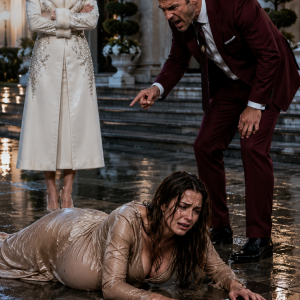
He slammed his hand down on the table, the silverware clattering violently. His face twisted into a mask of pure, unadulterated venom. He pointed a finger directly at my face, shedding his suave consultant persona entirely.
“That is enough, Paige!” Richard snarled, his voice echoing off the high ceilings. “Who the hell do you think you are? She is not your daughter. Don’t you dare correct her. Don’t you ever tell her what to do in front of me again.”
The room fell dead silent. Britt, on the other end of the phone, had gone quiet. Martha and David looked horrified, paralyzed by the sudden aggression.
I looked at Richard. I looked at the vein throbbing in his forehead, at the sneer on his lips. Then I looked at Sienna, who was smirking, victorious, reveling in my public humiliation.
I didn’t cry. I didn’t shout. I didn’t throw my wine in his face.
Instead, a profound, glacial peace washed over me. Richard had just given me the greatest gift a manipulator can ever give their victim: he had shown me his absolute truth. He had publicly absolved me of any maternal duty, any societal expectation, and any moral obligation. He had drawn the battle lines in permanent ink.
I looked at him. I felt the corners of my mouth slowly curve upward into a smile that did not reach my eyes.
“Fine,” I whispered into the silence.
I stood up, apologized to my mother, and escorted my family to the door, promising to make it up to them. After they left, Richard and Sienna retreated to the west wing, laughing about something, completely dismissing the incident as a victory over my “hysteria.”
While Richard slept soundly in our master bedroom, deeply satisfied that he had put his rich wife in her proper place, I did not go to bed.
At 1:00 AM, I was sitting alone in my dark, soundproofed home office. The only light came from the blue glow of my triple monitors. My hands, steady and precise, flew across the mechanical keyboard. I opened three separate online banking portals, navigating the complex financial webs I had built with a cold, predatory stare.
I am a woman of my word, and I decided to take Richard at his.
She’s not your daughter. Don’t correct her. Don’t tell her what to do.
He was absolutely right. She wasn’t my daughter. And in the eyes of the law, and now in the eyes of our household, I was nothing more than a stranger with a fat wallet. But the beautiful thing about being a stranger is that strangers owe you absolutely nothing. If I had no rights as a parent, I had zero obligations as a sponsor.
The execution was entirely administrative, devoid of emotion, and breathtakingly fast.
At 1:15 AM, I logged into my corporate American Express portal. I located the platinum authorized user card assigned to Sienna. I didn’t just freeze it; I permanently canceled the card and reported the account closed.
At 1:45 AM, I accessed the financial portal for the Ivy League university. I had signed a guarantor agreement for the upcoming spring semester, promising to cover the $42,000 balance out of pocket. Because the semester had not yet begun, the funds were in a holding state. With three clicks, I revoked my financial support guarantee, canceled the pending ACH transfer, and severed my banking connection to her student account.
At 2:30 AM, I pulled up the lease agreement for the pearl-white BMW. The car was registered to my holding company for tax purposes; Sienna was merely an authorized driver. I contacted the luxury leasing agency’s 24-hour emergency line. I reported that the vehicle was no longer authorized for use by the current driver and requested an immediate, voluntary repossession to my corporate lot downtown. I paid the $500 rush tow fee without blinking.
For the next three hours, I sat in the dark, drinking black coffee, watching the Boston skyline slowly turn from pitch black to a bruised, pre-dawn purple. There was no screaming. There were no threats. I was simply realigning the universe to match the boundaries my husband had so aggressively demanded.
At 6:00 AM, the silence of the estate was broken by the heavy, diesel rumble of a flatbed tow truck pulling onto the circular crushed-gravel driveway.
I watched from the kitchen window. The driver, a burly man in a reflective vest, hopped out and expertly hooked the winch to the front axle of the $85,000 BMW. The metallic clanking was loud enough to wake the dead.
It certainly woke Sienna.
The heavy oak front door flew open. Sienna sprinted outside into the freezing autumn air, wearing silk pajamas, her hair a tangled mess. She looked like a banshee.
“Hey! What the hell are you doing?! Stop! What are you doing to my car?!” she shrieked, waving her arms wildly at the tow truck driver.
The driver paused, pulling a clipboard from his vest. He looked incredibly bored. “You Sienna?”
“Yes! That is my car! Put it down right now!”
The driver unhooked a yellow sheet of carbon paper and handed it to her. “Not according to the title, lady. Order of repossession initiated by the primary owner, Ms. Paige Miller. Have a good one.”
As the winch groaned, dragging the pristine car onto the flatbed, Sienna’s phone buzzed in her pocket. I knew exactly what it was.
Through the glass, I watched her look down at the screen. Her face dropped. It was an urgent, automated SMS notification from her university bursar’s office, triggered by the morning’s batch processing: URGENT: Your tuition payment for the upcoming semester has been canceled by the account holder. Your class registration is currently on HOLD pending full payment of $42,000. Please contact financial aid immediately.
Panic set in. I watched her fingers fly across her screen as she opened her Uber app, likely trying to order a black car to chase down the tow truck or flee to a friend’s house.
She held the phone up, staring at it. Even from thirty feet away, I could practically read the red text glaring back at her: PAYMENT METHOD DECLINED.
She was stranded. She was broke. She was expelled. All in the span of six hours.
The front door slammed open again, vibrating on its hinges. I didn’t turn around. I took a slow sip of my black coffee, enjoying the bitter, rich taste. I heard heavy, furious footsteps pounding down the grand staircase.
Richard marched into the kitchen, his face a terrifying shade of crimson, violently waving his phone in the air. “Paige! What the hell is going on? Sienna is outside crying on the driveway! Her car is gone, and she’s saying she’s kicked out of—”
Richard stopped dead in his tracks.
He had expected to find a cowering wife, or perhaps a hysterical woman ready for a screaming match. Instead, he found me sitting calmly at the massive marble kitchen island. Standing directly behind me, arms crossed and looking utterly devoid of sympathy, were two men in crisp, tailored business suits holding thick legal folders. One was my corporate attorney. The other was Marcus, the head of my firm’s private legal security team.
For a moment, the only sound in the kitchen was the gentle hum of the Sub-Zero refrigerator. Richard stared at the two men, the color rapidly draining from his face, leaving him looking sickly and gray.
“What… who are they?” Richard stammered, his bravado instantly evaporating. “Paige, what have you done? Are you out of your mind?! You towed Sienna’s car? You canceled her college tuition? She is an innocent kid! How could you do something so incredibly spiteful?!”
I placed my coffee mug on a cork coaster. I didn’t raise my voice. I didn’t need to. I had all the power in the room, and we both knew it.
I looked Richard dead in the eye and let the silence stretch until he shifted uncomfortably.
“I am simply following your instructions, Richard,” I said, my voice echoing the freezing calm of a winter lake. “You made it crystal clear last night in front of my family. I believe your exact words were, ‘She’s not your daughter. Don’t you dare correct her.’“
I tilted my head, feigning innocence. “You were right, Richard. She isn’t my daughter. And since I have absolutely no rights as her parent, I realized I no longer have any obligations as her sponsor. I am officially resigning from the role of her walking ATM.”
Richard stepped back as if physically struck. “I—I didn’t mean it like that! I was just stressed! I’m her father, Paige, I can’t afford $42,000 a semester on my salary! You know my savings are tied up in the market!”
I smiled faintly. It was the smile of a predator watching a mouse realize it’s in a trap.
I reached out and slid a heavy, black binder across the polished marble counter. It stopped exactly an inch from his hands.
“Then I suggest you liquidate those assets,” I said smoothly. “Or better yet, why don’t you unlock your private savings account at First Republic Bank? You know, the one you’ve been hiding from me for eight months? The one where you’ve deposited every single paycheck you’ve earned since we said ‘I do,’ while I paid for the roof over your head and the food in your daughter’s mouth.”
Richard’s eyes bulged. He looked at the binder, then at my attorney, who simply raised a single eyebrow.
“You… you went through my desk?” he whispered, his voice cracking with a mix of terror and outrage. “That is an invasion of privacy! That is illegal!”
“No, Richard,” Marcus, my security head, chimed in, his voice a deep, resonant baritone. “What is illegal is committing financial fraud by hiding assets during a marriage while maintaining a parasitic reliance on your spouse’s capital. My team has spent the last five hours pulling every digital footprint you have. We know everything.”
I leaned forward. “So here is the new reality. As of 8:00 AM today, you are no longer a guest in my life. You will pay exactly half the mortgage on this estate, half the utilities, and half the grocery bill. You will fund your daughter’s life entirely on your own. If you cannot do that, I suggest you pack your Brioni suits and find somewhere else to live by sundown.”
Just then, Sienna burst through the kitchen doors, shivering, her face streaked with mascara tears. She looked at me, then at the lawyers, and finally fixed a look of absolute, unhinged betrayal on her father.
“Dad! Fix this!” she screamed, stomping her foot like a toddler. “Tell her to turn my card back on! I have Aspen next week!”
“Sienna, shut up!” Richard hissed, panic sweating through his shirt. “I can’t… I don’t have the money right now.”
Sienna froze. The entitlement in her eyes shattered, replaced by a vicious, ugly realization. She turned on her father, her voice echoing off the tile.
“What do you mean you don’t have the money?!” she shrieked, pointing a shaking finger at him. “You promised! You told me she was weak! You said she was desperate for a family and she’d just keep paying for everything no matter what we did as long as you played the good husband! You said her money was our money!”
The words hung in the air, heavy and damning. Sienna clamped her hands over her mouth, realizing too late what she had just confessed. She had just unwittingly revealed that Richard had orchestrated this financial exploitation from the very beginning. I wasn’t a wife; I was a mark.
I looked at Richard. The man was completely destroyed, exposed not just to me, but to his own daughter.
“Well,” I said, breaking the silence as I stood up, smoothing the front of my slacks. “I suppose the consultation is over.”
The unraveling of Richard’s carefully curated life was swift, brutal, and entirely of his own making. Without my money to subsidize his illusions, economic reality hit him and his daughter like a freight train.
Within two weeks, the facade crumbled. Richard, desperate to maintain his daughter’s affection and his own pride, attempted to secure personal loans to cover her tuition and the lease of a new car. He was universally denied. The hidden savings account he had hoarded was rapidly drained by attorney retainers—not for a divorce, but to defend himself against the barrage of legal actions my team initiated regarding his hidden assets and breach of marital fiduciary duty.
A month later, Sienna was officially un-enrolled from her Ivy League university.
Stripped of her platinum card and her status, she was forced to move out of her luxury dorm. She transferred to a local community college in a dilapidated suburb. The girl who had scoffed at my mother’s working-class roots was now working thirty hours a week as a waitress at a twenty-four-hour diner, smelling of old grease and cheap coffee, just to afford the insurance on a rusted, ten-year-old sedan her father had scrounged up.
Richard didn’t fare much better.
I didn’t file for a standard divorce; my legal team filed for an immediate annulment based on premarital deceit and financial fraud. I evicted him from the Chestnut Hill estate with a thirty-day notice. He moved into a cramped, noisy one-bedroom apartment near the airport, buckling under the weight of his own credit card debt now that he actually had to pay for his own groceries and electricity.
Our final meeting took place at my lawyer’s office downtown.
It was a cold, rainy November afternoon. I sat across a long mahogany table from Richard. In just over a month, he had aged ten years. The silver-fox charm was gone, replaced by deep, dark circles under his eyes and a suit that suddenly looked too big for him. He looked pathetic.
He stared at the dissolution papers in front of him, his hand trembling as he held the expensive Montblanc pen I had gifted him for our wedding.
“Paige, please,” he begged, his voice a hoarse whisper. He looked up at me, tears welling in his bloodshot eyes. “I made a terrible mistake. I let my pride and my fear of debt get the best of me. I was terrified of losing Sienna, so I used you. I know that now. But we can fix this. I’ll go to therapy. I’ll pay you back. Please, don’t throw us away.”
I looked at him. I didn’t feel anger. I didn’t feel vindication. I felt absolutely nothing but a cold, sterile pity.
I reached across the table, tapped the signature line on the document, and looked into his desperate eyes.
“You didn’t make a mistake, Richard,” I said, my voice soft but entirely devoid of warmth. “A mistake is forgetting to pay the electric bill. What you did was a calculated, daily choice to consume my life to fund yours. You showed me exactly who you were. I just finally believed you.”
He swallowed hard, a tear spilling over his cheek. Defeated, he signed the papers. The marriage was erased.
As I walked out of the towering glass law office and stepped onto the busy Boston pavement, the bright afternoon sun broke through the rain clouds, warming my face. I took a deep breath of the crisp city air. I felt lighter than I had in years. The heavy, suffocating cloak of obligation had been lifted.
As I walked toward my waiting car, my phone chimed softly in my purse.
I pulled it out. It was a secure push notification from my private banking app. The joint account Richard and I briefly shared had been officially closed and dissolved by the bank. But beneath that notification was another, stranger alert.
A wire transfer had just cleared into my primary checking account.
I tapped the screen. The amount was exactly $50,000. The origin was an encrypted, anonymous offshore account based in the Cayman Islands—the exact same region as the anomalous routing number I had seen in Richard’s hidden ledger a month ago.
There was only a brief, cryptic memo attached to the wire: “For keeping quiet.”
One year later, the Boston estate was sold. I had traded the suffocating, ivy-choked stone for the open, salty air of Cape Cod.
I bought a beautifully renovated oceanfront villa with floor-to-ceiling windows that looked out over the crashing Atlantic. The house was filled with light, and more importantly, it was filled with people who actually loved me.
It was my mother Martha’s sixty-first birthday.
The dining table was made of reclaimed driftwood, and it groaned under the weight of a massive seafood boil, fresh sourdough, and excellent, unpretentious wine. David was there, laughing loudly at a joke my mother made. Surrounding us were my true friends—colleagues who had been with me since my startup days in Queens, people who knew the value of a dollar and the heavier value of loyalty.
As the sun began to set, painting the sky in strokes of bruised violet and burning gold, I stepped away from the table for a moment, walking out onto the wooden deck. I pulled my phone from my pocket.
Human curiosity is a stubborn thing. I opened a dummy social media account and typed in Sienna’s name.
Her profile was public. Her latest post was a mirror selfie taken in a dingy employee bathroom, wearing a diner uniform stained with ketchup. The caption read: “Double shift again. The struggle is real. #Grindset.” There were no pictures of Aspen. There were no BMWs.
I clicked on Richard’s tagged profile. He had lost his mid-level consulting job—turns out, when my legal security team dug into his finances, they uncovered that his “consulting” involved laundering small amounts of cash for some very dangerous people, hence the offshore hush money I received and subsequently donated to a domestic abuse charity. Richard was now working as a shift manager at a big-box retail store to cover his rent, his reputation in the corporate world entirely incinerated.
I locked my phone and slipped it back into my pocket. I felt no anger. I felt no malice. I didn’t even feel the thrill of vengeance. I felt only a profound, peaceful indifference. They were ghosts, haunting a life I no longer inhabited.
I walked back inside, the warmth of the room washing over me. I picked up my wine glass and tapped it with a spoon. The chatter died down, and my mother looked up at me, her eyes shining with pride and unconditional love.
I looked around at the faces of the people who loved me for who I was, not for what my bank account could provide them.
“To clear boundaries,” I toasted softly, raising my glass toward my mother. “And to knowing exactly when to walk away.”
“Hear, hear,” David cheered, raising his beer.
I set my glass down, a genuine, unburdened smile breaking across my face. As I did, a tall, handsome man with gentle eyes and a sharp jawline stepped up beside me. It was Marcus—formerly my head of legal security, now something much more. He had been the one to untangle Richard’s offshore mess, and in the ashes of that chaotic month, we had found a quiet, steady respect for one another that had blossomed into a beautiful romance.
Marcus reached down, his large, warm hand gently taking mine. He squeezed it reassuringly, looking out at the endless horizon of the ocean.
He leaned down, his breath warm against my ear, and whispered, “Ready for our next chapter?”
If you want more stories like this, or if you’d like to share your thoughts about what you would have done in my situation, I’d love to hear from you. Your perspective helps these stories reach more people, so don’t be shy about commenting or sharing.