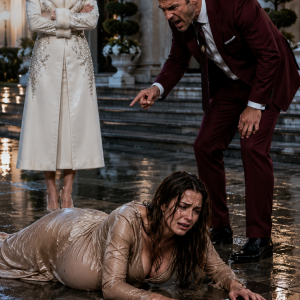
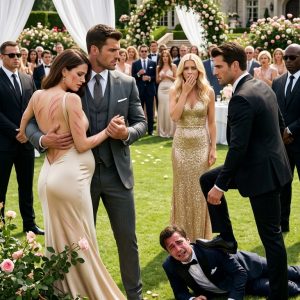
Chapter 1: The Architecture of a Cage
The rain in Seattle does not merely fall; it lingers, wrapping the harbor in a relentless, misty shroud that chills the bones. On a late summer afternoon, the coastal wind whistled through the towering timber pines of the cemetery, carrying the scent of salt and decayed leaves. There are certain types of cold that have nothing to do with the weather. They originate from the human soul, specifically when you are standing before a polished granite headstone where no body is actually buried beneath the earth.
My name is Sarah Miller, and I am thirty-five years old. Before the tragedy that cleaved my life in two, I was simply the wife of David Hayes, the visionary CEO of Northstar Shipping. To the outside world, David was the undisputed titan of the port, a man who commanded fleets with a flick of his wrist. To me, he was a husband who chronically suffered from stress-induced gastritis, a man who, after navigating a boardroom of sharks, wanted nothing more than a steaming bowl of homemade beef stew and a piece of crusty bread.
Everything shattered on the night of June 18, 2021.
David was attending a high-stakes networking gala aboard the luxury yacht, the Red Horizon, anchored off the Puget Sound. Sometime before midnight, the vessel was engulfed in an inferno. By the time I sprinted down the pier, tearing past the police barricades, the flames had already stained a massive corner of the dark water a terrifying, violent crimson. Emergency responders held me back as I screamed myself hoarse, demanding to know where my husband was. No one had an answer.
After three agonizing days of dredging the sound, the authorities handed me a sealed, sterile evidence bag. Inside lay a charred fragment of his tailored suit jacket, the shattered face of the watch I had gifted him for his birthday, and a piece of his wedding band, warped beyond recognition by the intense heat. There was no body. Not a single bone. No final goodbye.
Despite the lack of remains, my husband’s family rushed to erect a cenotaph—an empty tomb to honor his memory. At the unveiling, Eleanor, my husband’s stepmother, stood before the dark stone, weeping with such theatrical intensity she nearly collapsed. Clutching my hands with trembling fingers, her voice broke perfectly on cue. “Sarah, darling… the water is simply too deep, too cold. If the sea will not return him to us, David must at least have a place to come home to. Stop torturing yourself, you poor, sweet thing.”
I stared at the photograph of David encased in the stone. He was wearing his favorite navy-blue suit, his gaze profound yet sparkling with quiet intelligence. I heard Eleanor’s weeping. I registered the pitying sighs of the extended family. But deep in the marrow of my bones, a singular, unshakable mantra took root: Unless I see his body, I will never believe he is gone.
In the weeks following the memorial, the family’s estate lawyers besieged me. They presented stacks of thick, legally binding documents, insisting I sign David’s declaration of death to “facilitate the transition” of his shares, the estate, and the operational control of Northstar Shipping. I shoved the mahogany desk away and flatly refused to sign a single page.
Eleanor’s mask of grief slipped, revealing a flash of genuine outrage. “Are you planning to embrace a ghost for the rest of your natural life, Sarah?”
I met her furious gaze with icy calm. “If you choose to call David a ghost, that is your prerogative. To me, he is still my husband.”
From that moment, the Hayes family’s patronizing pity curdled into impatient hostility. Without David at the helm, Northstar Shipping began to list like a cargo freighter with a shattered rudder. I remembered David once standing by our bedroom window, looking out over the water. “Sarah, this company isn’t just a spreadsheet of profits,” he had whispered. “It is my father’s sweat. It is half my soul. It puts food on the tables of hundreds of families.”
Back then, I had simply nodded, never daring to imagine a future where I would be forced to occupy his imposing leather chair. Yet, I learned to be a CEO in boardrooms where the tension was strung as tight as piano wire. I endured the condescending glares of veteran shareholders and the sexist whispers echoing through the corporate hallways. What does a grieving widow know about global logistics and freight routes? It stung, naturally. But in this ruthless industry, people’s opinions are like the crashing waves of the open sea; you cannot demand they cease just because you are exhausted.
For three years, I navigated the storms. Eleanor maintained her facade of the doting, concerned mother-in-law. She would frequently send her staff to deliver organic chicken soup to my office, placing a manicured hand on my shoulder. “Seeing you shoulder this massive empire breaks my heart, Sarah. Why won’t you let Ryan carry some of the weight? After all, he is David’s own flesh and blood.”
Ryan Hayes was David’s younger half-brother, four years his junior. He possessed a honeyed voice, an immaculate wardrobe, and a smile he deployed like a weapon. “Sister-in-law,” he would say, his tone dripping with practiced humility. “Please, consider me your safety net. I don’t want to usurp anything. I merely wish to preserve Northstar for my brother’s legacy.”
It sounded flawlessly supportive. But I remembered a warning David had given me long ago: “Ryan’s mouth smiles constantly, Sarah, but his eyes remain completely dead. Don’t hate him, but never trust him unless there are ironclad signatures on paper.”
The true siege began during the memorial dinner for my late father-in-law, Thomas Hayes. The sprawling Hayes estate was illuminated against the torrential evening rain. The dining room table groaned under the weight of smoked brisket, roasted root vegetables, and rich macaroni and cheese—Thomas’s favorite comfort foods.
Ryan arrived late, shaking a wet umbrella and presenting an obscenely expensive bottle of bourbon. He made a grand show of bowing before his father’s portrait. “Forgive my tardiness, Dad. The workload at the company is practically suffocating lately.” He pitched his voice to ensure the entire room heard him.
Yes, the work had multiplied, primarily because Ryan’s loyalists had been quietly infiltrating various departments, stalling operations.
Eleanor dabbed her dry eyes with a lace handkerchief. “Seeing you two collaborate to save Northstar brings me such peace.”
Ryan turned his predatory gaze toward me. “Sarah, you look dreadfully thin. If David saw you crushing yourself beneath the weight of this corporation, he would be devastated. Let me temporarily take over the banking and vendor relationships. You remain the face of the company; I’ll just be the invisible engine in the back.”
“I can still manage,” I replied, my voice hard.
“A shipping empire cannot be sustained by a single, emotionally compromised woman,” an uncle chimed in from the end of the table, cutting into his brisket. “You need a man from the bloodline to anchor you.”
“Executive control and port data are governed by the board, not transferred over a plate of brisket,” I fired back, setting my silverware down with a sharp clatter.
The room plunged into a frigid silence. Eleanor sighed, a masterclass in weaponized victimhood. “Sarah, you must remember you aren’t the only one mourning. You lost a husband. I lost a son. My pain is magnified tenfold. Why must you be so stubborn?”
I did not apologize. I had learned that those who cry the loudest are rarely the ones suffering the most. That night, hiding in the kitchen hallway, I overheard Ryan on the porch, speaking into his cell phone.
“Yes, let the pressure build,” he murmured to an unknown caller. “The tighter she clings, the faster the shareholders will panic. Don’t squeeze the throat just yet. A few well-placed media leaks about her mental instability will be enough. She’s just a hysterical woman obsessed with an empty grave.”
I backed away into the shadows, the aroma of the brisket suddenly turning my stomach. They didn’t plan to fire me. They planned to slowly suffocate my credibility until I handed them the keys myself.
By Monday morning, the invisible hands tightening around Northstar Shipping made their final, brutal move. I stood in the 17th-floor boardroom, staring at a cascade of catastrophic reports. Continental Freight abruptly pulled an $8 million contract, citing “internal management instability.” Worse, Cascadia Bank froze our $40 million credit line.
Teresa, my pale-faced CFO, slid a printed email across the mahogany table. “Sarah… the bank received an anonymous dossier. It claims you spend hours talking to a gravestone, citing it as proof of severe psychiatric detachment. They won’t release funds to an ‘unstable’ CEO.”
Before the shock could fully register, the door swung open, and Ryan strolled in, looking appropriately somber. But he wasn’t alone. Behind him walked Michael Sterling, the slick, calculating CEO of Pacific Blue, our fiercest industry rival.
“Sarah,” Ryan said, his voice dripping with faux concern. “Michael has heard about our credit freeze. He’s here to offer a lifeline.”
Michael took a seat, steepling his manicured fingers. “I can guarantee thirty million upfront and access to our auxiliary docks. Your stranded ships can sail today.”
“And the price?” I asked, my voice dangerously level.
“A strategic alliance,” Michael replied smoothly.
That evening, the trap snapped shut. Eleanor summoned me to the estate. Michael Sterling was sitting in the parlor, sipping artisanal coffee. Over a tense dinner, the true nature of the “alliance” was laid bare.
“If you and Michael were to join our families in marriage,” Ryan suggested softly, swirling his wine, “the capital injection from Pacific Blue would be completely legitimate. The market would stabilize instantly. Northstar survives.”
Eleanor reached across the table, her eyes glittering. “No one is forcing you, darling. But are you truly going to let David’s legacy rot because you refuse to move on from a corpse? Marry Michael. Save the company.”
I looked at the three of them. The loving stepmother, the supportive brother, the generous savior. A trio of vultures politely asking me to season myself before they took a bite.
I knew if I refused outright, the board would vote me out by Friday. I needed time. I needed leverage. I took a slow, deep breath, burying my pride so deep it ached.
“Fine,” I whispered, my voice trembling perfectly. “I will agree to the engagement. But I need one week to get the affairs in order. One week to say goodbye to David.”
Ryan beamed, a terrifying, triumphant grin. “Of course, Sarah. Take your week.”
I drove away from the estate, the rain pounding against my windshield. They thought I was a broken bird submitting to the cage. They didn’t realize I had only agreed to buy myself seven days. Seven days to find a way to dismantle them all.
Chapter 2: The Boy at the Cenotaph
The following morning, I drove to the cemetery alone. The sky above Seattle was the color of bruised iron, weeping a fine, continuous mist. I didn’t tell my lawyer; I didn’t tell my driver. I needed to stand before David’s stone and beg his forgiveness for the absolute betrayal I was about to commit in the name of saving his life’s work.
I parked at the wrought-iron gates, pulling a bouquet of white lilies, a small box of local artisanal fudge, and a miniature bottle of Kentucky bourbon from the trunk. The fudge had been David’s secret vice. He used to complain it was too sweet, right before eating three pieces. “A man’s life needs a little sugar, Sarah, lest he dry up like salted cod,” he used to joke, his eyes crinkling at the corners.
The black granite of the cenotaph was slick with rain. David’s photograph, sealed beneath protective glass, looked serenely out toward the churning gray waters of the sound. I knelt on the sodden earth, ignoring the mud seeping into my dark wool trousers. I used a gray towel to meticulously wipe the raindrops from his face.
“I’m so sorry, David,” I whispered, the words tearing at my throat. “I promised I would hold the line. But they are suffocating your company. The ships are stranded. The banks have locked us out. They call me a lunatic because I still talk to you.”
I placed the flowers, the fudge, and the bourbon at the base of the stone. Tears, hot and bitter, finally spilled over my freezing cheeks. “They want me to marry Michael Sterling. It’s a hostile takeover disguised as a wedding. I had to say yes to buy time, but I feel like I’m trying to bail out a sinking ship using my own blood.”
I stayed there until my knees went completely numb. The wind howled through the pines. Suddenly, a tiny sound broke through the rustling branches—the distinct whispering of children.
I wiped my face and turned. Peeking from behind the massive trunk of a Douglas fir were three small children. They wore threadbare jackets, their sneakers caked in thick, yellow mud. They looked terrified, except for the oldest, a boy of about eleven with sun-darkened skin and unevenly chopped hair. He stepped forward, clutching a crumpled plastic bag, his eyes darting hungrily toward the box of fudge on the grave.
“What are you doing here?” I asked, my voice cracking.
The boy flinched, holding his hands up. “I wasn’t gonna steal it, ma’am! I swear! My grandma says if you take offering food without asking the family, the dead get furious. We were just waitin’ for you to leave so we could ask.”
My heart physically ached at his words. So impoverished they scavenged cemetery offerings, yet possessing more honor than the billionaires sitting in Northstar’s boardroom.
“What is your name?” I asked, reaching into my purse.
“Leo, ma’am. We live in the fishing village across the marshlands.”
I pulled out a handful of wrapped candies from my bag and extended them. “Here, Leo. Share these. And you are right; always ask.”
Leo bowed deeply, a gesture of profound respect, and took the candies with both hands. “Thank you, ma’am.” He turned to leave, but as he pivoted, his gaze snagged on the photograph of David on the headstone.
Leo froze. The wind whipped his messy hair across his forehead as he took a slow, deliberate step closer to the granite. He squinted, his childish features contorting into deep confusion.
“What is it?” I asked, a strange flutter of unease stirring in my stomach.
Leo pointed a dirty finger at the glass. “Ma’am… is that rich man in the picture your husband?”
“Yes,” I swallowed hard. “He was my husband.”
Leo scratched his neck, looking at me with wide, hesitant eyes. “Well… it’s just… that man looks exactly like Uncle Seven. The guy who lives at my grandma’s house.”
The coastal wind seemed to instantly stop. The world plunged into a vacuum of silence. A cold, electric shock violently traveled up my spine, freezing the blood in my veins. Kids say random things, my rational brain screamed. It’s just a coincidence. But the sheer sincerity in his eyes paralyzed me.
“Who is Uncle Seven?” I breathed, the words barely audible.
Leo clutched his plastic bag to his chest. “He lives with us. He ain’t from our town. My grandma fished him out of the marsh reeds a long time ago.”
“How long ago, Leo? Think carefully.”
He counted on his mud-stained fingers. “I was in third grade. Now I’m going into sixth… so, about three years.”
Three years. The words struck me with the force of a physical blow. Three years since the Red Horizon burned. Three years of standing before an empty box in the dirt.
“What is his real name? Where is he from?” I demanded, dropping to my knees to be at his eye level.
“Nobody knows,” Leo shrugged sadly. “When grandma found him, he was all messed up. Purple from the cold water. His head was bleeding real bad, and half his back was burned up. When you ask him his name, he just grabs his head and starts shaking.”
I gripped the lapels of my coat to stop my hands from violently trembling. “Why didn’t you take him to a hospital? Why didn’t he call his family?”
“Grandma took him to the clinic! But he didn’t have no ID. A few days later, two men in fancy suits came. They said they were from a charity and wanted to take him to a free hospital. But as soon as Uncle Seven heard one of their voices, he screamed and hid under the cot, shaking like a leaf. Grandma knew they were bad men, so she lied and told ’em he died.”
If this man was David, someone had actively hunted for him. Not to rescue him, but to finish the job.
“Leo,” I said, my voice vibrating with a desperate, terrifying hope. “Look at this picture again. Does he have any marks? A scar?”
“Yeah!” Leo nodded vigorously. “Behind his left shoulder, there’s a big, ugly scar. And he wears this weird, burnt-up watch tied to his wrist with a rag. If anyone tries to touch it, he cries. Grandma yelled at me once for hiding it as a joke. She said we shouldn’t play with a broken man’s memories.”
A roaring sound filled my ears. When David was thirty-two, he had saved a dockworker from a collapsing freezer unit, earning a wicked, jagged scar behind his left shoulder. And the burnt watch… the police had only returned the face of the watch to me, claiming the strap burned away.
“Does he say anything? Any names?” I sobbed, the tears flowing freely now, mixing with the rain.
“Sometimes, when he has nightmares, he yells… I think he yells the name Sarah.”
I collapsed against the wet grass, covering my mouth to stifle a guttural scream of pure, agonizing relief and horrific realization. The grave beside me was a monument to a lie. My husband had been living in absolute terror, stripped of his identity, hiding in the mud for over a thousand days.
I shoved a fifty-dollar bill into Leo’s hand. “Take me to him. Now. But you cannot tell a single soul who I am.”
We left the cemetery, navigating a treacherous, muddy path that skirted the desolate marshlands. The stench of rotting kelp and brine filled the air. After an hour of trekking through the sludge, losing a shoe in the muck and not caring, we arrived at a cluster of dilapidated, corrugated-metal shacks.
An elderly woman with a spine curved by a lifetime of labor sat on a porch, gutting fish. This was Granny Rose. Her eyes, milky with cataracts, were sharp as scalpels as she assessed my ruined designer clothes.
“I am Sarah Miller,” I said, bowing deeply to the matriarch. “I am looking for my husband.”
Granny Rose wiped her bloody hands on a rag, her expression unreadable. “Are you certain you wish to find him, child? Sometimes folks find what the sea took, and they realize they cannot bear what the sea gave back.”
“I will bear it,” I said, my jaw locked. “I don’t care what he has become. He is my husband.”
She sighed, a sound like dry leaves, and pointed toward the rear of the shack. “He is on the back porch, mending nets. Do not rush him. Do not scream. If you startle him, he will flee into the wetlands, and the darkness will swallow him for good.”
I nodded, my heart hammering violently against my ribs. I crept through the small, onion-scented kitchen and peered through the screen door.
A man sat on a wooden crate beneath the tin overhang. He was heartbreakingly gaunt, his skin baked to a dark leather by the sun. His hair was overgrown, grazing the nape of his neck. His hands, once manicured for boardrooms, were calloused and scarred as they rapidly wove a green fishing net. But as he shifted, the loose collar of his threadbare shirt slipped.
There it was. The jagged, silver scar behind his left shoulder. And strapped to his wrist with a filthy piece of canvas was the charred, blackened face of the watch I had bought him in Paris.
I clamped a hand over my mouth, a choked sob escaping my throat.
At the sound, the man’s head snapped up.
I looked into the eyes of David Hayes. But there was no recognition. There was no joy. There was only the feral, wide-eyed panic of a hunted animal. He dropped the netting needle, scrambling backward until his spine hit the wooden siding of the shack. He looked at me, a woman weeping uncontrollably, and shrank behind Granny Rose, who had stepped onto the porch.
“Who is this woman?” David rasped, his voice rough and unused. “Make her leave. I don’t know her.”
The words sliced through my chest like a rusty blade. I had finally found him, but my husband was utterly, completely gone.
Chapter 3: Ghosts of the Marshland
I stood frozen on the weathered floorboards of the back porch, my lungs burning as I forgot how to exhale. For three years, I had sustained myself on the fantasy of our reunion. I imagined running into his arms, the tears, the desperate kisses, the triumphant whisper of “I’m home.”
Reality offered no such cinematic grace. The man cowering before me was undeniably David—the slight crook of his ring finger, the line of his jaw beneath the scruff—but his soul was locked behind a fortress of amnesia and absolute terror.
“David…” I whispered, taking a fraction of a step forward.
Upon hearing the name, he violently clamped his calloused hands over his ears. His chest heaved in a panic attack, his eyes darting frantically. “Don’t call me that! Don’t say that name! I don’t know you!”
Granny Rose raised a stern, weathered hand, physically blocking my path. “Mrs. Sarah, stop. Names he doesn’t remember are a trigger. The last time I pressed him about his past, he collapsed on this very porch, screaming about the smell of fire. You are pushing him toward the edge.”
I dropped my arms, the bitter taste of helplessness flooding my mouth. Never in my thirty-five years had I felt so profoundly impotent. The physical distance between us was mere feet, but the psychological chasm was wider than the ocean.
“I’m sorry,” I stammered, stepping back, keeping my hands visible and open. “I won’t hurt you. I won’t come closer.”
David eyed my dark wool coat and my leather purse with deep suspicion, pressing himself tighter into the corner. He clutched his burnt watch as if it were a talisman keeping him tethered to the earth.
Granny Rose guided me gently back into the kitchen, pouring a mug of bitter herbal tea and pressing it into my trembling hands. “Don’t take his fear as a rejection, child. Since the sea spat him out, he fears everything. Open flames. The smell of diesel fuel. The sound of metal doors slamming shut. He is a man whose roots were ripped out by a hurricane. If you pull too hard, he will simply snap.”
Before I could process her wisdom, the aggressive, guttural roar of a motorcycle engine shattered the quiet of the fishing village. A chorus of stray dogs began barking furiously.
Leo darted to the front window, peering through the grimy glass. When he turned back, his face was drained of color. “Grandma. It’s a stranger. A man in a black jacket is out front, asking the fishmonger questions and pointing at our house.”
David heard the engine. A low, animalistic whimper escaped his throat. He scrambled beneath the wooden table on the porch, pulling his knees to his chest, hyperventilating. “They found me. They came back.”
“Who came back, Seven?” Granny Rose demanded softly, trying to soothe him, but his eyes were rolled back in sheer panic.
I didn’t hesitate. I pulled out my cell phone and dialed Gabriel Mitchell, my corporate lawyer and David’s oldest college friend. He picked up on the second ring.
“Gabriel,” I hissed, keeping my voice dead level. “I found him. David is alive.”
The silence on the other end was absolute.
“He has severe dissociative amnesia,” I continued rapidly. “We are in the coastal marsh village. A scout is outside right now. I need an unmarked, secure vehicle immediately. Tell no one. Especially not Ryan.”
“Frank is on his way. Keep him hidden,” Gabriel ordered, his professional facade snapping instantly into place.
While we waited in suffocating tension, the stranger outside lingered, snooping around the perimeter of the property before the villagers’ hostile glares finally forced him to retreat. When Leo went out to check the dirt path, he found a piece of cracked plastic the man had dropped near the fence.
He handed it to me. It was a broken parking validation token. Emblazoned on the plastic was a faded, unmistakable logo: Pacific Blueport.
Michael Sterling’s domain.
I squeezed the token so hard it bit into my palm. My husband’s survival wasn’t a secret just to me; his attempted murderers had known he was missing, not dead, and they had been hunting him in the shadows for three years to finish the job.
Hours later, under the cover of utter darkness, Frank—Thomas Hayes’s most fiercely loyal driver—pulled a nondescript SUV into the alley behind the shack. Coaxing David into the vehicle was a nightmare. He stared at the dark car as if it were a hearse.
“I’m not going,” David stammered, backing away. “They throw you in the dark. They lock the doors.”
I stood ten feet away, my heart breaking anew. “You don’t have to trust me, Seven. But the men in black are coming back. Granny Rose and Leo are going with you. I will sit in the front. I swear on my life, no one will lock you in.”
With Leo clutching his left hand and Granny Rose his right, David finally folded his gaunt frame into the backseat.
As we navigated the treacherous, winding marsh roads, Frank glanced at the rearview mirror, his jaw tight. “Sarah. We have a tail. A single headlight, keeping pace.”
I twisted in my seat. The motorcycle was back. I pulled the Pacific Blue token from my pocket, the plastic feeling heavy with malice.
Frank killed the headlights and executed a brutal, sudden swerve onto an overgrown, hidden logging road known only to the locals. The tires chewed through gravel and tall grass. We drove blindly in the dark for twenty terrifying minutes until the motorcycle’s headlight finally vanished in the distance.
Our destination was a secluded, moss-covered cabin on a remote lake—a forgotten weekend retreat belonging to the late Thomas Hayes. It wasn’t on any recent corporate ledger. It was a ghost house for a ghost.
Upon arrival, Gabriel Mitchell was already pacing the porch. When he saw David step out of the car, looking like a shattered husk of the powerhouse CEO he once was, Gabriel froze. Tears instantly spilled down the lawyer’s face.
“David…” Gabriel choked out.
David flinched violently, grabbing his head. I yanked Gabriel by the lapels of his coat, dragging him inside. “Do not say his name! Do not overwhelm him!” I hissed, though I was crying just as hard.
Gabriel wiped his face, nodding rapidly. “I’m sorry. I just… God, Sarah. If we announce this now, Ryan will destroy him. David has no ID, no memory, and he’s been living under an alias. Ryan’s lawyers will claim you hired an actor to maintain control of the board. They will have him locked in a psychiatric ward before the sun comes up.”
“Then we keep him hidden,” I declared, looking through the window at David, who was sitting by the fireplace, gratefully accepting a bowl of soup from Granny Rose. “We don’t just speak the truth, Gabriel. We build a trap so inescapable they hang themselves with it.”
Shortly after midnight, Dr. Clare Adams arrived. A discreet trauma psychologist, she wore a soft grey sweater and approached David without maintaining direct eye contact. She didn’t interrogate him. She simply sat on the floor near his chair.
“You don’t have to tell me who you are,” Dr. Clare murmured. “I just want to know what hurts.”
David looked at Granny Rose, who nodded encouragingly. He looked down at his scarred, trembling hands. “I am afraid of the fire,” he whispered.
“It is perfectly okay to be afraid,” the doctor replied softly. “We don’t have to fix the fear tonight.”
Hearing that simple validation, I leaned against the doorframe and pressed my face into my hands. I had spent three years wanting to bring the CEO of Northstar back. But standing here, I realized I had to let the CEO die to save the man I loved.
My phone buzzed in my pocket. A text message illuminated the dark screen. It was Ryan.
Sarah, Michael has booked the Grand Emerald Hotel for the engagement gala next Sunday. Remember, you have your dress fitting tomorrow. Everything must be perfect.
A second text arrived from Michael Sterling.
Soon, you won’t have to carry this burden alone, Sarah.
I stared at the glowing screen, the sheer audacity of their manipulation making my blood run hot. In the public eye, I was the defeated, hysterical widow surrendering her crown. But in this forgotten cabin, my husband was breathing.
I typed my reply to Ryan:
I will attend the fitting. But prior to the gala, I demand both Pacific Blue and Northstar open their historical archives for a full pre-merger audit. Complete transparency. No exceptions.
Ryan replied within seconds: How wonderfully cautious of you, sister-in-law. Agreed. I’ll authorize the archives.
I locked my phone and looked out at the black, placid waters of the lake. They thought they were chaining me to a trap. They didn’t realize they had just handed me the keys to the armory.
Chapter 4: Unearthing the Ashes
For the next four days, I lived a grotesque double life. By day, I walked the marbled halls of Northstar Shipping, wearing impeccable suits and a mask of serene submission. I allowed Michael Sterling’s assistants to deliver an outrageously expensive, ivory silk engagement dress to my office. I smiled tightly at the board members who patted my arm, congratulating me on “finally seeing reason.”
By night, I sat on the porch of the lake cabin, listening to the agonizing sounds of David thrashing in the grip of night terrors, unable to touch him, unable to comfort him without triggering a panic attack.
On Thursday evening, the trap I had laid for Ryan began to bear fruit. Armed with the signed audit authorization, I descended into the bowels of Pier 3. The Old Archive was a windowless concrete bunker located amidst a labyrinth of towering shipping containers. The air smelled of mildew and ozone.
Frank and Gabriel accompanied me. We met Paul, a veteran security guard who had served my father-in-law for decades. Paul’s face was grim as he unlocked the heavy steel door. “I can only give you two hours, Mrs. Miller. The maintenance crews log the electronic locks by dawn.”
“That’s all we need,” Gabriel said, producing a handheld digital camera and a stack of plastic evidence bags.
We tore through the filing cabinets. My heart hammered a frantic rhythm as Frank finally pulled a thick, dust-covered binder bearing the logo of the Red Horizon, 2021. Beside it was a box of VHS security backups that Ryan had arrogantly assumed no one would ever have the authorization to access.
Paul slid the primary deck tape into an old CRT monitor. The screen flickered to life, displaying a grainy, timestamped feed of the yacht’s lower corridor.
At 8:48 PM, the figure of my husband appeared. He was gripping the wall, stumbling heavily, his left hand pressed agonizingly to his stomach—a posture I recognized from his worst gastritis attacks. Behind him, head bowed, walked a man in a server’s uniform.
“Pause it,” Gabriel commanded, noting the timestamp in his ledger.
At 9:02 PM, the feed abruptly snapped to black static.
“Check the engine room cameras. The aft deck,” Frank ordered.
Paul typed furiously. “They’re all dead. At exactly 9:02 PM, every camera on the lower levels was manually severed. Mrs. Miller, this wasn’t fire damage. The blaze wasn’t reported until 9:49 PM. Someone cut the eyes of the ship on purpose.”
Gabriel flipped open the physical fire alarm maintenance log. He pointed a pen at a faded line of dot-matrix ink. “Look at this. The aft-zone thermal alarms were manually disabled at 8:59 PM. The access code used belongs to Ray Davis.”
“Ray Davis,” Frank growled, his fists clenching. “Ryan’s right-hand fixer. The rat quit and vanished down south a week after the funeral.”
My blood ran like ice water. Forty-seven missing minutes. In less than an hour, they had incapacitated my husband, killed the cameras, disabled the alarms, and dragged him off the ship before igniting the inferno to cover their tracks.
“Look at the port departure manifests,” I whispered, pointing to a secondary ledger.
Paul traced his finger down the page. “At 9:16 PM, an unregistered auxiliary skiff departed the Red Horizon’s anchor zone.” He pulled up a distant, wide-angle harbor camera feed.
The image was terrible, but it was enough. The skiff was speeding away from the yacht. In the center of the small boat lay a long, heavy shape completely concealed beneath a dark canvas tarp.
I stared at that tarp, bile rising in my throat. I was looking at my husband being carted away like a piece of refuse.
Gabriel meticulously photographed every document, sealing the originals in the evidence bags. “This is no longer a corporate dispute, Sarah. This is conspiracy to commit murder.”
The next morning, Gabriel and I hunted down the accomplices.
We found Pete, the former chief mechanic of the Red Horizon, hiding in a squalid apartment in Ballard. When I revealed my identity and showed him a current photograph of David’s scarred back, the old man collapsed into a chair, weeping into his grease-stained hands.
“I didn’t know they were gonna kill him!” Pete sobbed. “Ray Davis gave me twenty grand in a duffel bag. He just told me to tweak the camera angles and disable the alarms for an hour so they could move some ‘sensitive cargo’ off the books. When the ship burned the next morning, Ryan threatened to hurt my family if I didn’t blame it on a thermal malfunction.”
Pete dug under his floorboards and handed us a burner phone containing saved text messages from Ray Davis, explicitly detailing the payoff.
By afternoon, we cornered Laura, the VIP lounge waitress, in a diner in Tacoma. When I showed her David’s photo, she dropped a pot of boiling coffee, shattering the glass.
“I gave him the water,” she confessed, trembling uncontrollably in the diner’s back office. “A maintenance guy handed it to me. Said Mr. David needed his medication. After he drank it, he turned grey. He couldn’t even stand.”
“Who took him down the stairs?” Gabriel pressed, the recorder running.
Laura bit her lip hard enough to draw blood. “A waiter… and another man in black. I didn’t see the man’s face, but I heard his voice. It was Ryan Hayes. He told the waiter, ‘Get him below deck. Don’t let anyone see.’ Later, they gave me ten thousand dollars and told me to disappear.”
As we walked back to our car, the magnitude of the betrayal settled over me like a suffocating blanket. Half a million dollars in bribes, a few severed wires, and my husband’s life had been erased.
As I opened my car door, a sleek, black sedan idled across the street. The tinted window rolled down just an inch, lingering for a heavy, menacing moment before speeding off.
My phone vibrated in my pocket. A text from an unregistered number:
The dead should rest in peace. The living shouldn’t dig graves, lest they fall in.
I showed the screen to Gabriel. He adjusted his glasses, his expression turning lethal. “They know you’re digging, Sarah. They are panicking.”
I looked down the street where the black sedan had vanished. For three years, I had lived in terror of the shadows. But tomorrow was the engagement party. And tomorrow, I was going to drag them all into the blinding, unforgiving light.
Chapter 5: The Wedding March to Hell
The morning of the engagement gala, the lake cabin was cloaked in a thick, eerie fog. The silence was profound, broken only by the crackle of the woodstove.
Dr. Clare arrived early. She unpacked a small canvas bag containing a piece of coarse, brine-soaked rope, a square of dark canvas, a portable speaker, and David’s charred watch. Today was the crucial breakthrough session.
David sat in the armchair, his eyes locked nervously on the objects. Granny Rose knitted silently in the corner, while Leo sat on the floor, watching his uncle with wide, protective eyes. I stood by the door, forcing my breathing to remain shallow and quiet.
“We are just going to look and listen today,” Dr. Clare said softly. She pressed a button on the speaker. The rhythmic, ambient sound of ocean waves filled the room.
David flinched, gripping the armrests until his knuckles turned white.
“What do you smell?” Dr. Clare prompted gently.
“Diesel,” David gasped, his chest rising and falling rapidly. “Smoke. And… and a glass of water. It tasted like bitter metal.”
Dr. Clare pushed the square of dark canvas across the table.
As soon as David’s eyes registered the fabric, all the color drained from his face. His breathing devolved into hyperventilation. “They put a cloth over me,” he choked out, his eyes wide with recalled terror. “It was dark. I couldn’t move my legs. The floor was freezing. Someone was pulling me by my shoulders.”
I dug my fingernails into my palms so hard the skin broke.
“Did you hear any voices?” Dr. Clare asked.
David gritted his teeth, sweat beading on his forehead. Suddenly, a name ripped from his throat like a jagged stone. “Ryan.”
The room froze.
“What did Ryan say?”
David closed his eyes, tears squeezing past his lashes. “He said… ‘Don’t blame me, brother. If you want to blame someone, blame yourself for being in the wrong place.'”
I closed my eyes. The final, damning puzzle piece had clicked into place. My husband hadn’t just been in an accident; he had been executed by his own blood.
“There was another man,” David stammered, his voice dropping to an erratic whisper. “I didn’t see his face. But he said, ‘Let’s do this fast, before the wind changes direction.’“
A chill radiated through my entire body. Before the wind changes direction. It was a highly specific maritime idiom. I had heard Michael Sterling use that exact phrase during a contentious board meeting two years ago.
Dr. Clare immediately killed the wave sounds and swept the items back into her bag. “We stop here. You are safe. You are in the cabin. Breathe, David.”
As David slowly regained his bearings, he lifted his head. His gaze drifted across the room and finally landed on me. The feral panic was gone, replaced by a profound, agonizing clarity. The amnesia had cracked.
“Sarah…” he whispered, his voice shattering on the syllables.
My knees nearly gave out. After three years of corporate warfare, of Eleanor’s gaslighting, of Ryan’s manipulations… hearing my name in his voice felt like breathing oxygen after drowning.
“I’m here,” I choked, tears streaming down my face.
David stood up on shaky legs. He crossed the room, stopping inches from me, as if terrified I was a mirage. Slowly, trembling, he raised a calloused hand and cupped my cheek. His thumb brushed away my tears.
“Are you still going to stand next to that man tonight?” he asked, his eyes filled with a heartbreaking mixture of guilt and sorrow.
I leaned into his rough palm, looking into the eyes of the man I loved. “I am not going there to be his bride, David. I am going there to burn their empire to the ground.”
Sunday evening, the Grand Emerald Hotel was a monument to opulence and deceit. The grand ballroom was dripping with crystal chandeliers and suffocating arrangements of white orchids. A massive digital banner read: A Celebration of the Strategic Merger between Northstar Shipping and Pacific Blueport.
I did not wear the ivory silk dress Michael had bought me. I wore a tailored, midnight-blue gown, severe and armor-like.
As I waited in the VIP antechamber, Ryan approached, adjusting his silk tie. He frowned at my dress. “Sarah, what are you wearing? Michael went to great lengths for the bridal gown.”
“I am wearing what is appropriate for the occasion,” I said coldly.
Eleanor glided into the room, draped in amethyst velvet, flashing her predatory, maternal smile. “You look stunning, darling. Finally, you are securing the future.” She leaned in, her voice dropping to a hiss. “When you get on that stage, smile. Do not embarrass this family.”
I met her gaze, my eyes dead. “The Hayes family lost its honor the day it traded a son’s life for stock options, Eleanor.”
She blanched, stepping back. Before she could demand an explanation, the orchestral music swelled, and the master of ceremonies called us to the stage.
The ballroom was packed with Seattle’s elite. Shareholders, banking magnates, and a swarm of business journalists snapping photographs. Michael Sterling stood at the center podium, looking like a conquering king. He extended his hand to me. I ignored it, stepping past him to my own microphone.
Ryan took the main mic, beaming at the crowd. “Ladies and gentlemen! Tonight, my sister-in-law chooses the best path for Northstar. If my brother David were looking down on us from heaven, he would finally rest in peace.”
Polite applause rippled through the room. I felt physically ill at his words.
I adjusted my microphone. The feedback shrieked, silencing the room instantly.
“Thank you all for attending,” I began, my voice echoing off the vaulted ceilings. “However, I must clarify something immediately. There will be no engagement tonight. There will be no merger.”
A collective gasp sucked the air from the room.
Ryan lunged forward, his smile frantic. “Sarah, you’re overwhelmed. You misspoke—”
“I haven’t misspoken,” I cut him off, my voice turning to steel.
Michael Sterling stepped up, his charming facade fracturing. “Sarah. Let us discuss your nerves in private. Do not ruin this.”
I turned to face him, the cameras flashing like strobe lights. “Burying a man alive is not something that should be discussed in private, Michael.”
Total, paralyzed silence fell over the five hundred guests.
I pressed a remote hidden in my palm. The massive digital banner behind us vanished, replaced by the grainy, timestamped video from the Red Horizon. The crowd watched in stunned silence as David stumbled down the corridor. Then, the screen snapped to black, displaying the 9:02 PM timestamp.
“This is the backup security feed,” I announced. “An hour before the yacht burned, all cameras were severed. Not by fire, but by design.”
I clicked again. The fire alarm log appeared. “The alarms were deactivated at 8:59 PM by Ray Davis, Ryan Hayes’s personal fixer.”
I clicked again. The blurry image of the skiff speeding away, the tarp-covered body in the center. “This unregistered skiff departed with a body at 9:16 PM. And finally…” I brought up the financial ledgers. “…here are the bank transfers routing 2.8 million dollars from Pacific Blue’s shell companies to the mechanic and the waitress who drugged my husband.”
Eleanor collapsed into her chair, clutching her chest. “She’s insane! Someone turn off the screen! She’s lost her mind!”
Michael Sterling gestured wildly to the audio-visual team, but Gabriel Mitchell stepped out from behind the curtain, flanked by four off-duty police officers. “Do not touch that board,” Gabriel boomed into a secondary mic. “All evidence has already been authenticated and submitted to the District Attorney.”
Ryan was hyperventilating, his face a mask of primal panic. He pointed a trembling finger at me. “Lies! You forged this to destroy me! I am David’s brother! I am a Hayes!”
“If you are his brother,” I said, my voice echoing like a judge’s gavel, “then tell me why your name is the only thing that gives him night terrors?”
Ryan froze, his mouth opening and closing soundlessly.
At that exact moment, the heavy oak doors at the side of the ballroom opened.
David walked in.
He wore a simple, pressed white shirt and the faded, salt-stained jacket he had worn in the fishing village. He was gaunt, his hair longer, his face etched with unimaginable trauma. But the piercing intelligence in his eyes was unmistakable.
A wine glass slipped from a shareholder’s hand and shattered against the marble floor. The sound was like a gunshot.
“My God… it’s David,” someone whispered in the front row.
Chaos erupted. Journalists surged forward. Eleanor let out a blood-curdling shriek of pure horror. Michael Sterling physically recoiled, knocking over the podium holding the engagement rings.
David walked slowly, deliberately up the steps of the stage. He did not look at the crowd. He walked directly to Ryan.
Ryan was trembling so violently he looked as though his bones were vibrating. “No… no, it’s a trick. You’re… you’re dead.”
David stopped inches from his brother. The silence in the room was so absolute you could hear the hum of the chandeliers.
“You didn’t want to save Northstar, Ryan,” David spoke. His voice was raspy, but it carried the undeniable authority of a CEO. “You wanted to bury me for the second time.”
Chapter 6: Resurrection and Retribution
David held his brother’s terrified gaze, refusing to let him look away.
“I remember the water they gave me,” David continued, his words falling like hammer blows in the silent room. “I remember the dark tarp. I remember the freezing floor. And I remember what you whispered in my ear as you dragged me away. ‘Don’t blame me, brother. Blame yourself for being in the wrong place.’“
Ryan broke. He fell to his knees, sobbing hysterically. “They brainwashed you! Sarah fed you these lies! She wants to steal the company!”
I stepped forward, pulling a yellowed, wax-sealed envelope from my portfolio. “This is a letter Thomas Hayes left with his estate lawyer before he died. He knew you were selling Northstar’s shipping routes to Pacific Blue. That is why your father stripped you of your voting rights. You tried to murder your brother because you felt marginalized.”
Ryan let out an unhinged, feral laugh, spitting at my feet. “And what are you?! A daughter-in-law! A charity case who gets to sit in the throne while I, the blood son, had to bow to you?!”
“Shut up, Ryan!” Eleanor screamed from the floor, her makeup running in dark streaks down her face.
I looked down at the stepmother who had tortured me for three years. “You knew, Eleanor. You knew why Thomas sidelined him. But you used the word ‘family’ to gaslight me into surrendering the company to a murderer, just to protect your biological son.”
Eleanor wept, reaching a hand out toward the stage. “David… son…”
David looked down at her, his expression utterly devoid of emotion. “You ceased to be my mother the day you chose to cover my grave in ashes.”
Detectives flooded the stage. Michael Sterling, maintaining a rigid, pale silence, was handcuffed and read his rights regarding corporate espionage, bribery, and conspiracy. Ryan was dragged away, kicking and screaming obscenities until the elevator doors swallowed him. Eleanor was escorted out by paramedics, utterly broken, ignored by the very high-society peers she had sought to impress.
The next morning, the financial world exploded. The “Miracle of the Red Horizon” dominated every global headline.
In the weeks that followed, Northstar Shipping experienced a massive resurgence. The banks immediately unspooled our credit lines, apologizing profusely. Clients who had fled to Pacific Blue—which was now undergoing a massive federal raid—begged to return to our fleet.
I remained the active CEO while David focused on his healing. Some days were brilliant and lucid; other days, he would sit by the window, staring out at the rain, quietly piecing his fragmented soul back together. But every morning, he would look at me and say my name. Sarah. And every time he did, a piece of the ice in my chest melted away.
We brought Granny Rose and Leo to the corporate headquarters. In front of the entire board of directors, I presented them not as charity cases, but as the true saviors of the Hayes legacy. We established a massive trust for the fishing village, ensuring Leo would have a full ride to any university he chose.
A month later, David and I returned to the cemetery.
The weather had broken. The sun shone brilliantly through the pines, casting warm, golden light over the granite headstones. I didn’t bring my cleaning towel this time.
David stood before the cenotaph, staring at his own name etched in the stone. He reached out, his calloused fingers tracing the letters.
“You came here alone for three years,” he murmured, his voice thick with emotion.
“I came here to tell you about the boardroom fights,” I said, a small smile touching my lips. “I told you when I was too tired to stand. I told you I would never let your ship sink.”
David turned to me, his eyes shining with unshed tears. With a sudden, decisive movement, he pulled a small pry bar from his pocket. He wedged it beneath the glass portrait on the headstone and applied pressure. With a sharp crack, the glass popped off. He handed the photograph to me.
“I’m sorry I made you carry the weight of the world, Sarah,” he whispered, pulling me into a fierce, desperate embrace. His arms were strong, the scent of the sea and the pine trees surrounding us.
“You’re here,” I sobbed into his shoulder. “That is the only thing that matters.”
The empty grave remained in the cemetery, but it was no longer a monument to grief and lies. It was a testament to the fact that even when buried beneath the deepest, darkest waters of betrayal, if there is one person left on the shore who refuses to let go, the truth will always find its way back to the surface.
In a world driven by greed and power, love and unbreakable loyalty are the only true anchors in the storm.
Like and share this post if you find it interesting.