There is a distinct, sterile scent to an intensive care unit that burrows into the fabric of your clothes and the lining of your lungs. It smells of bleached linens, fading hope, and the quiet, metallic hum of machinery keeping death at bay. For seven months, that scent had been my entire world. I had traded my drafting tables and blueprints for medical charts and medication schedules. My career as an architectural designer had been paused, folded away like a delicate tracing paper, so I could manage the failing health of Silas Bennett, the self-made titan who founded Bennett Global Logistics.
Silas was my father-in-law, but in the structural blueprint of my life, he was the foundation. He was a man of gruff warmth and unshakable integrity, qualities that his son—my husband of seven years, Harrison Bennett—had somehow managed to entirely bypass in the genetic lottery.
I sat in the dim light of Room 412 in a private ICU wing in Seattle, Washington, a warm washcloth in my hand. I gently pressed it against Silas’s forehead. His skin was paper-thin, translucent, mapping a geography of pale blue veins. The rhythmic beep of the cardiac monitor provided a bleak, unrelenting soundtrack to the midnight hour.
Silas’s eyelids fluttered, heavy with exhaustion. He looked at me, his gaze cutting through the haze of morphine with startling clarity. “Harrison isn’t coming, is he, my dear?” he whispered, his voice a dry rasp against the silence. “He always runs away when life demands actual courage.”
My throat tightened. A familiar, sickening wave of second-hand embarrassment washed over me. “He’s in meetings, Silas,” I lied, forcing a warm, reassuring smile as I tucked the edges of the cellular blanket around his frail shoulders. “He’ll be here soon.”
I didn’t know I was lying at that exact second, but a quiet vibration against my thigh betrayed the truth. I pulled my phone from my pocket. A notification illuminated the screen. It was an Instagram story update from Desiree Miller, a glamorous social media influencer whose official title at my husband’s company was “Luxury Lifestyle Consultant,” though everyone in our circles knew her real role involved far fewer spreadsheets and far more hotel keys.
I tapped the notification. The screen filled with the ethereal, glowing green ribbons of the aurora borealis dancing over a snowy landscape. The location was tagged: a luxury arctic resort in Fairbanks, Alaska.
The caption read: “Chasing auroras with my favorite executive. Some nights are too magic to spend at work. 🌌✨”
But it wasn’t the caption that made the air evaporate from my lungs. It was the reflection in the glass of the snow cabin window. There, unmistakable in the foreground, was Harrison’s silhouette. I could perfectly make out the outline of his custom-tailored winter coat and the glint of the limited-edition platinum chronograph watch I had bought him for our fifth anniversary.
A cold, hollow ache settled into the cavity of my chest. It wasn’t just infidelity; it was a profound, narcissistic abandonment. While his father’s heart was struggling to beat, Harrison was chasing elusive lights across a frozen sky, fleeing the inconvenient reality of grief for the cheap warmth of a mistress.
I closed my eyes, letting the phone screen fade to black. I felt Silas’s weak fingers brush against my wrist. He didn’t need to see the screen. The patriarch of the Bennett family had always possessed an uncanny ability to read the unspoken architecture of a room. He knew.
I stood up, desperate to clear the sudden constriction in my throat. “I’m going to get you some fresh water, Silas. I’ll be right back.”
I walked over to the small sink in the corner of the room, my hands shaking as I filled a plastic cup. Just as I turned back, placing the cup onto the bedside table, the steady rhythm of the cardiac monitor shattered. The rhythmic beep exploded into a frantic, continuous, shrill tone. A flatline.
Instantly, the heavy wooden doors of the ICU burst open. A crash cart team flooded the room, a blur of blue scrubs and urgent shouts.
“Code Blue, Room 412! We need to push one of epi, now!”
A nurse grabbed my shoulders, her grip firm and urgent, pulling me away from the bed. “Ma’am, you need to step outside. Now. Please!”
I was shoved into the blindingly bright hallway, the heavy doors swinging shut behind me, cutting off my view of Silas. My back hit the cold plaster of the wall, and I slid down until I hit the linoleum floor. My fingers fumbled with my phone. The screen was still warm. I opened my contacts, found Harrison’s name, and pressed dial for the very first time that night.
The hospital hallway was a purgatory of fluorescent light and absolute isolation. I sat with my knees pulled to my chest, the phone pressed so hard against my ear it ached.
Ring… ring… ring…
“Hey, it’s Harrison. I’m currently off the grid pursuing key corporate ventures. Leave a message.”
I hung up. I dialed again.
Call 4. Voicemail.
Call 12. Voicemail.
Call 19. Voicemail.
With every unanswered call, the remaining threads of my marriage snapped one by one. I was calling my husband to tell him his father was dying, to beg him to pick up the phone, to ask him to be a son for just five minutes. But Harrison was purposefully ignoring my calls. I knew exactly what he was doing. He was silencing his phone, annoyed by the persistent buzzing, complaining to Desiree about how his ‘neurotic wife’ was trying to ruin their romantic getaway with a ‘buzzkill’ emergency.
On the 27th call, it went straight to voicemail without ringing. He had turned the phone off entirely.
The heavy doors to Room 412 slowly opened. The lead physician stepped out, his surgical cap pulled low. He didn’t say a word. He didn’t need to. He just bowed his head in solemn, heavy silence.
I didn’t cry. The 27 unanswered calls had burned the tears out of me, replacing my grief with something cold, sharp, and terribly lucid. I stood up, smoothing the wrinkles in my skirt, and walked past the doctor back into the room.
The machines were quiet now. The chaos had receded. Silas lay still, the agonizing struggle finally over. I walked to his side, the room thick with the sudden absence of a giant. I knelt beside the bed, picking up his calloused, lifeless hand. Before the doctors had rushed in, with his last faint breath amidst the chaos, I remembered him squeezing my fingers. The memory of his final, strained whisper echoed in my mind.
“Watch… lawyer… trust no one but yourself, Clara.”
Two days later, the sky over Boston, Massachusetts, broke open in a torrential, freezing downpour. Silas had requested to be buried in the ancestral family plot, a sprawling, moss-covered cemetery that felt centuries away from the sleek corporate towers of Seattle.
I stood completely alone under a black umbrella beside a polished mahogany casket. The rain lashed against the canvas, soaking through the hem of my black wool coat. The cemetery staff stood at a respectful distance, waiting. I was the only family member present. No board members, no distant cousins, and certainly no son. I carried the total weight of the Bennett family honor on my shoulders as the priest rushed through the final rites to escape the storm.
My phone buzzed in my coat pocket. I pulled it out with a numb, freezing hand. A text message from Harrison.
“Hey babe, snowstorm held us up in Fairbanks. Super bummed I missed the service. Handle the press releases, okay? Be home Tuesday.”
Super bummed.
He didn’t ask how I was. He didn’t ask about his father’s final moments. He demanded I handle the public relations while he waited out a fabricated snowstorm in a luxury suite. I stared at the text until the screen blurred from raindrops, then I slowly deleted it. I slipped the phone back into my pocket, watching the cemetery staff step forward to begin lowering the casket into the dark earth.
As the ropes creaked under the weight of the mahogany, a subtle movement caught my eye. From behind a large weeping willow, an elderly man in a sharp, charcoal wool overcoat stepped out from under a wide umbrella. It was Attorney Richard Holloway, Silas’s long-time personal legal counsel and the only man Silas trusted outside of our home.
Holloway’s face was a mask of professional stoicism, but his eyes were heavy with a shared mourning. He walked up to me, standing just at the edge of my umbrella’s shelter. He didn’t offer empty condolences. Instead, he reached into the deep pocket of his overcoat and pulled out a small, faded velvet pouch.
He pressed it into my damp palm, his fingers lingering for a brief second to ensure I had a firm grip. He leaned in, his voice barely a murmur over the sound of the rain hitting the mud.
“Silas gave me strict instructions a month ago,” Holloway whispered. “Before the official estate reading on Tuesday, you must open this pocket watch… alone.”
The flight back to Seattle was a blur of turbulence and exhaustion, but my mind was operating with terrifying clarity. By midnight, I was locked inside the quiet darkness of my private study in our sprawling lakeside home. The rain was beating against the glass panes, a rhythmic drumming that mirrored the thudding in my own chest.
Only a single brass desk lamp illuminated the room. I sat at my drafting table, the velvet pouch resting in the center of the wooden surface. I untied the drawstrings and let the heavy object slide into my palm.
It was an antique brass pocket watch, heavy and ornate, etched with intricate celestial patterns. It hadn’t ticked in decades. It was Silas’s grandfather’s watch, a piece of family history I knew he cherished above all his corporate awards. I turned it over in my hands, tracing the engravings. Why had he insisted I open it alone?
I retrieved a precision jeweler’s screwdriver from my drafting kit. Carefully, slotting the tiny metal edge into the imperceptible seam on the back of the watch, I applied a gentle pressure. With a soft, metallic click, the brass back cover popped free.
I lifted it away. Beneath the intricate, frozen mechanical gears of the timepiece, a false bottom had been installed. Tucked neatly inside the microscopic chamber was a tiny, black micro-flash drive, and beneath that, a tightly folded square of thick parchment paper.
My breath caught in my throat. I unfolded the paper. It was covered in Silas’s bold, unmistakable cursive script, written with a fountain pen that must have bled slightly as his hand shook in his final weeks.
My dear Clara,
If you are reading this, my son chose his illusions over his duty when I passed. Harrison inherited my blood, but you inherited my spirit. I am not blind, Clara. I have watched him for years. He thinks Bennett Enterprise is his birthright, a golden trough to squander on fleeting vices, exotic trips, and foolish choices. He thinks he has hidden his transgressions. He has not.
I have made sure he receives exactly what he deserves: nothing.
The drive enclosed connects to the secure digital ledger compiling three years of his corporate fraud and embezzlement. But more importantly, it contains the legal restructuring of my empire. I have stripped him of his inheritance. The company, the estates, the trust—they are yours. You are the sole trustee. Drive this company with the honor he lacks. Build a foundation that will outlast his superficial vanity. Do not weep for him. Destroy his arrogance before it destroys my legacy.
With profound love, Silas.
I read the letter three times. The words burned themselves into my retinas. Silas knew. He knew about the money Harrison was bleeding from the accounts, he knew about Desiree, and he knew that Harrison would abandon him at the end.
I plugged the micro-flash drive into my laptop. It required a password. I typed in my birthday. Access Granted.
The screen bloomed with thousands of files. Bank statements, offshore transfers, shell company registrations, and at the very top, the finalized, irrevocable legal documents executed by Richard Holloway. Silas had secretly placed 85% of Bennett Global Logistics and the entire private family trust into an irrevocable master trust. He had appointed me as the sole trustee and Chairman of the Board. I had absolute power to liquidate, restructure, or fire anyone.
I wasn’t just a grieving widow. I was the owner of a multi-billion dollar international logistics empire.
The sound of the front door opening downstairs jolted me back to the present. Footsteps echoed in the marble foyer. Harrison was home.
I quickly ejected the drive, folded the note, and snapped the pocket watch back together, slipping it into my blazer pocket. I closed my laptop and walked out to the landing overlooking the foyer.
Harrison breezed in, shrugging off a snow-dampened cashmere coat. He was impossibly tanned from the Alaskan sun reflecting off the snow, wearing expensive sunglasses resting on his head, and carrying a leather duffel bag that undoubtedly smelled of Desiree’s nauseatingly sweet perfume.
He looked up and saw me on the stairs. He offered a practiced, theatrical sigh, attempting to pull his features into a mask of solemn grief. He walked up the stairs, casually kissing my cheek—a kiss that felt like a spider crawling across my skin.
“Rough week, Clara,” Harrison said, pouring himself a glass of scotch from the crystal decanter in the hallway. “Dad’s gone, but life moves on. I called Attorney Holloway on the ride from the airport. The estate reading is tomorrow at 10 AM.”
He took a sip of his scotch, a smug, avaricious gleam in his eye. “Once the transfer goes through, I’m taking over the executive suite. I’m restructuring the upper management. We’ll finally have the freedom we deserve, Clara. No more of the old man’s archaic rules holding the company back.”
I looked at him. Seven years of marriage. Seven years of supporting him, covering his mistakes, loving a phantom I thought was real. In that second, any lingering shred of attachment I had to him evaporated, leaving nothing but cold, architectural steel.
My voice was entirely devoid of anger. It was perfectly, terrifyingly composed. “Yes, Harrison. Tomorrow at 10 AM. Everything will finally be clear.”
“Good,” he smiled, patting my shoulder before walking toward the master bedroom. “Make sure you wear black. We need to look the part for the board members.”
I watched his retreating back. He had no idea. He was a man standing on a trapdoor, admiring the rope around his neck, utterly unaware that I was the one holding the lever.
The morning of the estate reading dawned grey and oppressive. The glass-walled executive boardroom on the fiftieth floor of the Bennett Global Logistics headquarters overlooked the Seattle skyline, a sprawling kingdom of commerce.
When I arrived, the room was already filled with the senior board members, legal counsel, and key corporate executives. The air was thick with the scent of expensive cologne and unspoken anxiety. At the head of the massive mahogany table sat Harrison, wearing a custom-tailored mourning suit.
And right beside him, completely inappropriately, sat Desiree Miller.
She wore a sleek, black designer dress that was entirely too tight for a legal proceeding, her manicured nails tapping impatiently on the wood. Harrison had his arm draped casually over the back of her chair.
As I walked in, silence fell over the room. I took a seat near the middle of the table, placing my leather portfolio neatly in front of me. Harrison smirked, leaning forward.
“Let’s make this quick, Holloway,” Harrison commanded, his voice dripping with unearned authority. He gestured toward Desiree. “I’d like to formally introduce Desiree Miller to the board. Pending the finalization of my father’s estate today, I am appointing her as the new Senior Vice President of Global Branding. Now, read the trust distribution so I can sign the authority documents and get back to business.”
A few board members shifted uncomfortably. I didn’t blink. I simply looked across the table at Attorney Holloway.
Holloway cleared his throat, adjusting his reading glasses. He didn’t look at a stack of papers. Instead, he tapped a button on his laptop. The heavy automated blinds on the floor-to-ceiling windows whirred shut, plunging the room into shadow. The massive 4K wall screen at the end of the table illuminated.
“Silas Bennett left specific instructions that his final testament be delivered personally,” Holloway stated, his voice echoing in the quiet room.
The screen flickered, displaying a crisp video recording of Silas Bennett. He was sitting in the hospital study I knew so well, an oxygen tube discreetly taped beneath his nose. The video had been filmed a mere four days before his death.
Harrison sat up straight, his smug smile faltering slightly. “What is this?”
Silas’s voice, amplified through the boardroom speakers, was a thunderclap of quiet, devastating authority.
“If this recording is playing in the boardroom, it means I am dead. It also means my son, Harrison, is sitting at my table, waiting to steal my throne.”
Harrison’s face drained of color.
“To my son,” Silas’s digital ghost continued, staring directly into the camera lens with piercing judgment. “You were absent when your father drew his last breath, off squandering family resources on vanity and deceit in Alaska. You thought you were clever, Harrison. You thought you could systematically embezzle over three million dollars from corporate funds to finance personal extravagances and illicit affairs without the old man noticing.”
Harrison leapt to his feet, his chair crashing to the floor behind him. “Shut that off!” he screamed, his voice cracking with sheer panic. “That’s a forgery! It’s a deepfake! Holloway, stop this immediately, I am the CEO!”
Holloway didn’t touch the keyboard. He looked at Harrison with absolute disgust.
Silas’s video continued, unbothered by the screaming man in the room. “I have documented every stolen cent. Therefore, I exercise my legal right under Clause 9 of the master founding charter to strip Harrison Bennett of all executive power, all corporate shares, and all private trust funds. I disinherit you entirely.”
The room went dead silent. You could hear a pin drop. Desiree slowly pulled her hand away from Harrison’s arm. Her eyes darted around the room, performing a rapid, mercenary calculation.
“I bequeath one hundred percent of my voting shares, personal real estate, and controlling assets to the only person who possesses the integrity to lead,” Silas proclaimed. “My daughter-in-law, Clara Bennett. She is the sole Chief Executive Officer and Chairman of the Board. Goodbye, Harrison.”
The screen went black. The lights in the boardroom flickered back on.
Harrison stood frozen, his chest heaving, his eyes wild with the terror of a man who has just watched his universe implode. He looked at Desiree, reaching for her hand. “Desiree, wait, we can fight this—”
Desiree stood up, grabbing her designer purse. She looked at Harrison not with love, but with the cold, calculating disdain of a parasite realizing its host is dead. “Don’t call me, Harrison,” she muttered, stepping back toward the exit doors and slipping out of the room without looking back.
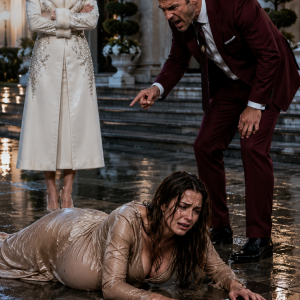
Harrison whipped his head toward me. His face contorted into a mask of pure, unadulterated rage. He pointed a trembling finger at my face.
“You did this!” he spat, his voice echoing off the glass walls. “You tricked him! You manipulated an old, sick man! You’re nothing without my family name! I’ll tie you up in litigation for decades!”
I stood up slowly from my leather seat. I didn’t raise my voice. I didn’t need to. I possessed the serene, untouchable dignity of absolute power.
“I didn’t trick anyone, Harrison,” I said softly, my voice slicing through his hysteria like a scalpel. “You chose to ignore twenty-seven phone calls. You made twenty-seven choices to abandon your father. Now you get to live with them.”
“You bitch!” Harrison roared, lunging across the mahogany table toward me in a blind, animalistic fury.
He didn’t make it halfway. Two massive building security guards, whom I had instructed Holloway to position just outside the door, burst in and tackled Harrison to the floor. The sound of his expensive suit tearing and the dull thud of his body hitting the carpet echoed loudly.
As Harrison was restrained, his cheek pressed humiliatingly into the floor, Attorney Holloway walked around the table. He leaned down and placed a freshly printed document directly in front of Harrison’s face.
“Mr. Bennett,” Holloway said dryly. “This is a federal audit notice. As of ten seconds ago, Clara has initiated an immediate freeze on all your personal credit lines and company cards. Please vacate the premises. You are trespassing.”
The collapse of Harrison Bennett was as spectacular as it was rapid.
Within three months, the glamorous façade of his life had been entirely dismantled. Cut off from the Bennett fortune, he was instantly evicted from his company-owned luxury penthouse. His high-society friends, recognizing that his power had vanished, stopped returning his calls. Desiree Miller blocked his number on every platform and was rumored to be dating a tech billionaire in Silicon Valley. He was alone, drowning in debt, and facing severe civil litigation for the three million dollars he had embezzled.
While Harrison spiraled into obscurity, I ascended.
Stepping into the role of CEO wasn’t easy, but my background in architectural design served me well. I understood how to analyze a structure, find the rot in the foundation, and rebuild it stronger. I systematically cleansed the company of the corrupt, sycophantic middle-management Harrison had installed. I redirected corporate profits toward legitimate community initiatives and sustainable logistics practices. The board, initially skeptical of a former designer taking the helm, quickly rallied behind me as profit margins soared alongside our ethical ratings. I was restoring Silas’s original vision.
Three months after the disastrous boardroom meeting, I sat across from Harrison in a neutral, sterile legal office downtown to finalize the divorce.
The visual contrast between us was staggering. I wore a tailored navy power suit, my posture perfect, radiating the quiet, unshakeable authority I had earned. Harrison looked utterly hollowed out. He was disheveled, sporting a patchy beard, deep, bruised bags under his eyes, and wearing an off-the-rack jacket that was slightly too large. The arrogant fire in his eyes had been extinguished, replaced by the desperate pleading of a beaten man.
Harrison stared at the mahogany table, nervously rubbing his hands together. His voice cracked when he spoke.
“Clara… please,” he begged, not meeting my eyes. “Just give me five percent of the trust. Two percent. Anything. I have nowhere to live. My car was repossessed. The bank froze everything. I’m facing criminal charges, Clara. I’m going to jail.”
I looked at him. I felt no triumph. I felt no joy in his suffering. I simply felt the absolute finality of a closed door. I unlatched my leather briefcase and pushed a crisp stack of divorce papers across the table. Alongside them, I placed a single, legally binding document.
“This is a non-prosecution agreement, Harrison,” I said softly, my voice steady, betraying zero emotion. “Sign the divorce papers, surrender all claims to the Bennett estate forever, and Bennett Global Logistics will not file criminal embezzlement charges against you.”
Harrison stared at the papers as if they were venomous snakes.
“You walk away free,” I continued. “But you walk away with absolutely nothing. You will have to build your own life from scratch, stone by stone, just like your father did.”
His hands shook as he picked up the heavy gold pen. He hesitated, the reality of his complete defeat washing over him. Slowly, agonizingly, he signed his name on the dotted line, severing his ties to his family, his wealth, and his wife forever.
He dropped the pen. He looked up at me, a pathetic, broken vulnerability finally breaking through his shattered ego.
“Did you ever love me?” he whispered.
I took the signed documents, checked the signatures, and placed them neatly back into my briefcase. I snapped the golden latches shut with a resounding click and stood up.
“I loved who I thought you were, Harrison,” I said, looking down at him one last time. “But you showed me who you truly are. And I am finally paying attention.”
I turned and walked out of the office, leaving him alone with the silence he had earned.
Six months after the ink dried on the divorce papers, my life had settled into a beautiful, productive rhythm. I was standing on the expansive deck of my newly purchased oceanfront house on the rugged coast of Oregon, breathing in the sharp, salt-heavy air. The Pacific Ocean was a churning, majestic expanse of deep blues and greys.
My phone chimed in my pocket. I pulled it out. It was a text from Richard Holloway.
“Clara. The final audit of Silas’s private off-shore accounts is finally complete. The IRS has cleared everything. However, there is one last physical asset left in your name that Silas never listed on official corporate papers. Check your secure email.”
I walked inside to the kitchen island, opening my laptop. The email from Holloway contained a deed of ownership and a set of coordinates. It wasn’t a bank account or a shell company. It was a plot of land located less than thirty miles from where I currently stood on the Oregon coast.
One year later.
The air on the Oregon coast is crisp and impossibly clean. I stood on the circular observation deck of the restored stone observatory that Silas Bennett had secretly purchased decades ago.
It turned out that whenever Silas needed to escape the relentless pressure of his empire, he didn’t fly to luxury resorts or chase artificial highs. He came here, to a solitary stone tower perched on a cliffside, to look at the night sky, far away from the noise and deceit of the world below.
Under my leadership, Bennett Global had achieved record growth, recognized nationally not just for profits, but for our ethical supply-chain practices. But my greatest joy wasn’t the profit margins. I had returned to my true passion—architectural design. I had personally drafted the blueprints to renovate Silas’s hidden observatory, transforming the surrounding acreage into a state-of-the-art community star-gazing center for underprivileged youth in the Pacific Northwest.
I leaned against the stone parapet, watching the ocean crash against the dark, jagged rocks below in majestic, violent rhythms.
Earlier that week, I had received a rare update from a mutual acquaintance regarding my ex-husband. Harrison was currently living in a small, cramped studio apartment in Phoenix, Arizona. He was working fifty hours a week at an entry-level call center for a minor insurance firm. He was entirely stripped of his high-society social circle, forced to confront the harsh, unyielding reality of earning his own keep without a safety net, a famous name, or a trusting wife to catch him. He spent his nights alone, far removed from the glittering parties he once prioritized over human decency.
I felt a profound, settling peace. The universe, in its own slow, methodical way, had balanced the scales.
I walked inside the dome, looking up through the massive, brass telescope tube toward the vast, glittering expanse of the cosmos. The dome was open to the heavens. The night sky sparkled with millions of distant stars—pure, constant, and completely unbothered by the darkness that surrounded them. They didn’t need to dance or put on a show. They simply burned.
I smiled softly to myself, my hand coming up to rest on my chest. Resting against my collarbone was the antique brass pocket watch, which I had taken to a master jeweler to be fashioned into a heavy pendant.
I clicked the tiny latch, opening the watch face one last time. Beneath the glass, right below Silas’s folded note which I kept permanently encased there, I read the small inscription I had commissioned the jeweler to engrave into the brass backing.
“The strongest lights are never chased in distant skies; they are lit from within.”
I snapped the watch shut, the metallic click echoing satisfyingly in the quiet observatory. I turned my back to the telescope, walking toward the warm, inviting glow of the staircase that led back down to my life, stepping forward into a future that was, finally and completely, my own.
If you want more stories like this, or if you’d like to share your thoughts about what you would have done in my situation, I’d love to hear from you. Your perspective helps these stories reach more people, so don’t be shy about commenting or sharing.