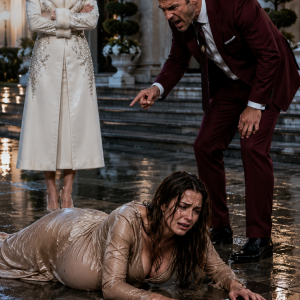
I thought the day my wife vanished five years ago was the end of my life… until a seven-year-old girl selling wilted flowers in the pouring rain held out her wrist, wearing the exact silver bracelet I had buried with her memory.
This is the chronicle of my descent into a five-year nightmare, and the silent, ruthless war I fought to pull my family out of the dark. It is a narrative of unyielding maternal sacrifice, corporate conspiracy, psychological resilience, and the reclamation of a stolen life. Set against the bleak, rain-soaked streets of Seattle and the deceptive halls of high-society power, this was my battle to shatter a dark syndicate and drag my wife and daughter into the light.
Chapter 1: The Silver Bracelet in the Rain
The November rain in Seattle didn’t just fall; it saturated everything, turning the city into a cold, monochromatic watercolor of wet asphalt and gray slate. It rattled against the glass towers of downtown, carrying the sharp, metallic tang of diesel exhaust and salt water off Puget Sound. I pulled the collar of my worn trench coat tighter against the biting wind, stepping out of the office building on 4th Avenue where I had spent the afternoon reviewing dry corporate insurance fraud files.
To the rest of the world, I was David Mercer, a thirty-six-year-old former investigative journalist who had resigned from the Seattle Times to run a quiet, uninspired private investigation firm. But in reality, I was a ghost. I had died five years ago, on a freezing Tuesday night when my pregnant wife, Clara, failed to come home from her laboratory at Sterling Pharmaceuticals.
Her sedan had been found abandoned beside a muddy embankment near the Snoqualmie River. No blood, no struggle, no ransom demands. Just an empty vehicle with its hazard lights blinking into the dark. Five years of police dead-ends, private search teams, and sleepless nights had eroded my soul down to a hard, bitter husk. I lived in perpetual mourning, trapped in an apartment that still smelled faintly of her lavender perfume.
I walked toward the subway entrance, my head down, eager to escape the freezing drizzle.
“Please, sir… buy these flowers.”
The voice was tiny, shivering, almost swallowed by the roaring hum of gridlock traffic.
I almost brushed past her. In a city like Seattle, you learned to tune out the background noise of urban misery. But something about the tremor in her voice made me hesitate. I stopped beside the tiled subway stairs and looked down.
Standing on the wet concrete was a little girl, no older than seven. She wore an oversized, faded yellow slicker that hung past her knees, drenched at the hem. Her dark hair was plastered to her forehead, framing a pale, delicate face with striking brown eyes. In her gloved hands, she held a bundle of wilted red carnations wrapped in damp brown paper.
“Please, mister,” she whispered, her teeth chattering beneath pale lips. “Just two dollars. I need to sell them all.”
My heart twinged with a familiar, dull ache. Clara and I had dreamed of having a daughter. I reached into my coat pocket to pull out a five-dollar bill, wanting to give it to her and tell her to go inside where it was warm.
“Here, sweetheart,” I said, leaning down. “Keep the flowers.”
As I extended the money, the little girl reached out with both hands to accept it. In the movement, the oversized sleeve of her yellow raincoat slipped back past her forearm.
The breath tore from my lungs. The gridlock traffic, the rain, the entire city of Seattle seemed to vanish into a suffocating, dead silence.
Resting on her thin, pale wrist was an antique filigree silver bracelet with a clover-shaped jade inlay.
My hands began to shake violently. The five-dollar bill fluttered out of my fingers into the freezing slush at my feet. It was unmistakable. The silver was tarnished, the jade worn at the edges, but I knew every microscopic curve of that metal. I had spent six months working alongside a master jeweler in Pioneer Square to design that exact piece for Clara’s twenty-fifth birthday. On the inside of the clasp, invisible to the world, were the hand-engraved initials: D & C.
I dropped to my knees in the wet slush, ignoring the cold soaking through my trousers, and gently wrapped my fingers around her tiny wrists.
“This…” My voice cracked, raw and barely audible. “This bracelet… where did you get this?”
The girl flinched, pulling back slightly, her brown eyes widening with caution as she clutched her carnations to her chest. “It’s mine. My mom gave it to me.”
“Your mom?” Tears burned behind my eyes, blurring my vision as I gently turned the clasp over. There, scratched into the silver, were those three sacred letters: D & C.
“What is your mom’s name, sweetie?” I begged, my hands trembling against her arms. “Where is she?”
The girl pointed her small, gloved finger down a narrow, misty alleyway between two dilapidated brick warehouses across the street.
“She’s waiting by the back door of the old diner,” the girl whispered. “She told me to stay on this corner until I sold all the flowers. She said… she said if I wore the bracelet, someone kind would stop.”
A surge of adrenaline hit my bloodstream like an electric shock. I stood up, grabbing the little girl’s hand. “Show me. Take me to her.”
We hurried across the rain-soaked street, slipping into the shadows of the narrow alleyway. Steam rose from the sewer grates, smelling of damp brick and grease. The diner at the end of the alley had been boarded up for years, its neon sign rusted dark.
“Mommy!” the little girl called out, her voice echoing off the brick walls. “Mommy, a man bought the flowers!”
No answer came from the shadows.
We reached the rusted back door of the diner. The alley was empty. But as I stepped closer to the doorway, my eyes fell upon the wet pavement.
Fresh, slick crimson blood was pooling in the cracks of the concrete, washing away in the rain. And resting right beside the pool of blood was a wet, monogrammed silk scarf—the blue silk scarf I had bought Clara on our first anniversary in Paris.
Chapter 2: Shadows of the Past
The sight of that blood sent a wave of icy terror straight to my core. The journalist, the detective, the husband—every instinct I possessed screamed that we were standing in the middle of an active kill zone.
“Mommy?” the little girl whimpered, looking at the scarf on the ground.
“Don’t look, baby,” I said instantly, scooping her up into my arms and tucking her face into my neck. I didn’t care about protocol or evidence. I grabbed her, turned on my heel, and sprinted back out of the alley toward 4th Avenue.
If whoever had ambushed Clara near that diner realized I had the girl, they would be coming for us next.
I hailed a yellow cab on the fly, sliding into the back seat with the shivering child wrapped beneath my coat. Instead of heading to my public apartment—which felt entirely compromised—I gave the driver the address of a discreet, industrial loft I maintained under a false name in the River District.
Twenty minutes later, I slammed the deadbolts shut behind us in the loft. I turned on the space heaters, retrieved a bundle of dry towels, and set the little girl down on the leather sofa. She looked so tiny sitting there, her hair damp, her hands clutching a hot mug of cocoa I had hastily poured for her.
I sat on the coffee table directly across from her, my heart hammering against my ribs.
“What is your name, sweetie?” I asked softly, keeping my voice as gentle as I could manage.
“Lily,” she murmured, taking a slow sip of the cocoa.
“Lily,” I repeated, the name tasting like sweet rain on my tongue. “Lily… how old are you?”
“I’m seven.”
Seven. Clara had been two months pregnant when she vanished five years ago. My hands began to shake again.
“Lily… your mom. Does she have a picture of you two? Anything she told you to keep safe?”
Lily hesitated, looking at me with those deep, intelligent brown eyes—the exact shape and color of Clara’s. Slowly, she reached down inside her yellow raincoat, unzipping a small inner pocket. She pulled out a tiny, cloth pouch, reaching inside to retrieve a worn, laminated photograph that had been cut into a circle to fit inside a shoe lining.
She held it out to me with a small, cautious smile. “Mommy told me to keep this hidden inside my boot. She said if I ever got lost, I should show it to the man who recognized the bracelet.”
I took the photograph. My fingers brushed the laminated plastic, and my breath caught in my throat.
The picture showed Clara. She was thinner, her cheekbones sharp, her complexion pale beneath harsh fluorescent lights, but she was smiling. She was sitting in a windowless concrete room, holding a newborn baby wrapped in a hospital blanket. On the back of the photo, written in Clara’s unmistakable, delicate handwriting, were words that shattered my heart into a thousand pieces:
To my husband David—keep searching. She has your eyes. Don’t let him win.
Tears overflowed my eyes, dripping onto the photograph. “She’s alive…” I sobbed, pressing the picture to my forehead. “Oh God, Clara… you’re alive.”
Lily looked at me, her small mouth opening in surprise. “Are you… are you the man in Mommy’s stories? Are you David?”
“I’m your daddy, Lily,” I whispered, reaching out to wrap my arms around her frail frame, pulling her tight against my chest as a sob tore through me. “I’m your daddy.”
She didn’t pull away. She buried her small face into my neck, her tiny arms wrapping around my shoulders, weeping softly into my coat.
Before I could say another word, my private, unlisted satellite phone on the desk began to ring.
The screen illuminated with an encrypted, caller-ID-blocked number. My intelligence instincts flared. I set Lily down gently on the sofa, walked over to the desk, and swiped the screen, putting the call on speaker.
“Hello, David,” a smooth, cultured, baritone voice echoed through the speaker.
It was a voice I hadn’t heard in five years, but one I would recognize if I were deaf and blind. It belonged to Julian Sterling—the sixty-year-old billionaire founder of Sterling Pharmaceuticals, a philanthropist lauded by the city, and the man I had been investigating for illegal offshore clinical trials right before Clara disappeared.
“Sterling,” I hissed, my voice dropping an octave into pure, lethal rage. “Where is my wife?”
“You were always such an insufferable, tenacious reporter, Mercer,” Sterling chuckled softly over the line, the sound devoid of any human warmth. “I must admit, allowing Clara to send her little street peddler out today was a calculated risk. I needed to see if you were still monitoring the city… or if five years of grief had finally broken your spirit.”
“If you touch her, Sterling—”
“You have five minutes to bring the girl back to the corner of 4th Avenue,” Sterling interrupted smoothly, his tone as cold as surgical steel. “Return her to my men, and perhaps I will let Clara live another week. Keep her… and your wife won’t survive until midnight.”
“You’re a dead man, Sterling,” I spat.
“No, David,” Sterling replied calmly. “I am a billionaire. And you are a man sitting in the dark with a target on his back.”
The line went dead.
A split second later, the overhead lights in the loft flickered and completely died, plunging the room into pitch blackness.
Through the large floor-to-ceiling window overlooking the alley, a tiny, bright red laser dot cut through the dark, sweeping across the floorboards until it painted a bright crimson target directly over Lily’s chest.
Chapter 3: The Bainbridge Heist
“Down!” I screamed.
I dove across the coffee table like a madman, tackling Lily off the sofa and slamming our bodies onto the hardwood floor just as a suppressed rifle round shattered the double-pane glass above us—THWIP-CLACK!
Glass rained down around us in a sharp, glittering shower. I rolled over, shielding Lily with my body as two more high-velocity rounds tore through the leather couch cushions where she had been sitting a second prior.
“Stay flat, baby! Don’t move!” I yelled over the sound of shattering glass.
I dragged Lily beneath the heavy mahogany desk, pulling my concealed Glock 19 from my shoulder holster. I didn’t waste time returning fire against a sniper three hundred yards away on a rooftop across the street. I reached beneath the desk, pulled a hidden release lever, and swung open a concealed wall panel that revealed a service ladder leading into the building’s old coal chute.
I scooped Lily into my arms, dropped into the dark chute, and slid two floors down into the subterranean alley network beneath the River District.
Ten minutes later, we were speeding through the rainy streets in a non-descript gray van I kept parked in a rental garage three blocks away. My hands were gripped tightly around the steering wheel, my mind working at a fever pitch.
I couldn’t go to the Seattle Police Department. Sterling had police chiefs, judges, and city council members on his payroll. If I handed Lily to the authorities, she would vanish into a state facility controlled by Sterling’s operatives within an hour.
I needed the one man in this city who owed me his life.
I drove down into Pioneer Square, pulling into the alley behind a dusty shop marked Vance Radio Repair. I knocked four times on the heavy iron basement door.
The door unlocked with a heavy pneumatic click. Standing in the doorway was Marcus Vance—a massive, fifty-year-old former military intelligence analyst whose career I had saved six years ago when he was framed for a data breach.
Marcus looked at me, then looked down at Lily tucked under my arm, his eyes widening. “David? What the hell happened to you? Your face is bleeding.”
“I found her, Marcus,” I said, stepping inside and locking the iron door behind us. “I found Clara’s daughter.”
For the next two hours, inside Marcus’s subterranean surveillance workshop surrounded by bank after bank of glowing monitors, we worked with feverish intensity. While Marcus prepared warm soup for Lily and set her up with a sketchbook in his private office, he ran Sterling Pharmaceuticals’ encrypted server files through his decryption algorithms.
“Here it is, David,” Marcus said, pointing a thick finger at a glowing blue floor plan on his main monitor. “This is why Sterling kidnapped Clara five years ago.”
I leaned over his shoulder, scanning the documents.
Five years ago, Clara had been the lead biochemist on Sterling’s top-secret project, Phobos-9—a synthetic, highly addictive neurological agent designed to alter human compliance and memory. When Clara discovered Sterling was illegally testing the compound on homeless individuals in undocumented facilities, she attempted to download the research files to bring to me at the newspaper.
Sterling abducted her before she could leak the data. But Clara had locked the primary encryption key inside a biometrically sealed drive that required her unique DNA sequence to operate. Sterling had kept her alive in a subterranean medical facility for five years, trying to force her to complete the weaponized formula—using her newborn daughter as leverage.
“Where is she, Marcus?” I demanded, my voice dropping into a lethal whisper.
Marcus tapped a blinking red thermal signature on the map. “Sterling’s private estate on Bainbridge Island. It’s a ten-acre compound surrounded by ten-foot security walls, infrared sensors, and twenty private armed guards. He’s holding her in the subterranean medical sub-basement beneath the guest house.”
“How do we get in?”
“Normally? You don’t,” Marcus replied grimly. “It’s a fortress. But tonight… tonight is Sterling’s annual Black-Tie Charity Gala at the main mansion. Three hundred wealthy socialites, politicians, and media executives will be on the grounds. At precisely nine o’clock, they are firing off a ten-minute fireworks display over the bay. During the display, the perimeter infrared grid automatically steps down to prevent the pyrotechnics from setting off false alarms.”
A cold, lethal smile touched my lips. “A ten-minute window.”
“It’s suicide, David,” Marcus warned, laying his heavy hand on my shoulder. “If you get caught inside that perimeter, his security team will put a bullet in your head and bury you in the Sound.”
“He stole five years of my life, Marcus,” I replied, pulling my tactical vest tight around my ribs and checking the magazine on my sidearm. “He put my daughter on a street corner in the rain. I’m going in.”
I walked into the small side office where Lily was sitting on a cot, coloring a picture of a sunlit garden with blue crayons. I dropped to one knee beside her, stroking her hair.
“Lily, sweetie,” I said softly. “I have to go get Mommy now. You’re going to stay here with Uncle Marcus. He’s going to protect you.”
Lily looked up at me, her brown eyes filled with an intelligence far beyond her seven years. She reached into her yellow raincoat pocket, pulled out the antique silver-and-jade bracelet, and placed it gently in my palm.
“Give this back to Mommy,” Lily whispered. “Tell her I kept it safe.”
I squeezed the silver bracelet in my fist, kissing her forehead. “I’ll bring her home, baby. I promise.”
An hour later, Bainbridge Island was engulfed in darkness and heavy rain.
I crouched in the thick fern underbrush fifty yards from the perimeter wall of the Sterling Estate, wearing black tactical clothing, a night-vision monocular strapped over my eye. Through the dense trees, I could hear the muffled sound of classical orchestra music and the clinking of champagne glasses coming from the illuminated glass pavilion of the main mansion.
BOOM!
A massive shell detonated high in the night sky above the bay, exploding into a brilliant cascade of gold and green light.
“Perimeter infrared grid is down, David,” Marcus’s voice crackled through my earpiece from three miles away. “You have nine minutes and forty seconds. Go!”
I cleared the ten-foot wall in three seconds using a grappling hook, dropping silently into the wet grass on the other side. Moving like a shadow, I sprinted across the landscaped gardens, bypassing two oblivious security guards who were watching the fireworks display over the water.
I reached the guest house, used a bypass decoder to pick the electronic lock on the basement door, and slipped inside.
The air inside the subterranean hallway smelled of bleach, rubbing alcohol, and damp concrete. I drew my suppressed Glock, moving down the sterile white corridor past rows of locked storage rooms.
At the end of the hall stood a heavy, reinforced steel security door with a digital keypad. I attached Marcus’s hacking device to the junction box. The screen flashed through thousands of code combinations before clicking green.
The heavy steel door swung open with a pneumatic hiss.
“Clara!” I whispered, bursting into the room.
My heart shattered into a thousand pieces.
The room was completely empty.
The cot was unmade, a medical IV stand knocked over on the floor. But standing in the center of the empty room was a single metal pedestal holding a high-definition monitor.
As I stepped inside, the screen flickered to life, illuminating the dark cell in bright white light.
On the screen was a live video feed from the grand ballroom upstairs. Julian Sterling was standing on the main stage behind a wooden podium, holding a microphone in one hand. And standing right beside him, bound at the wrists in heavy steel handcuffs, her face bruised but her chin held high, was Clara.
Sterling looked directly into his stage camera, smiling a sickening, arrogant smile, and spoke into the microphone:
“And now, my distinguished guests… allow me to introduce the woman who tried to destroy my company five years ago.”
Chapter 4: The Unmasking at the Gala
“David, get out of there! It’s a trap!” Marcus’s panicked voice screamed through my earpiece. “Security team delta is moving down the service stairs right now!”
“Override the ballroom AV feed, Marcus!” I barked into my comms, sprinting back out of the cell into the hallway. “Do it now!”
“I need thirty seconds to hack their media server!”
I didn’t wait. I drew my weapon, rounded the corner of the subterranean hallway, and came face-to-face with two armed security guards charging down the stairs. I didn’t hesitate—I fired two non-lethal rubber rounds into their tactical vests, knocking them flat onto the concrete, vaulted over their bodies, and charged up the grand marble staircase leading directly into the main mansion.
I slammed through the double mahogany service doors, stepping straight into the grand ballroom of the Sterling Estate.
The ballroom was a dazzling display of high-society decadence. Three hundred guests in black-tie tuxedos and evening gowns stood beneath crystal chandeliers, holding glasses of vintage champagne. On the elevated main stage at the front of the room stood Julian Sterling, wearing a flawless tuxedo, holding a small silver remote control in his hand. Beside him, pinned between two burly guards, stood Clara.
When Clara’s eyes swept the room and landed on me standing at the back of the hall in black tactical gear, her breath caught. Tears erupted from her eyes.
“David!” she screamed, her voice cutting through the soft orchestral music.
“Silence!” Sterling hissed, grabbing Clara by her arm and pulling her close, pressing a small, concealed snub-nosed revolver into her ribs beneath her silk gown where the audience couldn’t see it.
Sterling looked out at the crowd, smiling brilliantly for the news cameras stationed along the perimeter. “My friends,” Sterling announced over the house speakers, “tonight we celebrate progress. This woman, Clara Mercer, was a former employee who suffered a tragic mental break five years ago. She has been receiving private, specialized care at my facility—”
SCREECH!
A deafening audio feedback loop blasted through the ballroom speakers, making high-society guests cover their ears in pain.
The massive, thirty-foot 4K display screens behind the stage glitched, turning from Sterling’s corporate charity logo into a bright, blood-red screen.
“I’m in, David!” Marcus’s voice boomed in my ear. “Broadcasting live to the house feed… and every local news station in Washington State!”
The display screens suddenly flickered to life, playing high-definition security footage from the subterranean medical lab. The crowd gasped in collective horror as video played showing emaciated test subjects bound to medical chairs, followed by clear, unedited audio files of Julian Sterling’s voice discussing human experimentation and ordering Clara’s abduction five years prior.
“Keep her alive,” Sterling’s recorded voice boomed through the ballroom speakers. “If she doesn’t finish the Phobos-9 key, use the baby. Put the child on the streets if you have to. Break her spirit.”
Pandemonium erupted across the ballroom. Women screamed, champagne glasses shattered on the floor, and wealthy donors scrambled toward the exits in utter terror. News camera operators frantically pointed their lenses at the giant screens, broadcasting Sterling’s monstrous confession to over two million viewers live across the Pacific Northwest.
“Shut it off! Turn off the power!” Sterling screamed, his cultured, aristocratic facade crumbling into ugly, manic rage.
“Your empire is over, Sterling!” I roared, striding down the center aisle of the ballroom, my eyes locked onto the man who had stolen my life.
Sterling snapped. Seeing his multi-billion-dollar reputation disintegrate in seconds, he raised his snub-nosed revolver, aiming it directly at Clara’s chest. “If I go down, Mercer, she dies with me!”
“No!” I screamed.
I didn’t think. I didn’t draw my gun. I sprinted forward, launching my body across the stage just as Sterling pulled the trigger.
BANG!
The shot cracked through the ballroom, shattering a crystal chandelier above. I tackled Sterling mid-air, slamming his body into the podium, crashing both of us through the velvet curtains onto the hardwood stage floor in a violent tangle of limbs.
I smashed my fist into Sterling’s jaw, knocking the revolver from his hand. I grabbed him by his silk lapels, hauling his bloodied face up to mine.
“That was for my daughter,” I spat, smashing his head back into the stage floor, knocking him cold.
The heavy oak doors at the back of the hall slammed open. A dozen FBI tactical agents in full combat gear stormed into the ballroom, weapons raised. “FBI! Nobody move!”
Marcus stepped onto the stage behind them, leading two federal paramedics.
I ignored the chaos, ignoring the FBI agents pinning Sterling’s limp body to the floor. I scrambled across the stage on my knees, reaching Clara.
She collapsed into my arms, sobbing hysterically as I pulled her tight against my chest. Her hands, rough and calloused from five years of confinement, clutched at my back as if she believed I was a ghost.
“David… oh God, David…” she sobbed into my shoulder. “Lily… is she… did you find her?”
“She’s safe, Clara,” I cried, burying my face in her hair, smelling the faint, sweet scent of lavender beneath the hospital chemical smell. “She’s safe. She’s waiting for us.”
I reached into my tactical vest pocket, pulled out the antique filigree silver-and-jade bracelet, and gently slipped it back onto her wrist, fastening the clasp.
Clara looked at the jade inlay, tears pouring down her face, and kissed my lips with a fierce, desperate love that five years of darkness had failed to extinguish.
Behind us, as FBI agents hauled Julian Sterling up from the floor and snapped heavy steel handcuffs onto his wrists, Sterling opened his eyes. He spat blood onto the stage floor, looked at me with a sickening, defeated smirk, and leaned toward my ear as he was dragged past:
“You think you won, Mercer?” Sterling whispered, his voice dripping with venom. “Check Clara’s medical records… she wasn’t just my scientist. She was my successful prototype.”
Chapter 5: The Road to Healing
Sterling’s parting whisper sat like a drops of acid in my mind, but I refused to let his poison steal our victory.
The hours that followed were a blur of federal affidavits, medical evaluations, and media storms. I immediately took Clara to Swedish Medical Center in downtown Seattle, securing a private wing under armed FBI protection to investigate Sterling’s final claim.
For twelve agonizing hours, I sat beside Clara’s hospital bed while top toxicologists and neurologists ran comprehensive blood panels and brain scans.
At seven o’clock the following morning, the chief of toxicology walked into the private room holding a manila folder. He looked at Clara, then looked at me, a warm, reassuring smile breaking across his tired face.
“Mr. Mercer,” the doctor declared softly. “I don’t know what mind games Julian Sterling was playing with you, but I can give you absolute assurance. Your wife’s bloodwork is completely clean. There are no synthetic compounds, no nerve agents, and no neurological damage in her system.”
Clara looked up from her bed, tears shining in her eyes as she held my hand tightly.
“I tricked them, David,” Clara whispered, her voice trembling with emotional release. “Every morning when they brought those experimental doses to my cell, I pretended to swallow them. I hid them under my tongue and flushed them down the drain when the guards weren’t looking. Every single day for five years… because I knew I had to keep my mind clear for Lily.”
The last lingering shadow of Sterling’s lie shattered into dust.
In the months that followed, the legal hammer of the United States Justice Department crushed Sterling Pharmaceuticals. Julian Sterling was convicted of human trafficking, illegal medical experimentation, kidnapping, and treason, sentenced to three consecutive life terms without the possibility of parole at a supermax facility in Colorado. His assets were liquidated by court order, with hundreds of millions allocated to his victims and their families.
We didn’t stay in the city.
I sold my private investigation firm, closed my office on 4th Avenue, and bought a beautiful, two-story wooden home on the sunlit coast of Puget Sound, near Sequim. The house sat on a bluff overlooking the deep blue waters of the bay, surrounded by pine trees, wildflowers, and fresh sea air.
The healing process was slow, quiet, and deeply human.
For the first three months, Clara struggled with severe agoraphobia and night terrors. She couldn’t sleep in total darkness, terrified that she would wake up back in that windowless concrete cell. Lily, too, had to learn what normal childhood was—relearning how to play without watching the door, how to sleep in a real bed, and how to smile without fear.
I became their anchor. I built a wooden porch overlooking the water, brewed tea for Clara every morning, and taught Lily how to ride a bicycle along the quiet coastal trails.
Six months after the trial, warm spring sunshine flooded the wooden porch.
Clara sat on the porch swing, wrapped in a soft cardigan, watching eight-year-old Lily run across the green lawn, laughing hysterically as she chased a golden retriever puppy through a bed of blooming wild roses.
I stepped out onto the porch, carrying two mugs of chamomile tea. I sat beside Clara, wrapping my arm around her waist, pulling her close.
Clara rested her head against my chest, watching our daughter’s bright yellow dress catch the golden sunlight.
“I used to count the seconds in that dark room, David,” Clara murmured softly, her fingers tracing the filigree silver bracelet on her wrist. “Every single night, I told myself that if I could just keep Lily safe until you found that bracelet, everything would be okay.”
“You saved us all, Clara,” I whispered, kissing her temple. “You brought our daughter home.”
Just then, a black courier van pulled up to our front gate. The driver stepped out, left a small, unmarked wooden box on our porch steps, nodded respectfully toward us, and drove away.
I walked down the steps, picked up the wooden box, and opened the lid.
Inside was an official FBI intelligence file confirming that Sterling’s secondary offshore assets had been completely seized. But resting atop the file was a smaller, black wax-sealed envelope stamped with my family’s heirloom crest.
Chapter 6: A Seed That Blooms in the Dark
I broke the wax seal on the envelope, standing on the sunlit porch beside Clara.
Inside was a personal letter written in the hand of the United States Attorney General, thanking our family for our courage, confirming that every last member of Sterling’s global human trafficking network had been arrested across Europe and North America. The past was officially, permanently dead. The door was closed forever.
We didn’t let our survival remain a private blessing.
One year later, I published my investigative memoir, Unbroken Silence, documenting Clara’s extraordinary survival and the collapse of Sterling Pharmaceuticals. The book became an international bestseller, and together, Clara and I donated every single dollar of royalties—over four million dollars—to establish a national foundation that rescues and rehabilitates victims of human trafficking.
The summer sun shone brightly down on a crisp June morning in downtown Seattle.
Hundreds of people gathered at the corner of 4th Avenue—the exact subway corner where I had found Lily selling wilted carnations in the rain nineteen months ago.
The cold, concrete stairs and rusted alley had been completely demolished and transformed. In its place stood Clara’s Garden—a magnificent, half-acre public park filled with blooming red roses, lavender beds, marble benches, and a sparkling stone fountain. It was a sanctuary of light and color built right in the heart of the city’s dark concrete.
Eight-year-old Lily ran through the rose bushes wearing a bright yellow sundress, her dark hair flying in the breeze, handing fresh, vibrant red roses to smiling visitors for free.
I stood near the stone fountain at the park’s center, holding Clara tightly around the waist.
The rain had stopped. The sky above Seattle was a brilliant, endless blue. On Clara’s wrist, the antique silver-and-jade bracelet caught the brilliant golden sunlight, gleaming like an unbreakable shield of honor.
Clara looked up at me, her brown eyes filled with profound peace, love, and light.
“What are you thinking about, reporter?” she asked softly, leaning her head against my shoulder.
I wrapped my arms around her, watching our daughter run toward us across the grass, her arms filled with flowers, laughing with pure, unadulterated joy.
“I was just thinking,” I said, my voice rich with emotion, “that rain might wash away footprints… but it can never wash away love.”
Lily reached us, throwing her tiny arms around both of our waists, burying her face into our embrace. As she pulled back, she reached into her small sundress pocket and pulled out a polished silver seed charm left on the fountain by an anonymous visitor.
She held it up into the sunlight, smiling with that bright, beautiful smile that had rescued my soul.
“Mommy, look…” Lily whispered softly, her eyes sparkling with hope. “…someone left us a seed that blooms in the dark.”
If you want more stories like this, or if you’d like to share your thoughts about what you would have done in my situation, I’d love to hear from you. Your perspective helps these stories reach more people, so don’t be shy about commenting or sharing.