Chapter 1: The Intrusion
The morning light in my Buckhead, Atlanta condominium had always been a sanctuary. It filtered through the floor-to-ceiling windows, casting long, golden shadows across the wide-plank oak floors and illuminating the purple canopy of the jacaranda trees outside. This space, a modern, light-filled two-bedroom haven, was entirely mine. My name alone sat on the deed, a point of quiet pride and a testament to the foresight of my parents.
I was twenty-one when my father installed the high-definition, 1080p security system after a string of local break-ins. He spent a sweltering July weekend running the wiring himself, pausing only to wipe the sweat from his brow and deliver a lesson that would eventually save my life. A woman without legal control over her own home eventually becomes a guest inside somebody else’s life, he had told me, his voice rough but uncompromising. I didn’t fully grasp the weight of those words then. I certainly didn’t understand them three days ago, when I stood at an altar and said “I do” to Gabriel Thornton.
It was day three of our marriage. A Tuesday. I was standing beside my custom walnut kitchen island, carefully plating freshly made chilaquiles, the scent of toasted jalapeños and warm corn tortillas filling the air. Gabriel was still asleep. Then, the sharp, electronic chirp of the front door keypad echoed through the hall.
I froze. I hadn’t given out the code.
The heavy door swung open, and in walked Patricia Thornton, my new mother-in-law, dragging three oversized grocery bags. She didn’t knock. She didn’t announce herself. She simply breached the perimeter, her heels clicking against the hardwood with the rhythmic precision of an invading general.
“Patricia?” I asked, setting down my spatula. “What are you doing here?”
She ignored my question, marching straight into the kitchen and dropping the bags onto the pristine marble counter. She surveyed my breakfast with a look of theatrical disgust. Without a word, she picked up the plate of chilaquiles I had just finished arranging and scraped the entire meal into the stainless steel trash can.
“No son of mine is eating this,” Patricia sneered, the skin around her eyes tightening.
A cold shock radiated through my chest. “Excuse me?”
She didn’t look at me. She was already opening drawers—drawers she had no right to touch—pulling out my meticulously organized utensils and rearranging them. “You need to understand how things work now, Evelyn. You’re a Thornton. This career of yours, these little domestic shortcuts… it ends. A wife provides. And frankly, this space is entirely inadequate. Where is the nursery going to go? We will need to clear out your office.”
“Stop,” I demanded, stepping forward, my voice trembling with a mixture of disbelief and mounting rage. “Stop touching my things. You need to leave. Now.”
Patricia’s hands stilled. She turned to me, and the mask of the overbearing mother slipped entirely, revealing a face hardened into raw, vibrating hatred.
“Mom?” Gabriel’s voice was thick with sleep. He emerged from the hallway in his bathrobe, rubbing his eyes.
“Gabriel, your mother just let herself in and threw away our breakfast,” I said, my heart hammering against my ribs. “I want her out.”
Gabriel sighed, a long, exasperated sound that entirely dismissed the violation of my space. He ran a hand through his hair and chuckled weakly. “Mom’s dramatic, Evelyn. Don’t take everything personally. Just let her organize a bit. It makes her happy.”
He was taking her side. My husband of seventy-two hours was standing in my home, watching his mother dismantle my boundaries, and he was taking her side.
“I am not asking,” I said, my voice dropping to a dangerous, steady calm. I pointed toward the front door. “Get out.”
Patricia didn’t move toward the door. Instead, she stepped closer to the stovetop. Her eyes locked onto mine, devoid of anything resembling humanity. She gripped the heavy cast-iron skillet, which was still radiating intense heat, filled to the brim with the boiling green tomatillo sauce I had prepared for the eggs.
Her voice dropped to an icy whisper, meant only for me. “Inside this home, I decide how things work, even if your name happens to be printed on the deed.”
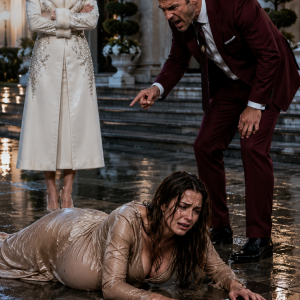
Before I could even process the threat, Patricia took a deliberate step forward, her eyes darkening. With a swift, calculated flick of her wrist, she tilted the skillet and poured the boiling, gelatinous liquid directly across my unprotected legs.
The world erupted into a blinding white agony, and I collapsed to the floor, screaming.
Chapter 2: The Blistering Truth
Pain is not a sound; it is a frequency that overrides every other sense. On the cold kitchen tiles, the skin across my thighs and shins instantly began to blister beneath my soaked pajama pants. The acrid smell of burnt sauce and searing flesh filled my nostrils. I gasped for air through jagged, tearing sobs, curling into a fetal position as the nerve endings in my legs screamed.
I waited for Gabriel’s hands. I waited for my husband to drop to his knees, to scream for an ambulance, to pull the fabric away from my burning skin.
He didn’t.
Through the blur of my tears, I watched as Gabriel rushed past me. He bypassed his agonizing wife on the floor and went straight to his mother. He wrapped his arms around Patricia as she buried her face in his chest, unleashing a wail of theatrical, crocodile tears.
“She startled me!” Patricia sobbed, clinging to his robe. “It slipped, Gabriel! It was an accident! She attacked me verbally, and I just—I panicked!”
“Shh, Mom, it’s okay, I know,” Gabriel cooed, rubbing her back.
I lay there, shivering from the shock, the blistering heat eating through my skin, realizing with a horrifying clarity that I was entirely alone.
The drive to the emergency clinic was a silent nightmare. Gabriel refused to call an ambulance, claiming it would “cause a scene in the building.” He shoved me into the passenger seat of his car, my legs wrapped in a wet towel that offered zero relief. Patricia had stayed behind in my condo to “clean up.”
Inside the sterile, iodine-scented examination room, the attending physician took one look at the severe second-degree burns spanning my legs and his expression darkened.
“How exactly did this happen?” the doctor asked, his eyes darting between me and Gabriel.
Before I could open my mouth, Gabriel stepped smoothly in front of me, blocking my line of sight to the physician. “It was just a terrible cooking accident, doctor,” he blurted out, his voice laced with practiced concern. “She was moving a heavy pan of boiling water, and it just slipped out of her hands.”
I stared at the back of Gabriel’s head, a cold dread coiling in my gut beneath the physical agony. He was lying. He was actively covering up a violent assault to protect the woman who had maimed me.
That night, my legs heavily bandaged and throbbing with a dull, relentless fire, I lay on the living room couch. Gabriel walked in, pouring himself a glass of scotch.
“Gabriel,” I croaked, my throat raw from crying. “Your mother assaulted me. She did it on purpose.”
Gabriel stopped, slamming the glass down on the side table. His face contorted in annoyance. “She’s my mother, Evelyn. Stop making this out to be a crime. It was a reflex. You were screaming at her. You need to stop using such dramatic language.”
Without another word, he turned his back on me and walked into the master bedroom, shutting the door firmly. The click of the latch echoed in the silent apartment.
I was left alone in the dark. The physical pain was excruciating, but it was eclipsed by the death of my marriage. The man I loved was a coward, an accomplice to my abuse. I had invited a parasite into my sanctuary.
At midnight, bathed in the pale blue light of the moon filtering through the windows, the victim inside me died, making way for a cold, calculating strategist. I remembered my father. I remembered the wiring.
With trembling fingers, I reached for my phone and opened the mobile security application. I navigated to the kitchen camera feed and scrolled back to 8:15 AM.
I pressed play.
There it was. 1080p high-definition video. The audio was crystal clear. I watched Patricia throw the food away. I heard her vile words. And then, I watched the assault. I watched it three times, my heart pounding a violent rhythm against my ribs.
On the fourth viewing, I zoomed in. I slowed the playback down to frame-by-frame. As the video crawled forward, I noticed something that made the blood in my veins turn to ice. The cameras didn’t just catch the assault. They caught Patricia’s distinct facial expression right before she tilted the pan.
She didn’t flinch. She didn’t slip. She lowered her gaze directly to my legs, squared her shoulders, and smiled.
It was premeditated.
Chapter 3: The Paper Trail
Two days later, heavily medicated and walking with a stiff, agonizing limp, I sat in the high-rise downtown Atlanta law office of Andrea Vasquez. Andrea was a shark in a tailored suit, renowned for tearing apart complex property disputes and domestic criminal cases.
I slid my tablet across her massive glass desk. The video played. Andrea watched it in absolute silence, her sharp, dark eyes unblinking. When it finished, she didn’t offer empty condolences. She just nodded.
“Your mother-in-law committed aggravated domestic assault,” Andrea stated plainly, pulling out a legal pad. “We have grounds for an immediate restraining order, and we can fast-track a marriage annulment based on fraud and physical endangerment. But, Evelyn…”
Andrea paused, opening a thick manila folder on her desk and sliding it toward me. “That’s not all. When you called me to look into the condo’s security protocols, I pulled the public real estate records. Just to be thorough.”
I looked down at the documents. They were photocopies of property deeds and transfer requests from the county clerk’s office.
“Two weeks before you walked down the aisle,” Andrea continued, her voice devoid of emotion, “your husband filed paperwork attempting to transfer half of your condo deed into his name.”
The air left my lungs. I stared at the forged application signatures in utter disbelief. Gabriel had signed my name. The only reason it hadn’t gone through was due to a missing notary stamp and secondary verification signatures.
A fault line cracked open right through my chest. The red flags I had ignored—Gabriel asking about my mortgage, Patricia insisting we didn’t need a prenup because “family trusts family”—suddenly snapped into a terrifying mosaic. Marriage hadn’t been a romantic commitment for Gabriel. It had been an orchestrated asset takeover. They were trying to bleed me dry.
I returned to the condo late that afternoon. The moment I walked through the door, Gabriel appeared from the kitchen, holding a massive bouquet of performative white roses. He smiled—a weak, placating expression that made my stomach churn.
“Evie,” he murmured, taking a step toward me. “I wanted to apologize for the other night. Tensions were high. I spoke to Mom, and she feels terrible. She wrote you an apology card. Can we just move past this and be a family?”
I didn’t take the flowers. I stood in the center of the living room, staring at the man I had married.
“Did you think I wouldn’t check the county records, Gabriel?” I asked, my voice terrifyingly calm.
Gabriel froze. The white roses dipped slightly. “What?”
“Two weeks before our wedding. You forged my signature to put your name on my deed.”
All the color drained from his face. His mask of the bumbling, peacemaking husband fell away, replaced by a bitter, entitled scowl. He threw the roses onto the coffee table.
“We are married!” he shouted defensively, stepping toward me with a sudden, aggressive posture. “Couples share assets! I bring value to this relationship! If you had just respected my mother instead of challenging her authority, none of this would have happened! You owed us that respect, Evelyn!”
He was trying to gaslight me again. He truly believed I was property to be conquered.
I didn’t argue. I didn’t scream. I calmly picked up the television remote from the side table, aimed it at the 65-inch screen mounted on the wall, and hit play. I had synced my phone to the television an hour before he got home.
The screen flared to life. Patricia’s shrill, arrogant voice echoed through the high-end surround sound speakers of the condo: “Inside this home, I decide how things work…”
Gabriel spun around, his jaw dropping as the horrifying scene of his mother pouring boiling liquid onto his wife played out in massive, undeniable high definition.
“Turn that off,” Gabriel panicked, his voice cracking as he lunged for the remote. “Evelyn, turn it off right now! If that gets out, it will ruin her!”
He dropped to his knees, literally begging me to delete the footage, tears of sheer panic streaming down his face.
Before I could reply, three sharp, confident knocks echoed at the front door.
Gabriel froze on the floor. I walked past him, looked through the peephole, and felt a cold smile stretch across my face.
Standing outside, perfectly coiffed and utterly unaware of the digital execution currently paused on my television screen, was Patricia Thornton. And flanking her were two highly prominent members of her elite charity board.
Chapter 4: The Reflection of a Killer
I opened the door wide.
Patricia stepped into the foyer with her signature practiced smile, holding a basket of artisanal muffins. To her left and right stood two older, incredibly wealthy women from the Atlanta Women’s Leadership Guild—the social bedrock of Patricia’s fabricated high-society identity. I recognized one of them instantly: Mrs. Beatrice Caldwell, a formidable woman whose billionaire husband had passed away earlier that year.
“We came to visit our poor, clumsy little bride—” Patricia started, her voice dripping with saccharine condescension, intending to perform damage control and reinforce her narrative to her peers.
She stepped into the open-concept living room and stopped dead in her tracks.
The two charity board members walked in behind her, their polite smiles instantly evaporating. They stared past me, past a kneeling, pale Gabriel, and locked eyes on the massive television.
The image was paused perfectly. Patricia, her face contorted in malice, gripping the skillet, hovering over me.
The room went tomb-silent. The air grew thick, suffocating.
I stepped aside, picked up the remote, and calmly pressed unpause.
The high-definition video resumed. The three women watched in absolute horror as Patricia sneered, deliberately poured the boiling contents of the pan over my legs, and smiled as my agonizing screams tore through the speakers. They watched Gabriel stand there, doing absolutely nothing to help me.
The video looped and paused again on Patricia’s face.
“Oh my God, Patricia…” whispered Mrs. Beatrice Caldwell, the muffin basket slipping from Patricia’s limp hands and crashing to the floor. Beatrice took a step back, her hands trembling.
Patricia’s face was ashen. She opened her mouth to speak, to lie, to spin the web, but no words came out. She was trapped in the glare of her own cruelty.
Suddenly, Beatrice gasped, a sharp, ragged sound. She stepped closer to the massive screen, pointing a shaking manicured finger not at Patricia, but at the dark, reflective glass of the kitchen window captured in the background of the shot.
“Wait…” Beatrice breathed, her eyes widening in sheer terror. “Look at the window reflection on the left… rewind it ten seconds.”
My brow furrowed. I hit rewind.
We all stared at the glass window reflection on the screen. Plain as day, captured seconds before the skillet was thrown, while my back was turned plating the food, Patricia was filmed pulling a small object from her purse. It was a distinct amber prescription bottle with a custom gold cap. In the reflection, she uncapped it and swiftly dropped several drops of clear liquid into the mug of coffee I had poured for myself on the counter.
I felt the blood drain from my head. She hadn’t just come to abuse me. She had come to poison me. The burn was a distraction.
Beatrice turned to Patricia with wild, terrified eyes.
“That is my husband Harrison’s cardiac medication,” Beatrice whispered, the realization hitting the room like a physical blow. “That custom bottle… it vanished from my house the week before Harrison died of cardiac arrest. You were his volunteer nurse.” Beatrice’s voice rose to a hysterical scream. “You poisoned my husband, and you were trying to poison Evelyn!”
Patricia lunged toward the door, abandoning all pretense, but she didn’t make it past the foyer.
Through the thick floor-to-ceiling windows, the flashing red and blue lights of police cruisers painted the living room in chaotic bursts. Sirens blared, echoing off the Buckhead high-rises.
Andrea Vasquez had done exactly what I paid her to do. The heavy knocks at the door this time weren’t from socialites. They were from the police, swarming the corridor with arrest warrants drawn.
Chapter 5: Ashes and Architecture
The justice system is often described as slow, but when presented with undeniable 1080p video evidence of aggravated assault, corroborated by the seizure of a coffee mug laced with a lethal dose of stolen cardiac medication, the wheels turn with terrifying velocity.
Three months later, I sat in the polished wooden pews of the Fulton County Superior Court. I wore a sharply tailored navy suit, my posture resolute, a stark contrast to the broken woman who had writhed on the kitchen floor.
Across the aisle, Patricia Thornton sat in a baggy orange jumpsuit. Her hair was limp, her arrogant demeanor entirely erased, replaced by the hollow desperation of a caged animal. Her defense had crumbled within days. The forensic analysis of my coffee cup matched the medication missing from the Caldwell estate. The judge denied her bail entirely, citing her as a severe flight risk due to the now-active, sprawling homicide investigation into the deaths of three other wealthy charity benefactors under her “care.” She wasn’t just a toxic mother-in-law; she was a serial predator who had used her son to locate fresh, wealthy victims.
Gabriel sat a few feet away, beside an exhausted public defender. He looked ruined. Upon his arrest as an accomplice, the prestigious investment firm he worked for fired him instantly. Disbarred from his industry, publicly disgraced, and bankrupted by legal fees, he was forced to finally face the reality that his absolute allegiance to his mother had destroyed his life. He was pleading out to a four-year state prison sentence for real estate fraud, forgery, and obstruction of justice.
The judge, a stern man with no patience for Gabriel’s lingering victim complex, slammed his gavel down sharply. The sound echoed like a gunshot in the cavernous room.
“The marriage between Evelyn and Gabriel Thornton is hereby annulled on the grounds of severe fraud, coercion, and criminal endangerment,” the judge declared. “It is legally dissolved, as if it never occurred. Furthermore, the deed to the property in question remains unencumbered and exclusively owned by the petitioner. A permanent protective order is granted.”
I walked out of the courthouse into the bright Atlanta sun, and for the first time in months, I took a deep, unrestricted breath.
A year of grueling burn therapy and physical rehabilitation followed. The scars on my legs faded from angry red to a pale, silvery pink. I didn’t hide them. They were my battle terrain.
I took back my home with a vengeance. I tore out the kitchen island where the attack happened, replacing the walnut with sleek, unyielding black quartz. I redesigned the space, stripping away any lingering shadows of the Thorntons, transforming the condo to reflect my absolute autonomy. It was my sanctuary once more.
Life settled into a peaceful, empowering rhythm. Until a Tuesday afternoon, while organizing my office mail, I spotted a rigid, certified envelope. The return address made my pulse skip a beat: the state penitentiary.
I sliced it open. It was a letter from Gabriel, his handwriting frantic. He was begging for a meeting before his transfer to a maximum-security facility. He claimed he had found something in his mother’s old files—information about an offshore account Patricia had set up using stolen charity funds, an account that he hinted contained money with my name forged on the tax documents.
He was throwing a hook, desperate for a lifeline, trying to pull me back into the dark.
Chapter 6: The Summit
I didn’t open the letter.
Two years after the nightmare in my kitchen, I stood in front of a roaring fire in my living room. I held the sealed envelope from the penitentiary for a brief moment, feeling the weight of the manipulation inside it. Then, I tossed it into the flames. I watched the paper curl, blacken, and turn to ash, floating up the chimney. I severed the final, pathetic thread connecting me to Gabriel Thornton without a second thought.
I had no room in my life for ghosts.
Later that morning, I stood backstage at the Atlanta Women’s Leadership Summit. It was the very organization Patricia had once used as a hunting ground, now thoroughly reformed and under new direction. I had thrived in my career, stepping into a senior executive role, but more importantly, I had established a non-profit foundation that provided emergency legal aid and housing security for victims of domestic financial abuse.
I walked out onto the brightly lit stage. Before me sat an audience of eight hundred women. I adjusted the microphone, looking out at the sea of faces.
“My father once told me that a woman without legal control over her own home eventually becomes a guest inside somebody else’s life,” I shared, my voice echoing with steady, hard-won strength. “I survived to learn that he was right, but that legal control over a deed is only the beginning.”
I paused, letting the silence command the room.
“True ownership,” I continued, “means enforcing your boundaries without apology. It means cutting out toxicity without guilt, no matter what mask it wears. It means recognizing that you are the architect of your own reality, and never, ever allowing anyone to make you feel like a guest inside your own soul.”
The standing ovation was deafening, but it wasn’t for me. It was for the shared truth that resonated in every woman in that room.
That evening, I stepped onto my quiet balcony in Buckhead. The night air was warm, carrying the sweet, intoxicating scent of jacaranda blossoms. The city lights of Atlanta hummed below, a vibrant tapestry of life moving forward. I took a slow sip of my coffee, relishing the absolute silence of my safe, beautiful home. There were no footsteps I had to fear. There were no voices telling me I was inadequate. There was only me.
As I turned to re-enter my apartment, the screen of my phone lit up on the patio table. It was a text message from a warm, deeply respectful colleague I had been casually seeing over the past few months.
I got those tickets for the private gallery opening tonight. Only if you’re up for it. No pressure. Let me know.
I smiled, tracing the silver scar on my leg through my silk trousers. It was a gentle reminder that while the past was a closed book, a brand new, healthy chapter was waiting for me. And this time, it was going to be written entirely on my own terms.
If you want more stories like this, or if you’d like to share your thoughts about what you would have done in my situation, I’d love to hear from you. Your perspective helps these stories reach more people, so don’t be shy about commenting or sharing.