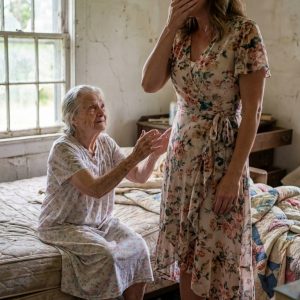
Chapter 1: The Easter Sunday Executioner
“You think I cheated, Karen?”
I didn’t even get the chance to finish my sentence before my older sister slid the heavy manila envelope across the linen tablecloth. She pushed it toward my husband with two fingers, smiling with the predatory patience of a woman who had waited three long years for this exact execution.
“Not think, Molly,” Karen purred, her voice dripping with artificial sympathy. “I know. Lark’s pale blonde hair doesn’t match Nolan at all. You’ve been lying to him for six years. Today, everyone finally gets to see what kind of woman you really are.”
My sister, the golden child who had spent her entire life proudly wearing the mantle of the “real Boyd daughter,” sat back in her chair, a victor’s smirk plastered across her face. She genuinely believed she had just detonated a bomb that would reduce my life to ash. She had absolutely no idea that the explosive she had carried into our parents’ dining room wasn’t wired for me. It was wired for her. And when my husband finally turned to page four of that laboratory report, the architecture of the lie she had spent thirty-eight years inhabiting was going to collapse directly onto her head.
To understand how my sister ended up holding that envelope like a loaded gun, you have to understand the soil we grew up in. No one actively seeks out Nixa, Missouri to plant new roots. It is a town of twenty-four thousand stubborn souls wedged between Springfield and the rugged foothills of the Ozarks. It’s the kind of place people retreat to when they’ve run out of geography. We boast a few traffic lights, three fiercely competitive Baptist congregations, and a single truck stop on Highway 160 where my father, a long-haul driver for three decades, used to drink black coffee before hauling freight up to Chicago. My mother worked the griddle at the Nixa Family Diner from the Reagan administration until her knees finally surrendered in 2018.
In a town this insular, anonymity is a myth. Everyone eventually knows your sins. But in January of 2026, I still foolishly believed the narrative our family was performing.
My husband, Nolan, is a large-animal veterinarian. He operates on a circadian rhythm the rest of modern society abandoned fifty years ago. He is a man of few words, preferring the honest language of labor. We share a daughter, Lark, who was born just before the world locked down in 2020. She arrived with hair so fine and pale it looked like spun silver under the harsh hospital fluorescents. Nolan is dark-haired; I am a deep chestnut. But genetics is a patient thief. My great-grandfather, Elmer Boyd, had stepped off a boat from Kaiserslautern, Germany in 1923, boasting white-blonde hair until he turned fifty. The recessive gene had skipped my grandfather, bypassed my father, and landed squarely on my six-year-old.
That biological footnote was the last time I thought about my daughter’s hair. Until Christmas Eve of 2025.
We were gathered at my parents’ house. Karen, recently single after breaking her second engagement, arrived with a bottle of cheap Cabernet and a manic energy. She barely looked at me. Instead, she fixated on Lark.
“Come here, sweetheart,” Karen cooed, grabbing my daughter’s small hand. “Let Auntie Karen get you looking pretty for Grandma’s pictures.”
I stayed in the kitchen, whisking eggs for my mother. I didn’t think to follow them upstairs to the guest bathroom. Ten minutes later, Karen returned, my daughter’s silver-blonde hair tied neatly in a red velvet ribbon. Karen set Lark’s favorite pink Elsa hairbrush down on the kitchen counter, wiping her hands on a dish towel with the bizarre satisfaction of a surgeon who had just completed a complex extraction.
“There,” Karen smiled, her eyes glittering with a strange, frantic light. “Now she looks like Christmas.”
I thanked her, entirely unaware that nestled in the bristles of that plastic brush was the genetic material my sister would soon mail to a laboratory in Salt Lake City. But before the trap could snap shut, I would make a discovery of my own that would change the trajectory of my family forever.
Chapter 2: The Geometry of Envy
If you don’t understand what thirty-five years inside my family’s ecosystem had forged me into, you might mistake my silence for weakness. I was not weak. I was trained.
From the day my mother brought me home from Cox South Hospital in 1990, the hierarchy was set in stone. Karen was the christened, cataloged, celebrated firstborn. I was the surplus daughter. Tolerated, clothed, and fed, but never the protagonist of our family’s story.
My father was on the road twenty days out of every month. When his rig finally rumbled up our driveway, he came home to Karen. He came home to her crayon drawings proudly magnetized to the fridge, to her boisterous stories, and to her weekend fishing trips with his best friend, Uncle Wayne. Wayne Keller was a fixture in our house—a towering, childless man who possessed infinite patience for my sister and absolute indifference toward me.
There is a framed photograph permanently anchored to my parents’ living room wall. It features an eight-year-old Karen, freckled and grinning fiercely, holding a two-pound bass. Wayne stands behind her, his thick arm slung proudly around her shoulders. Beside it sits another framed memory: Karen’s baptism, with Wayne standing tall as her godfather. My baptism photo sits on a lesser shelf, featuring the pastor’s wife—a woman I had met exactly twice—standing in as my sponsor. When I was ten, I asked my mother why Wayne didn’t sponsor me, too.
“Wayne’s been through a lot of heartbreak, honey,” she had muttered, scrubbing a pan. “He needs a break from family stuff.”
I accepted the lie because children always consume the poison their parents serve them. I didn’t become an angry person; I became a forensic observer. I grew up to become an emergency room trauma nurse because deciphering a room full of bleeding, terrified strangers was vastly easier than reading my own bloodline. Patients in agony do not lie with their bodies. My family had been lying with theirs for three and a half decades.
Karen’s envy metastasized as we aged. She couldn’t occupy the same room as someone else’s joy without plotting to redistribute it. She broke off two engagements because both men eventually realized she was hollow inside.
Her final project became my marriage.
It started at Thanksgiving in 2023. We were gathered around the table. Lark, then a toddler, was wandering the living room. Karen watched my daughter for a long, calculating minute before dropping her poison into the silence.
“Hey, Nolan,” Karen said loudly. “Do you ever think Lark looks a little more like Molly’s side of the family? Or maybe… someone else’s side?”
My father kept chewing his turkey. My mother stared blankly at the pumpkin pie she was slicing.
Nolan set his fork down on his china plate. The metallic clink rang out like a gunshot. He stared across the table at my sister for eight agonizing, silent seconds. He didn’t blink. Then, he calmly picked up his fork and took a bite of mashed potatoes. That was his entire answer.
I assumed the boundary had been drawn. I was wrong. It was merely the opening skirmish. Over the next two years, Karen began texting Nolan directly. Under the guise of asking veterinary advice for a neighbor’s dog, she would systematically pivot the conversation to Lark’s genetics.
Has she ever asked why she looks so different?
Our beautiful little mystery.
Nolan never mentioned these messages to me. Instead, he quietly took screenshots.
I didn’t discover his secret until I was looking for a recipe on our shared iPad in the kitchen. I opened the files app and found a hidden folder labeled simply: CB. Inside were fifty-two meticulously categorized screenshots. Every passive-aggressive text, every subtle accusation, every digital footprint of my sister’s obsession. Nolan wasn’t building a divorce case. He was building a defense perimeter. He knew a storm was coming, the same way he knew when a heifer was about to breach.
And then, a new notification pinged on the screen, a direct message from Karen that made the blood freeze in my veins.
Chapter 3: The Ghost in the Ledger
The text message glowed against the dark screen of the iPad: “I’m going to say this once, Nolan. If you want to know the real truth about Lark, I can help you. Just say the word.”
Nolan didn’t reply.
That night, my nervous system finally registered the proximity of the threat. I stopped sleeping. I needed to understand the root of Karen’s malignant entitlement.
Three weeks before Easter, I drove to my parents’ house on a Tuesday morning. My mother was sitting alone at the kitchen table, staring into a cup of chamomile tea that had long since gone cold. The house smelled of lemon Pledge and stale silence.
I sat across from her, my hands folded on the placemat. “Mom,” I began, keeping my voice dangerously casual. “Why did Uncle Wayne leave his hunting cabin to Karen when he died, and not to both of us?”
In 2019, Wayne had passed away from a massive coronary. His will had explicitly left forty acres of prime Ozark timberland to “my dear friend’s daughter, Karen.” Singular. Not daughters.
My mother went completely still. She didn’t freeze for a second; she froze for six full seconds. As an ER nurse, I have watched human beings bleed out and die faster than my mother went quiet.
When she finally spoke, she didn’t look at me. “Some things don’t have a reason, Molly. Some things just are.”
A cold dread coiled in my gut. My mother was a woman who had a rigid justification for everything—from the exact angle the good silver was stored, to why towels had to be folded in thirds. She had never, in my thirty-five years of existence, claimed that something just was.
I drove home and relayed the conversation to Nolan. He stared into his coffee mug for a long time before speaking. “Molly, do not ask her another question until Easter is over.”
I didn’t ask what he knew. I trusted his instincts implicitly. But to understand what my mother was desperately trying to keep buried, you have to rewind the clock to a bitter, freezing January night in 1988.
Wayne Keller was thirty-seven years old. His wife, Loretta, had just suffered her third consecutive miscarriage and was catatonic in a psychiatric rest facility in Springfield. Wayne was drowning in the deafening silence of an empty house. Terrified of the whiskey bottle, he took to driving the dark, icy backroads of Nixa at midnight.
My mother was twenty-seven. She had lost two pregnancies of her own. My father was somewhere in Illinois, hauling freight, leaving her entirely alone in a town that knew her name but never actually saw her.
At 10:52 PM on January 28th, 1988, Wayne Keller walked into the Nixa Family Diner.
I know this because, in a plastic tub in my parents’ garage labeled Diner 1985-1989, I later found my mother’s old order book. Amidst pages of blue ballpoint ink detailing patty melts and black coffees, there was a single entry written faintly in pencil: Closed early. Headache.
She had locked the diner doors. She had poured him a cup of coffee. Somewhere between eleven at night and one in the morning, the crushing weight of their mutual, childless grief had collided. She wiped down the Formica counter, drove home, and made a silent, ironclad decision: the child growing inside her would belong to the man she was married to.
Karen was born eleven months later. Wayne came to the hospital, standing behind his fragile wife, staring at the linoleum floor because looking at his biological daughter was an agony he couldn’t mask.
In 2018, a year before his fatal heart attack, Wayne submitted his DNA to a local Ozark historical genealogy project. He opted into relative matching. Perhaps it was an old man’s vanity, or perhaps it was the subconscious desire of a ghost wanting to leave a door cracked open.
My sister, armed with arrogance and the hair she had stolen from my daughter’s brush, walked right through that door. She ordered a $149 genetic test from Meridian Genetics, swapping her own cheek swab and Lark’s hair, entirely bypassing our mother.
When the PDF results arrived in her inbox, Karen sat in the faculty parking lot and read only the top summary line: Genetic relationship consistent with half-aunt to niece.
Her mind, eager for my destruction, violently misinterpreted the data. She didn’t read pages two, three, or four. She didn’t realize the trap she had just armed was pointing squarely at her own chest.
Chapter 4: The Easter Sunday Trap
Easter Sunday of 2026 was unnervingly warm, the heavy Missouri air thick with the sweet, rotting scent of blooming redbuds.
Nolan drove us in his truck. I sat in the passenger seat, balancing a pecan pie on my knees, my palms slick with cold sweat. In her booster seat behind me, Lark happily sang the soundtrack to an animated movie, entirely oblivious to the impending slaughter.
As we idled at the four-way stop near the Baptist church, Nolan reached across the center console. His calloused hand enveloped mine.
“Whatever happens in that room today,” he said, his voice a low, steady rumble, “we take our daughter home tonight exactly the same way we came. We are whole.”
I nodded, my throat too tight to swallow. My body already knew what my brain was refusing to calculate.
My mother had set the dining room for eight. The table groaned under the weight of the good white china banded in gold. A massive glazed ham sat in the center, flanked by macaroni and cheese, green beans, and a tray of deviled eggs. My father sat at the head of the table, nursing a glass of sweet tea. My cousin Hollis and her husband Grady had driven down from Springfield, serving as the unwitting audience my mother had invited to perform her perfect holiday illusion.
Karen was already seated. She wore a new floral dress, her hair meticulously straightened. When I walked in, she offered me a smile so wide and synthetic it looked painful.
“There you are, Molly,” she chimed. “Come sit down. I’ve been waiting for you.”
She had been waiting for six days.
My father bowed his head to say grace. “Lord, we thank you for this family, for the sacrifice of your Son, and for the truth that sets us free. Amen.”
I opened my eyes a fraction of a second early. Karen was already staring directly at Nolan across the table, an executioner’s grin stretching across her face.
The first course was agonizing. Forks scraped against china. Hollis made polite small talk about the spring calving season. Grady discussed truck prices. Through it all, the tension in the room thickened until it was difficult to draw breath.
My mother suddenly stood up to clear the appetizer plates. It was a reflex; she was trying to keep the room moving, trying to outrun the shadow she felt creeping up the walls. I stood to help her, a habit ingrained over thirty-five years of servitude.
“Sit down, Molly,” Karen commanded, her voice slicing through the clatter of silverware. “I’ve got something for Nolan. And I think it’s better said with everyone here to witness it.”
My mother froze. She stood rigidly at the head of the table, clutching a stack of gold-rimmed china to her chest, her knuckles bone-white.
Karen reached down into her navy tote bag. She retrieved the manila envelope, heavily sealed with a metal clasp. With a theatrical flourish, she placed it onto the tablecloth and slid it toward Nolan.
“You think I cheated, Karen?” I asked, my voice terrifyingly hollow.
She ignored me entirely, her eyes locked on my husband. “Not think, Molly. I know. Lark’s blonde hair doesn’t match Nolan. Today, everyone sees the truth.”
Nolan didn’t flinch. He set his fork down with the slow, deliberate precision of a surgeon setting down a scalpel. He looked at the envelope, then lifted his dark eyes to my sister.
“Karen,” Nolan said softly, offering her one final lifeline. “Before I open this… you just told a room full of our family that my wife has been unfaithful. Are you absolutely sure this is the story you want to be locked into?”
“I’m sure,” she sneered, leaning forward. “Read it.”
Nolan popped the metal clasp. He withdrew the four stapled pages. He scanned the first page, his expression entirely unreadable. Then, he looked up, the air in the room dropping ten degrees.
“Karen, this report doesn’t say what you think it says,” Nolan murmured. “Did you bother to read page four?”
Chapter 5: The Detonation
Karen’s triumphant smile faltered, just a millimeter. “It says exactly what it says. Stop stalling.”
Nolan didn’t argue. He simply began to read section two aloud, his voice projecting the calm, clinical authority he used when diagnosing a terminal illness in a barn.
“Shared DNA between subject sample Karen Boyd and secondary sample alleged niece: twelve point five percent.” Nolan lowered the paper, his gaze pinning my sister to her chair. “Karen, you are a fourth-grade math teacher. What percentage of DNA does a full aunt share with a full niece?”
Karen’s mouth opened, but no sound emerged. The heavy silver fork slipped from her fingers, clattering loudly against her plate. She had rehearsed a hundred different arguments, but she hadn’t prepared for basic biology.
Nolan didn’t wait for her to find her voice. “A full aunt and a full niece share twenty-five percent. A half-aunt shares twelve point five. This laboratory report is telling you, Karen, that you and my wife are not full sisters. You share one parent. Not both.”
At the head of the table, my mother finally sat down. She didn’t drop the heavy stack of china plates; she lowered them to the tablecloth with agonizing, silent care.
Karen shook her head, her freshly straightened hair falling into her eyes. “No. No, you’re reading it wrong. Give it to me!”
She lunged across the ham, her hand grasping for the paper. Nolan pulled it back smoothly and turned to page three.
“Section three: Ancestry markers,” Nolan continued, his voice echoing off the yellow walls. “Subject sample Karen Boyd: Sixty-two percent Irish Munster region. Eighteen percent Scots-Irish. Fourteen percent English. Six percent German.”
The dining room descended into a silence so absolute it felt like a vacuum.
Nolan slid the paper across the table, utilizing the exact same two-finger motion Karen had used ten minutes prior, stopping it directly in front of my father.
“Curtis,” Nolan said gently. “Look at the genetic breakdown of your daughter. The woman you have proudly called the ‘real Boyd’ for thirty-seven years is six percent German. Your grandfather Elmer was full-blooded German. A true Boyd granddaughter would test in the high forties, at minimum.”
My father didn’t touch the paper. He stared at it as if it were coated in anthrax. Slowly, he lifted his eyes to my mother. His face had drained of all color, the deeply etched lines around his eyes deepening into ravines.
“Wayne was Irish,” my father whispered. The sound was barely a rasp. “Keller. Munster region.”
My mother’s tears finally broke. She didn’t sob. She didn’t attempt to hide her face in her hands. She simply sat at the head of her ruined Easter table and wept with the total, silent devastation of a woman who had been waiting for the firing squad for thirty-eight years.
My father didn’t scream. He didn’t upend the table. He was a man crushed under the sheer, suffocating weight of a retroactive betrayal. He looked at his wife of forty-three years and spoke her name like a prayer.
“Adele. Was it Wayne?”
My mother couldn’t meet his eyes. She simply offered a single, microscopic nod.
Nolan turned to the final page. “Cross-reference indicates the subject’s Irish Munster markers are consistent with the Keller line profile submitted for genealogy comparison in 2018 by Wayne Keller. Confidence: Parental.”
The word parental landed on the dining table like a brick.
Karen’s entire face went slack, all the vicious arrogance melting away, leaving behind a terrified, hollow shell. She finally reached out, her hands shaking so violently the paper rattled like dry leaves, and snatched page four. Her eyes scanned the text. A strangled, animalistic whimper escaped her throat.
“Nolan,” she begged, tears spilling over her mascara. “Please. Please don’t say another word.”
“I don’t need to,” Nolan replied softly.
My father stood up. He placed both his heavy, calloused hands flat on the linen tablecloth to steady his trembling knees. In the span of ten seconds, I watched a strong, stoic man age a decade. He slowly walked around the table. He didn’t walk toward his weeping wife. He didn’t walk toward the shattered golden child.
He walked directly to my chair.
He placed his heavy hand on my shoulder. His grip was tight, desperate, and grounding.
“Molly,” my father said, his voice thick with gravel and grief. “Take your daughter home. Take your husband. I need… I need to sit in quiet with my wife.”
For thirty-five years, I had been the secondary character, the surplus child, the afterthought in my own home. In one breath, at the ruins of his Easter table, my father made me the only name that mattered. He didn’t soften it. He didn’t qualify it. He claimed me, and he asked me to leave so he could face the ashes of his life.
I stood up. I didn’t glance at my sister, who was staring blankly at the paper that had erased her identity. I didn’t look at my mother. I walked into the living room, scooped Lark into my arms, and walked out the front door, the screen door slamming behind us with a definitive, hollow thwack.
Chapter 6: The Ledger Balanced
We drove home in silence, the fading evening light washing the Ozark hills in a bruised purple hue. Lark fell asleep against her car seat within minutes, insulated from the shrapnel of the adults.
I stared out the passenger window, the adrenaline finally leaving my blood, replaced by a profound, hollow ache. “You knew,” I whispered to Nolan.
He kept his eyes locked on the road. “I knew a storm was coming. I knew it would come through her. I just didn’t know what shape the lightning would take.”
When we got home, Nolan handed me the unlabeled craft-brown folder containing the fifty-two files of Karen’s digital harassment. I read them all at the kitchen table, realizing he had been silently guarding the gates of our marriage while I had been sleeping.
Small towns do not require lawyers; they possess the Walmart bakery aisle. Within seventy-two hours, what happened in that dining room was public record. Nixa understands the brutal pauses between sentences, and the town devoured the scandal with quiet, ruthless efficiency.
Karen submitted her immediate resignation to Nixa Elementary, citing a “personal family crisis.” Three days later, she packed her life into a small U-Haul trailer and fled up Interstate 44 toward Kansas City. She left no forwarding address. She didn’t say goodbye to my parents. She kept the brass key to Wayne’s two-hundred-thousand-dollar cabin, clinging to it not as an asset, but as the only tangible proof of an identity she had lost.
Two weeks after the explosion, I drove to the Springfield Memorial Cemetery.
I stood before the modest granite headstone of Loretta Keller. The grass was neatly trimmed. Someone—my father, I would later learn—had placed fresh daffodils in the metal vase. I stood there for twenty minutes, listening to the wind rustle through the oak trees.
“He didn’t know,” I whispered to the cold stone. “She didn’t know. I am so sorry.”
Three women’s lives had been warped around a single, desperate lie born in a diner in 1988. Two of them were dead. One was sitting in a silent house. I was the only one left who could stand at that grave and balance the moral ledger. Sometimes, surviving a family means apologizing for the ghosts who cannot apologize for themselves.
The following Monday afternoon, I was sitting on my front porch when my father’s Ford Ranger crunched up the gravel driveway.
He didn’t get out immediately. He sat behind the wheel for twelve agonizing minutes, staring straight ahead. I didn’t go to him. He had to cross the distance himself; I owed myself that boundary.
Finally, the truck door groaned open. He walked up the wooden porch steps, his shoulders slumped, and sat in the rocking chair next to mine. I poured him a mug of black coffee. He held it with both hands, staring out at the massive maple tree in my front yard.
“Molly,” he said, his voice stripped of all its former booming authority. “I owed you thirty-five years of knowing, without a shadow of a doubt, that you were mine. I know I cannot undo the past. But let me start now.”
I let the silence stretch between us, letting the coffee cool. For the first time in my life, I didn’t shrink to make him comfortable.
“You can’t make up thirty-five years, Dad,” I answered, my voice steady. “You can only stop them from becoming thirty-six.”
He nodded slowly, accepting the sentence. He drank the cold coffee. He didn’t beg for absolution. He didn’t ask me to forgive my mother. He simply asked if he could come back the next week.
I told him he could.
He has returned every Monday since. He is currently teaching Lark how to bait a fishing hook on our back deck, replacing the phantom memories of Wayne and Karen with the reality of a grandfather and his true blood.
My mother writes me letters on yellow legal pads every two weeks. She details her counseling sessions, her baking, the quiet hours she spends on the porch with my father. She hasn’t asked for forgiveness, and I haven’t written back. I will, eventually, when the anger finishes burning itself out.
My sister paid one hundred and forty-nine dollars to prove I was an imposter in my own family. She was entirely right about the fraud; she was just wrong about the target. I spent thirty-five years believing I owed my family an apology for taking up space. It turns out, I was the only honest thing in that house.
The only name worth keeping is the one my husband, my daughter, and my father now use without hesitation. My name is Molly Martin. I am thirty-five years old, I am finally someone’s real daughter, and I am entirely done apologizing for the space I occupy.