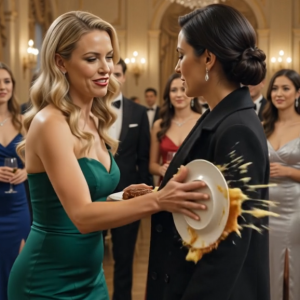
Title: The Second Day of Forever
Chapter 1: The Wilting Vows
I learned an agonizing truth exactly forty-eight hours after saying “I do”: a marriage can brutally mutate before the expensive floral centerpieces on the reception tables have even begun to drop their petals.
My name is Emily Harper. On a brilliantly clear Saturday afternoon in Portland, Oregon, I married Daniel Whitmore. To the outside world, he was the absolute pinnacle of an eligible bachelor. At thirty-two, Daniel was relentlessly polished, dripping with an effortless, practiced charm. He was the specific breed of man who memorized the names of restaurant servers, pulled out chairs, and instinctively opened car doors—especially when he knew an audience was watching.
Residing in his sprawling, impeccably decorated home was his younger sister, Vanessa. She was twenty-seven and had been occupying his guest suite “temporarily” for the better part of a year.
During our engagement, Daniel had meticulously cultivated a narrative around her. “She’s exceptionally fragile,” he would murmur, stroking my hair as we lay in the dark. “She’s weathered a horrific sequence of bad relationships and career failures. Just extend her a little patience, Emily. For me.”
I tried. Lord knows, I poured every ounce of grace I possessed into the attempt.
On Monday evening, the reality of my new life commenced. I trudged through the front door, my feet aching fiercely inside my sensible heels. I was still wearing the stiff, formal blouse from my first day of orientation at a new corporate marketing firm. Throughout the afternoon, Daniel had bombarded my phone with a highly specific grocery list, following it up with two phone calls exclusively to remind me that Vanessa preferred her mashed potatoes “extra buttery and whipped.”
When I finally pushed the heavy oak door open, the house smelled of stale air and lethargy. The television in the living room was blasting the shrill, manufactured drama of a reality dating show. Vanessa was curled into a tight ball on my expensive velvet sofa beneath a heavy fleece blanket, her thumb scrolling rapidly across her smartphone screen while she giggled mindlessly at the television.
I glanced into the kitchen. The stainless-steel sink was a graveyard of dirty dishes. Empty, sticky soda cans cluttered the glass coffee table.
Daniel stood leaning against the granite kitchen island, his arms tightly folded across his chest. His posture was not that of a husband welcoming his new wife; it was the rigid, expectant stance of a lord waiting for the hired help to clock in.
“You’re late,” he stated, his voice devoid of warmth.
“It’s exactly six-twenty,” I replied carefully, setting my heavy leather tote bag onto the floor. “The traffic crossing the bridge was an absolute nightmare.”
Vanessa didn’t bother to tear her eyes away from the glowing screen. “I’m literally starving to death over here.”
I swallowed the rising lump of exhaustion in my throat and moved to the stove. I cooked anyway. I pan-seared the chicken, boiled and whipped the potatoes precisely to her ridiculous specifications, and sautéed the green beans. I carefully plated the meal, arranging two portions at the formal dining table. Daniel pulled out his chair and sat down, unfolding a linen napkin.
Vanessa remained permanently cemented to the sofa cushions, her eyes remaining fixed on the flashing television.
“Dinner is ready,” I announced, my voice carrying evenly across the open floor plan.
“Just bring it over here,” Vanessa commanded, casually waving her free hand in my general direction without so much as a backward glance.
I froze. My hands gripped the edge of the granite counter. “You can eat at the table, Vanessa.”
The air in the living room seemed to instantly solidify. The only sound left was the hollow, canned laughter emanating from the television speakers.
Daniel’s heavy oak dining chair scraped violently against the hardwood floor. “What did you just say to her?”
“I said she is perfectly capable of eating at the dining table,” I answered, keeping my gaze steady. “I am not going to serve dinner to a grown woman glued to a television set as if I am her newly hired maid.”
Vanessa finally turned her head. Her face contorted into an ugly, twisted sneer. “Wow. We are exactly two days in, and she already thinks she owns the damn place.”
Daniel closed the physical distance between us so rapidly that my body flinched backward purely on primal instinct.
“Apologize to her,” he snapped, his breath hot against my face.
“No.”
The physical impact struck my left cheek before my brain even registered that his arm had moved.
A blinding, white-hot burst of pain exploded across the side of my face. My jaw cracked sharply, and a high-pitched ringing pierced my left ear. For one terrifying, suspended second, the entire universe simply froze in place. I saw the blue and white flashes from the television illuminating the room, Vanessa’s mouth hanging slightly open in a silent gasp, and Daniel standing mere inches from me, his chest heaving with aggressive, shallow breaths.
Then, a fundamental tether inside my soul snapped cleanly in two.
I did not weep. I did not cower. Without a single microsecond of hesitation, I swept my arms violently across the kitchen counter.
I shoved the meticulously prepared food away with every ounce of force I could summon. Heavy ceramic plates launched into the air, crashing onto the kitchen floor with a deafening shatter. Greasy chicken breasts slid across the pristine white tiles. The glass bowl of green beans detonated against the lower cabinets, raining sharp shrapnel and vegetables directly onto Daniel’s polished leather shoes.
I straightened my spine, looked directly into the dark, unrecognizable void of my husband’s eyes, and delivered a promise.
“You just made the most catastrophic mistake of your entire life.”
Daniel stared at the ruined dinner, his jaw clenching. But he didn’t step back. Instead, he slowly shifted his weight, planting his feet firmly to block the only exit from the kitchen. His eyes lost their fiery rage, replaced by a cold, calculating emptiness that was infinitely more terrifying.
He isn’t going to let me leave, I realized, a cold dread pooling in my stomach. He’s figuring out how to lock me in.
Chapter 2: The 911 Call
For years afterward, my memory of that specific night would arrive in jagged, fragmented shards: the searing heat radiating from my bruised cheek, the nauseating scent of melted butter and minced garlic masking the metallic tang of fear in the back of my throat, Vanessa clutching the fleece blanket to her chest like a protective shield, and Daniel’s handsome face shifting from explosive rage to absolute shock when he registered the dry, hardened defiance in my eyes.
He had explicitly expected tears. He had anticipated panicked begging. He had fully expected me to lower my gaze, shrink into myself, and frantically apologize for embarrassing him in front of his sister in his own domain.
Instead, I plunged my hand into my blazer pocket and retrieved my smartphone.
Daniel lunged forward, the muscles in his neck straining. “What the hell do you think you’re doing?”
I took a massive step backward, putting the kitchen island between us, and elevated the phone to my ear. “I am calling the police.”
Vanessa sprang up from the sofa, the blanket falling to the floor. “Are you completely insane, Emily? It was literally one hit!”
“One physical strike exactly two days after I put a ring on my finger,” I shot back, my voice vibrating with adrenaline but remaining perfectly articulated. “That is not an isolated mistake, Vanessa. That is a theatrical trailer for the rest of my life.”
Daniel’s entire demeanor shifted on a dime. The violent anger visibly drained from his posture, instantly replaced by a sickeningly smooth, manipulative calculation. He artificially softened his voice, utilizing the exact same honeyed, persuasive tone he had used to charm my skeptical parents at our rehearsal dinner.
“Emily, sweetheart,” he murmured, holding both hands up peacefully. “Let’s not be incredibly dramatic about this. I had a long day, I briefly lost my temper, and you threw scalding food all over my kitchen.”
“You physically struck me first.”
“You intentionally humiliated my fragile sister.”
“I asked a twenty-seven-year-old woman to sit at a dinner table.”
Vanessa scoffed loudly from the living room. “You waltzed into our family acting like some entitled queen!”
That singular sentence unlocked the entire mystery.
Our family.
Not my sanctuary. Not our new marital home. It was their family ecosystem, and I had been forcefully drafted into it, expected to earn my keep by serving as their emotional and physical subordinate.
Daniel took another slow, deliberate step around the island. “Put the phone down, Emily. Now.”
I maintained eye contact and dialed 9-1-1.
The color instantly drained from his face.
When the emergency dispatcher answered, I rattled off the address with rapid-fire precision before Daniel could even open his mouth to intervene. I stated clearly that my husband had just struck me across the face, that I was actively trapped in the kitchen, and that I required immediate police assistance to safely exit the premises.
Daniel immediately began talking loudly over me, pacing the floor and projecting a voice of deep, husbandly concern. He loudly proclaimed to the empty room that I was merely highly emotional, suffering from extreme post-wedding exhaustion, and having a manic episode. Vanessa began shrieking from the background that I had violently destroyed their kitchen.
The dispatcher’s calm, steady voice instructed me to physically separate myself from them if it was safe to do so.
I snatched my heavy purse from the dining chair.
Daniel immediately mirrored my movement, planting his large frame directly in the narrow hallway leading to the front door.
“Move out of my way,” I demanded.
“You are absolutely not leaving this house looking like that,” he hissed, his eyes darting toward the front window.
I looked at him—truly analyzed the man standing before me. This was the exact same human being who had spun me around a dance floor two nights prior beneath romantic, twinkling string lights, whispering tearful vows that he would protect my heart until his dying breath. Now, he stood as my warden, his jaw locked, the knuckles of his right hand still flushed red from the impact against my skull.
“I am walking out that door,” I stated, my voice dropping an octave. “And if you lay another finger on my body, I promise you, they will arrest you tonight.”
For one agonizing, suspended heartbeat, his muscles coiled. I genuinely believed he was going to tackle me to the floor.
Then, the bright, sweeping headlights of a police cruiser washed through the sheer curtains of the living room window, casting long, erratic shadows across the walls.
Vanessa covered her mouth. “Oh my god. You actually called them.”
“Yes,” I said, never breaking eye contact with my husband. “I actually did.”
Three heavy, authoritative knocks rattled the front door. Daniel cursed viciously under his breath and took a reluctant step backward. I practically sprinted to the entryway, throwing the deadbolt open before he could adequately construct his next persona for the authorities.
Two uniformed officers stepped inside. They immediately separated us. The older, female officer gently guided me onto the front porch while her partner remained inside with the Whitmore siblings.
I provided the absolute, unvarnished truth. I did not attempt to decorate the narrative. I did not minimize my own actions. I explained the argument, the exact nature of the blow, the destruction of the dinnerware, and his subsequent attempt to physically block my exit. The night air was cool, but the left side of my face was burning, the flesh already swelling into a tight, aching knot.
Through the open door, I could hear Daniel utilizing his corporate voice, eloquently explaining to the male officer that I had “gone completely crazy” and initiated a violent food fight over a minor disagreement.
The female officer shined a small penlight across my bruised cheekbone, then glanced through the doorway at the shattered porcelain scattered across the kitchen floor.
“Ma’am, do you have a secure, safe location to sleep tonight?” she asked quietly.
I nodded, fighting the sudden urge to weep. “My best friend, Rachel, lives twenty minutes across town.”
I packed a solitary overnight bag while the female officer stood guard in the doorway of the master bedroom. Daniel watched me from the living room couch. He was entirely silent now, the charismatic mask severely cracked, though not completely discarded.
As I aggressively zipped my leather suitcase shut, my eyes drifted to the closet door. Hanging there, encased in a protective plastic garment bag, was my custom lace wedding dress. It looked impossibly white. Impossibly naive. Impossibly useless.
I walked out of the bedroom, marched into the ruined kitchen, and slid the diamond engagement ring and the matching wedding band off my finger. I set them gently on the pristine granite counter, right next to a jagged shard of a broken dinner plate.
I walked out into the damp Oregon night, threw my bag into the trunk of my car, and drove away. I thought the worst was over. I thought the physical separation meant safety.
But as I pulled onto the dark highway, my phone illuminated the passenger seat. It was an image from Daniel. Not an apology. It was a photograph of the street sign at the entrance to my friend Rachel’s private apartment complex—a place he was never supposed to know existed.
Chapter 3: The Fortress of Solitude
Rachel Morgan threw her apartment door open before my second knuckle had even rapped against the wood.
At thirty-one, Rachel was a seasoned emergency room trauma nurse. She possessed the rare, hardened ability to catalog human damage in a single, sweeping glance. Her dark eyes instantly locked onto the swollen, discolored lump protruding from my cheekbone. She didn’t gasp theatrically. She didn’t launch into a barrage of intrusive questions about what I had done to provoke it.
She simply stepped aside, her face an unreadable mask of furious protection, and commanded, “Come inside.”
That absolute, unconditional acceptance was the very first kindness of the night that successfully broke my composure. The tears finally came.
I collapsed at her small, battered wooden kitchen table while she silently wrapped a bag of frozen peas in a clean dish towel. Her apartment was a sanctuary, smelling faintly of roasted coffee beans and lavender laundry detergent. Outside, the perpetual Portland rain tapped a gentle, rhythmic lullaby against the windowpanes. It sounded so incredibly ordinary, so peaceful, as though my entire existence hadn’t just been violently bisected in the span of a single hour.
Rachel gently pressed the makeshift ice pack against the throbbing heat of my face.
“Did the responding officers take a formal incident report?” she asked, her voice entirely devoid of panic.
“Yes. They gave me the report number.”
“Good.”
Her voice remained perfectly steady, but I noticed her hands were visibly trembling with suppressed rage when she turned her back to fill the electric kettle.
I stared numbly down at my bare left hand. The pale, un-tanned indentation where my bridal rings had rested looked foreign, almost obscene. I had been a married woman for exactly two days. Forty-eight hours. Extended family members on Facebook still hadn’t finished hitting the ‘like’ button on our professional wedding portraits, and here I was, shivering in my best friend’s kitchen with a bruised skull and a police report tucked into my purse.
At precisely 9:14 p.m., my cell phone began to vibrate violently across the wooden table.
Daniel.
Then Daniel again.
Then Vanessa.
Then Daniel’s mother, Patricia.
Rachel glanced down at the glowing screen, her eyes narrowing. “Do not answer a single one of them. Turn it over.”
“I know,” I whispered.
But logically knowing what to do and possessing the emotional fortitude to execute it were entirely different battles.
The digital messages flooded in, arriving in distinct, psychological waves.
Daniel: You completely embarrassed me in front of my sister.
Daniel: I literally said I was sorry.
He hadn’t. Not once.
Daniel: We need to sit down and talk this out like rational adults.
Vanessa: Are you seriously trying to ruin his entire life and career over one tiny slap? Grow up.
Patricia: Emily, dear, a successful marriage requires immense forgiveness. Call me immediately.
Then, my husband sent a high-resolution photograph from our wedding ceremony. It was a picture of the two of us smiling joyously beneath the floral archway, his strong hand wrapped protectively around my waist, my face tilted up toward his as if I had discovered the only safe harbor in the world.
Below the image, he typed a single sentence: Don’t destroy our forever just because you’re having a temper tantrum.
I flipped the phone face down, feeling physically ill.
Rachel carried two steaming mugs of tea to the table and sat directly across from me. “Tomorrow morning, the very minute the doors open, we are driving to the county courthouse.”
I looked up, my vision blurry. “For what exactly?”
“To file for an emergency protective order, if you possess the courage to want one. And after that, we secure a shark of a lawyer.”
The word lawyer hung heavily in the lavender-scented air. It sounded enormous. It felt infinitely heavier than the word divorce. It sounded like a heavy iron vault slamming shut on my future.
“I don’t even know if a legal annulment is practically possible,” I admitted, staring into my tea.
“Then we will forcefully extract that information from the system,” she replied fiercely.
I slept fitfully on Rachel’s sagging sofa. Every time a vehicle’s headlights swept past the living room blinds, my entire muscular system seized in terror. My brain cruelly trapped me in a loop, replaying the exact sensory details of the violence over and over: the blur of his hand, the sickening crack against my bone, Vanessa’s apathetic face, the chicken sliding across the pristine tile. By the time dawn broke, the flesh on my cheek had matured into a deep, mottled tapestry of purple and black that no amount of cosmetic foundation could ever successfully conceal.
At 8:30 a.m. sharp, Rachel navigated her car through the slick downtown streets to the county courthouse.
I had always imagined a courthouse would feel inherently dramatic, pulsing with cinematic justice. It didn’t. It was an oppressively gray, heavily congested, fluorescently lit labyrinth filled with exhausted people clutching manila folders, all desperately trying to hold back tears.
A bored clerk slid a thick stack of paperwork across the bulletproof glass. I forced my hand to steady as I wrote Daniel’s full name, my name, our marital address, and a clinical, detached description of the physical altercation. My fingers cramped violently from gripping the cheap plastic pen.
When I reached the specific legal section inquiring whether the respondent had utilized threats or physical intimidation to prevent my departure, my pen hovered over the paper.
Rachel placed a warm, grounding hand on my shoulder. “Do not protect him, Emily. Write it.”
So, I documented the blockade.
By two o’clock that afternoon, a judge had reviewed the police report and granted a temporary protective order. It wasn’t a mystical, impenetrable forcefield. It was merely a few sheets of stamped paper. But it was paper that boldly declared the legal apparatus of the state had heard my voice and believed it.
Our next stop was a prestigious law firm occupying the sixth floor of a sleek downtown high-rise. The attorney’s name was Marjorie Klein. She appeared to be in her late fifties, possessing sharp, analytical eyes, a perfectly tailored suit, and a demeanor that was simultaneously calming and utterly ruthless.
She sat behind her massive mahogany desk, steepling her fingers, and listened to my entire narrative without interrupting a single time. When I finished, she simply asked for the timeline.
“The wedding ceremony was Saturday, June 14th,” I recited, my voice hollow. “He physically struck me on Monday, June 16th.”
One of Marjorie’s perfectly arched eyebrows twitched upward, but her professional facade remained impenetrable.
“Were there any direct witnesses to the assault?”
“His sister, Vanessa. She was sitting three feet away.”
“Will she truthfully testify to the court?”
“Absolutely not. She is completely reliant on his income.”
“Did you capture any photographic evidence of the injury?”
Rachel immediately produced her phone, displaying the high-definition pictures she had taken of my bruised face in harsh natural light that very morning. Marjorie studied the glowing screen intensely, then offered a single, curt nod.
“Do you possess the police report number?”
I slid the card across the desk.
“Excellent,” Marjorie stated, leaning forward. “Here is our tactical approach. We are going to file a petition for immediate divorce. Pursuing a legal annulment can become unnecessarily complicated depending on the specific state grounds, but a fault-based divorce with documented physical abuse is brutally straightforward. Moving forward, you require three things: absolute geographical distance, meticulous documentation of his harassment, and zero private contact.”
“Zero private contact,” I echoed.
“None whatsoever,” Marjorie instructed, her tone turning ironclad. “Abusers always cycle through different strategic approaches when they lose control. He will deploy anger, followed by groveling apologies, weaponized guilt, nostalgic romance, and finally, absolute panic. Do not respond to a single syllable. Every piece of communication from him goes directly through my office.”
Marjorie’s prediction was terrifyingly accurate.
But Daniel’s escalation wasn’t limited to digital harassment. When Rachel and I returned to her apartment complex that evening, we found a massive, two-hundred-dollar bouquet of white lilies—my wedding flowers—sitting directly on Rachel’s welcome mat.
I had never, at any point, given Daniel Rachel’s home address.
The attached card read: I always find what belongs to me. Come home, Mrs. Whitmore.
Chapter 4: The Illusions Shattered
The lilies terrified me far more than the initial blow to the face. They were a visceral, physical manifestation of his refusal to relinquish ownership. Rachel, without uttering a single word, picked up the expensive floral arrangement, marched down three flights of stairs, and hurled it violently into the industrial dumpster behind the building.
I immediately contacted the police to file a formal addendum to the incident report, documenting the stalking behavior.
With the romantic approach failing, Daniel rapidly pivoted to weaponizing guilt through proxy warfare.
Patricia, my mother-in-law, initiated a tearful, manipulative phone call to my own mother, Linda. My mother had always adored Daniel. She possessed a generational weakness for highly polished men who offered firm handshakes, maintained lucrative careers, and dressed impeccably. During their phone call, Patricia expertly spun a narrative of a stressed-out groom and an overly sensitive bride.
My mother called me thirty minutes later, her voice laced with hesitant concern. “Emily, honey… are you absolutely certain you want to detonate an entire marriage over one, isolated incident? Weddings are stressful. Men make mistakes.”
I didn’t argue. I didn’t yell. I simply opened my photo gallery and texted her the unedited, brightly lit photograph of my swollen, violently purple face.
My mother called back exactly ninety seconds later. Her voice had undergone a tectonic shift.
“I am so incredibly sorry,” she choked out, weeping.
Those four words effectively demolished the last crumbling wall of my own self-doubt.
My father, George, drove the forty-five miles from Salem the very next morning. At sixty-one, my father was a retired diesel mechanic—a man of few words, broad, calloused shoulders, and a fiercely protective heart. When he walked into Rachel’s apartment and laid eyes on my face, he pulled me into a hug so intensely careful that my knees nearly buckled.
“I should have seen the darkness in him,” my father grumbled, his voice thick with self-directed fury. “I should have known.”
“So should I, Dad,” I whispered against his flannel jacket.
He pulled back, gripping my shoulders. “No. Men like him spend their entire lives practicing how to hide the monster in the basement. That sin is entirely on his soul, Emily. Not yours.”
The ensuing month progressed with a surreal, disorienting velocity. I was legally required to return to Daniel’s house on one final occasion to retrieve my remaining personal belongings. I did not go alone; I was flanked by two armed police officers to enforce the protective order.
Referring to it as “Daniel’s house” in my mind felt entirely accurate now. I had resided within those walls as his wife for a grand total of two nights. My clothing was still packed inside cardboard moving boxes. My favorite ceramic coffee mug sat isolated in the kitchen cabinet, impeccably clean and untouched. The marital bed was perfectly made.
Vanessa was present for the extraction.
She leaned casually against the drywall in the hallway, her arms defensively crossed over her chest, watching me with venomous eyes as I packed my toiletries.
“You’re absolutely reveling in this drama, aren’t you?” she sneered.
I systematically ignored her existence, moving methodically from the bathroom to the closet.
She followed me like a persistent shadow into the master bedroom. “Daniel is a wreck. He’s barely sleeping. He can’t even eat.”
I silently folded my cashmere sweaters into the open suitcase on the mattress.
“He actually cries,” Vanessa continued, her voice rising in desperation. “He sits in the living room and cries because of what you are doing to his reputation!”
I finally stopped packing and turned to face her. She was swimming in one of Daniel’s oversized collegiate hoodies, her unwashed hair scraped into a messy knot. Her eyes were sharp with a deep, festering resentment.
“Vanessa,” I said, my tone devoid of any empathy. “Your brother physically assaulted me.”
Her mouth tightened into a thin, ugly line. “You deliberately provoked him.”
“No,” I corrected her, stepping closer so she couldn’t evade my gaze. “I boldly disobeyed the twisted, subservient system the two of you carefully constructed.”
For the very first time since I had met her, Vanessa lacked an immediate, biting retort.
I snapped the suitcase shut and zipped it with finality.
“You desperately wanted me to seamlessly mold myself into the punching bag you were already accustomed to,” I continued, my voice echoing slightly in the hollow room. “You wanted an unpaid maid who cooked, cleaned, served your every whim, remained utterly silent, and absorbed the physical blame whenever Daniel lost control of his volatile emotions. I was trapped in this toxic house for two days, and he was arrogant enough to immediately reveal the rules of the game. I consider myself exceptionally lucky he showed his true colors before I wasted my youth on him.”
Her cheeks flushed a deep, embarrassed crimson. “You honestly think you’re so much better than us.”
“No,” I replied, gripping the handle of my luggage. “I simply think I am leaving.”
The male police officer stationed in the hallway took a subtle, authoritative step forward, his hand resting near his duty belt. Vanessa immediately shrank back against the wall.
I marched out the front door with my heavy suitcases in tow, refusing to cast a single, parting glance at the framed wedding photograph still proudly displayed on the living room mantelpiece.
But Daniel’s ego could not handle a silent defeat. He instructed his legal counsel to aggressively contest the divorce proceedings.
He formally claimed we were prime candidates for marital reconciliation. He legally asserted that I had maliciously abandoned the marital home without cause. He insinuated to the court that I had inflicted the bruise upon myself for financial leverage.
But raw, meticulously documented evidence possesses a crushing gravity that charismatic charm cannot easily displace. The 911 audio existed. The police report existed. The time-stamped photographs existed. The active protective order existed. And perhaps most damning of all, the frantic text messages existed—specifically the ones where he explicitly admitted he had “lost his temper.”
Marjorie Klein advised me to remain ruthlessly patient.
“Men like Daniel Whitmore crave a private, emotional battlefield where they can manipulate the shadows,” she explained during a prep meeting. “We are denying him that arena. We are dragging this out into the blinding light of the courtroom, maintaining a permanent, legal record.”
Daniel despised the light.
And as the date for our first major hearing arrived, his lawyer filed a shocking, retaliatory motion. They threatened to subpoena the HR department of my newly acquired corporate job, implying they would drag my professional reputation through the mud by claiming I was highly unstable and prone to domestic violence in the workplace, unless I immediately dropped the protective order.
Chapter 5: The Courtroom and the Echoes
The threat against my career was designed to break my spirit. It failed. I authorized Marjorie to counter-file for sanctions against his attorney for intimidation tactics. We marched into the courthouse.
At the preliminary hearing, I saw Daniel sitting across the expansive, polished wooden table in Courtroom 4B. He was clad in a sharp, tailored navy suit. He looked slightly thinner, yet undeniably handsome. His hair was meticulously styled. His mother, Patricia, sat rigidly in the gallery behind him. Vanessa was noticeably absent.
He caught my eye once. He deployed a long, intensely wounded look, staring at me as if I had profoundly betrayed him simply by possessing the audacity to survive his specific brand of matrimony.
Beneath the table, my hands were trembling so violently my knuckles ached.
Marjorie leaned subtly toward my chair. “Breathe, Emily. Let the paper do the talking.”
The presiding judge, a stern woman with zero tolerance for theatrics, systematically reviewed the temporary protective order and the accompanying mountain of evidence. Daniel’s slick, high-priced attorney attempted to aggressively frame the violent incident as a passionate, mutually escalated argument typical of stressed newlyweds.
Marjorie did not raise her voice. She did not engage in theatrics. She stood up and clinically laid out the undeniable sequence of events, weaponizing the timeline.
A verbal disagreement over dinner etiquette.
Aggressive screaming from the respondent.
A physical strike resulting in documented facial contusions.
A calculated attempt to physically barricade the exit.
The emergency police dispatch.
The subsequent barrage of unwanted, harassing digital contact.
The stalking incident involving the delivery of flowers to an undisclosed safe house.
The judge barely hesitated before permanently extending the protective order for the maximum allowable duration.
I watched Daniel’s handsome face harden into an ugly, unrecognizable mask of pure venom.
That was the precise moment the cognitive dissonance finally evaporated. I completely stopped seeing two versions of Daniel—the charming prince who bought me flowers, and the violent monster who struck me. I realized there was only ever one man. The intoxicating charm hadn’t necessarily been fake; it had simply been a highly effective tool. The explosive rage was just another tool in his arsenal. He seamlessly deployed whichever instrument yielded the control he desired.
As we exited the heavy double doors of the courtroom, Patricia intercepted me in the crowded hallway.
Rachel immediately stepped forward, using her body as a physical shield between us, but Patricia raised both of her trembling hands in a gesture of surrender.
“I just… I just want to say something to her,” Patricia pleaded.
Marjorie’s authoritative voice cut through the noise. “Mrs. Whitmore, I highly advise you to be incredibly careful with your next sentence.”
Patricia’s lips quivered. Stripped of the protective bubble of her son’s false perfection, she looked significantly older than she had at the wedding reception. Her expensive foundation had settled deeply into the tired, anxious lines mapping her face.
“I told him he needed to sincerely apologize to you,” she whispered to me, her eyes pleading for some twisted form of absolution. “I told him he simply couldn’t behave that way toward a wife.”
I stared at her, offering absolutely nothing in return.
Then, unable to help herself, she added with a bitter, resentful edge, “But you really didn’t have to ruin him by calling the police, Emily.”
And there it was. The ugly truth laid bare.
It wasn’t genuine remorse for my pain. It wasn’t a demand for her son’s accountability. It was, as it had always been, an exercise in desperate reputation management.
I turned my back on her and walked toward the elevators.
The divorce was officially finalized seven agonizing months later.
By the time the ink dried on the decree, I had secured a lease on a small, one-bedroom apartment situated within walking distance of my office. The space possessed creaky, uneven hardwood floors, walls thin enough to hear my neighbors’ television, and a thoroughly uninspiring view of a weathered brick building.
But the air inside belonged exclusively to me.
I utilized my first bonus check to purchase a small, circular dining table, just large enough to comfortably accommodate two chairs. The very first evening it was delivered and assembled, Rachel came over carrying two massive bags of spicy Thai takeout and a chilled bottle of sparkling apple cider.
We sat at the new table.
There was no blaring television demanding attention. There were no barked orders. There was absolutely no one waiting to be subserviently served.
There were just two fiercely resilient women, laughing far too loudly in a half-furnished apartment, while the dependable Portland rain slid peacefully down the glass windows.
Exactly one week after the judge signed the final divorce decree, Daniel dispatched one final email to me through his legal counsel. It was pathetic in its brevity.
I sincerely hope that someday you wake up and comprehend exactly what you maliciously destroyed.
I read the digital text once. I forwarded the correspondence to Marjorie for the permanent file. I did not dignify it with a response.
Because I did comprehend it. Completely.
I had successfully destroyed the dystopian future where I slowly learned to flinch at the sound of heavy footsteps in the hallway. I had annihilated the twisted marriage where the pristine condition of dinner plates held a higher value than the physical safety of my own face. I had aggressively dismantled the dangerous illusion that slipping a gold band onto a finger could magically transmute abusive control into genuine love.
And I had accomplished it a mere two days into the sentence—before our names were bound by a thirty-year mortgage, before innocent children were brought into the crossfire, and before decades of conditioned excuses could wrap around my throat like heavy iron chains.
Fourteen months later, on a mundane Tuesday afternoon, I unexpectedly crossed paths with Vanessa in the fluorescently lit frozen food aisle of a local grocery store.
She was standing in front of the frozen vegetables, looking significantly thinner than I remembered. Her face was entirely devoid of makeup, highlighting the dark, exhausted circles beneath her eyes. For a long, suspended moment, we both froze in our tracks. She darted a panicked glance toward the sliding exit doors, clearly calculating an escape route, before her shoulders slumped and she looked back at me.
“Emily,” she breathed.
“Vanessa.”
There was no theatrical screaming. There was no captive audience to perform for. There was only the low, mechanical hum of the industrial freezer units.
She swallowed heavily, her throat bobbing. “Daniel eventually moved out of state. To Seattle.”
“I had heard rumors to that effect,” I replied neutrally.
“He and Mom… they don’t really speak much anymore.”
I remained silent, allowing the weight of the moment to rest entirely on her shoulders.
Vanessa’s knuckles turned white as she gripped the red plastic handle of her shopping basket. She looked down at the linoleum floor. “He started screaming at me constantly after you packed up and left. It was infinitely worse than before.”
The horrific reality of her confession hung in the freezing air, heavy and tragically late.
“I am truly sorry that you experienced that,” I said, and I meant it.
She let out a small, fractured laugh that contained zero humor. “You were entirely right about the system we built, Emily.”
I looked at her—truly looked at the broken woman standing before me. She was far from innocent in the trauma that had befallen me. She had viciously mocked me, she had reflexively excused his violence, and she had actively protected his monstrous behavior. But she had also been trapped inside that psychological pressure cooker far longer than my forty-eight hours. Perhaps she had learned to survive the only way she knew how: by becoming a useful, compliant tool to the very person who terrified her the most.
That tragic realization did not erase her complicity. It merely brought the entire, horrific picture into sharper focus.
“Take care of yourself, Vanessa,” I offered softly.
She nodded once, her eyes shining with unshed tears, and practically fled down the aisle.
I never saw a single member of the Whitmore family again.
On what would have technically been my first wedding anniversary, I refused to sit isolated in my apartment grieving a phantom life. Instead, I invited my parents and Rachel to an upscale, vibrant restaurant overlooking the dark, rushing waters of the Willamette River. My father proudly wore the exact same charcoal suit he had worn to walk me down the aisle, but tonight, his smile was wide, relaxed, and entirely free of strain. My mother defiantly ordered a massive slice of chocolate cake before our entrees arrived, joyously declaring, “We are celebrating everything in reverse tonight!”
Rachel raised her crystal glass of champagne.
“To Emily,” she toasted, her fierce, protective eyes locking onto mine. “For having the immense courage to close the book before the story turned into a tragedy.”
I looked around the small, circular table. I took in my father’s weathered, loving hands. I saw my mother’s careful, relieved smile. I felt the absolute, unwavering loyalty of my best friend. I watched the colorful city lights trembling beautifully on the surface of the water outside.
Then, I slowly reached up and gently touched my left cheek.
There was no physical bruise remaining. There was no visible mark that anyone passing me on the street could detect. But I intimately remembered the impact—not as the definitive moment I was violently broken, but as the fiery, necessary catalyst where the truth became absolutely impossible to ignore.
Daniel had demanded blind, fearful obedience.
Vanessa had demanded unearned, royal service.
Patricia had demanded complicit, dignified silence.
I simply chose the door.
And whenever people in my life later worked up the courage to politely inquire why my spectacular marriage had imploded after a mere two days, I entirely stopped shrinking away from the uncomfortable reality of the answer.
I looked them dead in the eye and said, “Because on the second day, he chose to strike me. And on the second day, I chose to leave.”
That was the entirety of the story.
It wasn’t a shameful, whispered scandal. It wasn’t a tragic, moral failure dressed up in white lace and tulle.
It was the most beautiful beginning of my life.
Like and share this post if you find it interesting!