The Invitation That Was Meant to Hurt Me
The rain was a rhythmic assault against the floor-to-ceiling windows of my Boston townhouse, a cold, gray reminder of the world I had left behind. I was sitting at my mahogany desk, the glow of my laptop the only light in the room, when my assistant, Brielle, walked in. She didn’t say a word. She simply placed a thick, ivory envelope on the blotter.
I knew that family crest before I even touched the paper.
The Ashford coat of arms. A golden lion, arrogant and unyielding, embossed against a background of deep navy. For nearly four years, I had seen that lion on silver gates, silk napkins, crystal glasses, and the cold, thin smiles of a family that believed their bank account was a measure of their soul.
I opened it with a steady hand. My heart didn’t race. It didn’t even skip a beat. I had spent four years becoming a woman who couldn’t be rattled by stationery.
Grant Ashford was getting married.
The bride was Caroline Whitcomb. I recognized the name immediately. Her father was a senator; her mother was a billionaire heiress from the Connecticut social circles. She was “old money,” the kind of woman whose pedigree was checked before her pulse. She was exactly what Eleanor Ashford, Grant’s mother, had always wanted for her son.
I read the invitation twice. It wasn’t a gesture of peace. It was a polished insult.
It was a reminder that I was the waitress he had “dallied” with, the girl from the wrong side of the tracks who had been briefly allowed into their ivory tower before being discarded like a chipped teacup. Grant was my former husband—the man who had stood by and watched as I walked out of his family’s mansion while I was pregnant, carrying nothing but a small suitcase and the weight of his silence.
Then, my phone buzzed. A text message from Eleanor Ashford.
“I hope you attend, Claire. The food will be excellent—at least for one evening, you won’t have to worry about where your next meal is coming from. Please try to dress appropriately. We wouldn’t want you to be mistaken for the waitstaff again.”
Four years ago, those words would have sent me into a spiral of tears in a dark parking lot. Today, they only made me go still. A cold, calculating stillness.
Eleanor didn’t know that I no longer needed her charity or her approval. She didn’t know that I was the founder of Winslow Digital Marketing, a firm that now handled the reputations of the very people she spent her weekends trying to impress.
But most importantly, she didn’t know about the three reasons I woke up every morning.
Noah. Owen. Luke.
Three four-year-old boys with dark, wavy hair and the same piercing, storm-gray eyes that Grant used to have before he gave up his soul to please his mother.
Grant had no idea they existed. He had never asked. And on the night I tried to tell him, Eleanor had cornered me at the foot of that grand, sweeping staircase in their Greenwich estate.
“If you show up with a child,” she had whispered, her voice like a razor wrapped in silk, “I will make sure you never raise that child yourself. Ashford children are not raised by women who used to carry dinner plates for tips. I will bury you in legal fees until you’re living under a bridge, and your child will grow up calling someone else ‘Mother.’”
I had looked past her, toward the stairs. Grant had been standing there. He heard it all. He saw the terror in my eyes. And he did nothing. He looked at the floor, his silence becoming the final nail in the coffin of our marriage.
I looked at the invitation again, then at the text from the woman who thought she still owned me.
“Brielle,” I said softly, not looking up.
“Yes, Claire?”
“Clear my schedule for Saturday. We’re going to a wedding.”
Brielle leaned over the desk, her eyes wide. “You’re going? Alone? To that lion’s den?”
I looked toward the playroom down the hall. I could hear the boys laughing, the sound of wooden trains clacking together. A slow, dangerous smile touched my lips.
“No,” I said. “I’m not going alone. Eleanor wanted a family gathering. I think it’s time she met the rest of the family.”
The Drive to the Lion’s Den
The morning of the wedding was beautiful—the kind of crisp, clear day that socialites in Greenwich live for. I dressed carefully. I didn’t wear black, the color of mourning, nor did I wear white to compete with the bride. I chose a custom, emerald-green satin gown that draped over my frame like liquid gold. It was the color of envy and growth.
I looked at myself in the mirror. The woman staring back wasn’t the broken waitress who had fled in the night. This woman was a CEO. A mother. A warrior.
“Are we going to a castle, Mommy?” Luke asked, tugging at his tiny navy-blue suit jacket.
“Something like that, honey,” I said, kneeling to straighten his bow tie.
Noah and Owen stood beside him, looking like miniature versions of the man I had once loved. They were identical in their features but distinct in their spirits. Noah was the leader, Owen was the thinker, and Luke was the heart. Together, they were an unstoppable force.
“Is the man from the picture going to be there?” Owen asked quietly. He was the most observant. He had found an old photo of Grant hidden in a box months ago.
“Yes,” I said, my voice steady. “He’ll be there.”
“Is he a king?” Noah asked.
“No,” I replied, standing up and grabbing my clutch. “He’s just a man who forgot how to be brave.”
We piled into my black SUV. The drive from Boston to Connecticut took two hours, but it felt like a journey through time. With every mile, I shed another layer of the fear I had carried for years.
As we pulled up to the Ashford Estate, the grandeur was sickening. White roses lined the mile-long driveway. Valets in white gloves moved through a sea of Ferraris and Bentleys. A massive glass tent had been erected over the garden, filled with champagne towers and a string quartet.
I drove past the secondary entrance.
“Ma’am, the service entrance is that way,” a security guard said, leaning toward my window. He recognized my face from the guest list but clearly had his instructions from Eleanor.
I lowered the window just enough for him to see my eyes. “Check the list again. I am a guest of the groom. Open the main gate. Now.”
There was something in my voice—a command that didn’t allow for argument. The guard hesitated, then hit the button.
I parked the car right at the front of the terrace. I stepped out, the emerald satin catching the sun. Then, I opened the back door.
“Out you get, boys. Stay close to me.”
The garden went silent.
It started near the fountain and rippled outward like a wave. People who were holding crystal flutes of Mimosa stopped mid-sip. Socialites turned their heads, their pearls clicking.
I walked down the center aisle, a son on each side and one holding my hand. We were a phalanx of truth moving through a sea of lies.
I saw Eleanor Ashford first. She was standing near the altar, draped in champagne-colored lace. She looked like a queen mother presiding over her kingdom. When her eyes landed on me, a smug smile began to form—she was ready to deliver the killing blow to my dignity.
And then she saw the boys.
The champagne glass in her hand tilted. A slow, dark stain of Moët spread across her expensive lace sleeve, but she didn’t even notice. She went pale—a ghostly, sickly white that matched her pearls.
Beside her, Grant turned.
He looked older. Tired. But when he saw me, his eyes lit up with a momentary flicker of the man I used to know. Then, his gaze dropped to the three boys standing at my feet.
The air seemed to leave his lungs. He didn’t move. He didn’t speak. He just stared at three pairs of storm-gray eyes—his eyes—staring back at him from faces that were unmistakable.
I didn’t stop. I walked straight to the front row, to the seats reserved for “Immediate Family.”
“Excuse me, ma’am,” a young usher whispered, trembling. “These seats are reserved for the Ashfords.”
I looked at Noah, Owen, and Luke, then back at the usher. My voice carried across the silent garden.
“That’s exactly why we’re sitting here.”
The Shattered Ceremony
I sat down, and my sons followed suit, sitting perfectly still as I had taught them. They were better behaved than the adults in the room.
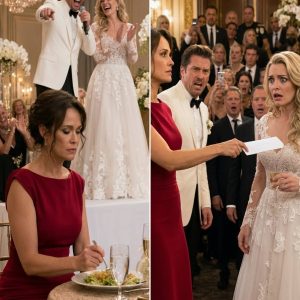
Eleanor finally found her legs. She marched over, her heels clicking like gunfire against the stone path. “Claire! What is the meaning of this? This is a private event. How dare you bring… these… children here?”
I didn’t stand up. I looked her in the eye. “You invited me, Eleanor. You told me to dress appropriately. I thought my sons should look their best for their father’s big day.”
“Don’t you dare,” she hissed, her voice low so the guests couldn’t hear, though every ear was strained in our direction. “You are a liar. You are a common girl trying to pull a common scam. These children are nothing to us.”
“They have your husband’s brow,” I said calmly. “They have your son’s eyes. And more importantly, they have a birth certificate that will stand up in any court in this state. Would you like to discuss the DNA results now, or should we wait for the priest to start?”
Grant finally stepped down from the altar. He walked toward us as if he were walking through deep water.
“Claire…” he breathed. His voice was broken.
“Mommy,” Luke said, pointing a small finger at Grant. “That man looks like the one in the box. Is he the man who was afraid?”
A collective gasp went up from the crowd. The “Whitcomb” family—the bride’s side—was looking on in horror. Senator Whitcomb was already whispering fiercely to his wife.
“Are they mine?” Grant asked. It was a pathetic question. He already knew.
“They were yours to know four years ago,” I said. “The night you watched your mother threaten to steal them from me. You chose silence then, Grant. And you’ve been living in that silence ever since.”
“I didn’t know you were actually pregnant,” he stammered. “I thought… my mother said you were just trying to trap me.”
“And you believed the woman who hated me over the woman who loved you,” I replied. “That was your choice.”
Just then, the music changed. The “Wedding March” began to play, a cruel irony.
Caroline Whitcomb appeared at the top of the aisle. She was stunning in a gown that probably cost more than my first house. She began her walk, her smile radiant—until she realized the groom wasn’t looking at her. He was looking at a woman in an emerald dress and three little boys who looked exactly like him.
Caroline stopped dead in the middle of the aisle.
The music faltered. The violinist actually hit a sour note.
“Grant?” she called out, her voice trembling. “What is going on? Who are these people?”
Eleanor tried to intercept. “It’s nothing, Caroline! Just a disgruntled former employee trying to make a scene. Security is coming to remove them!”
“Touch my children,” I said, rising to my full height, “and I will have the press, who are currently waiting at your gates, inside this garden in thirty seconds. I’ve already sent a press release to the Hartford Courant. ‘The Ashford Secret Heirs.’ Do you want that to be the headline of your wedding day, Eleanor?”
Grant looked at his mother, then at me, then at the woman in the white dress.
“I can’t do this,” Grant whispered.
“Grant, don’t be a fool!” Eleanor barked. “Think of the merger! Think of the Whitcomb endorsement!”
“Is that all I am to you?” Grant yelled, finally snapping. “A merger? I have sons! I have three sons, and you knew! You knew and you chased her away!”
Caroline Whitcomb didn’t wait for a reply. She lifted her veil, her face a mask of cold fury. She looked at Grant, then at me. She wasn’t a villain—she was just another pawn in Eleanor’s game, and she realized it.
“I will not marry a man who is a coward,” Caroline said. She turned to her father. “Dad, we’re leaving.”
The Whitcombs marched out of the garden in a flurry of white silk and indignation. The guests began to murmur, then talk, then shout.
The wedding was over. The Ashford reputation was in tatters.
But I wasn’t finished.
The Aftermath in the Garden
I gathered my sons. “Let’s go, boys. We’ve seen enough.”
“Claire, wait!” Grant scrambled after me, his tuxedo jacket flapping in the wind. He caught up to me near the fountain. “Please. Talk to me. I want to see them. I want to be a father.”
I turned to him. I looked at the man I had once thought was my entire world. He looked small.
“Being a father isn’t a title you get because you share a bloodline, Grant. It’s a job you earn by showing up when it’s hard. You didn’t show up for four years. You didn’t even check to see if I was okay.”
“My mother told me you moved to California! She said you were with another man!”
“And you believed her because it was easier than fighting for me,” I said. “If you want to know these boys, you’ll have to do it on my terms. And my first term is that they are never, ever to be near that woman.” I pointed a finger at Eleanor, who was standing on the terrace, watching her world crumble.
“I agree,” Grant said, his voice cracking. “Whatever you want.”
I walked to my car, the boys in tow. I felt a sense of lightness I hadn’t known in years. I had faced the dragon and walked out with my head held high.
But as I pulled out of the driveway, I saw a black sedan following me. It wasn’t Grant. It was a lawyer I recognized—Arthur Vance, the Ashford family’s “cleaner.”
The war wasn’t over. It was just moving from the garden to the courtroom.
The Legal Storm
Three days later, the “Emergency Custody” filing arrived at my office.
Eleanor Ashford wasn’t going down without a fight. She had convinced Grant—or perhaps coerced him—to sue for full custody, alleging that I had “kidnapped” the heirs to the Ashford fortune and was emotionally unstable.
I sat in my office at Winslow Digital, looking at the documents. Brielle was pacing the floor.
“She’s trying to take them, Claire. She has more money than God. She’ll buy the judge. She’ll buy the witnesses.”
“She can try,” I said, opening a drawer and pulling out a small, encrypted USB drive. “But Eleanor forgot one thing. I was a waitress in her house for a year. People don’t notice the help. They talk in front of us. They argue in front of us. And sometimes, they leave things behind.”
“What’s on that drive?”
“Evidence of the ‘merger’ she was so worried about,” I said. “And proof that the Ashford Estate isn’t as wealthy as they pretend to be.”
The hearing was held in a private chamber in Hartford. Eleanor arrived in her battle armor—pearls, a gray suit, and a look of supreme confidence. Grant was there, looking like he wanted to be anywhere else.
Her lawyer, Vance, began his opening statement with a scathing attack on my character.
“Ms. Winslow is a woman of low means who has manipulated these children to extort the Ashford family,” he claimed.
I waited. I let him finish. Then, my lawyer, Mara Keating, stood up. Mara was a legend in Boston—she was the woman who had taken down three Fortune 500 CEOs in divorce court.
“Your Honor,” Mara said, her voice calm and lethal. “Before we discuss custody, we need to discuss the fitness of the Ashford household. I would like to play a recording from four years ago.”
Eleanor’s eyes widened.
The audio filled the room. It was the night of the staircase. Eleanor’s voice was crystal clear, cold and predatory, threatening to “bury me under a bridge” and “steal my children.”
The judge’s expression turned to stone.
“Furthermore,” Mara continued, “we have evidence that the Ashford Estate is currently under investigation for tax evasion and that their primary holdings in Greenwich have been mortgaged three times over to cover Grant Ashford’s failed investment in a luxury hotel chain.”
Grant looked at his mother in shock. “What? Mom, you said the estate was fine!”
“Be quiet, Grant!” Eleanor snapped, but the damage was done.
The “powerful” Ashford family was a house of cards. They didn’t want my sons because they loved them. They wanted them because the “Ashford Heirs” were the only thing they had left to leverage for a new loan from the Whitcomb family banks.
I stood up. I didn’t wait for my lawyer to speak for me.
“I don’t want your money, Eleanor,” I said, looking across the table. “I have my own. I don’t want your name. I’ve made my own. But I am going to make sure that you never lay eyes on my sons again. You are not a grandmother. You are a predator.”
The judge leaned forward. “Motion for emergency custody is denied. In fact, I am issuing a temporary restraining order against Mrs. Eleanor Ashford regarding the children. As for Mr. Grant Ashford, if he wishes to seek visitation, he will do so through a court-appointed supervisor and after a full psychological evaluation.”
Eleanor slumped in her chair. The lion had finally lost its teeth.
The Final Move
As we left the courthouse, the sun was setting over the Connecticut River. Grant caught up to me on the steps. He looked broken, his expensive suit suddenly looking too big for him.
“Claire… I’m sorry. I had no idea about the money. I had no idea she threatened you like that. I was… I was a coward.”
“Yes, you were,” I said. “But the question is, are you going to stay one?”
“I want to change,” he said. “I want to be the man you thought I was when we first met.”
I looked at him for a long time. I saw the ghost of the boy I had loved. “Then start by standing on your own two feet. Get a job. Leave that house. And maybe, in a few years, my sons will want to know you.”
I walked to my car, but I stopped at the door. I looked back at Eleanor, who was being escorted to her car by her lawyer. She looked small. She looked old.
“Oh, and Eleanor?” I called out.
She turned, her eyes full of venom.
“I bought the primary note on the Greenwich estate this morning through an anonymous holding company,” I said with a smile. “I’m your landlord now. I expect the rent to be on time. And tell the gardener to take care of the roses. My sons might want to play in that garden one day, and I want it to be perfect.”
The look on her face was better than any million-dollar check.
The Victory of Peace
A year has passed since that day in the garden.
The Ashford name is no longer spoken in hushed, reverent tones in Greenwich. The scandal of the “Secret Heirs” and the financial collapse of the estate became the talk of the season. Eleanor now lives in a small apartment in New Jersey, her lifestyle funded by a modest allowance from Grant, who finally found the courage to cut her off.
Grant is working for a mid-sized firm in Boston. He’s not a king, and he’s not a mogul. He’s a man who spends his Saturdays at a park, sitting on a bench, watching three boys play soccer from a distance. He’s earned supervised visitation now. He doesn’t bring expensive toys or talk about “legacy.” He brings orange slices and knows how to fix a scraped knee.
He’s learning. And for the first time, he’s actually happy.
As for me, Winslow Digital has tripled in size. But when I come home at night, I’m not a CEO. I’m just “Mommy.”
Tonight, the rain is falling again, but it doesn’t sound like an assault. It sounds like a lullaby. I’m sitting on the floor of the boys’ room, surrounded by wooden blocks and half-finished drawings.
“Mommy?” Noah asks, looking up from his book.
“Yes, honey?”
“Are we the good guys?”
I pull him into my lap and kiss the top of his head. I look at Owen and Luke, who are already drifting off to sleep.
“We’re the ones who stayed,” I say. “And in the end, that’s all that matters.”
I realized then that my victory wasn’t in ruining a wedding or taking over a mansion. My victory was in creating a world where my sons didn’t have to be afraid of the people who were supposed to love them. I had turned their “polished insult” into the foundation of our new life.
The Ashford lion was gone. In its place, there was just a mother and her three sons, and for the first time in my life, the silence was beautiful.
If you want more stories like this, or if you’d like to share your thoughts about what you would have done in my situation, I’d love to hear from you. Your perspective helps these stories reach more people, so don’t be shy about commenting or sharing.