Chapter 1: The Gilded Cage
My husband operated under a fatal, arrogant misconception. For seven years, he truly believed I was merely a fragile, decorative ornament—a weak housewife he could systematically bruise, permanently silence, and lie about until the end of time.
He forgot that before I wore his extravagant diamond on my left hand, I had spent a decade making dead bodies speak.
For the entirety of our marriage, Evan Vance meticulously curated two distinct versions of my existence. In the sprawling, manicured estates of Fairfield County, Connecticut, he paraded me as his delicate prize. At high-society charity galas and corporate dinners, he would possessively rest his heavy hand on the small of my back, offering brilliant, predatory smiles for the local lifestyle photographers. But behind the heavy mahogany doors of our isolated mansion, his hand ceased to be an anchor. It became a weapon. His voice mutated into an iron cage, and every forced, whispered apology came wrapped in extravagant bouquets of imported hydrangeas that I was expected to dutifully arrange on the dining room table.
“You are incredibly lucky I married you, Clara,” Evan liked to whisper, his breath hot against my ear as his fingers dug into my collarbone. “Without my name, you are absolutely nothing. You’d disappear.”
His mother, Vivian Vance, was the architect of his entitlement. She was a woman who wore her vintage Mikimoto pearls like Kevlar armor and routinely inspected me with the same disdain one might reserve for a piece of heavily discounted, imitation furniture.
“She was passably pretty when you married her, Evan,” Vivian remarked one crisp autumn afternoon, sipping Earl Grey tea while I stood a mere three feet away, holding a heavy silver tray of pastries. “But women of her… pedigree… age so terribly fast when they lack a definable purpose.”
I kept my eyes glued to the Persian rug. I said absolutely nothing.
And that agonizing, forced silence was exactly what they mistook for absolute weakness.
When I surrendered my flourishing career as a forensic pathologist shortly after our honeymoon, everyone in our elite social circle readily swallowed the narrative Evan spun: that the gruesome nature of the morgue had finally broken my fragile constitution, that the sight of blood made me hopelessly faint, and that I simply preferred the quiet sanctuary of domestic life.
The reality of my resignation was infinitely uglier. Evan despised the fact that I possessed an authoritative title that preceded his own name. He loathed the nights we attended civic fundraisers where superior court judges and veteran police captains would bypass him entirely, reaching out to shake my hand with deep, reverent respect for my past expert testimonies.
So, with the slow, methodical precision of a parasite, he separated me from my vocation. Then, he cut the tether to my former colleagues. Finally, he attempted to amputate me from my own identity.
The night the illusion completely shattered, Evan stumbled through the front door at two in the morning, reeking of expensive scotch and the cheap, synthetic vanilla perfume favored by his executive assistant, Marissa. A vivid, undeniable smear of coral lipstick stained the collar of his bespoke Italian dress shirt.
I made the mistake of asking a single, quiet question.
Evan didn’t answer with words. He lunged across the kitchen island, twisting his fists into the heavy wool of my cardigan, and violently slammed my spine against the unyielding edge of the Calacatta marble counter. The air exploded from my lungs in a sharp, ragged gasp as the stone bruised my ribs.
He leaned in, his eyes dark and dilated with familiar rage. “If you ever open your mouth about this,” he hissed, his spit hitting my cheek, “I will destroy you. I will take everything. And nobody in this town will ever believe a hysterical, washed-up housewife.”
He let me drop to the hardwood floor, stepping over my gasping body as he headed up the sweeping staircase. Lying there in the cold, oppressive silence of the kitchen, staring at the flawless ceiling, a terrifying, icy clarity washed over me. Evan thought he had just issued a final warning. He had no idea he had just handed me a scalpel.
Chapter 2: The Architecture of a Lie
By noon the following day, Evan had preemptively struck. He filed for absolute divorce.
When the towering stack of legal documents arrived via a grim-faced process server, they read like a meticulously fabricated autopsy report of my character. In his sworn petition, Evan claimed I was emotionally unstable, prone to violent hysterics, financially parasitic, and suffering from severe, untreated delusions. He formally requested exclusive possession of the Fairfield estate, sole control of our joint investment accounts, and, most audaciously, an emergency restraining order against me.
He didn’t act alone. Vivian had cheerfully provided a notarized, sworn affidavit explicitly stating she had personally witnessed me “harming myself in desperate bids for attention.” Marissa, playing her part flawlessly, filed a concurrent police report claiming I had cornered her in a parking garage and issued graphic death threats.
They had built a perfect, impenetrable fortress of perjury.
What Evan failed to realize, however, was that while he was busy coordinating his high-priced legal team, I was resurrecting the ghost he thought he had buried seven years ago.
For the three agonizing months leading up to the preliminary hearing, I moved through the oppressive halls of the mansion like a phantom. I did not cry. I did not beg. I became a machine of pure, clinical observation.
Every time Evan’s temper flared into physical violence, I retreated to my locked bathroom. Under the harsh, unforgiving glare of the vanity lights, I transformed my own body into a documented crime scene. I set up a hidden digital camera on a small tripod. I used a macro lens to capture the high-resolution evolution of my injuries, always ensuring that day’s newspaper was clearly visible in the corner of the frame to establish an unbreakable timeline.
I photographed the immediate, angry red flush of blunt force trauma. I documented the transition into the deep, purplish-blue of pooling hematomas, and tracked the chemical degradation of hemoglobin as the bruises faded into sickly greens and yellows. I recorded private visits to out-of-state urgent care clinics under my maiden name, paying exclusively in cash. I secretly backed up Evan’s threatening, drunken voicemails to three separate, encrypted solid-state drives.
Once a week, I slipped out of the house at dawn, mailing sealed, tamper-evident envelopes containing hard copies of the evidence and detailed medical notes to my former mentor, Dr. Helen Park, who was now the formidable Chief Medical Examiner for the adjacent county.
Most importantly, I meticulously studied the canvas of my own abuse.
I mapped every pale scar. I calculated the geometry of every healing pattern. I measured every angle of impact. The human body does not flatter anyone. It does not care about your zip code, your bank account, or your carefully managed social reputation. It records kinetic force with brutal, unassailable honesty.
The morning of the first major evidentiary hearing, I stood in the foyer of the courthouse, buttoning my heavy wool trench coat up to the collar, deliberately hiding the constellation of fading violence etched across my shoulders and collarbone.
My attorney, a sharp, unyielding litigator named Marcus Thorne, leaned in close as the bailiff announced the docket. “Are you ready for this, Clara? Once we pull the pin on this grenade, there is no putting it back.”
I looked through the glass doors, watching Evan laugh confidently with his legal team.
“Yes,” I said quietly, the ice in my veins freezing solid. “For the first time in seven years, I am entirely ready.”
But as I walked through the heavy oak doors, I knew the true trap I had set had not even been sprung.
Chapter 3: The Theater of Justice
The interior of the Fairfield Superior Court smelled of lemon polish, old paper, and the distinct, metallic tang of institutional anxiety.
Evan sat at the petitioner’s table draped in a bespoke navy suit, impeccably clean-shaven, exuding the casual, omnipotent confidence of a man who believed he had already purchased the verdict. He smiled at me across the aisle—a slow, predatory smirk that promised absolute annihilation.
Directly behind him in the gallery sat Vivian, gently dabbing her entirely dry cheek with a monogrammed silk handkerchief. Two rows back, Marissa sat upright, the harsh fluorescent lights catching the brilliant sparkle of the diamond tennis bracelet Evan had bought her with our joint funds.
Evan’s lead attorney, a theatrical bulldog named Richard Sterling, opened the proceedings like a man passionately reading from a script he genuinely believed God himself had endorsed.
“Your Honor,” Sterling boomed, pacing aggressively before the elevated bench. “My client is a pillar of the Fairfield business community. A respected philanthropist. His wife, unfortunately, has a tragically documented history of severe emotional instability. She abruptly abandoned a promising medical career because she simply lacked the mental fortitude to handle the pressure. Now, facing the reality of a divorce she provoked, she has invented a series of heinous, fictitious abuse allegations purely to punish my client and extort his wealth.”
Evan lowered his eyes toward the plaintiff’s table at exactly the right, calculated moment, portraying the exhausted, heartbroken husband.
Then, Sterling introduced their physical evidence.
A glossy photograph of a shattered Ming vase in our hallway. A close-up of deeply scratched paint on the master bedroom door. And finally, a prominent, ugly purple bruise blooming on Evan’s right forearm.
Evan took the stand. His performance was Oscar-worthy.
“My wife… she attacked me in a blind rage,” Evan testified, his voice executing a perfectly calibrated, masculine tremble. “She was throwing glass. I simply raised my arm to defend my face, and I tried to gently restrain her until she calmed down. That’s all I ever did. I loved her. I never, ever wanted this private tragedy dragged into a public forum.”
The judge, a stern woman with decades of family court experience, watched him carefully, her pen hovering over her legal pad.
I didn’t watch Evan’s face. I watched his hands.
Throughout our entire marriage, Evan possessed a subconscious, unavoidable physical tell. Whenever he was actively, maliciously lying, his left thumb would rhythmically trace the edge of his gold cufflink. As he sat on the stand detailing my supposed violent breakdown, his thumb was spinning the gold metal like a roulette wheel.
Marcus Thorne stood up for the cross-examination. He didn’t pace. He stood perfectly still, exuding a quiet, terrifying gravity.
“Mr. Vance, I will be brief,” Marcus stated. “Did you physically strike your wife on the evening of March ninth?”
“No,” Evan replied, his thumb grazing the cufflink.
“Did you forcefully push her spine into the edge of a marble kitchen counter on that same evening?”
“Absolutely not. That is a complete fabrication.”
Marcus let the silence stretch for three agonizing seconds. “Did you ever, at any point during your marriage, utilize a leather belt, a walking cane, or any heavy metal object as a weapon against her?”
Evan’s jaw hardened, a flash of genuine, unmasked fury bleeding through his victim persona. “That is a disgusting, insulting question. No.”
From the gallery, Vivian leaned toward Marissa, her stage-whisper intentionally loud enough to carry across the quiet room. “She always was so dreadfully dramatic. It’s embarrassing.”
I sat perfectly still, my hands folded neatly in my lap.
Because while Evan and his mother performed their little soap opera, the first wire of my trap was about to pull taut.
Sterling stood back up for redirect. “Your Honor, to definitively prove Mrs. Vance’s propensity for self-inflicted hysteria, I submit exhibit D—a hospital admission record from last November, where she was treated for a supposed ‘attack.’ My client testified she threw herself down a flight of carpeted stairs during a manic episode.”
Marcus Thorne casually picked up a sheet of paper from our table. “Objection, Your Honor. Counsel is mischaracterizing the medical documentation. If you look at page two, the attending emergency physician explicitly noted the injuries were consistent with ‘suspicious, localized blunt force trauma,’ not a tumbling fall.”
Sterling waved his hand dismissively. “A vague, defensive note written by an overworked ER resident to avoid liability. It means nothing.”
Right on cue, the heavy oak doors at the back of the courtroom swung open with a loud, echoing groan.
Dr. Helen Park walked down the center aisle. She wore a razor-sharp charcoal suit, her silver hair pinned back in an austere bun, her dark eyes scanning the room with the lethal precision of a hawk. The ambient temperature in the courtroom seemed to instantly drop.
Evan’s confident smile faltered. His hand froze on his cufflink.
In the gallery, Vivian gripped her pearls, leaning forward. “Who on earth is that?” she whispered, actual confusion piercing her arrogance.
I finally turned my head, locking eyes with my mother-in-law for the first time that day.
“That,” I whispered softly, ensuring she could read my lips, “is someone who remembers exactly what I was, long before your son tried to erase me.”
Chapter 4: The Geometry of Violence
By the time the bailiff called my name to take the stand, a visible sheen of panicked sweat had broken out across Evan’s forehead, staining the crisp white collar of his shirt. He knew Dr. Park. He had met her once at a gala, years ago, and had complained the entire ride home about her intimidating, unyielding demeanor.
I stood from my chair, my movements fluid and calm. I walked up the wooden steps to the witness stand and placed my right hand flat upon the worn leather of the Bible. When I swore to tell the truth, the whole truth, and nothing but the truth, my voice did not possess a single tremor.
Before Marcus could even ask his first introductory question, Sterling leaped from his chair, his face flushed.
“Your Honor, I strongly object to the trajectory of this testimony!” Sterling shouted, gesturing wildly toward Dr. Park sitting in the gallery. “Mrs. Vance is a party to this divorce! She is a housewife! She is absolutely not qualified to act as a medical expert in her own domestic dispute!”
I didn’t look at my lawyer. I looked directly at the judge.
“Objection?” I asked, my voice echoing with a cold, clinical authority that I hadn’t used in seven years. “If opposing counsel believes I am unqualified to interpret my own medical records, Your Honor, then I ask the court to let me present the primary evidence.”
A low, confused murmur moved through the gallery. The judge narrowed her eyes, studying my face. “Proceed, Mrs. Vance.”
I stood up from the wooden chair.
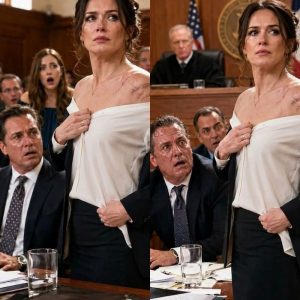
Slowly, methodically, I unbuttoned the front of my heavy trench coat. I slipped my arms out of the sleeves, letting the thick wool garment slide down my arms and pool onto the floor of the witness stand. Underneath, I wore a simple, sleeveless black shell.
The physical reaction from the room was immediate and visceral.
A sharp, collective gasp sucked the oxygen out of the courtroom. Vivian’s hand flew to her throat, not out of empathetic horror, but out of absolute, terrified realization. Marissa violently covered her mouth, her eyes wide as saucers. Evan squeezed his eyes shut, his face turning the color of ash, refusing to look at the witness stand.
The skin across my shoulders, upper back, and left bicep was a brutal tapestry of violence. Pale, crescent-shaped scars crisscrossed over faded, yellowish-green contusions.
I turned slightly, pointing my index finger to a distinct, raised white line tracking diagonally across my right shoulder blade.
“This primary laceration,” I stated, my voice ringing out with the detached, professional cadence of a medical examiner dictating an autopsy, “was caused by a narrow, cylindrical object. The impact was swung from above and slightly behind my position. If you measure the trajectory, the angle of impact is downward at approximately forty degrees. From an anatomical perspective, it is physically impossible for this specific linear trauma to have occurred from a forward, tumbling fall down a flight of carpeted stairs.”
Marcus Thorne tapped a button on his laptop. The massive digital screens mounted on the courtroom walls flickered to life, displaying the high-resolution, dated macro photographs I had taken in my locked bathroom.
“This deep-tissue contusion here,” I continued, pointing to the screen showing a massive, multi-colored bruise on my ribcage, “was documented as being between seven and ten days old when the photograph was taken. The surrounding border shows significant bilirubin breakdown. However, this secondary laceration just above it was under forty-eight hours old. The inflammatory response is still entirely localized. These represent entirely different healing stages, definitively proving different, isolated incidents of trauma. This was not one unfortunate accident. This was a sustained, calculated pattern of battery.”
Sterling scrambled to his feet, his composure entirely shattered. “Objection! Your Honor, this is rampant speculation! She is guessing!”
I snapped my gaze to him, my eyes burning with a decade of suppressed fire. “Forensic pathology is never speculation, Mr. Sterling. It is the science of measurement. And the math does not lie.”
The judge leaned heavily over her bench, her eyes locked onto the scars on my arms. “Overruled,” she snapped at Sterling. “You will let the witness finish.”
So, I did. I systematically dismantled Evan’s entire defense.
I named the specific width of the leather belt buckle that caused the abrasion on my hip. I detailed the exact brass handle of the antique walking cane Vivian proudly kept in her foyer, matching its unique curvature to the scar on my shoulder. I described the precise, ninety-degree angle of the Calacatta marble kitchen counter that perfectly matched the deep, crescent-shaped bone bruise resting just below my floating ribs.
Then, Marcus stepped forward. “Your Honor, we would like to submit exhibit F into evidence. An audio recording extracted from my client’s secure cloud storage.”
He pressed play.
The tinny, distorted, but unmistakably cruel voice of Evan Vance filled the dead silence of the courtroom.
“You think anyone will ever believe you? Look at you. You’re a pathetic, dependent housewife. If you open your mouth, I’ll tell the judge you’re crazy. And my mother will happily swear to it under oath.”
The silence that followed the recording was heavier than gravity. But Evan’s absolute destruction was only just beginning.
Chapter 5: The Collapse of the Dynasty
When Dr. Helen Park took the stand directly after me, she didn’t just corroborate my testimony; she buried Evan’s legal team under an avalanche of irrefutable, scientific evidence.
Speaking with the terrifying, unshakeable authority of a county medical examiner, Dr. Park confirmed my forensic analysis point by agonizing point. But she saved her most devastating blow for Evan’s prized piece of evidence—the photograph of the bruise on his forearm.
“The injury presented by the petitioner is highly anomalous,” Dr. Park testified, adjusting her reading glasses as she scrutinized the photo on the monitor. “The pooling pattern and the location on the medial aspect of the forearm are entirely inconsistent with a defensive wound sustained while blocking a thrown object. The specific, concentrated point of impact indicates the contusion was either self-inflicted by striking a stationary object, or deliberately staged. It is a fabricated injury.”
Sterling slumped back in his chair, dropping his pen onto the table. He was a smart enough lawyer to know when a ship was sitting at the bottom of the ocean.
Next, Marcus systematically detonated the false testimonies of Evan’s accomplices. He submitted subpoenaed security footage from Marissa’s luxury apartment complex, definitively proving she was entering her own building twenty miles away at the exact hour she claimed I was threatening her in a downtown parking garage.
He then submitted certified cellular geolocation data obtained from Vivian’s service provider. It proved conclusively that on the night she swore she witnessed me “harming myself” in the mansion’s foyer, her phone was pinging off a cell tower adjacent to a country club in an entirely different zip code.
The impenetrable fortress of their perjury had been atomized in less than an hour.
Evan, realizing his wealth, his mother, and his high-priced lawyers could no longer protect him from the sheer weight of the truth, finally snapped. The polished, charismatic businessman evaporated, revealing the feral, violently uncontrollable narcissist beneath.
He violently kicked his heavy wooden chair backward, the sound echoing like a gunshot. He slammed his fists onto the plaintiff’s table, his face contorted in a mask of absolute, unhinged rage.
“She planned this!” Evan screamed, his voice cracking as he pointed a shaking finger at me. “She manipulated the evidence! She deliberately trapped me, Your Honor! Look at her! She’s a sociopath!”
I didn’t flinch. I didn’t recoil. I sat perfectly upright, meeting his manic, bloodshot eyes with absolute, chilling serenity.
“No, Evan,” I said, my voice cutting cleanly through his chaotic screaming. “I didn’t trap you. I simply, methodically documented exactly what you chose to do.”
The judge’s gavel came down with the finality of a guillotine.
The rulings were swift, merciless, and absolute. The judge immediately granted my petition for a permanent, ironclad restraining order. She ordered the immediate freezing of all of Evan’s personal and corporate financial accounts pending a full forensic audit. She aggressively sanctioned Sterling’s legal team for willingly presenting fabricated testimony to the court.
But the most devastating blow came last. Looking down with absolute disgust, the judge formally referred Evan Vance and Vivian Vance to the District Attorney’s office for immediate criminal investigation regarding domestic battery, extortion, and felony perjury.
As the bailiffs moved in to escort a screaming, thrashing Evan out of the courtroom, I watched Marissa quietly stand up and slip out the back doors, her head hung in disgrace. Within a week, corporate investigators would uncover her role in helping Evan hide marital assets, and she would be unceremoniously fired, stripped of her severance and her reputation.
The untouchable dynasty of the Vance family had been reduced to ash in a single afternoon.
Chapter 6: The Exhumation
Six months later, the suffocating, bitter winter of Fairfield County had finally surrendered to the brilliant, forgiving warmth of late spring.
I returned to the imposing granite steps of the Superior Court, but this time, I did not arrive through the side doors as a terrified, bruised victim bracing for an ambush. I walked through the main entrance as a credentialed expert witness, subpoenaed to provide forensic pathology testimony on a complex, high-profile homicide case.
I was wearing my crisp, perfectly pressed white coat again. The heavy wool trench coat had been burned in a metal barrel behind my new building.
After delivering three hours of flawless, scientifically impenetrable testimony, I pushed open the heavy glass doors of the courthouse and stepped out into the blinding afternoon sunlight. I closed my eyes, tilting my head back, and inhaled a deep, expanding breath of clean air. For the first time in nearly a decade, there was no phantom grip tightening around my throat. There was no fear of the shadows.
My new apartment in the city was small, lacking the cavernous, echoing grandeur of the Fairfield estate. But it was profoundly, beautifully quiet. The kitchen counters were cheap laminate, not Calacatta marble, and the dining table was cluttered with vibrant, wild orchids that I bought specifically for myself, with my own money.
Evan was currently sitting in a stark, heavily guarded county cell, awaiting a highly publicized criminal trial that his remaining, bargain-basement lawyers assured him he was going to lose. Vivian’s beloved pearls had been quietly pawned to cover her mounting, exorbitant legal fees for her own perjury indictment. The sprawling, cursed mansion that had served as my prison was currently sitting empty, listed for sale at a desperate, slashed price, haunted only by the ghosts of their ruined legacy.
I walked down the concrete steps toward the street, feeling the familiar, comforting weight of my medical badge clipped to my lapel.
I rolled up the sleeves of my white coat, letting the warm spring sun bathe the faint, fading silver lines etched into the skin of my forearms. I didn’t hide them anymore. They were no longer a source of shame, nor were they a secret map of my subjugation.
For the first time in seven long, agonizing years, my body no longer felt like a documented crime scene. It no longer felt like a piece of clinical evidence waiting to be evaluated by a jury.
As I hailed a cab to take me back to the laboratory, a genuine, unbreakable smile finally touched my lips. My body was finally, irrevocably, mine.