The Fortress of Silence: A Major’s Vindication
Chapter 1: The Shadow of the Monument
The first time my father called me a fraud, the world didn’t end; it just went silent.
He was standing in a courtroom packed with strangers, his voice cracking through the stillness like a gunshot in a canyon. The court reporter’s fingers froze over the keys. The air, thick with the cloying scent of mahogany wax and the metallic tang of lukewarm courthouse coffee, seemed to solidify around me.
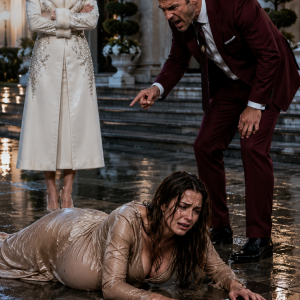
“That woman is not my daughter!” he bellowed, his finger leveled at me like a loaded weapon. “She is a liar, a thief, and an impostor wearing a uniform she never earned!”
I remember the sharp sting of the winter air still clinging to the wool of my dress blues. I remember the weight of every eye in the room turning toward me, some filled with pity, others with the voyeuristic hunger of a town that thrived on scandal. But mostly, I remember my father’s eyes—the cold, piercing blue of a frozen lake.
To understand how we got there, you have to understand Cedar Hollow, Virginia. It was a town where men like Thomas Bennett were treated like living monuments. My father had spent twenty-three years as a military police officer, retiring with a ruined knee and a personality sharp enough to cut through cold-rolled steel. People in the hollow respected him because he spoke with the cadence of a man who had survived something monumental. Perhaps he had. But by the time I was born, whatever softness he might have possessed had long since desiccated.
“Girls need stability,” he would mutter, his gaze fixed on my older brother, Jake Bennett, as they threw a football in the yard. “Men need purpose.”
I was eight years old when I realized that, in my father’s eyes, I would always be an inventory error—something to be managed, but never truly valued. When Jake crashed Dad’s truck into a row of mailboxes at sixteen, my father laughed about it for years, calling it a “rite of passage.” When I brought home a B+ in chemistry, he didn’t speak to me for three days.
My mother, Eleanor, was the only thing that kept the house from splintering. She moved through our lives with the grace of someone holding together cracked glass with trembling fingers. She was the warmth to his frost, the silk to his gravel. Late at night, she would slip into my room and brush my hair away from my face while I feigned sleep.
“You don’t have to become hard to survive him, Claire,” she whispered once, her voice a fragile thread in the dark.
I didn’t understand her then. I thought hardness was the only armor available. By the time I was seventeen, my escape plan was forged. I wasn’t leaving for a husband or a college degree; I was leaving for the only thing my father respected: the military.
The day my acceptance letter from the United States Military Academy arrived, my hands shook so violently I nearly tore the envelope. My mother wept the moment I read the words “West Point” aloud.
“Oh, Claire,” she sobbed, her hand over her mouth.
My father didn’t even look up from his steak. He cut into the meat with methodical precision. “You’ll wash out in six months,” he said, his voice flat. “You’re stubborn, Claire, but you aren’t strong. There’s a difference.”
I sat there in our dining room, the yellow wallpaper peeling near the ceiling like old skin, and felt a hole open up in my chest. Outside, the summer rain tapped rhythmically against the glass, a soft, mocking applause. Jake smirked into his mashed potatoes, and in that moment, I realized I wasn’t just fighting for a career. I was fighting for my right to exist.
But as I stared at the “wash out” who was now a Major in the United States Army, I realized my father had one more card to play—one that would threaten to erase my very identity.
Chapter 2: The Ghost of the Service
At West Point, I learned that pain is just a different kind of fuel. I learned to run until my lungs felt like they were filled with crushed glass. I learned to function on four hours of sleep and to keep my back straight while men twice my size waited for me to crumble.
They thought I was fragile. They didn’t realize I had been trained for this my entire life. Physical exhaustion was nothing compared to the emotional permafrost of my childhood. During mountain training exercises, when grown men collapsed from sheer fatigue, I kept climbing. I wasn’t faster or stronger; I was just more comfortable in the cold.
When I graduated and received my commission, my mother drove nine hours alone to see me. My father stayed behind. He claimed he had “better things to do,” which I later learned meant drinking whiskey at a fishing cabin with men who still called him “Sir.”
My career took me to Germany, then Kuwait, and eventually into assignments I couldn’t even tell my mother about. I missed holidays, funerals, and the kind of milestones that build a normal life. Meanwhile, Jake was a walking catastrophe. Failed businesses, DUIs, gambling debts—he was a black hole of crises. And every time he hit the ground, my father was there to catch him.
“That’s my son,” Thomas would say, as if those three words were a universal absolution.
The more I achieved, the more my father resented me. It wasn’t an open hatred; it was a simmering, quiet bitterness. He hated the way neighbors asked about my promotions. He hated the “Thank you for your service” comments at the grocery store. During one Christmas dinner, a family friend congratulated me on making Major.
My father snorted into his glass. “Military’s different now,” he grumbled. “Half of it’s just politics and diversity quotas.”
The table went silent. My mother looked like she wanted to disappear. That was the night I realized she had spent her entire marriage apologizing for a man who had never uttered an apology in his life.
Then, the cancer came. Pancreatic cancer. It was fast, cruel, and indifferent to our family’s fractured history. I took leave and spent six weeks at her bedside. My father rarely stayed longer than twenty minutes. He couldn’t handle the reality of a fortress he couldn’t control.
One night, after she had drifted into a morphine-induced sleep, he stood in the doorway of the hospital room, staring at me with a look of pure loathing.
“You always did love the attention, didn’t you?” he said.
I looked at him, my heart breaking for the woman dying between us. “She’s dying, Dad. How can you possibly make this about me?”
“You think you’re so special in that uniform,” he hissed. “You’re nothing.”
She died two days later. At the funeral, the town showed up in droves. They told me how proud she was of me, how she kept my formal portrait by her bed. My father didn’t speak to me once. As the mourners headed for the church basement for coffee and casseroles, he stopped me at the cemetery gates. The wind was whipping through the dead grass, biting and cold.
“The moment you chose that uniform over this family, you stopped being my daughter,” he said.
I was stunned. “I served my country, Dad. I did what you did.”
“No,” he said, leaning in close. “You tried to outshine me. And you’re going to regret it.”
Three weeks later, I was back in my kitchen in Arlington when the mail arrived. Among the bills was a thick, legal envelope. I opened it, expecting a copy of the will or some mundane probate paperwork.
Instead, I found a summons. Thomas Bennett was suing me for my mother’s house, her life savings, and every asset she had left behind. But it was the legal basis for the claim that made the room spin.
Claim filed under Disputed Paternity.
My father was claiming that I wasn’t his biological child. He wasn’t just taking the money; he was trying to erase me from the earth.
Chapter 3: The Architecture of Betrayal
I didn’t sleep that night. I sat at my kitchen table while the silver streaks of rain slid down the windowpane, reading the same sentence over and over until the words lost their meaning. Disputed Paternity. It was a surgical strike. By claiming I wasn’t his daughter, he was attempting to invalidate my status as a legal heir under a specific, archaic clause in their pre-nuptial agreement that he’d dug up from decades ago.
At 3:00 AM, I called Jake. I don’t know why. Maybe I hoped there was a shred of decency left in the brother I used to protect from the neighborhood bullies.
“You knew about this?” I asked when he picked up.
Silence. Then a heavy sigh. “Dad’s doing what he has to do, Claire. He’s retired, his pension isn’t what it used to be, and Jake… well, I’ve got debts.”
“He’s claiming Mom was an adulteress,” I whispered, my voice trembling. “He’s dragging her name through the dirt for a house she paid for with her own inheritance.”
“So?” Jake snapped. “You were always her favorite. You have your big Army salary and your ‘important’ life. We’re the ones who stayed. We’re the ones who dealt with him.”
“You stayed because you’re a parasite, Jake,” I said, and hung up.
The lawsuit became the talk of Cedar Hollow. The local paper ran a headline that felt like a hot iron to my skin: Decorated Female Officer Accused in Family Fraud Case.
Suddenly, my service was a liability. Because so much of my work was classified, I couldn’t provide a line-by-line accounting of my time overseas to the public. Suspicion grew like mold. People I’d known since kindergarten started crossing the street when they saw me.
I knew I needed help. I sought out Evelyn Brooks, a legendary attorney recommended by an old Colonel friend. Her office sat above a hardware store on Main Street, smelling of peppermint tea and old law books. Evelyn was in her late sixties, with silver hair and eyes that could see through a brick wall.
“Your father isn’t just grieving, Claire,” she said, looking over the documents. “He’s a tactician. He’s using your security clearance against you. He knows you can’t talk, so he’s filling the silence with lies.”
“He’s my father,” I said, the word feeling like ash.
“No,” she corrected firmly. “He is the plaintiff. And he is trying to destroy you. Now, tell me about your service record. Is there anything—anything at all—that proves your identity beyond a birth certificate?”
I hesitated. I thought about the locked briefing room in the basement of the Pentagon three years ago. I thought about the sealed blue envelope the General had handed me.
“If your integrity is ever challenged,” the General had said, “this is your shield. But once you break the seal, there is no going back.”
“I might have something,” I told Evelyn. “But it’s protected under a federal seal.”
Evelyn leaned forward. “Claire, if we go to court, he’s going to bring in ‘witnesses’ to say you fabricated your medals. He’s going to paint you as a ghost. Are you ready to stop being a ghost?”
I nodded. That night, I drove to a secure storage facility in Alexandria. The wind was howling as I unlocked my unit and pulled out an old, scratched military footlocker. At the bottom, beneath my dress uniforms and my mother’s old letters, sat the flat black case. The wax seal, embossed with the Department of Defense insignia, was still intact.
I held it in my hands, feeling the weight of the secrets inside. My father thought he knew me. He thought he could bully me into a corner because I was “just a girl who ran away.” He had no idea that the girl who ran away had become a woman who knew exactly how to dismantle an enemy.
As I walked into the Fairfax Courthouse the next morning, I saw my father and Jake sitting with their lawyer, smiling. They thought they had already won. They didn’t realize I wasn’t there for a settlement. I was there for a court-martial.
Chapter 4: The Breaking of the Seal
The preliminary hearing felt more like an execution. My father’s attorney, Richard Vance, was a man who smelled of expensive cologne and cheap ethics. He spent forty-five minutes painting a picture of me as a manipulative, absentee daughter who had “allegedly” served in the military to escape her responsibilities.
“Your Honor,” Vance said, gesturing toward me with a flourish. “Major Bennett’s records are suspiciously vague. We have reason to believe her ‘heroic’ service is largely a fabrication designed to garner sympathy and secure an inheritance she doesn’t deserve.”
I looked at my father. He was leaning back in his chair, a smug, self-satisfied grin on his face. He wanted to see me cry. He wanted to see me break.
“Major Bennett,” Judge Harold Whitmore said, his voice gravelly. “The court is struggling with the lack of verifiable data regarding your deployments between 2014 and 2019. Can you provide any clarity?”
Evelyn stood up. “Your Honor, we would like to submit Exhibit D. It is a federally sealed document protected under the National Security Act, but authorized for judicial review in cases of identity verification.”
The courtroom went dead quiet. Vance scoffed. “A secret envelope? This isn’t a spy novel, Your Honor.”
“Sit down, Mr. Vance,” the Judge muttered. He signaled the bailiff to bring the black case to the bench.
I watched the Judge’s face. He used a small letter opener to break the blue wax seal. He pulled out several sheets of heavy, cream-colored paper. As he read, the color slowly drained from his cheeks. He stopped, looked at me, then looked at my father.
He read for ten minutes in total silence. The only sound was the ticking of the clock on the back wall.
“Mr. Bennett,” the Judge said, his voice now dangerously quiet. “You claimed your daughter was an ‘office clerk’ who fabricated her accomplishments?”
“That’s right,” my father said, standing up. “She’s a liar. Always has been.”
The Judge slammed his gavel so hard the sound echoed like a thunderclap. “Everyone in this courtroom will stand up right now!”
People scrambled to their feet, confused and frightened.
“Mr. Bennett,” the Judge continued, his eyes burning. “This document is a direct commendation from the Secretary of Defense. It details your daughter’s role in three separate high-risk diplomatic extractions. It verifies that she is not only who she says she is, but that she has served this nation with a level of distinction that you—in your twenty-three years of policing parking lots—couldn’t possibly comprehend.”
My father’s face went from smug to pale in seconds.
“Furthermore,” Evelyn stepped forward, “we have the results of the subpoenaed county archives. Your Honor, in 2004, Thomas Bennett filed a private petition to reduce child support payments by certifying—under oath—that Claire Bennett was his biological child. He did this to avoid a larger settlement during a period of debt.”
The gallery gasped. Jake looked at his father in horror. “Dad? You lied about the paternity test?”
“I… I was protecting the estate!” my father stammered.
“No,” the Judge said. “You were committing perjury. And you were attempting to use this court to carry out a personal vendetta against a decorated officer.”
Suddenly, the doors at the back of the courtroom opened. Two men in dark, charcoal suits entered. They didn’t have badges, but they didn’t need them. The air in the room changed—it became heavy, professional, and terrifying.
One of the men walked up to the bench and handed a set of papers to the Judge.
“It seems,” Judge Whitmore said, a grim smile on his face, “that the federal government has taken an interest in your attempts to illegally access Major Bennett’s classified personnel files six months ago. Mr. Bennett, you aren’t just losing this case. You are under federal investigation.”
My father collapsed back into his chair, looking like a man who had suddenly aged twenty years. I stood there, my back straight, my uniform crisp, and for the first time in my life, I didn’t feel the need to look at him for approval.
The “monument” of Cedar Hollow had finally crumbled into the dust.
Chapter 5: The Dawn After the Storm
The aftermath was a blur of legal motions and public apologies. The same neighbors who had shunned me now left gift baskets on my porch. I didn’t want them.
Judge Whitmore dismissed every claim my father had made. The house, the savings, and the legacy of my mother were preserved. Jake fled to Florida a week after the hearing, leaving my father to face the federal inquiry alone.
I returned to my mother’s house in the spring. I didn’t sell it. Instead, I opened the windows and let the air out of the rooms that had been suffocated by my father’s bitterness for so long. I stripped the yellow wallpaper and painted the walls the color of the morning sky.
I found a cedar chest in the attic, hidden behind some old blankets. Inside were letters my mother had written to me over the years—letters she was too afraid to mail.
“Claire,” one read, “He fears your strength because he doesn’t have any of his own. Don’t ever let his darkness put out your light.”
I sat on the floor of the attic and cried—not for the father I lost, but for the mother who had loved me from the shadows.
A few months later, I established a scholarship fund in her name: The Eleanor Bennett Grant for Military Daughters. I wanted to make sure that other girls from towns like Cedar Hollow knew that their worth wasn’t defined by the men who failed to love them.
One evening, as I was working in the garden, a shadow fell across the grass. I looked up to see my father. He looked frail, his once-sharp eyes clouded with age and defeat. He stood by the gate, his hands trembling in his pockets.
“Claire,” he said, his voice a ghost of the roar it used to be. “I just… I wanted to say your mother would have liked the garden.”
I looked at him—this man who had tried to erase my life—and I felt something I never expected. I felt pity.
“I know she would, Dad,” I said softly.
He waited, perhaps for an invitation, perhaps for a word of forgiveness. But some things cannot be mended with a single conversation. Some wounds are too deep for a simple apology to bridge.
“Goodbye, Dad,” I said.
He nodded slowly, turned, and walked away into the twilight.
I watched him go, and then I turned back to my garden. The sun was setting over the hills of Virginia, painting the world in shades of gold and purple. For the first time in my life, I wasn’t a daughter, an officer, or a fraud.
I was just Claire. And that was more than enough.
If this story of resilience and justice resonated with you, please like and share this post.
Have you ever had to choose between protecting your peace and protecting your family’s image? We’d love to hear your story in the comments below. Stay tuned for more stories of strength, betrayal, and second chances.
Subscribe and stay with us for the next journey.