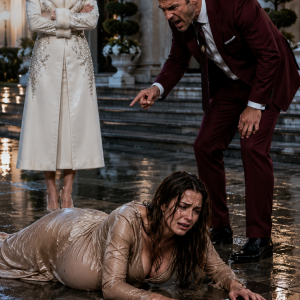
The Bleach-Scented Battleground: My Chronicle of a Domestic Coup
Chapter 1: The Scent of a Clean Crime
I returned from the front lines on a humid Thursday afternoon, carrying nothing but a mud-stained duffel bag, a bad knee that throbbed with every step, and a fragile chest full of hope. My name is Ethan Carter. For fourteen grueling months, I had lived in the dust and the noise of overseas deployment, anchored only by the mental image of my small brick house in Waverly, Ohio. I dreamt of the creak of the porch swing, the smell of my mother Linda’s pot roast, and the feel of my wife Rebecca’s hands—hands I remembered as soft, quick, and always reaching for mine.
I thought I was marching toward peace. I didn’t realize I was walking into a different kind of war—one where the enemy wears your wedding ring and the casualties are hidden behind closed doors.
The first thing that hit me wasn’t the warmth of home. It was the smell. It didn’t smell like cinnamon or old books. It smelled like Industrial Bleach. The scent was so sharp it stung the back of my throat, a sterile, clinical odor that seemed to be trying to scrub the very soul out of the house.
Rebecca met me at the door. She threw her arms around my neck with a frantic intensity that almost knocked me off my balance.
“You’re home,” she whispered, her voice a jagged mix of laughter and tears.
I pulled back to look at her. She was thinner, her collarbones standing out like knives under her skin. Her eyes, which used to be steady, kept darting over my shoulder, scanning the empty street as if she were waiting for an audience to appear. Shadows were etched deep into the corners of her eyes—a map of sleeplessness I didn’t recognize.
“Where’s Mom?” I asked, the duffel bag suddenly feeling like it was filled with lead.
“In her room,” Rebecca said, her response coming a fraction of a second too fast. “She’s resting. It’s been a very difficult few months, Ethan. The age… it’s finally catching up to her. She’s been so confused.”
That answer sat wrong in my gut. My mother, Linda Carter, was sixty-eight years old, but she was a woman of perpetual motion. She was the kind of person who gardened until her fingernails were permanently stained with earth and folded towels that were already crisp. She didn’t “rest” at 2:00 PM on a Thursday.
I walked down the hallway, my boots echoing on the hardwood. I found her door half-shut, the room plunged into a gloom that smelled of stale air and unwashed fabric. My mother was sitting on the edge of her bed, her spine curved like a question mark. She was wearing a heavy, long-sleeved wool sweater, despite the fact that the thermostat was set to seventy-four.
“Mom?”
She flinched. It wasn’t a small movement; it was a full-body jolt, as if the sound of my voice were a physical blow. She looked at me, and for a terrifying five seconds, I saw a stranger trying to place my face. Then, the recognition hit her, and she stood up, trembling.
When I hugged her, she winced—a sharp, hissed intake of breath. I pulled back just enough to see a flash of deep, purplish bruising near her collarbone before she frantically tugged the heavy wool of the sweater closed.
“Mom, what happened to your neck?”
“Nothing,” she stammered, her eyes wide and glassy. “I’m just… I’ve become so clumsy lately, Ethan. I keep tripping over my own feet.”
Rebecca appeared in the doorway then, her smile bright and brittle, like shattered glass. “I told you, honey. She had a terrible fall in the kitchen last week. She’s been so disoriented. I’ve been doing everything I can to keep her safe.”
My mother looked down at her lap, her face twisted with a shame so profound it made my heart ache. She didn’t look confused. She looked hunted.
I didn’t know it yet, but the bleach wasn’t there to clean the floors; it was there to wash away the evidence of a slow-motion execution.
Chapter 2: The Anatomy of a Lie
The tension in the house was a physical weight, a thick, suffocating fog that seemed to dampen every sound. Over dinner, Rebecca talked incessantly. She spoke about the neighbors, the rising cost of groceries, and the “burden” of maintaining the house while I was away. She spoke about my mother as if she weren’t sitting right there—a ghost at her own table.
“She forgets her pills, Ethan,” Rebecca said, gesturing toward my mother with a fork. “I have to watch her like a hawk. It’s exhausting. Sometimes she gets… aggressive when she’s frustrated.”
My mother pushed a pea around her plate, her lips pressed into a thin, white line. She didn’t offer a rebuttal. She didn’t even look up. The woman who used to command the room with her stories was gone, replaced by a shadow that seemed to be trying to disappear into the chair.
I spent the evening watching. My military training—the ability to read a room, to identify a threat before it strikes—was screaming at me. I noticed the way my mother moved, favoring her left side. I noticed the way she flinched whenever Rebecca’s hand moved too quickly near her.
“I’m going to take her medication to her room,” Rebecca said after dinner, her voice airy and sweet.
“I’ll do it,” I said, standing up.
“No, Ethan. You’re tired. You have a bad knee. Sit. Let me handle the difficult parts.”
She took the plastic orange bottles from the counter and ushered my mother toward the hall. I sat in the living room, staring at the television without seeing it. Ten minutes later, I heard a dull, heavy thud followed by a sharp, metallic clink.
I was through the kitchen door before the sound had even finished echoing.
My mother was on the floor, her cheek pressed against the cold tile. Blood was smeared across the white surface—a vivid, shocking red against the bleached floor. Two broken teeth lay near the baseboard of the cabinet, looking like small, white pebbles.
Rebecca was standing over her, her chest heaving, her face a mask of cold, flat fury. When she saw me, the mask slipped. She instantly pivoted into a look of panicked concern, her hands flying to her mouth.
“I was protecting your mother!” she cried out.
I ignored her. I dropped to my knees beside my mother, my hands steady even as my blood began to boil. I pulled her head into my lap, using a clean napkin to stem the flow of blood from her mouth.
“Mom, look at me,” I whispered. “Did she do this? Tell me the truth.”
My mother’s eyes flicked toward Rebecca, who was standing by the stove, her arms folded tightly across her chest. The fear in my mother’s eyes was absolute. She didn’t speak. She just gripped my wrist with a strength I didn’t think she had left, her fingernails digging into my skin. She pulled me close, her breath smelling of copper and salt.
“She’s not done yet,” my mother hissed through the blood.
Rebecca stepped forward, her voice rising in a defensive pitch. “You need to calm down, Ethan. You’re being dramatic. She came at me! She was hysterical because I tried to give her the blood pressure pills. She tripped and hit her face on the counter. It was an accident!”
The lie was so thin I could see the malice through it. My mother, a woman who couldn’t even stand without help, “coming at” a woman twenty years younger?
“An accident?” I said, my voice sounding like gravel. “She knocked out her own teeth in an ‘accident’ while you were ‘protecting’ her?”
“You’ve been gone too long!” Rebecca shouted, her face reddening. “You don’t know what it’s been like! She’s lost her mind, Ethan! She’s dangerous!”
As I looked at the two teeth on the floor, I realized I hadn’t come home to a sanctuary. I had come home to a slaughterhouse where the butcher was the woman I loved.
Chapter 3: The Call to Arms
The paramedics arrived twenty minutes after I dialed 911. Rebecca had tried to stop me, her hand clawing at the phone, her voice shifting between begging and threats.
“If you call them, you’re choosing her over our marriage, Ethan!” she had hissed, her face inches from mine. “I’ve sacrificed everything for this family while you were playing soldier! If you do this, we are over!”
“You put my mother on the floor, Rebecca,” I said, my voice dead. “The marriage ended the moment you touched her.”
She stormed out of the kitchen, and I heard the sound of drawers slamming in our bedroom. I sat on the floor with my mother, the dish towel now soaked with blood.
“How long, Mom?” I asked quietly. “How long has this been happening?”
Her hands shook in her lap like autumn leaves. “Since the day you left, Ethan. Almost from the moment the car pulled out of the driveway.”
I felt a wave of nausea so powerful I had to close my eyes. “Why didn’t you tell me? Every week on the video calls… you smiled. You said you were fine.”
“She was always behind the camera,” Mom murmured, her voice trembling. “She told me if I said a word, she’d put me in a home where no one would ever visit. She said she’d tell the neighbors I was hitting her. She took my phone, Ethan. She hid my medication so I’d feel dizzy and confused. She told everyone I was losing my mind so that if I ever did speak up, no one would believe a ‘crazy old woman.'”
Every word was a jagged shard of glass in my heart. Rebecca had been building a case for months. She had been planting seeds of doubt in the minds of our friends, our neighbors, even our doctor. She had been gaslighting my mother into a prison of silence.
The paramedics and two deputies from the Waverly Sheriff’s Office filed into the kitchen. They took one look at the blood, the teeth, and the bruising on my mother’s arms, and the atmosphere in the room changed instantly.
Rebecca came back into the living room then, a packed suitcase in her hand. Her face had changed again. The fury was gone, replaced by a composed, professional mask of “the weary caregiver.”
“She’s elderly and very confused, Officer,” Rebecca told the deputy, her voice steady and calm. “My husband just got home from deployment. He’s very emotional, very prone to outbursts. He doesn’t understand the reality of her dementia.”
The deputy, a man named Miller with twenty years on the force, didn’t look at her. He looked at my mother’s forearms. He saw the deep, jagged scratch marks—defensive wounds—and the old, yellowing bruises near her wrists where she had been gripped too hard.
“Ma’am,” Miller said, his voice flat. “I’m going to need you to sit down and stop talking.”
I followed the ambulance to the Waverly Community Hospital. I stayed in the room while the doctors examined her. The report was a chronicle of horror. Rib tenderness from a blunt-force impact weeks prior. Dehydration. Missed doses of essential medication that had caused her heart rate to spike to dangerous levels.
A social worker named Sarah came in. She asked me to step out so she could speak to my mother privately. Ten minutes later, she emerged, her face pale.
“She’s terrified to go back, Ethan,” Sarah said. “She says she hasn’t felt safe in her own home for a year.”
I leaned against the hospital wall, my bad knee finally giving out. I slid down to the floor and buried my face in my hands. I had spent fourteen months worried about snipers and IEDs, never realizing that the greatest threat to my family was sleeping in my own bed.
By sunrise, the police had obtained a warrant to search the house, and what they found on Rebecca’s phone would turn my stomach into lead.
Chapter 4: The Digital Smoking Gun
The deputies found the “Blueprint for Betrayal” hidden in plain sight on Rebecca’s secondary cloud storage. She hadn’t just been abusing my mother; she had been documenting it like a twisted trophy hunt.
There were messages to a friend in Cincinnati that dated back to my third month of deployment.
“I’m stuck babysitting the old bat,” one read. “She’s so clingy. She won’t stay in her room. I’m starting to understand why people just leave them at the mall.”
As the months progressed, the texts became more sinister.
“She’s weaker now. It’s getting easier to keep her quiet. I told the mailman she’s having ‘episodes’ again. Everyone thinks she’s losing it. I’m going to move her into a facility whether Ethan likes it or not. This house is mine now.”
But the most chilling discovery was the video clips. Rebecca had taken short, ten-second videos of my mother during moments of extreme stress—moments Rebecca herself had triggered.
In one video, my mother was sobbing, huddled in the corner of the laundry room. Rebecca’s voice could be heard off-camera, a low, mocking hiss: “Look at you. You’re pathetic. No wonder your son left. He wanted to get away from you. He’s never coming back for you.”
Rebecca had saved these videos as “proof” to show me if I ever questioned her. She was going to show me my mother’s “breakdown” to justify putting her in a locked ward. She had been architecting a reality where my mother was a burden and she was the long-suffering saint.
When the detective showed me the transcripts, I felt a cold, jagged fury coiling in my chest. It was a rage more dangerous than anything I’d felt in the trenches.
Rebecca was arrested at her sister’s house at noon on Friday. She was charged with Elder Abuse, Assault in the Second Degree, and Domestic Surveillance.
I went to the jail for the arraignment, not because I wanted to speak to her, but because I wanted her to see my face. I wanted her to see the man she thought she could deceive.
She stood behind the plexiglass, her eyes red, her hair unwashed. When she saw me, she tried one last time to pivot.
“Ethan, please,” she sobbed into the handset. “I was under so much pressure. I didn’t mean it. The house… the isolation… I just snapped. You have to help me. If I go to prison, I’ll die.”
“You already died to me, Rebecca,” I said, my voice like a serrated blade. “The woman I married wouldn’t have put my mother on the floor. The woman I married wouldn’t have mocked an old woman for crying.”
“I did it for us!” she shrieked, her face contorting. “I wanted our life back! I wanted her gone so we could be a family!”
“We were a family because of her,” I replied. “Now, we’re just a crime scene.”
I hung up the phone and walked out of the station. I didn’t look back when she started screaming my name.
The divorce papers were served to her in her cell forty-eight hours later. I didn’t ask for the house or the car. I just asked for my name back.
Chapter 5: The Fragile Peace
My mother moved in with my Aunt Carol in the countryside while the legal proceedings moved forward. The house in Waverly—the one I had dreamt of for fourteen months—felt like a tomb. I couldn’t stand the smell of it. Even after I scrubbed every inch of the floors, I could still smell that industrial bleach. I could still see the smear of blood on the white tile.
I spent my days at Aunt Carol’s porch, sitting with my mother. Slowly, painfully, the woman I knew began to return.
The bruises faded from her neck and wrists, but the psychological scars were deeper. For the first few weeks, she would apologize for everything—for dropping a spoon, for being thirsty, for existing. It took months of therapy and the constant, quiet presence of family to convince her that she wasn’t a burden.
“You came home when I needed you most,” she said one afternoon, her hand resting on mine.
I looked at the rolling hills of the Ohio countryside, my heart heavy with a guilt I knew I’d carry for a long time. “I came home late, Mom. I should have seen it. I should have known.”
“How could you have known?” she asked. “She was the person you trusted most. Evil doesn’t always look like a monster, Ethan. Sometimes it looks like a clean house and a warm smile.”
Rebecca was eventually sentenced to four years in a state correctional facility. Because of the evidence of premeditation and the video recordings, the judge showed no leniency. At the sentencing, the detective played the audio of Rebecca mocking my mother. The entire courtroom went silent. Even Rebecca’s own sister turned her head away in shame.
I sold the brick house in Waverly. I couldn’t live in a place where the walls held the echoes of my mother’s screams. I bought a smaller place, a quiet cottage near Aunt Carol’s, with a large garden and a kitchen with warm, wooden floors. No white tiles. No bleach.
My mother lives with me now. She has her own wing of the house, filled with her plants and her books. She doesn’t “rest” in the middle of the day anymore. She’s too busy teaching the neighbor’s kids how to plant tomatoes and arguing with me about the best way to fold a fitted sheet.
Sometimes, I wake up in the middle of the night, my knee aching, the phantom sounds of the desert still ringing in my ears. I’ll walk down the hall to the kitchen, and I’ll see the light on. I’ll find my mother sitting at the table with a cup of tea, the house smelling of lavender and old-fashioned peace.
We don’t talk much about that Thursday afternoon. We don’t have to. We both know that the war is over.
I still have scars—the ones from the army and the ones from the home front. But as I watch my mother laugh at a joke on the radio, I realize that some things are worth fighting for, even if the battleground is your own living room.
Abuse thrives in the silence of the “good” people. it hides behind the curtains of the houses we think are perfect. If you’re reading this and you feel that something is wrong in a house you know—if the smiles feel too bright or the “clumsiness” happens too often—don’t look away.
Trust your gut. Ask the hard questions. Because for some people, the only hope they have is the person brave enough to break the silence.
Like and share this post if you find it interesting.