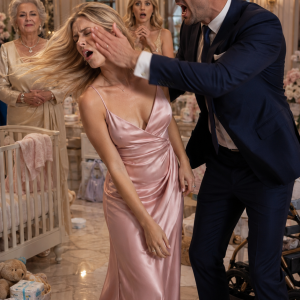
The Rose Garden’s Verdict
If you have ever been told that silence is a form of submission, that gentle women fade into the beige wallpaper of history, or that kindness is a currency that buys you nothing but disrespect, I need you to sit with this story. I need you to understand that the loudest person in the room is rarely the one holding the detonator.
My mother proved the world wrong in the most devastating, poetic, and legally explosive way imaginable. She didn’t fight fire with fire; she fought it with water—a slow, rising tide that drowned her enemies before they even realized their feet were wet.
My name is Lena Hartwell, I am thirty-four years old, and three days ago, I stood in the velvet hush of the Fairmont Memorial Chapel. The air was thick with the scent of lilies and expensive hypocrisy. I was surrounded by mourners drowning in black fabric and whispered sympathy, all of them staring at the gleaming ivory casket that held my mother, Margaret Hartwell. To them, she was a tragedy. To my father, she was an erased footnote, a burden he had finally escaped.
He wasn’t there to watch her being lowered into the earth. He wasn’t there to hold my hand or weep for the woman he had been married to for thirty-five years.
No. Gregory Hartwell was in Cancun.
He was sipping tequila on a white sand beach, celebrating his newfound “freedom” with his mistress. He thought the war was over. He thought he had won simply by outliving her.
And then, right as the priest began the final commendation, my phone buzzed against my thigh.
I looked down, my vision blurred by tears. It was a text message.
From my mother’s number.
Section C. Plot 19. Come alone. Now.
My blood ran cold. The phone felt heavy, like a stone in my hand. Before I tell you what we dug out of that graveyard, you need to understand the weeks leading to that moment—the deceit, the staggering arrogance, the betrayal, and the quiet, terrifying brilliance of a woman my father assumed would die without making a sound.
Chapter 1: The Architecture of Silence
The hospital room smelled of bleach, stale coffee, and surrender. It is a specific scent, the olfactory profile of waiting for the inevitable. Machines hummed and blinked in a rhythmic, indifferent cadence, trying to keep pace with time my mother didn’t have.
I sat by her bedside, holding her hand. Her skin was like parchment paper, translucent and fragile, barely covering the blue veins beneath. But her grip? Her grip was iron.
My father, Gregory, was leaning against the far wall, the harsh fluorescent light reflecting off his Rolex. He was scrolling through his phone, a look of profound boredom etched onto his handsome, aging face. He checked his watch every three minutes, as if death were a meeting running overtime.
“Gregory,” my mother whispered. Her voice was a dry rattle, like autumn leaves skittering on pavement.
He didn’t even lift his head.
“I have to take this,” he announced to the room at large, though no phone had rung. “Critical business matter. The merger in Tokyo.”
He left the room with relief in his stride, the heavy door clicking shut behind him. He didn’t look back. He never looked back.
I knew, just as my mother knew, that there was no merger in Tokyo. The “business matter” had a name. Celeste Monroe. She was a thirty-six-year-old “strategic consultant” who had been strategically entwined in my father’s life—and his finances—for six years. The neighbors knew. The country club knew. The entire city of Savannah probably knew. But the Hartwell family did not talk about disgrace. We swallowed it, polished it, and pretended it was dignity.
When the door clicked shut, the atmosphere in the room shifted. My mother pulled me closer, her eyes suddenly clear, burning with a lucid intensity that frightened me.
“You think you are soft, Lena,” she whispered, her breath hitching. “You think softness means losing. You think because you don’t scream, you aren’t heard.”
“Mom, please, rest,” I soothed, wiping a bead of sweat from her forehead.
“Listen to me,” she commanded, her voice gaining a surprising edge. “Cruelty is loud. Justice is quiet. Your father… he mistakes silence for emptiness. He thinks because I didn’t fight him at the dinner table, I wasn’t fighting him at all.”
She reached under her pillow and pulled out a small, heavy key. It looked old, like something that belonged to a diary from a different century.
“Tonight,” she said, pressing the cold metal into my palm. “A woman named Miriam Vale will come to the house. You let her in. You sign what she tells you to sign. And you do not tell your brother.”
“Evan?” I asked, confused. “Why not Evan?”
My brother, Evan, was the logical one. The peacekeeper. He worshipped our father, always defending Gregory’s “vision” and “burden.”
“Because Evan chose his side,” she said, a tear finally escaping the corner of her eye. “The roses, Lena. When they bloom, the truth blooms too.”
I thought it was the morphine talking. I thought she was drifting into poetic nonsense in her final hours.
That night, my mother died. I was holding her hand when the monitor flatlined, turning its rhythmic beep into a singular, unending tone of loss.
My father was at a rooftop bar in Beverly Hills, laughing in a photograph that Celeste posted on Instagram at the exact moment my mother’s heart stopped. The caption read: New beginnings.
I stood in the silent hospital room, the key burning a hole in my pocket. I didn’t know it then, but my mother hadn’t just left me a key. She had handed me a grenade, and pulled the pin.
As I walked out of the hospital, into the humid night air, I saw a black sedan idling at the curb. The window rolled down, and a woman with sharp eyes and silver hair looked out. “You must be Lena,” she said. “We have work to do.”
Chapter 2: The Vultures in the Garden
The morning of the funeral, the Hartwell estate felt less like a home and more like a hotel lobby under new management. It was busy, polished, and utterly heartless.
Celeste Monroe was in my mother’s kitchen.
She hadn’t even waited for the body to be buried. She stood by the granite island, rearranging the catering platters as if she had lived there for a decade. She was wearing a black dress that was cut too low for mourning and high enough for a cocktail party. But what made my stomach churn wasn’t the dress.
It was the necklace.
Around her neck sat the Hartwell Sapphire—a deep, midnight-blue stone that had belonged to my grandmother. My mother wore it every Christmas.
“Lena, darling,” Celeste cooed when I walked in, her voice dripping with artificial sweetener. “You look exhausted. You really should rest. Your father is absolutely shattered, you know. He couldn’t handle the logistics of today. I told him, ‘Gregory, let me handle it. That’s what strong women do.'”
“Strong?” I echoed, my voice trembling. “Is that what this is?”
“We have to be practical,” she said, touching the sapphire with a possessive stroke. “Life goes on. The caterers were late, so I fired them. I brought in my own team. Oh, and the landscapers are coming tomorrow.”
“Tomorrow?” I asked. “To do what?”
“To clear the garden,” she said casually, popping a grape into her mouth. “Gregory and I agree. Those rose bushes are ancient. They’re full of thorns and beetles. We’re putting in a zen rock garden. More modern. Cleaner.”
My heart hammered against my ribs. The roses. When they bloom, truth blooms too.
My brother, Evan, walked in then, adjusting his tie. He looked pale, but his eyes were hard.
“Don’t start drama, Lena,” he warned, stepping between me and Celeste. “Dad is under a lot of stress. He’s trying to hold it together.”
“He’s in Cancun, Evan!” I snapped. “He’s flying back this morning, hungover, for his wife’s funeral. That isn’t stress. That’s narcissism.”
“It’s grief,” Evan countered, his jaw tight. “Everyone grieves differently. Just… let Celeste help. Dad needs this house to feel… new. To move on.”
I looked at my brother, really looked at him. He was wearing a watch I had never seen before—a Patek Philippe. It was worth more than my car. A gift from Dad? A bribe?
I walked out the back door, needing air. I went straight to the rose garden. It was a labyrinth of thorny vines and explosion of color—reds, pinks, and whites. My mother had spent thirty years tending this soil. It was her sanctuary.
I knelt by the oldest bush, a massive ‘Grandiflora’ that twisted like a sculpture. And there, tucked behind the trellis, hidden from casual view but visible if you knew where to look, was a small, wax-sealed envelope.
I tore it open. My mother’s handwriting, shaky but distinct:
Don’t speak. Don’t fight yet. Watch. Wait. Then strike. Trust Miriam.
I pocketed the note just as the church bells began to toll in the distance. The funeral wasn’t going to be a farewell. It was going to be a battlefield.
I drove to the chapel with a sense of impending doom. Two hundred people filled the pews. My father’s reserved seat in the front row sat empty. Celeste, with zero shame, took the seat next to it.
The service began. The priest spoke of Margaret’s kindness, her quiet nature, her charity.
And then, the chapel doors slammed open.
He stumbled in.
Gregory Hartwell.
He was sunburned, peeling on the nose, his hair disheveled. He reeked of stale airplane air and expensive tequila. He didn’t look like a grieving widower; he looked like a man who had gotten lost on his way to a frat party.
He swaggered down the aisle, ignoring the gasps of the congregation. He stopped at the front row, grabbed Celeste’s hand, and pulled her to her feet.
He turned to the crowd, swaying slightly.
“Life is short,” he slurred, his voice booming in the acoustic space. “Margaret is gone. She was… she was tired. She was heavy. But we are still here.”
He lifted Celeste’s hand high. The sapphire glinted under the church lights.
“Time to celebrate something new. We’re engaged.”
The silence in the room was absolute. It sucked the air out of the building.
“House renovations start Monday,” he added cheerfully, seemingly oblivious to the horror on everyone’s faces. “Those damn roses go first. Out with the old, in with the new.”
He wasn’t just humiliating her memory. He was erasing her existence.
And then, it happened.
Every phone in the chapel vibrated at once. A collective hum that sounded like a swarm of angry bees.
I looked at mine.
Section C. Plot 19. Bring everyone.
I stood up. “Everyone,” I said, my voice cutting through the shock. “We need to go to the cemetery. Now.”
Gregory laughed, a harsh, barking sound. “The burial isn’t for another hour! Sit down, Lena.” But I was already walking out the door, and the entire congregation was following me.
Chapter 3: The Voice from the Earth
Section C of the cemetery was the oldest part, shaded by massive live oaks draped in Spanish moss. The wind brushed against the headstones like fingers pushing aside secrets.
Plot 19 was fresh. But there was no hole dug for a coffin. Instead, there was a pristine, polished granite bench, and in front of it, a strange, rectangular metal plate embedded in the earth.
The crowd gathered around, murmuring. My father and Celeste arrived last, stumbling slightly on the uneven grass. Evan looked like he was about to vomit.
“What is this?” Gregory demanded, wiping sweat from his brow. “This isn’t where I bought the plot. I bought the mausoleum by the lake.”
“Margaret changed the arrangements,” a cool voice said.
Miriam Vale stepped out from behind a large oak tree. She was dressed in a sharp charcoal suit, holding a briefcase. Two large men in dark suits stood behind her. They didn’t look like mourners. They looked like federal agents.
“Who the hell are you?” Gregory spat.
“I am Margaret Hartwell’s attorney,” Miriam said calmly. “And per her instructions, executed upon the confirmation of your location via GPS tracking during the funeral hour, we are to open the vault.”
“Vault?” Celeste screeched. “This is insane! I’m calling the police.”
“The police are already here, Ms. Monroe,” Miriam said, nodding to the edge of the cemetery where two cruisers had silently pulled up.
Miriam nodded to the men. They stepped forward with pry bars. They wedged them under the metal plate in the ground. With a groan of steel, the plate lifted.
It wasn’t a grave. It was a watertight, fireproof safe embedded in the earth.
My father roared. “This is desecration! That’s my property!”
“Actually,” Miriam interjected, “Margaret purchased this plot under a separate LLC three years ago. It belongs to the estate. And right now, the executor of that estate is Lena Hartwell.”
The men pulled a heavy steel chest from the ground. They set it on the granite bench.
Miriam turned to me. “The key, Lena.”
My hands shook as I pulled the old key from my pocket. It fit the lock perfectly.
Click.
The lid sprang open.
Inside, there was no money. There were no jewels.
There was a laptop. A stack of notarized documents thick as a phone book. A hard drive. And one single, chilling handwritten note on top.
Miriam picked up the note and read it aloud to the frozen crowd.
“Gregory, if you are reading this, you have done exactly what I knew you would. You skipped my burial. You brought her. And you tried to destroy my garden. You always were predictable.”
My father’s face turned a shade of purple I had never seen before.
“Open the laptop,” Miriam commanded.
She pressed a button. The screen flared to life. It wasn’t password protected. A video file was queued up.
Miriam turned the laptop so the crowd—and my father—could see.
The video started. It was my mother. She was sitting in her favorite armchair, looking healthier than she had in months. She held up a newspaper to date the recording. It was from three months ago.
“Hello, Gregory,” the video-Margaret said. Her voice was strong, steady, and cold as ice. “You think I’m weak. You think I’m confused. You think the medication is making me pliable.”
On the screen, my mother reached into her pocket and pulled out a handful of pills. Blue capsules.
“I haven’t taken the pills you’ve been giving me for six months, Gregory. I switched them with placebos. But I kept the ones you gave me. I had them analyzed.”
The crowd gasped. A collective intake of breath that sucked the oxygen from the air.
“Arsenic and sedative overload,” Video-Margaret stated matter-of-factly. “Enough to weaken the heart. Enough to mimic natural decline. Enough to make sure I died before the fiscal year ended, so you wouldn’t have to split the bonus with me in a divorce.”
“Lies!” Gregory screamed, lunging forward. “She’s crazy! She was senile!”
The agents stepped in his path, blocking him.
“I have recorded every time you swapped my bottle,” my mother continued. “I have hidden cameras in the kitchen. In the bedroom. And in the study.”
She leaned into the camera.
“But that’s not the worst part, is it? The worst part is who helped you doctor the documents to hide the assets.”
The screen flickered. A new clip played.
It was grainy, black and white night vision. It showed my father in his study. And standing next to him, holding a stack of papers, was Evan.
“If we change the trust date to prior to her diagnosis,” Evan’s voice came clearly through the speakers, “we can claim she was mentally incompetent when she signed the original will. Lena gets nothing. You keep the offshore accounts.”
I felt the ground sway beneath me. My knees buckled. Evan. My brother. The peacekeeper.
I looked at him. He was on the ground, on his knees, hands covering his face, sobbing.
“I’m sorry,” he wailed. “He told me he’d cut me off! I had debts, Lena! I’m sorry!”
Celeste was backing away slowly, her heels sinking into the soft dirt, trying to disappear into the tree line. But Miriam Vale wasn’t done.
Chapter 4: The Rose Garden’s Roots
“Where do you think you’re going, Ms. Monroe?” Miriam’s voice cracked like a whip.
Celeste froze. “I… I didn’t know anything about this. I’m just a girlfriend. I’m a victim here!”
“You’re a co-conspirator,” Miriam corrected. She reached into the steel chest and pulled out a thick binder. “Margaret hired a private investigator two years ago. We have the bank transfers. We have the emails where you instructed Gregory on which generic drugs to buy to replace her medication. We have the appraisal where you sold her engagement ring—the one you’re currently wearing—to a fence in Atlanta, before Gregory ‘bought’ it back to launder the money.”
Celeste clawed at her neck, trying to rip the necklace off, as if it were suddenly burning her skin.
Miriam turned to the federal agents. “The evidence in this chest includes verified toxicology reports, video surveillance of felony tampering, and forensic accounting of wire fraud totaling four million dollars.”
One of the agents stepped forward, pulling a pair of handcuffs from his belt. He walked straight to Gregory.
“Gregory Hartwell, you are under arrest for attempted murder, fraud, and elder abuse.”
My father didn’t fight. He just stared at the laptop screen, where my mother’s image was still paused, looking down at him with a ghost of a smile. The arrogance drained out of him like water from a cracked pitcher. He looked small. He looked old.
“Evan Hartwell,” the second agent said, moving to my brother. “You are under arrest for conspiracy to commit fraud and forgery.”
Evan didn’t resist. He was weeping too hard to stand.
As they dragged my father away, he passed me. He stopped for a second, his eyes wild, desperate.
“Lena,” he rasped. “I’m your father. You can stop this. She was sick. She didn’t know what she was doing. We can fix this. The money… we can share it.”
I looked at him. I looked at the man who had terrified me my whole life with his loud voice and his slamming doors. And I felt… nothing. No fear. No love. Just a profound, quiet pity.
“She wasn’t sick, Dad,” I said softly. “She was just patient.”
They shoved him into the cruiser.
The crowd watched in stunned silence as the flashing lights faded into the distance. The funeral had ended. The war was over.
Miriam walked over to me. She closed the laptop and placed a hand on my shoulder.
“There is one more thing,” she said gently. “The roses.”
“What about them?” I asked, wiping my tears.
“The USB drive contains the deed to the house,” Miriam explained. “But not just the house. Three months ago, Margaret petitioned the city to have the Hartwell Garden declared a historical botanical landmark. She proved that the specific breed of roses she cultivated—the ‘Margaret’s Resilience’—is a unique genetic hybrid.”
I stared at her. “What does that mean?”
Miriam smiled, and it was the first time I saw genuine warmth in her eyes. “It means, Lena, that it is a federal crime to alter, remove, or destroy that garden. Even if Gregory hadn’t been arrested, he could never have dug them up. The land is protected in perpetuity. And the trust fund to maintain it? It’s solely in your name.”
My mother hadn’t just saved herself. She had rooted us to the ground, impossible to move, impossible to destroy.
Chapter 5: The Bloom
The weeks that followed were a blur of depositions, lawyers, and headlines. The scandal was the talk of the state. The “Hartwell Horror,” the papers called it.
Celeste Monroe was picked up at the airport trying to board a flight to Cabo. She turned state’s evidence against my father in exchange for a reduced sentence. She lost everything—her reputation, her assets, and the sapphire necklace, which was returned to the estate evidence locker.
Evan is currently awaiting trial. He calls me sometimes from the detention center. He sounds like a child. He asks about the house. He asks if I hate him. I tell him I don’t hate him. I just don’t know him.
Gregory is looking at twenty years. His “friends” vanished the moment the handcuffs clicked. He spends his days in a cell, likely telling anyone who will listen that he is a victim of a vindictive woman.
But the house… the house is quiet now.
I walked into the garden this morning. The “renovations” never happened. The roses are in full bloom—a riot of crimson and velvet white.
I sat on the bench under the old oak tree, the place where I found her first note. I had Miriam give me the final letter, the one my mother said was only for me, to be read when the dust settled.
I opened it. The handwriting was strong.
My dearest Lena,
If you are reading this, the storm has passed. I know you are hurting. I know you feel betrayed by the men who should have protected you.
I know you always felt like the weak one. You watched me stay silent at dinners while Gregory berated the staff. You watched me nod when he made foolish decisions. You thought I was passive. You thought I was soft.
I let you think that because I needed you to be safe. I needed you to be the observer.
But I want you to know this: There is a strength beyond aggression. There is power in restraint. The world loves to tell women that we must be loud to be strong, or hard to be safe. They are wrong.
Water is soft, yet it cuts through rock. Vines are fragile, yet they can pull down a stone wall if given enough time.
I fought for you, Lena. I fought so that you would never have to be silent again. But never mistake your kindness for weakness. It was my softness that made Gregory underestimate me. It was my silence that allowed me to record the truth.
Keep the garden. Keep your heart. And never, ever let them see the trap until it snaps shut.
Love, Mom.
I folded the letter and pressed it to my chest. The wind stirred the rose bushes, sending a cascade of petals drifting across the grass.
I am not the same woman who stood in that hospital room. I am Lena Hartwell. I own this house. I own my future. And I have learned the most important lesson of all.
Power built on intimidation collapses. Power built on character endures.
I stood up and walked back toward the house. The phone in my pocket buzzed. It was a contractor, asking if I wanted to proceed with the repairs to the roof.
“Yes,” I said, my voice clear and steady. “We are rebuilding everything. Stronger this time.”
Epilogue: The New Gardner
Six months later.
I was deadheading the roses, my gloves stained with rich, dark earth. The garden was thriving. It had become a sanctuary for others now—I opened it on weekends for women recovering from domestic abuse. A place of quiet. A place of growth.
A black car pulled up the driveway. It wasn’t the police this time. It was Miriam Vale.
She walked into the garden, looking around with a satisfied nod.
“The settlement is finalized,” she said, handing me a file. “Gregory’s assets have been fully liquidated. The restitution is in your account.”
“Thank you, Miriam,” I said.
She looked at the roses. “She would be proud of you, you know. You didn’t just survive. You bloomed.”
I looked at a bud that was just beginning to open, revealing the deep, complex layers within.
“She taught me well,” I said. “Softness is steel wrapped in velvet.”
I watched Miriam leave, then turned back to my work. My father is in a cage. My brother is learning the hard way what integrity costs. Celeste is a memory.
But the Hartwell women? We are still here. We are the roots. And roots go deep.
If you found strength in Margaret’s silence, or if you’ve ever had to fight to be heard without screaming, please like and share this post. Let the world know: Kindness is not weakness. It’s a strategy.