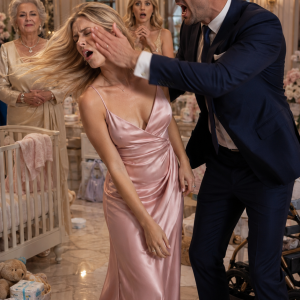
The Vessel’s Revenge: A Chronicle of Survival
“Your sister cannot carry a child, Amelia, so you are going to do it for her. You give Maya the baby, she gets the $450,000 allowance, and you go back to your little life. You are just the vessel.”
My mother, Karen, didn’t even blink as she said it. She slid the legal waiver across the glass table of her sunroom, the movement smooth and practiced, like a dealer handling cards in a high-stakes game. She looked at my six-month pregnant belly not with the wonder of a grandmother-to-be, but with the cold calculation of a butcher eyeing a cut of meat. There was zero affection in her eyes. It was 100% assessment.
She wasn’t asking for a favor. She was ordering me to sign over my unborn daughter so my sister, Maya, could unlock our grandfather’s inheritance clause.
“No.”
The word barely left my lips before the atmosphere in the sunroom shattered. The air, previously filled with the scent of expensive potpourri and old money, suddenly felt thin and sharp. Karen didn’t argue. She didn’t try to persuade me with sweet words or false promises. Her face twisted into a mask of pure, unadulterated rage. It wasn’t the anger of a mother disappointed in a child; it was the fury of a creditor being denied payment.
She lunged.
“It belongs to her!” she screamed, her manicured hand slamming into my shoulders with shocking force. “You selfish little mistake! It belongs to Maya!”
The force was enough to send me stumbling backward. My heel caught the edge of the Persian rug—an antique worth more than my car—and suddenly, the stability of the glass table was gone, replaced by empty air and the terrified realization of gravity taking over. Beneath me lay the hard, polished wooden steps leading down to the garden.
In that split second of weightlessness, as the world tilted on its axis, my brain didn’t panic. It switched gears. I am an emergency room nurse. Panic is a luxury I cannot afford. In the ER, panic kills.
As I fell, I didn’t reach out to break my fall. I didn’t flail. I tucked my chin to my chest. I curled my body inward, wrapping my arms tight around my midsection, transforming myself into a human shield for the life growing inside me.
Protect the airway. Protect the core.
I hit the first step with my shoulder, a jarring thud that rattled my teeth. Then my hip took the brunt of the next impact. Finally, there was the sickening crunch of ribs against the sharp edge of the final stair. I landed on the manicured grass of the garden, the breath knocked out of me, staring up at the sunroom deck through a haze of pain.
My mother stood at the top, looking down.
She wasn’t horrified. She wasn’t rushing down the stairs, screaming for help. She wasn’t fumbling for her phone to call 911. She was waiting. She was watching with a detached curiosity to see if the “problem” had been fixed.
My training kicked in before the pain did.
Airway patent. Breathing shallow but present. Sharp pain in the left lateral chest wall. Likely a rib fracture. Palpate abdomen.
My hands, trembling slightly, moved over my belly. Soft. No immediate cramping. Then, the most important check. I waited, holding my breath until my lungs burned, ignoring the screaming agony in my side.
A flutter. A tiny, protesting kick against my palm.
Fetal movement detected.
She was alive.
I didn’t scream. I didn’t cry for help. I knew in that moment, with a clarity as cold as ice, that crying would only confirm I was a victim. And in this family, victims get finished off. This wasn’t an accident. It was a clinical procedure—an attempted termination to clear the path for the preferred asset.
I pulled myself up, gritting my teeth against the fire in my side. I didn’t go back into the house. I walked straight to my car, got in, and locked the doors.
My father, Robert, was standing by the sliding glass door now, watching. He didn’t move. He didn’t try to stop me. He just watched, his face blank, like a man observing a business transaction that had gone slightly wrong but could still be salvaged.
I drove. Not to the nearest hospital, where my mother sat on the board of directors and my sister had sorority sisters in administration. I drove forty minutes into the city to Chicago Trauma Center, my own hospital. The one place where I controlled the narrative.
As the adrenaline began to fade and the throbbing in my ribs took over, the truth settled over me like a lead blanket.
For twenty-nine years, I had treated my relationship with my mother like a chronic illness—something to be managed, soothed, and endured. I thought if I was just good enough, quiet enough, successful enough, the symptoms would improve. But today, the diagnosis had changed.
My mother was a narcissist, but not the kind you read about in self-help magazines. To Karen, children weren’t people. We were extensions of her own ego. Maya, with her beauty and compliance, was the asset—the high-yield stock that made Karen look successful. I was the liability, the accident from twenty-nine years ago that forced her into a marriage she resented.
In her mind, pushing me down those stairs wasn’t attempted murder. It was a market correction. It was an attempt to liquidate a bad investment so the capital—my grandfather’s money—could flow to the performing asset.
I parked the car, my hand trembling as I reached for the door handle. They broke my ribs. They tried to kill my daughter. They laughed at me for years, thinking I was just the spare parts for their perfect machine.
But they forgot one thing. You don’t bring a checkbook to a knife fight. And you certainly don’t try to kill an ER nurse and expect her to just die quietly.
The Diagnosis
I walked into the triage bay. Not as a patient, but as a prosecutor building a case.
“Amelia?” Sarah, the charge nurse, looked up from her computer, her eyes widening as she took in my appearance. “What happened?”
“Trauma,” I said, my voice steady despite the pain. “I need a full workup. Document everything. Photos of the bruising. Ultrasound for fetal viability. X-ray for the ribs.”
Sarah didn’t ask questions. She moved.
Two hours later, my discharge papers were a receipt for survival. Bruised ribs, significant soft tissue damage, but a fetal heartbeat that sounded like a drum solo in the quiet exam room. I walked out of the hospital into the cool night air, clutching the folder of medical evidence to my chest. It wasn’t just paperwork. It was ammunition.
My phone had been vibrating against my thigh for the last two hours. A relentless, buzzing, angry insect. I finally pulled it out in the safety of my car.
17 Missed Calls.
32 Text Messages.
Most were from my father, Robert.
Amelia, pick up. Your mother is hysterical.
She didn’t mean to push you. You tripped.
We can pay for the hospital bills. Just come back to the house.
We need to settle this tonight.
Don’t make a scene, Amelia. Think about the family.
I stared at the glowing screen, feeling a cold detachment settle over me. This was the playbook. The gaslighting. The rewriting of history before the ink was even dry. He wasn’t worried about my ribs or his unborn granddaughter. He was worried about the narrative. He was worried that if I made a scene, the bank would find out about his debts, or the neighbors would find out his wife was violent.
He was offering to pay my medical bills with the same money they were trying to steal from my child.
My thumb hovered over the block button. It would be so easy to cut them off, drive home to my husband, Justin, lock the doors, and never speak to them again.
But silence wouldn’t protect me. Silence would just give them time to regroup, to spin the story, to sue me for custody later. If I wanted to be free, I couldn’t just run. I had to end it.
I thought about the patients I saw in the emergency room. The ones who came in screaming and fighting usually got sedated or restrained. And then there were the ones who went quiet. The ones who conserved every ounce of energy for survival.
I decided to become a Gray Rock.
It is a psychological technique for dealing with narcissists. You don’t argue. You don’t defend. You don’t explain. You become as uninteresting and impenetrable as a stone. You give them nothing to feed on, no emotion to twist. You let them project whatever they want onto your silence until they feel safe. Until they get careless.
I didn’t reply to the accusations. I didn’t send a picture of my bruises. I didn’t scream that he was a liar.
I typed out a single, carefully crafted message. It had to sound like surrender. It had to sound like the broken daughter they expected me to be.
I am scared. I don’t want to fight anymore. I am willing to talk about the waiver.
I paused, watching the three dots appear instantly. They were watching. They were hungry. I added the condition, the one thing that would spring the trap.
But not at the house. I can’t go back there. I will meet you at Mr. Henderson’s office tomorrow. Please just bring the papers.
The response came within seconds.
Good girl. We knew you would see reason. We will see you at 10:00 A.M. Don’t be late.
I lowered the phone. “Good girl.” The condescension dripped from the screen. They thought they had won. They thought the fall had scared the defiance out of me. They thought they were walking into a surrender negotiation.
They had no idea they were walking into an ambush.
I started the car. The pain in my side flared as I turned the wheel—a sharp, hot reminder of why I was doing this. I wasn’t going home to hide. I was going home to sharpen the knife.
The War Paint
The conference room at Henderson & Associates was designed to intimidate. Floor-to-ceiling windows overlooking the Chicago skyline. A mahogany table long enough to land a plane on. And air conditioning set to a temperature that felt less like a climate control setting and more like a preservation technique.
It was perfect. It was a sterile field for surgical removal.
I arrived forty minutes early. I needed time to get into character. In the pristine restroom of the law firm, I looked at myself in the mirror. The bruising on my ribs was real—a deep, ugly purple blooming across my torso. But my face was too clean. It looked defiant.
I needed to look defeated.
I opened my makeup bag. I didn’t use concealer to hide the damage. I used contour powder to enhance it. I deepened the shadows under my eyes to suggest a sleepless night of crying. I added a subtle, sickly yellow tint to the fading bruise on my jawline. Then I wrapped my ribs over my shirt with a bulky ACE bandage, making sure it was visible, clumsy, and pathetic.
I wasn’t dressing for a business meeting. I was dressing for a performance. I needed them to see a broken woman, a scared daughter ready to fold. I needed them to feel so powerful that they forgot to be careful.
Mr. Henderson was waiting for me. He was an old-school attorney—three-piece suit, silver hair, and a reputation for being as warm as a glacier. He was also the trustee of my grandfather’s estate, a man who valued order above all else.
“You understand what we are doing here, Amelia?” he asked, his eyes scanning my bandages with professional detachment.
“I’m not recording them,” I said, my voice steady. “Illinois is a two-party consent state. If I record them, it’s inadmissible. But you… you are an officer of the court. You are a mandatory reporter. If they admit to extortion or threats of violence in front of you, it’s not hearsay. It’s evidence.”
He nodded once. A shark recognizing another shark.
“I will leave the door to my office ajar,” he said quietly. “The paralegals are in the hall. Just get them talking.”
“They love to talk,” I said, buttoning my cardigan over the bandage. “Especially when they think they’ve won.”
At 9:58 A.M., they walked in.
Karen led the way, of course. She was wearing a cream-colored pantsuit that probably cost more than my car. Her hair was sprayed into an invincible helmet of blonde. She looked around the room with a sneer, as if the air quality wasn’t up to her standards.
Robert followed, looking sweaty and gray, clutching a briefcase like a life preserver.
And then Maya, my sister. She wore oversized sunglasses and a pout, looking bored, as if stealing my child was just another tedious errand she had to run before brunch.
They didn’t ask how I was. They didn’t look at my bandages with concern. They looked at them with annoyance, like I was wearing a tacky accessory that clashed with the decor.
“Let’s get this over with,” Karen said, dropping her purse on the table. “We have reservations at noon.”
I sat at the far end of the table, making a show of wincing as I lowered myself into the chair. I kept my posture hunched, my eyes downcast. I watched them settle in. They looked comfortable. They looked entitled.
But then I noticed something.
Karen wasn’t looking at me. She was looking at her phone, typing rapidly under the table. It wasn’t casual scrolling. Her thumbs were flying, her eyes darting around the room. I’ve seen that look in the ER waiting room—the look of someone coordinating a backup plan.
Who is she texting?
My mind raced. Robert was here. Maya was here. Who was left?
Then I remembered Aunt Linda. Karen’s sister. Her flying monkey. The one who did the dirty work whenever Karen wanted to keep her hands clean.
I realized with a jolt of cold clarity that Karen hadn’t just walked in here assuming victory. She had set a Dead Man’s Switch. She was likely texting Linda updates. If I don’t text you “all clear” by a certain time, burn it down.
She was prepared for a fight. She just wasn’t prepared for a surrender.
I took a shaky breath, letting my voice tremble just enough to sell it. “Did you bring the papers?”
Karen smiled. It was the smile of a predator watching a trap snap shut. “Right here, sweetie. Just sign on the line, and we can all go back to being a happy family.”
She slid the document toward me. The trap was set. Now I just had to bait them into stepping on the landmine.
The Confession
I picked up the pen. My hand wasn’t shaking because I was scared. It was shaking because I was holding back a tsunami of adrenaline. I let the tip hover over the signature line, watching the ink bleed slightly into the expensive paper.
“Why the rush, Dad?” I asked, keeping my voice small. “The trust doesn’t disperse for another six months. Why do you need the waiver today?”
Robert flinched like I had thrown a punch. He wiped a sheen of sweat from his upper lip with a handkerchief that looked days old. He wasn’t just nervous. He was terrified.
“It’s complicated, Amelia. Just sign the damn thing.”
“I can’t,” I whispered. “Not until I understand. Is it the house? Did you lose the lake house?”
“I didn’t lose it!” he snapped, slamming his hand on the table. The noise made Maya jump, but Karen didn’t even blink. She just kept typing on her phone under the table. “I leveraged it, okay? I borrowed against the equity to cover some shortfalls.”
“Shortfalls?” I pressed. “You mean the investments?”
“It wasn’t just investments!” He stood up, unable to sit still. He walked to the window, his back to me, his reflection ghosting against the skyline. “I borrowed from the wrong people, Amelia. Hard money lenders. Private equity. They don’t send late notices. They send guys to your office with baseball bats.”
I watched him unravel. The polished businessman I had grown up fearing was gone, replaced by a desperate gambler.
“I took a hundred thousand from the trust account early,” he confessed, the words tumbling out in a rush. “I forged the trustee’s signature to get a cash advance. I thought I could pay it back before the quarterly audit next Friday. But the investments tanked. If I don’t liquidate the rest of the trust to Maya and backfill that account by Friday, I’m not just broke. I’m going to prison or the morgue.”
There it was. Conspiracy to commit fraud. Embezzlement. Identity theft.
I looked at the slightly open door leading to Mr. Henderson’s office. I imagined him sitting there, his face a mask of professional horror. He had just heard a confession to a felony involving his own signature.
I looked back at Karen. She finally put her phone down. She wasn’t rattled by Robert’s confession. She looked annoyed by his weakness.
“So, that is it?” I asked, turning my gaze to her. “You need the money to keep Dad out of jail. But what about my daughter? You said I was just the vessel. You really want me to sign away my rights to my own child?”
Karen leaned forward. Her perfume, something heavy and floral, drifted across the table. It was the scent of my childhood nightmares.
“Let’s be clear, Amelia,” she said, her voice dropping to a smooth, lethal purr. “You are an ER nurse on a shift salary. You live in a two-bedroom rental. You have nothing.” She gestured to Maya, who was inspecting her manicure. “We have resources. We have lawyers. If you don’t sign that paper and give us the money, we will sue you for full custody. We will paint you as unstable. We will use your accident on the stairs as proof you can’t protect a child. We will bury you in court filings until you starve.”
My blood ran cold. This wasn’t just greed. This was annihilation. She was threatening to weaponize the legal system to steal my child because I wouldn’t pay for her husband’s crimes.
For a second, the fear was real. I imagined them taking her. I imagined Maya holding my baby while I was dragged away by security.
“Sign it,” Karen hissed. “Or we finish what we started on the stairs.”
Extortion. Threat of violence. Conspiracy.
It was everything I needed.
I looked down at the paper. The Disclaimer of Interest stared back at me. A contract to sell my soul.
I took a deep breath, letting the “Gray Rock” mask slip away. I stopped trembling. I straightened my spine. When I looked up, my eyes were dry.
“You ungrateful little—” Karen surged out of her chair, her hand raising instinctively as if to strike me. Forgetting where we were. Forgetting who was watching.
“I didn’t sign,” I said, my voice cutting through her rage like a scalpel. “But I think Mr. Henderson has heard enough.”
I pointed a finger past her shoulder toward the heavy oak door connecting the conference room to the main office. It had been cracked open the entire time. Just an inch, but enough for sound to travel. Enough for a witness.
The door swung open.
The Judgment
Mr. Henderson stepped through, his face grim. He wasn’t alone. Flanking him were two uniformed officers who had been waiting in the reception area for the signal.
The air in the room seemed to vanish, sucked out by the sudden, terrifying reality of consequences.
Robert made a sound like a dying animal—a high, thin whimper that got stuck in his throat. He slumped back into his chair, his face draining of color until he looked like a wax figure melting under heat. He knew. He knew about the audit. He knew about the loan sharks. And he knew that the handcuffs on the officers’ belts were the only things that could save him from the guys with baseball bats, even if it meant a cage.
Karen froze. Her hand was still half-raised, caught in a tableau of violence. She looked at the police, then at Mr. Henderson, and finally at me. Her expression wasn’t fear yet. It was confusion. Narcissists don’t process consequences; they process obstacles.
She tried to pivot, her voice pitching up into that saccharine tone she used for neighbors.
“This is a family dispute,” she said, smoothing her jacket, trying to regain the high ground. “My daughter is emotional. We were just having a heated discussion about her future.”
“No, Mrs. Davis,” Mr. Henderson said. He didn’t look at her. He looked at the officers. “This is attempted extortion and conspiracy to defraud a trust. And since you just admitted to the assault on the stairs, coupled with the threat to ‘finish the job,’ that constitutes attempted feticide.”
The officers stepped forward.
“Karen Davis, Robert Davis, Maya Davis. You are all under arrest.”
The handcuffs snapping onto Robert’s wrists sounded deafening in the silence. He didn’t resist. He just collapsed into sobs, rambling about interest rates and grace periods.
Karen screamed accusations at me, calling me insane, claiming I’d faked my bruises. But the real blow came from Maya.
She suddenly backed away from her parents, eyes darting between the officers and me as calculation replaced shock. For the first time in her life, Karen wasn’t the strongest person in the room.
“I didn’t do anything!” Maya shrieked. “She pushed her on the stairs! I saw it! I’m a witness!”
Karen froze, staring at the daughter she had always protected, now offering her up for immunity. That was when she broke.
“Don’t touch me!” Maya yelled as officers moved in.
“You’re an accessory to conspiracy,” one officer said, cuffing her wrists behind her back.
I watched them go. Robert crying. Maya protesting. Karen hollow-eyed, staring at me with an emptiness that was more terrifying than her rage.
When she glanced back at me, there was no hatred left. Only a void.
The Disclaimer of Interest form still sat unsigned on the table. The paper that had cost them everything.
Mr. Henderson told me to go home.
Justin met me in the hallway and pulled me into a hug that felt like it was holding my broken pieces together.
“They’re in custody,” I whispered into his shoulder.
We went home. We cleaned off the fake bruises, unwrapped the bandages, ordered Thai food, and tried to breathe again.
But it wasn’t over.
At exactly 7:15 P.M., police lights exploded across our living room walls. A bullhorn barked my name. Officers surrounded the house.
They said a relative had called 911, claiming I was in a psychotic break and planned to harm myself and my unborn child.
I knew immediately. Karen.
She had triggered the contingency plan. Since she couldn’t text Aunt Linda the “all clear,” Linda had followed the instructions: Burn it down. She reported me, even while her sister sat in a jail cell. She was trying to destroy me one last time, to have me committed so they could take the baby.
I stepped outside on the porch with my hands raised. I calmly explained the situation. I showed them my phone—no manic texts, no suicide notes. I gave them Mr. Henderson’s card.
The sergeant called him. Thirty seconds later, the mood shifted.
“I’m sorry, Ma’am,” the sergeant said, signaling his men to lower their weapons. “Mr. Henderson explained the situation. We’ll be adding ‘Filing a False Police Report’ to your aunt’s file.”
The lights vanished. The silence that followed was heavy, but it was finally ours.
Epilogue
The fallout was brutal.
Robert pleaded guilty to fraud to avoid a longer sentence for the embezzlement. Karen faced extortion and assault charges; her reputation in high society evaporated overnight. Maya was disinherited by the terms of the trust for her involvement in the fraud. They lost their properties, their status, and their access to me.
Six months later, I folded baby clothes in a quiet nursery painted a soft sage green. The trust fund was sealed, secure for my daughter’s future—not to be touched by anyone but her. My number, locks, and name were changed.
My daughter kicked against my hand, a strong, healthy movement.
“You’ll only ever be loved,” I whispered to her.
Peace was the most expensive thing I’d ever owned, and it was worth every cent.
If you’ve ever cut off family to save yourself, type “PEACE” in the comments.