The ambulance siren was not a sound; it was a jagged blade, flaying the silence of my consciousness. It shrieked in rhythmic agony, a perfect mirror to the rhythmic throbbing inside my skull. The scent of industrial-grade antiseptic and stale oxygen burned my nostrils, a stark contrast to the salt-heavy breeze of Naples, Florida, that I had inhaled just hours before.
“Ashley Brooks, stay with me. Eyes on me!” The nurse’s voice was a bark, authoritative and distant.
Above me, the fluorescent lights of the emergency transport stabbed at my retinas like white-hot needles. Every jolt of the vehicle sent a shockwave of pain through my ribs, which felt as though they had been crushed under the weight of a thousand disappointments. I tried to speak, but my throat was a desert, and my tongue felt like lead.
How had I ended up here? The answer lay three days in the past, on the polished wood of a graduation stage, where the illusion of family had finally, violently, dissolved.
Three days earlier, I had sat in the front row of the University of Miami commencement ceremony. I had watched my younger brother, Justin Brooks, adjust his cap with the unearned arrogance of a crown prince. When he reached the podium, he didn’t deliver a speech about the future or gratitude. He grabbed the microphone, his eyes locking onto mine with predatory intensity.
“I have an announcement,” he had bellowed, his voice echoing through the humid air. “My sister, Ashley, will be providing the $1.5 million seed capital from her trust to launch my startup, Brooks Yachts.”
Beside me, our mother, Deborah Brooks, had leaned in, her perfume—something expensive and suffocating—clinging to my skin. Her voice was ice-cold, a whisper meant to paralyze. “That is your duty, Ashley. This is a family legacy. Refuse him, and you are no longer a part of this bloodline.”
I had stood up then. Not out of anger, but out of a sudden, crystalline clarity. No.
The word had been small, but in the sudden vacuum of the crowd’s silence, it had sounded like a gunshot. Then, everything had exploded.
Now, as the ambulance doors hissed open at Naples Memorial, a shadow loomed at the foot of my stretcher. A man in a tall, charcoal-grey suit, his expression a mask of professional neutrality.
“Miss Grant,” he said, his voice low and resonant, ignoring the surname my father had branded me with. “Your grandmother, Margaret, left you far more than just capital. The clock has struck midnight. It is time.”
Long before the sirens and the blood, I believed in the sanctity of the Brooks Resort. It was a sprawling, Mediterranean-style monument to my father’s ego, where the Gulf of Mexico’s waters sparkled like a promise that was never quite kept.
At twelve years old, while other girls were attending summer camps, I was stationed at the front desk. I was the “Reliable One.” I learned to check passports, resolve double-bookings, and handle the explosive tempers of wealthy tourists before the managers even stepped out of their air-conditioned offices.
My father, Martin Brooks, would watch me from the lobby’s hidden camera feeds. He never came down to pat my shoulder. Instead, I would hear him through the concierge’s intercom, his voice a dry rasp: “Ashley is efficient. The system is working.” In the Brooks household, efficiency was the only accepted currency of affection.
By fifteen, I had amassed $8,000. It was a fortune built on Bellhop tips, birthday cash I’d hidden like a squirrel, and grueling weekend shifts at the pool bar. I had a map pinned to my wall—a route to a college far away from the humidity and the expectations. I wanted a used sedan, a vehicle for my own escape.
Then came Justin’s fifteenth birthday.
“Your brother needs a certain… presence,” Mother had said, pulling me into the resort’s executive office. The sunlight through the blinds sliced the room into golden bars. “A red Mustang convertible will give him the confidence a Brooks man requires. Family is an investment, Ashley. We pool our resources for the greater good.”
She had slid my shoe box across the desk. I watched my sedan, my escape, my independence, vanish into the roar of a Mustang’s exhaust that evening. Justin had waved once, a mocking gesture through the open top, as he peeled out of the lot.
At eighteen, the pattern was a solidified law. I balanced two lives: dawn shifts pouring lattes at the resort cafe, followed by evening hours drilling algebra into the heads of ungrateful high school seniors for $25 an hour. Every cent was funneled into a joint checking account that Mother audited with the precision of an IRS agent.
When Justin was accepted to the University of Miami, the $48,000 tuition for the first year was a mountain my father refused to climb alone.
“You’re already earning, Ashley,” Dad had said over his morning eggs. “Do your big sister duty. Cover the first semester.”
I transferred the funds. I watched Justin’s social media fill with “Yacht Life” selfies and fraternity formals in rented tuxedos. Meanwhile, I scrubbed guest rooms at midnight, vacuuming sand out of carpets and folding towels into swans until my hands were raw from bleach.
By twenty, Justin was the “Visionary.” He pitched a yacht-booking app on the resort’s rooftop, surrounded by candlelight and champagne flutes.
“Seamless luxury,” he promised the crowd of local investors.
Dad had raised a toast to the “Next Brooks Empire,” while I cleared the lobster shells from the tables. Later, by the humming ice machine, Dad had cornered me. “The prototype needs servers. Your remaining $12,000 closes the gap. Don’t be the weak link in the chain.”
I logged into my mobile banking under the flickering fluorescent lights. Transfer complete.
I stood on the beach that dawn, the waves lapping at my ankles, realizing a bitter truth. I wasn’t a daughter to them. I was a high-yield ATM with a factory-set combination. Deposits were forbidden; withdrawals were expected. And the pin code was “Family Obligation.”
The week before my twenty-seventh birthday, the lock finally clicked.
I was in my bedroom, the door bolted, when my phone buzzed. An email from the Fletcher Law Group. The subject line was a string of numbers that meant nothing until I opened the attachment.
Dear Miss Ashley Brooks,
The Margaret Grant Revocable Trust activates upon your 27th birthday. Total Valuation: $92 Million.
My breath hitched. My grandmother, Margaret Grant, had been a ghost in our family—a woman my father spoke of with a mixture of disdain and suppressed fear. She had been a pioneer in hotel management software in the 80s, a “builder” who had licensed her code to global chains.
I scrolled down to the Independence Audit.
“Margaret Grant specified that the principal beneficiary must be the first female descendant to demonstrate sustained financial independence without family subsidy. Ashley Brooks met this criterion at age 22, having self-funded her education and living expenses despite family-mandated withdrawals.”
There was a scanned note in Grandma’s jagged blue ink: “Ashley works the desk at 12. She saves every tip. She never asks for an allowance. She is the builder, not the borrower. The money is hers alone at 27. No co-trustees. No overrides.”
I sat in the dark, the glow of the screen illuminating the tears I hadn’t realized were falling. While I had been wiping counters and scrubbing floors, Grandma had been watching from afar, measuring my worth in pay stubs and grit.
A sharp knock rattled my door. “Ashley! Dining room. Now.”
I descended the stairs to find the “Board of Directors” in session. Dad stood at the head of the oak table, a folder centered before him. Justin was scrolling through his phone, feet up on a chair, while Mother aligned printouts beside water glasses.
“The law firm sent a duplicate notice,” Mother began, her voice trembling with a greed she tried to mask as excitement. “Ninety-two million. Grandma Margaret really outdid herself.”
Dad opened the folder. “Naturally, this capital is for the family’s expansion. Justin’s platform is ready for a Series A launch. We need to bridge the gap before the venture partners close.”
Justin didn’t even look up. “I need the first 1.5 million by Friday. It’s a drop in the bucket now, Ash.”
Dad slid a single document toward me. Power of Attorney.
“Sign this,” he commanded. “We will administer the trust until its maturity. It streamlines the taxes and ensures the capital isn’t squandered on… feminine whims.”
I looked at the paper. Irrevocable Grant. Full authority to Martin and Deborah Brooks. It was a death warrant for my freedom.
“No,” I said.
Justin laughed, a sharp, ugly sound. “Legacy cash, Ash. Don’t block progress. You’re not a businessman.”
“I’m the one who paid for your Mustang,” I replied, my voice gaining a lethal edge. “I’m the one who paid for your fraternity dues while I cleaned the sand out of your shoes. Grandma’s will says ‘no overrides.’ I won’t sign.”
Dad’s fist hit the table, making the water glasses jump. “You enjoy the privileges of this roof, Ashley! The utilities, the food, the car you drive—”
“I paid the last three utility bills from my cafe tips because you ‘forgot’ the resort’s overhead,” I interrupted. “And I bought that car with my own tutoring money. Grandma tracked every receipt. She knew.”
The silence that followed was suffocating. Dad pointed a trembling finger toward the stairs. “Go to your room. Reflect on your selfishness. You have until the graduation ceremony to realize that without this family, you are nothing.”
I climbed the stairs, but I didn’t reflect. I emailed Harold Fletcher.
“Require complete trust files. Cautisil originals. Fraud safeguards. Urgent.”
The afternoon of the graduation was a humid, oppressive weight. The University of Miami campus was a sea of white linen and silk, a theater for the wealthy and the entitled.
The Brooks family occupied the front row. Dad looked like a patriarch in his white suit; Mother’s pearls caught the sun like small, hard eyes. Justin was backstage, prepping for his “moment.”
When Justin reached the podium to accept his degree, the air seemed to thicken. He didn’t just accept the diploma; he hijacked the event.
“My sister will fund the next phase of Brooks Yachts with $1.5 million!” he shouted into the mic, his face flushed with the intoxication of public pressure.
Phones rose in the crowd. Three hundred faces turned toward me. It was a public ambush, a calculated move to shame me into submission.
Dad stood up, the Power of Attorney folder in his hand. He climbed the side stairs of the stage, Mother trailing behind him like a shadow. Security hesitated, but Dad’s “Owner of the Resort” aura pushed them aside.
He reached the edge of the stage, towering over me. “Sign the commitment, Ashley,” he said, his voice amplified by the nearby speakers. “Sign it, or you are dead to this family. No home. No name. No legacy.”
I stood up. My program was crumpled in my fist, a small ball of paper that felt like a stone.
“No,” I said, and this time, I didn’t whisper. I stepped into the aisle, my voice carrying over the humid breeze. “The money is mine. The legacy belongs to the woman who built it, not the boy who wants to spend it. No.”
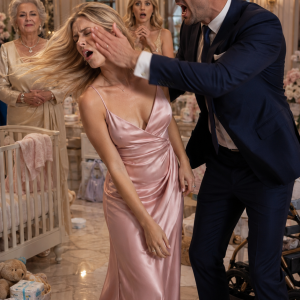
Justin’s face transformed. The “Golden Child” vanished, replaced by a snarling, cornered animal. He dropped his diploma and charged across the stage.
“You owe me!” he screamed.
He shoved me—hard. His hands slammed into my shoulders with the force of years of resentment. I stumbled backward, my heel catching the heavy metal base of a microphone stand.
The world tilted. I felt the sharp, cold edge of the stand collide with the back of my skull.
Crack.
White light exploded behind my eyes. Warmth—thick and metallic—began to pour down my neck. The screams of the crowd sounded like they were underwater. I saw Justin’s face go pale as he looked at his hands. I saw Dad try to grab the folder before it fell into the blood-soaked grass.
“Call 911!” someone screamed.
“It’s a family matter!” Dad’s voice was a desperate bark, trying to maintain the “Brooks” brand even as his daughter’s life leaked onto the stage. “We’ll handle it internally!”
But the world was recording. A hundred iPhones had captured the assault. The “Family Matter” was now a public felony.
As the paramedics loaded me onto the stretcher, the last thing I saw was the flash of police handcuffs clicking onto Justin’s wrists. The combination had finally been entered. But the vault wasn’t opening for them. It was slamming shut.
I woke up in the Naples Memorial ER to the sound of a steady beep-beep-beep.
The diagnosis was a grim tally: twelve stitches in my scalp, a mild traumatic brain injury, and two cracked ribs from the fall. But as the fog of the painkillers lifted, I saw a familiar charcoal-grey suit sitting by my bed.
Harold Fletcher.
“Margaret prepared for this,” he said, his voice a soothing balm. He clicked the locks on a heavy leather briefcase. “She knew your father’s temperament. She called it the ‘Brooks Fragility.’ She embedded audit triggers and an Anti-Duress Provision.”
He slid a document toward me. “Any attempt to transfer trust assets under physical or emotional coercion—such as a public assault or a forced Power of Attorney—results in an automatic, irrevocable freeze of all family access. It also triggers the release of the Secondary Evidence File.”
“Evidence of what?” I rasped, my ribs screaming as I shifted.
“In 1990,” Fletcher began, his eyes hardening, “your father didn’t just ‘inherit’ the resort. He forged your grandmother’s signature on a series of royalty diversions. He has been siphoning 70% of her software dividends into a Cayman entity called MB Holdings for thirty years. He didn’t build the resort, Ashley. He stole it.”
I exhaled, a shaky, painful breath. “He faked the contracts.”
“We have the originals,” Fletcher said. “And we have the forensic report showing a 98% probability of forgery. He can’t touch a cent of your trust. In fact, by the time the IRS is done with him, he won’t even own the shirt on his back.”
A knock rattled the glass door of the ICU. My father’s face appeared, distorted by rage and desperation. He was shouting, his fists thudding against the reinforced glass.
“She’s my daughter! Let me in!”
Security stepped in, flanking him. Fletcher stood up, tall and immovable. “I will coordinate with the police, Ashley. Rest. Margaret built this fortress for you. It’s time you lived in it.”
Two weeks later, the final battle was joined at the Collier County Courthouse.
My father had filed an emergency petition for Guardianship. His argument was a masterclass in gaslighting: “Ashley Brooks suffers from trauma-induced delusional disorder. Her refusal to support the family business is a symptom of impaired judgment following her head injury.”
The courtroom smelled of floor wax and old paper. Judge Elena Ramirez presided, her expression as neutral as a stone gargoyle.
My parents sat on the left, looking like the victims of a great tragedy. Mother clutched a lace handkerchief; Dad sat with his attorney, Richard Klene, who looked like he wanted to be anywhere else. Justin was absent, barred by a restraining order and awaiting his own assault trial.
Klene stood first. “Miss Brooks has a history of erratic behavior. She rejected a reasonable request for bridge capital, an act that led to a public disturbance. We seek to protect her from her own instability.”
Fletcher didn’t even stand up to object. He simply tapped a button on his tablet.
The courtroom’s wall screen flickered to life. It wasn’t my medical records. It was an email from Margaret Grant, dated 2018.
“Harold,” the voice-over read (a recording Grandma had left). “If Martin ever attempts to declare Ashley incompetent to gain access to the trust, release Exhibit B. He is a thief who mistakes silence for weakness.”
Next came the bank statements. The Cayman Islands routing numbers. The forged signature of 1990 side-by-side with Grandma’s real one. The room went deathly silent.
“The petitioner,” Fletcher said, his voice ringing through the chamber, “is currently under investigation by the IRS and the State Attorney for thirty years of royalty embezzlement totaling over $60 million. He is not seeking guardianship to protect his daughter. He is seeking it to hide his crimes.”
Judge Ramirez leaned forward, her glasses slipping down her nose. “Mr. Brooks, do you have a response to the alleged diversion of $2.3 million annually to MB Holdings?”
Dad stood up, his face draining of color. “It was… administrative restructuring. Margaret approved it verbally!”
“No record of such approval exists,” Fletcher countered. “Only a forged addendum.”
The gavel bang sounded like a thunderclap. “Petition for guardianship is denied with prejudice,” Judge Ramirez announced. “I am referring this entire file to the State Attorney for immediate fraud prosecution. Mr. Brooks, do not leave the jurisdiction.”
Mother burst into hysterical sobs, her handbag spilling tissues across the floor. “Our reputation… our life… everything!”
I stepped down from the witness stand, my legs steady for the first time in my life. I walked past them, not with anger, but with the cold indifference they had taught me so well.
“You were right about one thing, Dad,” I said as I passed his table. “Family is an investment. You just invested in the wrong child.”
Six months later, the Brooks Resort was gone.
The federal government had seized the assets to cover back taxes and fraud penalties. Martin Brooks now works at a strip-mall timeshare kiosk, his polyester tie a cheap imitation of the silk ones he used to wear. Deborah lives in a one-bedroom condo, her Bridge Club invitations having dried up the moment the headlines hit the Naples Daily News.
Justin’s app crashed before it ever left the dock. Without my “subsidy,” his creditors swarmed. He now drives for a rideshare app in Miami, his red Mustang long since repossessed by the bank.
I changed my name. I am now Ashley Grant.
I didn’t spend the $92 million on yachts or champagne. Instead, I established the Grant Builders Scholarship. We provide full-ride tuition and laptops to women in tech who come from single-parent homes—builders who know what it’s like to work the graveyard shift while coding their own futures.
I visited the first cohort of students last week. One girl, a nineteen-year-old with calloused hands from her job at a warehouse, clutched her acceptance letter like it was made of gold.
“This changes everything,” she whispered.
I looked at her and smiled. I thought of Grandma Margaret, of the shoe box under my bed, and of the blood on the graduation stage.
“No,” I told her. “You changed everything. The system just finally caught up.”
Cutting ties isn’t a betrayal. It’s an architectural necessity. You cannot build a skyscraper on a foundation of rot. I have found my own family now—not one of blood and obligation, but one of grit, merit, and the fierce, unshakeable peace of a woman who finally owns her own combination.
As I walked out of the scholarship gala, a private investigator stepped from the shadows, handing me a sealed envelope. “Your father’s kiosk job was a front, Ashley. He’s been meeting with someone from your grandmother’s past. Someone we thought was dead.”