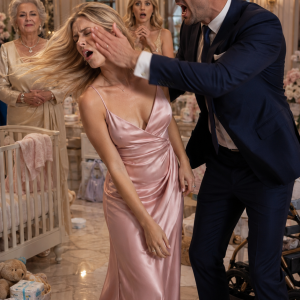
The Vintage of Vengeance: A Daughter’s Coup
Chapter 1: The Crows Gather
This isn’t just a story about wine; it is the chronicle of my own coup d’état.
They say that grief is a fog, a blinding mist that leaves you stumbling in the dark. But as I stood by the open grave of my father, Giovanni Rossi, the mist wasn’t blinding me. It was clarifying. The cold Tuscan wind bit at my cheeks, carrying the scent of damp earth and the faint, sweet decay of late-autumn grapes. It was the scent of Villa Rossi, the scent of my home, my heritage, and my lifeblood.
But there was another scent in the air that day, one far more pungent than the soil. It was the stench of ambition.
I watched them through the black lace of my veil—the board members of Rossi Vineyards. They stood in a phalanx of expensive charcoal wool, their heads bowed in performative sorrow, but their eyes were dry. They were vultures, circling a carcass, waiting for the priest to finish his Latin mumbling so they could begin the feast.
And standing at the head of the flock was Marco Valenti.
Marco had been my father’s protégé, the Operations Director who had charmed his way into the heart of the business while I was away finishing my MBA in London. He was handsome in a sharp, predatory way, with a smile that didn’t quite reach his eyes—eyes that were currently fixed not on my father’s coffin, but on me.
I was twenty-six years old. To them, I was “Little Isabella,” the heiress who knew how to swirl a glass but not how to run an empire. They thought I was soft. They thought I was broken by grief.
They were wrong.
The reading of the will took place two hours later in the great oak library of the Villa. The room smelled of old paper and cigar smoke, a masculine sanctuary where I had once played at my father’s feet. Now, it felt like a courtroom.
The family lawyer, a nervous man named Signore Botti, adjusted his spectacles. “Giovanni’s wishes are clear,” he stammered. “Fifty-one percent of the controlling shares pass to his daughter, Isabella Rossi.”
I let out a breath I didn’t know I was holding. Safety. Or so I thought.
“However,” Botti continued, his voice trembling, “there is a codicil. Added three months ago.”
My blood ran cold. “What codicil?” I demanded, my voice echoing off the mahogany shelves.
Marco stepped forward, smoothing the lapels of his suit. “Your father was worried, Isabella. He knew he was failing. He didn’t want to burden you with the immediate pressures of the harvest and the distribution deals. The codicil grants proxy voting rights for those shares to the Operations Director—me—until you reach the age of thirty, or until the Board deems you ‘competent.'”
The silence that followed was deafening. It was a hostile takeover masked as paternal concern. I stood up, my hands slamming onto the heavy desk. “This is a forgery. My father would never sign away my birthright.”
“It is notarized,” Marco said softly, his voice dripping with faux sympathy. “It’s for your own good, Bella. You can stay in the Villa. You can even keep your title as ‘Brand Ambassador.’ But the decisions? The business? That is man’s work now.”
He slid a document across the table. It was a contract. A gag order, effectively. It offered me a generous stipend in exchange for my silence and my total withdrawal from the winemaking process.
“Sign it,” Marco whispered, leaning in close, the smell of expensive cologne choking me. “Don’t fight this. You’ll only embarrass yourself.”
I looked at the pen. I looked at the Board members, who were studying their shoes or looking out the window. They were all in on it. They wanted the quick profits Marco promised, not the slow, artistic dedication my father had demanded.
I picked up the pen. Marco smiled, a triumphant curling of his lip.
Then, I snapped the pen in half. Ink bled over my fingers like black blood.
“I will not sign,” I said, my voice shaking with a rage so pure it felt like ice. “And I will not step aside.”
Marco’s smile vanished. His eyes hardened into flint. “Then you leave me no choice. As acting CEO, my first order of business is restructuring. We need to cut costs. And frankly, Isabella, your salary is a luxury we can’t afford.”
He checked his watch. “You have twenty-four hours to vacate the premises. The Villa is company property.”
Cliffhanger:
I stood there, ink staining my hands, homeless in my own home. But as I turned to leave, Marco called out one last thing. “Oh, and Bella? Stay out of the cellars. Security has been instructed to treat you as a trespasser.” I walked out with my head high, but my heart hammering against my ribs. He thought he had won. He didn’t know that the cellars held secrets only a Rossi would know—and I wasn’t leaving without a weapon.
Chapter 2: The Ghost in the Cellar
The rain began at midnight, a torrential downpour that lashed against the ancient stone walls of the Villa. It was the perfect cover.
I hadn’t left. I had parked my car down the hill and hiked back up through the olive groves, mud caking my boots, the cold seeping into my bones. Marco thought he had locked me out, but he forgot that I had grown up playing hide-and-seek in these walls. I knew the servants’ entrance behind the trellis of jasmine; I knew the loose grate that led into the old drying rooms.
My objective was the Sanctuary—my father’s private archive deep within the underground cellars.
I needed the original trust deeds. I needed to see the financial records Marco had been hiding. But more than that, I needed to know why my father would have signed that codicil. He had been sick, yes, but his mind was sharp as a tack until the very end. Something didn’t add up.
I slipped into the main cellar, the air thick with the smell of oak and fermentation. It was a smell that usually brought me peace, but tonight, it felt heavy with conspiracy. The security cameras were sweeping the main corridor, their red eyes blinking in the dark. I timed my movements, dashing from shadow to shadow, hiding behind the massive Slavonian oak casks that held our prize vintage, the Rossi Riserva.
I reached the heavy iron door of the Sanctuary. I punched in the code: my mother’s birthday.
Error.
I tried my birthday.
Error.
Marco had changed the codes. Panic began to flutter in my chest. If I triggered the alarm, it was over. I would be arrested for trespassing, and my credibility would be destroyed forever.
I took a deep breath and closed my eyes. Think, Isabella. Think like Papa.
When my father was teaching me to blend wine, he used to say, “The secret is in the finish.” It was his favorite phrase. The secret is in the finish.
I looked at the keypad. The numbers were worn. I typed in the vintage year of our first award-winning wine: 1-9-8-2.
The lock clicked. The door groaned open.
I slipped inside and clicked on my small flashlight. The room was a mess. Papers were strewn everywhere. File cabinets were open. Marco had been here, scouring the place. My heart sank. Had he already destroyed the evidence?
I began frantically digging through the remaining files. Production logs, shipping manifests, supplier contracts. At first, it looked normal. But as I cross-referenced the dates, a pattern emerged.
Starting six months ago—coinciding with when Marco took over daily operations while Papa was in the hospital—the orders for our premium Sangiovese grapes had dropped by 40%. Yet, our production output had remained the same.
How do you produce the same amount of wine with half the grapes?
You don’t. Unless you’re cutting it.
I frantically flipped through the chemical supply logs. There it was. Massive orders for Mega-Purple, a concentrated grape juice concentrate used by cheap manufacturers to add color and sweetness to bad wine. And tannins. And industrial alcohol.
My hands shook. Marco wasn’t just stealing the company; he was destroying the product. He was turning Rossi Riserva, a wine that had graced the tables of kings, into glorified grape juice, bottling it, and selling it at premium prices to cash out before anyone noticed the difference.
He was going to ruin the brand within a year, sell the land to developers, and walk away a billionaire.
I grabbed the files, stuffing them into my jacket. I had the smoking gun. Now I just needed to get out.
I turned to leave, but the sound of heavy footsteps in the corridor froze my blood.
“Check the archives,” a voice growled. It was Marco. “I saw a light.”
I was trapped. The Sanctuary had only one door. I looked around desperately. There was nothing but rows of dusty bottles and a large, empty ventilation shaft high on the wall.
The footsteps got closer. The handle of the door began to turn.
Cliffhanger:
I scrambled up a shelving unit, my boots slipping on the metal, and shoved the ventilation grate aside just as the door swung open. I pulled myself into the narrow, cobweb-filled darkness of the shaft and replaced the grate, holding my breath until my lungs burned. Below me, Marco walked in, flanked by two security guards. He scanned the room, his eyes landing on the spot where I had just been standing. He reached down and picked up something from the floor. My flashlight. I had dropped it. Marco looked up, straight at the vent, a slow, cruel smile spreading across his face. “She’s here,” he whispered. “Seal the exits.”
Chapter 3: The Trap
I crawled.
The ventilation shaft was a nightmare of claustrophobia. Dust clogged my throat, and spiders skittered over my hands. I could hear the shouts of the guards echoing through the ducts. They were sealing the building. I was a rat in a maze, and the cats were closing in.
I knew this shaft led to the old bottling plant, a detached building near the edge of the estate. If I could make it there, I could disappear into the forest.
It took me twenty agonizing minutes to reach the exit. I kicked the grate open and tumbled onto the concrete floor of the bottling plant, gasping for air. I was covered in soot, my hands bleeding, but I had the files.
I didn’t stop. I ran into the night, the rain washing the soot from my face. I reached my car, threw it into gear, and sped away just as headlights appeared in the rearview mirror.
I drove straight to the only person I could trust: Luca, our former head winemaker who Marco had fired on day one.
Luca lived in a small stone cottage five miles away. When I pounded on his door at 2:00 AM, he opened it with a shotgun in hand, his gray hair wild.
“Isabella?” he lowered the gun, his eyes widening at my state. “My God, child. What happened?”
“He’s poisoning the wine, Luca,” I choked out, pushing past him into the warmth of his kitchen. I slammed the files onto his table. “Look. Mega-Purple. Industrial tannins. He’s cutting the Riserva.”
Luca put on his glasses, his hands trembling as he read the manifests. His face turned a dangerous shade of red. “That bastardo. He is turning our legacy into vinegar.”
“We have to stop him,” I said, pacing the room. “The annual Gala of the Vines is in two days. The top critics from around the world will be there. Marco is planning to unveil the new vintage.”
“If he serves that swill to the critics,” Luca said grimly, “the Rossi name dies that night. The reputation will never recover.”
“Exactly,” I said, a plan forming in my mind. “We can’t just release these papers. Marco will claim they are forged. He owns the lawyers; he owns the police chief. We can’t fight him in court.”
“Then how?” Luca asked.
“We let him pour it,” I said, my voice hardening. “We let him stand on that stage and toast to his own genius. And then, we make him drink it.”
“But he won’t serve the bad stuff at the Gala,” Luca argued. “He’s a con man, but he’s not stupid. He’ll have a few cases of the real wine—the last barrels your father made—set aside for the VIPs and the critics. He’ll sell the poison to the public later.”
I paused. Luca was right. That was the oldest trick in the book. The bait and switch.
“Then we have to switch it back,” I said. “We have to get into the holding cellar before the Gala and ensure that every bottle opened on that stage is the adulterated filth he created.”
“Isabella,” Luca warned, “security will be tighter than the Vatican. If they catch you, you go to prison.”
“I don’t care,” I said. “This is for Papa.”
For the next forty-eight hours, we worked like spies. Luca called in favors from old cellar hands who hated Marco. We mapped out the delivery routes. We forged catering passes.
The night of the Gala arrived. The Villa Rossi was lit up like a palace, golden light spilling onto the manicured lawns. limousines lined the driveway. Inside, the elite of the wine world were gathering.
I was dressed not in a ballgown, but in a caterer’s uniform—black trousers, white shirt, hair pulled back tight. I carried a tray of empty glasses, keeping my head down as I navigated the chaos of the service entrance.
My heart was hammering a frantic rhythm against my ribs. Don’t look up. Don’t make eye contact.
I made my way to the staging area behind the main ballroom. There, on a velvet-draped table, sat the Magnums—the giant, ceremonial bottles destined for the critics’ table. They were labeled Rossi Riserva: The Giovanni Tribute.
Marco stood nearby, adjusting his tuxedo, laughing with a senator. He looked like a king.
I waited until he moved away to greet a guest. I signaled to Luca, who was disguised as a lighting technician up on the gantry. He cut the main power.
Zap.
The ballroom plunged into darkness. Screams of surprise. Confusion.
“Don’t panic! Just a fuse!” Marco’s voice boomed.
In the pitch black, I moved. I had thirty seconds. I felt my way to the table. I grabbed the ceremonial Magnums—the real wine—and slid them under the table draped in heavy cloth. Then, I pulled the decoy bottles from the crate we had smuggled in earlier. These bottles contained Marco’s chemical concoction, the stuff meant for the mass market.
I swapped them.
Click.
The lights flickered back on.
I was standing ten feet away, holding a tray of napkins, looking invisible. Marco was still in the center of the room, looking annoyed but composed. He glanced at the table. The bottles were there. He didn’t notice a thing.
Cliffhanger:
The music swelled. Marco took the stage, the microphone in his hand. “Ladies and gentlemen,” he purred. “Tonight, we honor the past by tasting the future.” He gestured to the sommelier to open the first Magnum—the bottle I had just planted. The cork popped with a sound like a gunshot. The sommelier began to pour the dark red liquid into the glasses of the three most vicious wine critics in Italy. Marco raised his own glass. “To the Rossi legacy,” he toasted. I stood in the shadows, holding my breath. If Marco tasted it first, he would know instantly. He brought the glass to his lips.
Chapter 4: The Taste of Betrayal
Time seemed to slow down. I watched the crimson liquid tilt against the crystal rim of Marco’s glass.
Drink it, I willed him. Drink your lies.
But Marco paused. He was a showman. He lowered the glass, smiling at the crowd. “But first,” he said, gesturing to the critics, “let us hear from the masters.”
He hadn’t drunk. He was waiting for their approval.
Signor Moretti, the most feared palate in Tuscany, swirled his glass. He held it up to the light. He frowned. ” The color…” he muttered, his voice amplified by the silence of the room. “It is… aggressive. Almost purple.”
“A robust vintage!” Marco interjected quickly, sweat beading on his forehead. “Full of vitality!”
Moretti sniffed the bouquet. His frown deepened. He looked confused. He glanced at his colleagues. They looked equally baffled.
“And the nose,” Moretti said, “It smells of… oak chips? And vanilla extract?”
A murmur went through the crowd. This was unheard of for a Rossi wine.
“Nonsense,” Marco laughed nervously. “It is the terroir! Please, taste.”
Moretti took a sip.
The reaction was visceral. The critic’s face contorted. He didn’t just spit the wine into the bucket; he practically gagged.
“Chemicals!” Moretti roared, standing up and knocking his chair over. “Sugar and chemicals! This is swill! This is an insult!”
The room erupted. Cameras flashed. Marco’s face drained of all color. “There must be a mistake! A bad bottle!”
“Open the others!” Moretti commanded. The other critics tasted. The reaction was the same. Spitting. Coughing. Outrage.
“Fraud!” someone shouted from the back.
Marco stood frozen on stage, the glass trembling in his hand. He looked like a deer in the headlights of a semi-truck.
This was my moment.
I ripped off my catering apron and stepped out of the shadows. I walked straight down the center aisle, the crowd parting for me as they recognized the daughter of Giovanni.
“It’s not a mistake,” I announced, my voice clear and ringing. “It’s a business model.”
Marco saw me. His eyes bulged. “Security! Get her out of here! She sabotaged the wine!”
“I didn’t sabotage it, Marco,” I said, climbing the stairs to the stage. I reached into my pocket and pulled out the crumpled manifest sheets. “I just served what you produced. The real wine—my father’s wine—is hidden in the warehouse, waiting to be sold off to collectors while you feed this poison to the public.”
I thrust the papers toward Moretti. “Read it. The orders for Mega-Purple. The industrial ethanol. The dates match his takeover.”
Moretti snatched the papers. He scanned them, his face turning purple with rage. He looked at Marco. “Is this true?”
“She’s lying! She’s hysterical!” Marco screamed, backing away.
But the crowd wasn’t looking at Marco anymore. They were looking at the screen behind him. Luca, from the control booth, had projected the security footage from the archives—the footage of Marco ordering the files to be burned. We had recovered it from the server.
“You’re finished, Marco,” I said softly, standing toe-to-toe with him. “Get out of my house.”
Marco looked at the hostile crowd, at the ruined wine, at the evidence looming behind him. His mask of charm shattered. He snarled, lunging at me. “You little brat!”
Security guards tackled him before he could reach me. Not his private goons, but the Carabinieri police, who Luca had tipped off an hour ago.
As they dragged Marco away, kicking and screaming threats, a hush fell over the room. I stood alone on the stage, the bright lights blinding me. I looked at the glass of purple poison on the podium.
I picked it up and poured it onto the floor.
“I apologize,” I said to the room, my voice shaking slightly. “The Rossi family will not be serving wine tonight. But if you return in six months… I promise you a vintage worthy of the name.”
Cliffhanger:
The applause started slowly, then built into a thunderous ovation. I had won. The company was mine. But as the adrenaline faded, a new reality set in. The reputation of the vineyard was in tatters. The bank accounts were empty—Marco had drained them. I stood amidst the cheering crowd, realizing that the coup was the easy part. The war for survival had just begun. And then, I saw him—a representative from VinoCorp, the massive conglomerate Marco wanted to sell to. He wasn’t clapping. He was typing on his phone, staring at me with a cold, calculating look. The sharks were still circling.
Epilogue: The Roots Run Deep
It has been one year since the Night of the Purple Wine.
They called it the scandal of the decade. For months, I fought lawsuits, creditors, and the press. There were days I wanted to give up, to sell the land and disappear.
But I didn’t.
I spent my days in the vineyard, pruning the vines with my own hands, my boots caked in mud, just like my father. I spent my nights in the cellar with Luca, blending, tasting, and crying over barrels.
We released the True Vintage—the barrels I had saved—six months later. It was a limited run. We called it La Rinascita (The Rebirth).
It didn’t just win awards. It reminded the world who we were.
Today, I sat in my father’s chair in the library. The smell of cigar smoke is gone, replaced by the scent of fresh lemons and open windows. The desk is cluttered with legitimate orders, not fake manifests.
I signed the final document officially transferring full ownership of the estate back to the Rossi family trust. Marco is awaiting trial for fraud and embezzlement. The representative from VinoCorp stopped calling months ago.
I walked to the window and looked out over the rolling hills of Tuscany. The vines were turning gold in the autumn sun. They looked tired, but strong. Their roots went deep into the earth, twisting through rock and soil, holding fast against the wind.
My father used to say that wine is just sunlight held together by water and struggle. He was right. We had struggled. We had nearly withered.
But the roots held.
I raised a glass of La Rinascita to the empty room.
“Salute, Papa,” I whispered. “We did it.”
The coup was over. The reign of Isabella Rossi had begun.
Did you enjoy this story of betrayal and redemption?
Like and share this post if you find it interesting! Let us know in the comments: Would you have exposed the fraud publicly, or tried to handle it quietly?