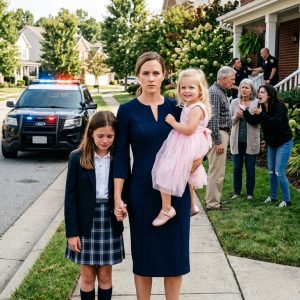
The Day I Died to Save My Daughters
They declared me dead at 3:47 AM. My husband’s mistress was already trying on my jewelry. His mother was negotiating the black-market sale of my second child. But they made a fatal miscalculation. I wasn’t dead. I was locked inside my own body, a silent witness to every act of treachery, hearing every whisper of their venomous plot.
And when I finally woke up, I didn’t just survive. I burned their world to the ground.
Before I take you into the darkness of that hospital room, you need to understand one thing: this isn’t just a story about betrayal. It is a testament to the primal, terrifying power of a mother’s rage. My name is Samantha, and this is how I died, how I listened to them plan my erasure, and how I returned from the grave to destroy them all.
The end of my life—or what I thought was the end—began sixteen hours into labor. It wasn’t the beautiful, glowing experience you see in movies. It was sixteen hours of excruciating, bone-grinding agony that felt like my body was being torn asunder from the inside out. The contractions weren’t waves; they were tsunamis, crashing over me with such violence I thought my spine would snap.
Andrew, my husband of five years, stood in the corner of the delivery room. Through the haze of sweat and tears, I reached out for him. I needed his hand. I needed his voice. I needed the man who had promised to love me in sickness and in health.
But Andrew wasn’t looking at me. He was scrolling through his phone, his thumb moving rhythmically against the screen, his face illuminated by the cold blue light. I was screaming in pain, and he was checking emails. Or so I thought.
“You’re doing great, Samantha. Just a little longer,” the doctor said, though his voice sounded tight, strained.
Then, the atmosphere in the room shifted. It wasn’t a sound, but a feeling—a sudden, terrifying warmth spreading beneath me. It was too much fluid. Too much heat.
I saw the nurse’s eyes widen above her mask. The color drained from her face as she slammed her hand onto the emergency call button.
“She’s hemorrhaging!” the doctor yelled, his calm facade shattering. “We’re losing pressure! Get the crash cart! Now!”
The room exploded into chaos. White coats swarmed around me, shouting medical terminology that sounded like a foreign language. My vision began to blur, the edges of the room darkening as if someone were slowly turning a dimmer switch. The rhythmic beep of the heart monitor accelerated into a frantic gallop, then flattened into one long, piercing scream.
As the darkness swallowed me, as my consciousness detached from my physical form, I heard Andrew’s voice cut through the noise. He didn’t sound panicked. He didn’t sound heartbroken. He sounded bored.
“Is the baby okay?”
Not, Is Samantha okay? Not, Save my wife. Just a flat inquiry about the heir. That singular sentence was the last thing I took with me into the void.
Then, there was nothing. Absolute, suffocating silence.
I don’t know how much time passed in that oblivion. It could have been minutes; it could have been an eternity. But slowly, sensory input began to bleed back into my awareness.
I heard the squeak of rubber wheels on linoleum. I felt a biting chill in the air, a coldness that seeped into my marrow. I tried to open my eyes, to gasp, to twitch a finger.
Nothing happened.
My mind was screaming, clawing at the walls of my skull, but my body was a heavy, useless stone. I was a prisoner in a corpse.
Then I felt it—the rough texture of a sheet being pulled up over my face. It settled over my nose and mouth, smelling of industrial bleach and finality.
“Time of death, 3:47 AM,” a tired voice droned.
No! I screamed in the silence of my mind. I’m not dead! I’m right here! Can’t you hear me?
But the wheels kept turning. I felt the transition from the smooth hospital floor to the threshold of an elevator. We were going down. Down to the basement.
Oh God, I realized, a fresh wave of terror washing over me. They are taking me to the morgue.
The metal table they transferred me onto was ice cold. I could feel every degree of the temperature sucking the remaining warmth from my skin, yet I couldn’t shiver. I heard the morgue attendant humming a tune, the sound of metal instruments clinking against a tray. He was preparing to process me. To cut me open.
Panic, raw and absolute, flooded my consciousness. This was it. I was going to be autopsied while fully conscious.
“Wait,” the attendant’s voice said, stopping abruptly. The humming ceased. A warm hand pressed against my carotid artery. “Wait a minute… holy hell. I feel a pulse.”
The next few hours were a blur of frantic motion, shouting voices, and the rhythmic pumping of air into my lungs. I was rushed back upstairs, wires reattached, machines forcing my heart to beat and my lungs to expand.
I lay there, floating in a dark sea, unable to blink or breathe on my own, but hearing every word.
“Your wife is in what we call a ‘locked-in’ state,” a neurologist, Dr. Martinez, explained to Andrew later that morning. His tone was grave. “It is an extremely rare condition resulting from the trauma and oxygen deprivation. She is in a deep coma, but there is a possibility—however slight—that she can hear and process auditory stimuli, even if she cannot respond.”
There was a heavy pause. The room felt thick with tension.
“Can she recover?” Andrew asked.
“It’s unlikely,” Dr. Martinez admitted. “Maybe a five percent chance of partial recovery. She could remain like this for months, years… or she may never wake up at all.”
I waited for the grief. I waited for Andrew to break down, to bargain with God, to weep for the wife he had lost.
Instead, I heard the rustle of fabric as he checked his watch. “I need to make some calls.”
And he walked out.
That was when the real nightmare began. Because Andrew didn’t just leave; he brought in the sharks.
I heard the click of high heels entering the room. I knew that stride. It was Margaret, Andrew’s mother. I had always known the woman despised me—I wasn’t rich enough, wasn’t poised enough for her precious son—but the venom in her voice that day was something inhuman.
“So,” Margaret said, her voice echoing in the sterile room. “She’s a vegetable now?”
“We don’t use that term, Mrs. Mitchell,” Dr. Martinez replied, clearly repulsed.
“Call it what you want,” Margaret snapped. “She’s brain dead and costing money every minute she lays there. What is the protocol? How long do we have to keep this charade going?”
“After thirty days,” the doctor sighed, “if there is no significant neurological improvement, the family can discuss options regarding the termination of life support.”
“Thirty days,” Margaret repeated, tasting the words. “That’s manageable.”
They left me alone with the rhythmic whoosh-hiss of the ventilator. I spent hours screaming into the void, praying for death, praying for movement, praying for anything other than this hell.
But the universe wasn’t done with me. A nurse, bless her distracted soul, had left a baby monitor on the counter in my room. The receiver was down the hall at the nurse’s station, but the transmitter was picking up conversations from the corridor outside my door.
It was Day Three when I heard the third voice.
Soft, feminine, and sickeningly familiar. It was Jennifer, Andrew’s executive assistant. The woman I had suspected for months. The woman Andrew swore was “just a colleague.”
“This is actually perfect,” Margaret was saying, her voice low and conspiratorial.
“Perfect?” Andrew sounded hesitant, perhaps the last shred of his conscience flickering. “Mom, my wife is in a coma.”
“Exactly, Andrew. Focus,” Margaret hissed. “She is as good as dead. You have the baby. You will have the life insurance payout. And Jennifer can finally step into her rightful place.”
“But she is still technically alive,” Andrew said. “People will talk.”
“Not for long,” Margaret countered. “Hospitals hate keeping hopeless cases. It drains resources. We give it the mandatory thirty days. We play the grieving family. Then we pull the plug. Clean. Legal. No one suspects a thing.”
“What about her parents?” Andrew asked. “They’ve been calling non-stop.”
“I’ll handle them,” Margaret said dismissively. “We tell them she’s already dead. A closed-casket funeral, cremation, the whole production. They live four states away and are too old to travel instantly. By the time they figure it out, the ashes will be in an urn. They will never know the difference.”
“Are you sure about this, darling?” Jennifer purred. I could practically hear her tracing a finger down Andrew’s arm.
“I’ve never been more sure,” Margaret said. “Soon, you will have everything you wanted. The house, the husband, the baby. Everything.”
I lay there, tears pooling in my eyes but unable to fall, listening to them divvy up my life like vultures picking at a carcass. They were going to kill me. They were going to steal my child. And they were going to lie to my parents about my death.
The torture escalated. Because my brain was active, I had to suffer through the indignity of hearing my life being dismantled piece by piece.
On Day Five, I heard the receptionist turning my father away on the phone. “I’m sorry, sir. You are not on the approved visitor list. Strict orders from the husband.”
Later that afternoon, Margaret stood right outside my door, making a call. “George? Oh, George, I am so devastated to tell you… Samantha didn’t make it. She passed away early this morning. It was an embolism. Very peaceful.”
She faked a sob. A convincing, choked-back cry. “We are handling the cremation. I will send you the details for the memorial service next month.”
She hung up and hummed a little tune as she walked away.
By Day Seven, the nurses were whispering.
“Can you believe it?” one whispered while changing my IV bag. “The girlfriend moved into the house. They’re having a party tonight. A ‘Welcome Home Baby’ party. The mother is lying here on life support, and they’re throwing a gala.”
“It’s sick,” the other nurse replied. “She’s not even dead yet.”
Not even dead yet.
The phrase haunted me. I tried to focus on my anger. Anger was heat. Anger was fuel. If I focused on the grief, I would fade away. But the rage… the rage kept me tethered to the earth.
Jennifer began visiting. She would sit in the chair next to my bed, wearing my perfume—Chanel No. 5, the bottle I saved for special occasions. She would talk to Andrew on speakerphone, planning renovations for my kitchen, discussing which of my clothes she was going to donate to charity.
“The nursery needs to be pink,” she said one afternoon. “Samantha chose yellow. It’s so dreary. We’ll repaint it before the funeral.”
I wanted to rip her throat out. I wanted to scream until the glass shattered. But I lay still, a statue of flesh and bone.
On Day Fourteen, the insurance agent arrived. They met in the cafeteria, but the nurses were gossiping about it right outside my door. Margaret was pushing for an early payout. The agent told her the $500,000 policy wouldn’t trigger until death was legally declared.
“That’s Day Thirty,” Margaret had said, her voice carrying that smile I loathed. “Perfect timing.”
They had a schedule. I had sixteen days left to live.
But on Day Twenty, the universe threw a wrench into their perfectly oiled machine. A wrench that would shatter everything.
Dr. Martinez requested an urgent meeting with Andrew in the hallway.
“Mr. Mitchell, please, this is urgent,” the doctor said.
“Make it quick,” Andrew snapped. “I have a meeting with the estate planners.”
“It’s about the delivery,” Dr. Martinez said, his voice lowering. “There is something you weren’t informed about due to the chaos of the hemorrhage.”
“I’m listening.”
“Your wife didn’t just deliver a baby girl, Mr. Mitchell. She delivered twins.”
The silence in the corridor was absolute.
“What?” Andrew’s voice was a whisper. “What did you just say?”
“Twins,” Dr. Martinez repeated. “Identical girls. The second baby was smaller, in distress. She was rushed to the NICU immediately while we tried to save Samantha. She’s been in intensive care this whole time. We tried to tell you, but you refused to take calls from the NICU, insisting we only contact you about your wife.”
“I didn’t… I didn’t know,” Andrew stammered.
“Well, Baby B is thriving now,” the doctor said. “She is ready to go home. We need a name for the birth certificate.”
“Don’t tell anyone,” Andrew said quickly.
“Excuse me?”
“Don’t tell anyone about the second baby. Not yet. I need to… I need to process this.”
An hour later, the triumvirate of evil was gathered in the hallway. Margaret, Andrew, and Jennifer.
“Two babies?” Margaret hissed. “Two? Why are you so incompetent, Andrew?”
“I didn’t know!”
“This ruins the narrative,” Margaret spat. “One grieving father raising a daughter is tragic and noble. Suddenly producing a secret twin three weeks later? People will ask questions. Where has she been? Why was she hidden? It draws attention. We don’t want attention.”
“So, what do we do?” Jennifer asked, her voice trembling slightly. “We can’t just… keep her?”
There was a pause. A pause so pregnant with malice it felt heavy.
“We get rid of her,” Margaret said.
My heart monitor spiked. Beep-beep-beep-beep.
“What?” Andrew asked.
“The second baby,” Margaret said calmly. “We give her up. Privately. I have a friend in Connecticut, wealthy, desperate for a child. She’s been on waitlists for years. She will pay one hundred thousand dollars, cash. No paperwork. No questions.”
“You want to sell my daughter?” Andrew asked. But there was no horror in his voice, only calculation.
“She’s not a daughter, Andrew. She’s a liability,” Margaret corrected him. “She is a loose end. One baby keeps your image intact. Two babies exposes everything. Plus, the money covers the funeral costs and that trip to the Maldives you promised Jennifer.”
“It’s cleaner this way,” Jennifer added softly. “One baby, one family. No complications.”
“Okay,” Andrew said. “Do it.”
Inside the room, the alarms were blaring. My heart rate had skyrocketed to 160 beats per minute.
“Nurse!” someone shouted. “She’s unstable!”
Nurses rushed in, checking IV lines, looking at the monitors. One nurse, a senior matron named Elena, looked down at my face. She froze.
“Look,” she whispered to her colleague.
Tears. Hot, salty tears were streaming down my face. My eyes were closed, but the tears were flowing freely, soaking the pillow.
“It’s just a reflex,” the younger nurse dismissed. “Autonomic nervous system.”
“No,” Elena said, shaking her head. She looked at the door where Margaret and Andrew were still whispering. “She spiked exactly when they were talking. She’s crying. She can hear them.”
Elena leaned down, her lips brushing my ear. “If you can hear me,” she whispered, so low the monitors barely registered it, “fight. You have to fight, honey. For your babies. Fight.”
And fight I did.
I didn’t pray anymore. I didn’t beg. I channeled every ounce of hatred, every drop of fury, into a single focal point: my right index finger.
Move, I commanded. Move, dammit.
For nine days, I waged a war against my own biology. I visualized the neural pathways reconnecting. I visualized grabbing Margaret by her pearl necklace. I visualized holding my two daughters.
Day Twenty-Nine. 11:47 PM. Three hours before the deadline.
My finger twitched.
It wasn’t much. A tiny spasm. But Elena, who had been sitting by my bedside on her break, saw it. She gasped.
“Do it again,” she urged. “Come on, Samantha.”
I focused everything I had. My finger lifted, just a millimeter, and tapped the sheet.
Elena bolted for the door. “Get Dr. Martinez! Now!”
By midnight, my eyelids were fluttering. By 1:00 AM, I could squeeze a hand. And at 2:17 AM on Day Twenty-Nine—less than eight hours before they were coming to kill me—my eyes flew open.
The light hurt. The tube in my throat choked me. But I was awake.
Dr. Martinez was there, looking at me as if he were witnessing a resurrection. He carefully removed the intubation tube. I coughed, my throat raw and burning.
“Mrs. Mitchell?” he asked gently. “Samantha? Can you understand me?”
I looked at him, my voice a rasping croak, unused for a month.
“Babies,” I whispered. “Both.”
His eyes widened. “You know about the twins?”
“I heard…” I swallowed, forcing moisture into my throat. “I heard everything. For twenty-nine days.”
I grabbed his wrist, my grip surprisingly strong. “They are coming at 10:00 AM. To kill me. To sell Grace.”
“Grace?”
“My second daughter,” I rasped. “Her name is Grace. And they are going to sell her to a woman in Connecticut for one hundred thousand dollars.”
The color drained from Dr. Martinez’s face. “Oh my God.”
“Call the police,” I commanded. “Call my parents. And get a lawyer. Now.”
The next six hours were a frenzy of activity, but it was a silent frenzy. Security was briefed. The NYPD arrived and took statements in hushed tones. My parents arrived at 5:00 AM. When my mother saw me sitting up, alive, she collapsed into my father’s arms, sobbing so hard she couldn’t breathe. They had mourned me. They had a shrine to me in their living room.
“They told us you were dust,” my father wept, holding my hand to his face.
“I’m here, Dad,” I promised. “And I’m going to bury them.”
We set the stage. I insisted on it. I wanted them to walk into the trap.
At 9:55 AM on Day Thirty, the execution squad arrived.
I heard them coming down the hall. Margaret’s heels clicking. Andrew’s nervous cough. Jennifer’s giggles. They were happy. They were about to be rich.
Dr. Martinez met them outside the door.
“Before you go in,” he started, playing his part.
“We don’t have time for a lecture,” Margaret snapped, waving a sheaf of legal documents. “We have the court order. We are terminating life support today. It’s been thirty days.”
“Are you absolutely sure this is what you want?” Dr. Martinez asked.
“Just open the door,” Andrew said, sounding exhausted. “Let’s get this over with.”
Dr. Martinez stepped aside.
Andrew pushed the door open. He walked in, head down, looking at the floor. “Goodbye, Samantha,” he mumbled.
“Hello, Andrew,” I said.
My voice was clear. Strong. Cold as the grave.
Andrew’s head snapped up. The coffee cup in his hand slipped from his fingers and shattered on the floor, splashing hot liquid over his shoes. He didn’t even flinch. He just stared, his mouth opening and closing like a fish on a hook.
Jennifer screamed—a short, sharp shriek—and tried to hide behind Margaret.
Margaret stumbled back, clutching her chest. “Impossible,” she whispered. “You… you’re brain dead.”
“I was in a coma,” I corrected her, sitting up straighter in the bed. “There’s a difference. And do you know the funny thing about locked-in syndrome, Margaret? The ears still work. The brain still records.”
The silence that fell over the room was heavy enough to crush bones.
“I heard the party,” I said, locking eyes with Jennifer. “I hope you enjoyed the cake. And the Chanel.”
Jennifer began to tremble violently.
“I heard the funeral plans,” I said to Margaret. “Closed casket. Very tasteful.”
Then I looked at my husband. “And Andrew? Did you tell them about our second daughter yet? Or is the sale still pending?”
Andrew went white. Translucent. “I… I don’t know what…”
“Grace,” I said. “Her name is Grace. And you were going to sell her for a hundred grand to cover your debt and take your mistress to the Maldives.”
“You can’t prove that,” Margaret hissed, her survival instinct kicking in. “You were hallucinating. It’s dream logic. No court will believe a woman with brain damage.”
“Want to bet?”
I nodded to the corner of the room. The bathroom door opened. Two police officers stepped out. Behind them was my father’s lawyer, and a social worker holding a laptop.
“We have the hospital security logs,” the lawyer said. “We have the recordings from the hallway monitors. And we have the wire transfer Andrew initiated yesterday for the ‘adoption fee.'”
“Nobody move,” the senior officer barked.
I smiled. It wasn’t a nice smile. It was the smile of a wolf watching a lamb realize the gate is locked.
“Andrew Mitchell,” the officer said, pulling out handcuffs. “You are under arrest for conspiracy to commit murder, attempted human trafficking, and fraud.”
“Margaret Mitchell,” the second officer said, stepping toward the old woman. “You are under arrest as a primary conspirator and accessory to trafficking.”
“Jennifer,” I called out as they started to panic. “You’re just an accomplice, but don’t worry. I’m sure you’ll look great in orange. It’s really your color.”
My mother walked in from the adjoining room then. She was carrying two bundles. My daughters. Hope and Grace. Finally together. Finally safe. She placed them in my arms.
Andrew looked at the babies, then at me. “Samantha, please… I was confused. My mother, she pressured me…”
“Don’t,” I cut him off. “Don’t you dare speak to me. Don’t you dare look at them. You aren’t a father. You’re a donor. And you are nothing to us now.”
As they dragged Margaret away, she was screaming obscenities, blaming Andrew, blaming the doctors, revealing her true, rot-filled soul to the world.
I didn’t watch them leave. I looked down at the two identical faces sleeping in my arms. One was Hope, the dream I had held onto. The other was Grace, the secret that had saved my life.
Three months later, I sat in the front row of the courtroom. I watched Andrew get sentenced to eight years. Margaret got five. Jennifer took a plea deal for three.
I secured full custody. Andrew lost all parental rights. My parents sold their house and moved in with me to help raise the girls. The insurance money Andrew tried to steal is now in a trust fund for the twins’ college education.
I wrote a book about my experience. It became a bestseller. Now, I travel the country advocating for patient rights and victims of domestic coercion.
But my favorite moment? It’s right now.
I’m sitting on a park bench. The autumn sun is warm on my face. Hope and Grace are six months old now, wearing matching yellow dresses—because I hate pink. They are reaching for falling leaves, their laughter bubbling up like music.
They tried to bury me. They tried to erase me. But they forgot the most important rule of nature:
You don’t bury a mother. You plant her. And she grows back stronger, fiercer, and more dangerous than before.
They wanted me dead, but I came back for everything. And I won.
Like and share this post if you found this story inspiring!