Title: The Ledger of Lies: Calculating the True Cost of a Mother’s Love
My name is Bianca Moore, and I am twenty-eight years old. I have always found comfort in numbers. They are clean, precise, and devoid of the messy, unpredictable nature of human emotion. In my line of work as a financial analyst at a mid-sized firm in Boston, numbers tell stories that people often try to hide. They don’t lie. They don’t play favorites. And unlike my mother, they don’t tell you one thing while meaning another.
Last Mother’s Day, that belief in the cold, hard truth of mathematics became my only shield.
It started with a notification on my phone, a singular ping that shattered my Sunday morning peace. My mother, Linda, had sent me an email. Attached was a document titled simply: “Bill.” But it was the subject line that made the bile rise in my throat, acidic and burning. It read: “The cost of raising a disappointment.”
She hadn’t just sent it to me. In the “CC” field were forty-eight other names—every aunt, uncle, cousin, and in-law from the sun-drenched coast of California to the rocky shores of Maine. She wanted an audience. She thought I would crumble. She thought I would call her weeping, begging for forgiveness for sins I hadn’t committed, shrinking into myself as I had done for nearly three decades.
But Linda Moore had made a critical miscalculation. She assumed I was still the frightened little girl who desperately craved her approval. She didn’t realize that while she was keeping a tally of my existence, I had been keeping a ledger of my own.
By the next morning, forty-seven of those relatives had blocked her. The forty-eighth, my Grandmother Eleanor, did something far worse. But before we get to the end, we have to start at the beginning—at the bottom of the balance sheet.
My apartment in Somerville is small, a six-hundred-square-foot sanctuary of exposed brick and quiet. It isn’t much, but I pay the rent. I have paid for every square inch of my life since I turned twenty-two, without a dime of help from anyone.
Contrast this with my sister, Vicki. Three years my senior, Vicki recently closed on a four-bedroom Colonial in Wellesley, a home with manicured hedges and a circular driveway. Our parents gifted her the eighty-thousand-dollar down payment, wrapped in a metaphorical bow of parental pride. I learned about this transaction the same way I learned about most family news: through an Instagram post captioned, “So proud of our girl!”
When I graduated from college, Magna Cum Laude, I received a text message from Mom three weeks late. It read: Congratulations. No exclamation point. No emoji. Just a period, marking the end of an obligation.
When Vicki made junior partner at her law firm, the family flew in for a catered champagne reception.
I don’t recite these grievances to garner sympathy. I stopped expecting fairness a long time ago. You learn to measure your worth in the things you can control: your credit score, your savings rate, the peace of a Sunday morning with Marcus, my boyfriend of two years. Marcus often asks why I still attend the gatherings, why I pick up the phone when Linda calls.
“She’s my mother,” I would say, though the words tasted like ash.
“That doesn’t mean you owe her your sanity,” he would reply, stirring sauce at the stove, his brow furrowed in concern.
I never had a good answer. Perhaps a part of me, the part that hadn’t yet been crushed by reality, still hoped. Maybe I thought if I stayed quiet enough, worked hard enough, and made myself small enough, she would finally look at me the way she looked at Vicki.
But two weeks before Mother’s Day, the pattern shifted. Mom announced a “Grand Family Reunion” to be held at Grandma Eleanor’s sprawling farmhouse in Connecticut. Everyone was summoned. Attendance was mandatory.
“It’s been too long since we’ve all been together,” she wrote in the family group chat. “Let’s make this Mother’s Day special.”
I sat at my kitchen island, staring at the message. A cold dread coiled in my stomach. Linda Moore did not do “sentimental” without an angle. The sheer scale of the event—forty-eight people—felt less like a celebration and more like a stage.
Marcus watched me from the living room. “You don’t have to go.”
“I know,” I whispered. But I also knew the consequences of absence: the guilt trips, the smear campaign to the relatives, the narrative that I was cold and unfeeling.
The next day, Vicki called. Her voice was saccharine sweet. “Hey, B! You’re coming early to help set up, right? Like usual?”
Like usual. Meaning I would arrive at dawn to scrub floors and roast meats while Vicki arrived at noon with a designer dress and a bottle of wine she didn’t pay for.
“Sure,” I said, my voice flat. “Like usual.”
That night, unable to sleep, I opened my laptop. Buried three levels deep in my hard drive was a folder I had named “Insurance.” It was a nondescript name for a collection of files that could burn my family to the ground. Inside were three items: a screenshot, a PDF, and a spreadsheet. I had been collecting them for three years, ever since I stumbled across a discrepancy I wasn’t supposed to see. I had told myself they were just precautions, phantom weapons I would never actually use.
I closed the laptop, the glow of the screen fading into the dark. I didn’t know I was walking into a trap. I just knew I had to be ready.
The morning of the reunion, the Connecticut air was thick with humidity and the scent of freshly cut grass. Grandma Eleanor’s farmhouse stood stoic against the sunrise, a white colonial beast that held generations of secrets within its walls.
I arrived at 7:00 AM. For four hours, I was a ghost in the machine. I arranged forty-eight place settings with the good china. I folded napkins into swans. I basted the roast until my face was slick with sweat and my hair frizzed around my temples.
Vicki swept in at 11:30 AM. She looked radiant in a cream silk dress, holding a bouquet of peonies that likely cost more than my weekly grocery budget.
“Everything looks perfect!” she chirped, kissing Mom on both cheeks. “You outdid yourself, Mom.”
Mom smiled, preening. “I had a little help.” She didn’t look at me.
By noon, the house was a cacophony of laughter and reunions. Cousins I hadn’t seen in a decade were clapping each other on the back; children were shrieking in the hallway. Mom moved through the crowd like a queen holding court, accepting praise and hugs, positioning herself in the center of every conversation.
When it was time for the family photo on the porch steps, Mom directed traffic. She pulled Vicki close, right to her right side. When I stepped forward, her smile tightened.
“Bianca, honey, stand in the back. You’re taller. You’ll block the lighting.”
I stood in the back, half-obscured by a rhododendron bush.
That was when Grandma Eleanor appeared beside me. She was a woman of few words, her spine as rigid as steel even at seventy-eight. She squeezed my elbow, her grip surprisingly firm.
“Whatever happens today,” she murmured, barely moving her lips, “hold your ground. You hear me?”
I frowned, looking down at her. “Grandma?”
“Just listen,” she said, and then she was gone, disappearing into the throng of relatives.
Lunch was a lavish affair, followed by the toasts. Uncle Robert raised a glass to the “heart of the family.” Aunt Patricia wept openly about the sanctity of motherhood. Cousin after cousin stood up to praise the sacrifices Mom had made. I sat in silence, staring at my plate, feeling the familiar sensation of invisibility wrapping around me.
Then, Mom stood up. The room fell into a reverent hush. She smoothed her lavender dress, her eyes sweeping across the forty-eight faces before landing, heavily, on mine.
“Thank you all for being here,” she began, her voice trembling with practiced emotion. “Being a mother is the most rewarding job in the world. But it is also the hardest.”
Murmurs of agreement rippled through the room.
“I have been blessed with two daughters,” she continued. “Two very… different daughters. One who has made me proud every single day. And one who has tested every ounce of my patience.”
The air in the room grew thin. Eyes shifted toward me—some pitying, some curious, some cruel.
“I have thought long and hard about how to express the reality of my journey,” Mom said, reaching into her pocket. “So, I have prepared something. A gift of clarity, you might say.”
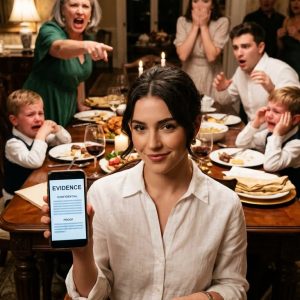
She pulled out her phone. “I want everyone to see exactly what it cost,” she said, her voice hardening, “to raise a disappointment.”
She tapped her screen.
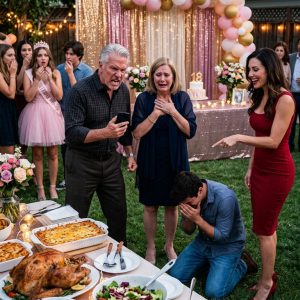
Around the dining table, forty-eight phones lit up simultaneously. A chorus of dings, buzzes, and chirps filled the silence, cascading like falling dominoes.
I watched as my relatives reached for their devices. I saw confusion morph into shock.
Subject: The cost of raising a disappointment.
The body of the email was an itemized spreadsheet. Twenty-eight years of my existence reduced to debits and credits.
Hospital Birth Costs: $12,400
Diapers (Years 1-2): $2,800
Childhood Clothing: $15,600
Orthodontia: $8,000
Summer Camps: $4,500
College Room and Board: $48,000
Cell Phone Bills: $8,400
The grand total, bolded at the bottom: $347,000.
“Does she ever say thank you?” Mom asked the room, her voice rising theatrically. She walked to the fireplace mantel and unveiled a framed copy of the spreadsheet—literally framed in gold leaf—hanging it next to the family portrait. “No. Instead, I get silence. I get distance. This is what a thankless child looks like in dollars and cents.”
The silence that followed was suffocating. I stood frozen in the doorway between the kitchen and the dining room. Forty-eight pairs of eyes bored into me. They were waiting for the script to play out. They were waiting for Bianca to cry, for Bianca to apologize for being a burden, for Bianca to shrink away so everyone could go back to their wine.
I looked at my father. He was staring at his plate, his face pale. He said nothing.
I looked at Vicki. She was whispering to her husband, a small smirk playing on her lips.
Then I looked at Grandma Eleanor. She sat perfectly still at the head of the table, her hands folded over her cane. She met my gaze and gave me the smallest, almost imperceptible nod.
Hold your ground.
My hands, which should have been shaking, were remarkably steady. I reached into my pocket and pulled out my phone. I navigated past the home screen, past the social apps, into the file manager.
I opened the folder marked “Insurance.”
“Mom,” I said. My voice wasn’t loud, but it cut through the tension like a razor blade.
Mom turned, her eyes glittering with triumph. “What?”
“Since we are sharing numbers today,” I said, stepping fully into the room, “I have some of my own.”
The smirk on her face faltered. “What are you doing?”
“Balancing the books.”
I walked toward the head of the table. “Keep your phones handy,” I addressed the room, my tone shifting into the professional cadence I used for client presentations. “Because I am about to send you something, too.”
“Bianca, stop,” Mom warned, stepping forward. “This isn’t the time.”
“Actually, Linda, it is the perfect time.” I looked her dead in the eye. “You calculated what I cost you. It seems only fair that I calculate what you cost me.”
I selected all forty-eight contacts in the email chain. I attached three files.
“Showing receipts,” I whispered.
I pressed Send.
Ding. Ding. Ding.
The sound was aggressive, a digital counter-attack filling the room. Mom’s face went gray.
“What did you just send?”
“The truth.”
I turned to the room. “The email contains three attachments. Let’s start with the first one.”
I held up my phone, projecting the PDF. “Mom, you charged me for my college education in your bill. Room and board, textbooks. But here is the reality: I paid for college myself. I have sixty-seven thousand dollars in student loans to prove it.”
“Your college fund ran out!” Mom shouted, her composure cracking. “I told you, we had unexpected expenses!”
“That is what you told me,” I corrected. “But numbers leave a trail.”
I pointed to the screen. “Grandma and Grandpa set up education trusts for both Vicki and me. Same amount: eighty-nine thousand dollars each. Vicki used hers to graduate debt-free.”
I swiped to the next page of the document. “My trust, however, was withdrawn in full on August 3rd, 2016. One month before I started my freshman year. The money was transferred to a personal account belonging to Linda Moore.”
A gasp rippled through the room. Aunt Patricia covered her mouth.
“One week later,” I continued, “Linda Moore purchased a brand-new Lexus LX. Paid in cash.”
“That money was for the family!” Mom shrieked. “You don’t understand!”
“I understand wire transfers,” I said coldly. “I understand that you stole my future to drive a luxury car while I drowned in interest payments.”
Dad stood up slowly. “Linda? Is this true?”
Mom opened her mouth, but I didn’t let her speak. “I’m not finished.”
I opened the second attachment: a spreadsheet.
“For the past few years, I’ve been battling the IRS. Audits, penalties, confusion. I hired a CPA to dig into it.” I looked around the room. “From 2018 to 2024, Mom claimed me as a dependent on her federal taxes.”
“So what?” Cousin Michael frowned. “Parents do that.”
“I was twenty-two in 2018,” I snapped. “I lived in my own apartment. I paid my own rent. I haven’t been anyone’s dependent since I left this house. That is tax fraud. She pocketed roughly thirty-two thousand dollars in illegal refunds using my Social Security number.”
Uncle George, a retired accountant, took off his glasses. “That’s a federal crime, Linda.”
Mom was trembling now, looking for an exit, but the room was closing in.
“And finally,” I said, my voice dropping an octave, “Attachment Three.”
I turned to Vicki. My sister froze, her wine glass halfway to her mouth.
“Do you remember when I applied for my first apartment in Cambridge? I got rejected. My credit score was 520. I had never owned a credit card.”
I pulled up the credit report on my screen. “I found three credit cards opened in my name between 2016 and 2018. All maxed out. Total debt: forty-seven thousand dollars.”
I looked at Vicki. “The statements were shipped to an address in Wellesley. Your address, Vicki.”
The room turned to look at the Golden Child.
“I have the shipping receipts,” I said. “Designer bags. Electronics. And one specific item—an engagement ring upgrade. Eight thousand, four hundred dollars.”
I looked at Vicki’s hand, at the diamond glittering under the chandelier. “You wore my stolen identity to your wedding.”
“I didn’t know!” Vicki burst into tears, the sudden sobbing jagged and ugly. “Mom said it was okay! She said it was an emergency! She said you would never check!”
“She told you to help her steal from me,” I said. “And you did.”
The room was in chaos. Relatives were standing up, shouting questions. Aunt Patricia looked like she was going to faint. But Mom wasn’t done. She saw her control slipping away, and she decided to burn the house down with her inside it.
“You ungrateful little wretch!” Mom screamed, lunging toward me. Uncle Robert caught her arm, holding her back. “I gave you life! I protected you!”
She glared at me with a hatred so pure it was terrifying. “You want to air dirty laundry? Fine. Let’s talk about why you’ve always been treated differently. Let’s talk about why you don’t fit in.”
She sneered. “There are things about you, Bianca, that would change everything. Secrets I kept to protect you.”
She thought she had leverage. She thought her secret was bigger than mine.
“You’re right, Mom,” I said softly. “There is one thing I didn’t know. Until three years ago.”
Mom stopped struggling. Her eyes widened. “What?”
“Three years ago, Vicki left her phone on the counter. A text came through from you. I wasn’t going to read it, but the preview showed my name.”
I held up my phone. “I took a screenshot.”
“Don’t,” Mom whispered. The color drained from her face completely. “Bianca, please.”
“I kept it for three years,” I said. “I told myself I would never use it. That it wasn’t my secret to tell. But you wanted a reckoning, Mom. You wanted to calculate the cost.”
I opened the email app one last time. I selected the draft I had saved for the nuclear option. Attached was a single image.
“If you ever loved me,” she begged, her voice breaking.
“I spent my entire life trying to earn your love,” I said. “Turns out, I never had a chance.”
I pressed Send.
Forty-eight phones buzzed.
The room went deathly silent as everyone opened the image. It was a screenshot of a text message from Linda to Vicki, dated July 15th, 2021.
It read: “This one isn’t Richard’s biological child. Don’t tell anyone. If he finds out, he’ll divorce me and I’ll lose everything.”
Dad made a sound like a wounded animal. He was staring at his phone, his hands shaking so violently he almost dropped it.
“Linda?” he whispered. “What is this?”
Mom couldn’t speak. She was hyperventilating, backing away toward the wall.
“Is it true?” Dad roared, slamming his hand onto the table. The china rattled.
It was Vicki who answered. “It’s true,” she sobbed. “She told me. She made me promise.”
The revelation hung in the air, heavy and suffocating. I wasn’t Richard Moore’s daughter. The man who taught me to ride a bike, who helped me with calculus, who walked me to the bus stop—he wasn’t my father.
And Mom had known. She had treated me like a stain on her perfect life not because I was difficult, but because I was evidence of her infidelity.
“You punished me for twenty-eight years,” I said to her, my voice trembling for the first time. “Not because I wasn’t good enough. But because every time you looked at me, you saw your own mistake.”
Grandma Eleanor stood up. She walked over to Mom, her cane tapping rhythmically on the hardwood floor. She stopped three feet away and looked at her daughter with an expression of absolute disgust.
“I suspected,” Eleanor said, her voice ice-cold. “For years, I wondered why you treated that girl with such disdain. But I never imagined you were capable of this level of deceit.”
“Mama, please,” Mom cried.
“Don’t call me that,” Eleanor snapped. “You lied to Richard. You lied to the family. And you stole from your own child.”
The room fractured. People were grabbing coats, car keys, purses. The exodus was swift. Aunt Patricia walked out without a word. Uncle George followed. The notifications on my phone started blowing up—people leaving the family group chat, people blocking Linda.
Dad walked past Mom without looking at her. He came straight to me. His eyes were red, brimming with tears.
“Dad,” I started, “I’m so sorry.”
“Don’t,” he choked out. He pulled me into a hug, fierce and desperate. “You are my daughter. You hear me? Biology doesn’t change who raised you. It doesn’t change who loves you.”
He pulled back, gripping my shoulders. “I can’t stay here. I can’t look at her.”
“I know.”
“But this…” He gestured between us. “This doesn’t change.”
He walked out the front door, leaving Linda alone in the wreckage of her own making.
The next morning, the sun rose over a different world.
I had spent the night at Marcus’s, my phone turned off. When I finally turned it on, the support was overwhelming. Apologies from aunts, furious messages from cousins about Mom’s behavior. But there was one text that stood out.
It was from Grandma Eleanor.
Come to the house. 9:00 AM. Bring no one.
I drove back to the farmhouse. The driveway was empty. Inside, the house was silent, the debris of the party cleared away. I found Grandma in her study, sitting with a man in a gray suit—Thomas Jameson, the family estate attorney.
“Sit,” Grandma commanded.
I sat.
“I didn’t block your mother,” Eleanor said, her hands folded on her desk. “Do you want to know why?”
“Why?”
“Because blocking her is temporary. What I did is permanent.”
She slid a document across the mahogany desk. “At 4:00 AM this morning, Mr. Jameson finalized the changes to my will.”
I looked at the legal jargon. “I don’t understand.”
“Your mother was set to receive thirty-five percent of my estate,” Eleanor said. “That has been reduced to five percent. Just enough so she cannot contest it legally.”
My breath caught.
“Your share,” she continued, “has been increased to thirty percent. Your father’s share remains untouched.”
“Grandma, I didn’t do this for money.”
“I know. That is why you deserve it.” She reached into her drawer and pulled out a cream-colored envelope. “And this… this is the graduation gift I tried to give you six years ago. Linda told me you refused it. She said you wanted to ‘make it on your own.'”
I opened the envelope. It was a check for fifty thousand dollars.
“I believed her lies,” Eleanor said, her voice cracking with regret. “I won’t make that mistake again.”
As I walked back to my car, clutching the envelope, I saw Vicki waiting by the gate. She looked haggard, stripped of her usual gloss.
“Bianca,” she called out.
I stopped but kept my distance.
“I know you hate me,” she said. “I deserve it.”
“You do,” I agreed.
“I just… I was scared,” she admitted, tears leaking from her eyes. “I saw how she treated you. I was terrified that if I stepped out of line, I would become the next target. Helping her was… survival.”
I looked at my sister—really looked at her. I saw a woman who was just as trapped, just as manipulated, but who had chosen cowardice over integrity.
“I understand why you did it, Vicki,” I said. “Fear makes people do terrible things.”
She nodded, hopeful. “So, can we—”
“But understanding isn’t forgiveness,” I cut her off. “I can’t have you in my life right now. Maybe not ever.”
I got in my car and drove away.
Two months later, the dust has begun to settle, though the landscape of my life is forever changed.
My credit score, cleared of the fraudulent debt, is climbing. I used Grandma’s check to pay down a massive chunk of my student loans. Marcus and I moved into a new apartment in Cambridge—one with a spare room and no ghosts.
Dad and I have dinner every Sunday. The divorce is messy, but he looks lighter, younger. He told me he doesn’t regret a single day of being my father.
And then, there was the letter.
It arrived last week, postmarked from Ohio.
Dear Bianca,
I recently took a DNA test on 23andMe. I believe we are a match. My name is Michael. I dated your mother briefly twenty-nine years ago. I never knew. I am not asking for anything, but I wanted you to know I am here if you ever want to talk.
I haven’t replied yet. I’m not sure I will. I already have a father. But knowing the truth—having the option—feels like a door opening in a room that was previously sealed shut.
Yesterday, leaving my office building, I saw her.
Mom was standing on the sidewalk. She looked smaller, her posture slumped. She wasn’t wearing her usual jewelry.
“Bianca,” she said, stepping into my path. “I’ve been trying to call. You blocked me.”
“That’s the point of a block, Mom.”
“I just want to talk,” she pleaded. “I’m your mother. You can’t just cut me out forever. People make mistakes.”
“Mistakes are accidents,” I said, my voice steady. “Identity theft is a choice. Tax fraud is a choice. Lying about my paternity for twenty-eight years is a choice.”
“I did it to keep the family together!”
“No,” I corrected her. “You did it to keep your image together. And now, the bill has come due.”
I stepped around her.
“If you walk away,” she called out, her voice rising in that familiar, threatening pitch, “don’t expect me to be here when you come crawling back!”
I paused and turned one last time. I looked at the woman who had calculated the cost of my diapers, who had framed a bill for my existence, who had tried to charge me for the air I breathed.
“Mom,” I said, smiling for the first time in her presence in years. “My bill is paid in full.”
I walked to my car, got in, and drove into traffic. My hands were on the wheel, and for the first time in my life, they weren’t shaking.
Like and share this post if you found it interesting.