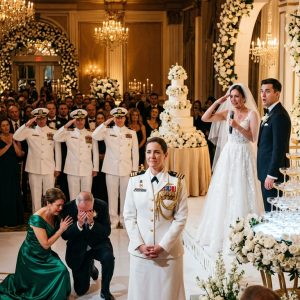
I almost didn’t go. Standing in the foyer of my small, meticulously organized apartment, I stared at the invitation as if it were a court summons rather than a celebration. The heavy cream cardstock, embossed with gold lettering, felt like a physical weight in my hand. The grand engagement of Julian and Sofia. It was less an invitation and more a directive: Come, witness the golden child ascend, and remember your place in the shadows.
My brother’s engagement party was being held at The Obsidian Room, one of those aggressively expensive venues in the city center designed to remind you, with every crystal chandelier and velvet drape, exactly who mattered and who did not. It was a place where the air smelled of imported lilies and old money, a scent that always made my stomach turn.
I stood in front of the mirror longer than I should have, adjusting a simple, charcoal-gray dress. It was elegant, structural, and understated—armor disguised as fabric. I knew what they would see: a lack of effort. A lack of funds. A woman who, at twenty-nine, was still “drifting” while her younger brother conquered the corporate world.
I didn’t want attention. I didn’t want a fight. I just wanted to show up, hand over the gift—a vintage watch I knew Julian wouldn’t appreciate—congratulate him, and vanish into the night before the dessert course.
That was my mistake. I underestimated their need for a target.
The moment I stepped out of the Uber and walked toward the entrance, I felt the atmosphere shift. The doorman checked my name on the list, his eyes flicking up and down my attire with professional indifference, before waving me through. Inside, the noise hit me—a wall of polite laughter, clinking glass, and the low hum of networking disguised as socializing.
People were dressed as if they were auditioning for success. Men in bespoke suits that cost more than my first car; women in gowns that shimmered like oil slicks under the lights. I navigated through the crowd, searching for a quiet corner, but the room was designed to expose everyone.
“Elena! You actually came.”
The voice was shrill, cutting through the jazz music. I turned to see my mother, Margaret, approaching. She was holding a flute of champagne, her face tight with that specific blend of disappointment and forced cheer she reserved exclusively for me.
“Hello, Mother,” I said, leaning in for a cheek kiss that didn’t connect. “You look lovely.”
She didn’t return the compliment. She stepped back, her eyes scanning me like a building inspector looking for cracks. “A bit plain for the occasion, isn’t it? But I suppose that’s your style. Minimalist.” She made the word sound like a disease. “Your father is over by the bar with the Vassiliou family. Try not to embarrass him, Elena. They are very important investors in Julian’s firm.”
“I’m just here to say congratulations,” I said, keeping my voice even.
“Of course,” she sighed, already looking past me. “Just… try to mingle. And if anyone asks what you’re doing these days, maybe just say you’re ‘consulting.’ It sounds better than ‘figuring things out,’ doesn’t it?”
She patted my arm—a gesture devoid of warmth—and fluttered away toward a group of women wearing enough diamonds to fund a small war.
I took a breath, letting the familiar sting wash over me. I had learned years ago that reacting only fed them. They needed me to be the failure so Julian could be the success. It was the ecosystem of our family; for the sun to shine, there had to be a shadow.
I made my way to the bar, ordering a sparkling water. I turned just in time to see him. Julian. My brother. He was standing in the center of the room, holding court. He looked the part of the conquering hero: jawline sharp, smile practiced, one hand resting possessively on the waist of his fiancée, Sofia, a sweet girl who looked terrified of my mother.
Julian spotted me. His smile didn’t reach his eyes. He raised his glass in a mock salute, loud enough for the surrounding circle to hear.
“Well, look who decided to grace us with her presence! The artist formerly known as employed!”
The circle laughed. It was a cruel, jagged sound. I felt the heat rise in my neck, not from shame, but from a cold, simmering rage I had been suppressing for a decade.
I raised my water glass in return, my expression flat. “Congratulations, Julian.”
He winked at his admirers. “She’s a free spirit, you know? While I’m out there slaying dragons in the boardroom, Elena is… well, Elena is vibrating on a different frequency.”
More laughter. I took a sip of my water. My hand didn’t shake. My heart didn’t race. Because what Julian didn’t know—what my mother, my father, and every sycophant in this room didn’t know—was that the “dragons” Julian claimed to be slaying were actually my pets.
And tonight, the leash was about to snap.
The dinner was a masterclass in exclusion.
I was seated at the far end of the head table, sandwiched between a deaf great-aunt and a cousin, Marcus, who had made a fortune in cryptocurrency and wanted everyone to know about it. The seating chart was a clear message: You are family, so we must feed you, but you are irrelevant, so we will hide you.
I picked at my sea bass, listening to the hum of conversation around me. It was all the same. The worship of status. The desperation to be seen.
“So, Elena,” Marcus said, leaning in, his breath smelling of scotch. “What is it you’re actually doing now? Aunt Margaret said something about… freelance?”
“I manage a private portfolio,” I said quietly. It was the truth, just not the whole truth.
Marcus snorted. “Right. Portfolio. like, stocks on an app? Look, if you need tips, I’ve got a guy. Serious returns. Not for the faint of heart, though. You need capital to play in the big leagues.”
“I’ll keep that in mind,” I said, cutting a piece of asparagus with surgical precision.
“No offense,” he continued, clearly enjoying himself, “but some people are just born with the drive, you know? Like Julian. The guy is a machine. Did you hear about the merger he’s handling? Apexion Group is acquiring a logistics firm in Rotterdam. Julian says he’s leading the integration.”
I paused, my fork halfway to my mouth.
“He said that?” I asked softly.
“Oh yeah. Says the CEO—some recluse nobody’s ever met—personally tapped him for it. Big stuff. That’s why he’s the Golden Boy, right?”
I lowered my fork. A cold smile touched my lips, invisible to Marcus. Apexion Group. My company. The empire I had built from a laptop in a studio apartment ten years ago, growing it into a multi-national conglomerate through sleepless nights, ruthless strategy, and a brilliance my family refused to believe I possessed.
And the Rotterdam merger? Julian wasn’t leading it. He was a mid-level manager in the Compliance Department. His only role in the merger was to check the spelling on the due diligence reports.
But he was lying to them. He was building a castle out of clouds, and my parents were living in it.
I looked down the table. My father, Robert, was standing up, tapping a spoon against his wine glass. The room fell silent.
“Friends, family,” my father began, his voice booming with pride. “Tonight is a night of joy. Not just because my son is marrying a wonderful woman, but because I see the man he has become.”
He placed a hand on Julian’s shoulder. Julian beamed, puffing out his chest.
“In this family,” my father continued, his eyes sliding over me briefly before returning to the crowd, “we value hard work. We value legacy. Julian has proven that he understands what it means to build something real. To work for a titan like Apexion, to be trusted with responsibilities that shape the market… it makes a father proud.”
Applause rippled through the room. My mother dabbed at her eyes with a napkin.
“Thank you, Dad,” Julian said, standing up. He looked flushed, drunk on praise and expensive Pinot Noir. “It means a lot. really. You know, it’s not easy. The pressure is immense. The CEO… let’s just say she’s a demanding woman. But she knows talent when she sees it.”
He chuckled, and the room chuckled with him.
“But seriously,” Julian went on, his gaze drifting down the table until it locked onto me. The warmth vanished from his eyes, replaced by that familiar, sneering superiority. “I feel lucky. Lucky to have stability. Lucky to have a path. Unlike some people…”
He trailed off, letting the silence do the damage. The guests shifted uncomfortably. Sofia looked down at her plate.
“I mean, look at Elena,” Julian said, gesturing with his glass. “My big sister. Always the dreamer. Always floating between ideas. I remember when you wanted to be a writer. Then a graphic designer. Then… what was it? A life coach?”
“Julian,” I said, my voice low. “That’s enough.”
“No, no, I’m serious!” he laughed, playing to the crowd. “It’s cute, really. It must be nice. To have zero responsibility. To not have people depending on you for their mortgages. At least now…”
He paused for dramatic effect, a smirk curling his lip.
“…at least now, I’ll never have to worry about ending up like the ‘disappointment’ of the family.”
The room went dead silent. It wasn’t a funny silence. It was a gasp. He had gone too far, and he knew it. But he didn’t care. He wanted to hurt me. He wanted to remind me of the box they had built for me.
I sat there, frozen. Not in shame, as he expected. But in clarity.
I looked at my parents. They weren’t stopping him. My mother was sipping her wine, looking vaguely amused. My father was nodding, as if Julian was speaking a hard truth that needed to be heard.
They were enjoying this. They liked me small. It made them feel big.
I took a slow sip of my drink. I felt the cool liquid slide down my throat. I placed the glass down on the tablecloth. The sound was soft, but in the silence of the room, it sounded like a judge’s gavel.
If I stayed silent now, I would be silent forever. I would be the doormat they wiped their feet on for the rest of my life.
I pushed my chair back. The screech of wood against the polished floor turned every head in the room.
“Elena, sit down,” my mother hissed, her eyes widening. “Don’t make a scene.”
I ignored her. I stood up, smoothing the front of my charcoal dress. I didn’t look angry. I looked like I was about to conduct a board meeting.
“I’d like to say a few words,” I said. My voice wasn’t loud, but it carried to the back of the room.
Julian rolled his eyes. “Oh god. Here we go. The victim speech.”
“No,” I said, turning to face him. “Not a victim speech. A clarification.”
The air in the room grew heavy, charged with static electricity. I looked at Julian, then at my parents, and finally, I addressed the entire room.
“I am very happy for my brother,” I began, walking slowly toward the head of the table. “An engagement is a milestone. It requires maturity. Honesty. And above all, a stable foundation.”
I stopped directly behind Julian’s chair. He shifted, trying to look unbothered, but I saw the sweat beading on his temple.
“We’ve heard a lot tonight about Apexion Group,” I said. “About the hard work it takes to succeed there. About the leadership. About the ‘demanding’ CEO.”
I paused. “And Julian is right. The CEO is demanding. She has to be. Because she manages four thousand employees across three continents. She manages assets worth over two billion dollars.”
“Elena, what are you blabbering about?” my father snapped. “Sit down.”
“The company you are all so proud of,” I continued, my voice hardening into steel. “The one that pays for this venue. The one that funds Julian’s bonus checks. The one that sponsors the charity galas my mother loves to attend.”
I leaned down, bringing my face close to my brother’s ear, but speaking loud enough for the microphone to catch.
“That company belongs to me.”
The silence that followed was absolute. It was the silence of a vacuum, where sound could not exist.
My mother’s face drained of color, turning the shade of old parchment. My father stared at me, his mouth slightly open, looking like I had suddenly started speaking Aramaic.
Julian was the first to break it. He laughed. It was a sharp, brittle sound, like glass stepping on stone.
“That’s… that’s not funny, Elena,” he stammered, looking around the room for support. “God, you’re delusional. You’re drunk. Sit down before you embarrass yourself further.”
“I’m not joking, Julian,” I said. I didn’t move. “And I’m certainly not drunk.”
“You own Apexion?” He scoffed, shaking his head. “You? You drive a Honda, Elena. You live in a studio apartment. You… you’re nobody.”
“I live in a studio because I reinvest 90% of my dividends back into the company,” I said calmly. “I drive a Honda because I don’t need a Porsche to validate my existence. And I am ‘nobody’ because I chose privacy over ego. I wanted the business to stand on its own. And, frankly, I didn’t want my family poisoning it.”
“This is insane,” my father sputtered, standing up. “Elena, stop this lying immediately. It’s pathetic.”
“Is it?” I reached into my small clutch purse and pulled out my phone. I tapped the screen three times and turned it around to face Julian.
It was the internal executive dashboard for Apexion Group. The screen showed the real-time logistics feed for the Rotterdam merger. It showed the encrypted chat log between the Board of Directors. And at the top, under the profile picture, was my name: Elena Vance – Chairman & CEO.
Julian stared at the screen. His eyes bulged. He knew what that interface looked like. He had seen it on his boss’s screen—from a distance. He didn’t have clearance to access it himself.
“How…” he whispered. “How do you have the admin codes?”
“Because I wrote them,” I said. “Ten years ago. When you were partying in Ibiza on Dad’s dime, I was coding the logistics algorithm that became the backbone of the entire company.”
I swiped the screen. “And Julian? About that Rotterdam merger you’re ‘leading’?”
I tapped a file. “According to HR records, you are listed as ‘Junior Associate, Compliance Sector B’. Your current task is verifying customs codes for shipping containers. You are not leading the integration. You aren’t even on the strategy team. In fact, your supervisor, Mr. Henderson, put you on a Performance Improvement Plan last week because you were late three times.”
The room gasped. This wasn’t just a revelation; it was an execution.
Julian’s face went from pale to a sickly gray. He slumped in his chair, the arrogance evaporating like mist. Sofia pulled her hand away from his, her eyes wide with shock.
“You… you knew?” my mother whispered. Her voice was trembling. “All this time? You let us think you were… struggling?”
“I let you think whatever you needed to think,” I said, turning to her. “Because no matter what I did, it was never enough for you. If I told you I was successful, you would have taken credit for it. If I told you I was rich, you would have asked for money. I wanted to see how you treated me when you thought I had nothing to offer.”
I looked around the room at the cousins, the aunts, the hangers-on who had laughed at me twenty minutes ago. They were all staring at their plates, terrified to make eye contact.
“And now I know,” I said softly.
“Elena,” my father said, his voice changing. The anger was gone, replaced by a desperate, fawning tone that was somehow worse. “Elena, sweetheart. We… we didn’t know. You have to understand, we were just pushing you. We wanted you to succeed! This is… this is wonderful news! My daughter, the CEO!”
He reached out to touch my arm. I took a step back.
“Don’t,” I said. The word was a blade. “Do not try to rewrite history just because the power dynamic has shifted. You didn’t want me to succeed. You wanted me to fit.”
I turned back to Julian. He looked small. Broken. The suit didn’t fit him anymore; it looked like a costume.
“I didn’t come here to embarrass you, Julian,” I said. “I truly didn’t. I was going to give you your gift and leave. But you couldn’t stop. You had to stand on my neck to feel tall.”
I picked up my clutch.
“The Rotterdam merger is actually stalled,” I said, dropping a piece of information only the inner circle knew. “Because the Dutch regulators found irregularities in the paperwork. Paperwork that your department was supposed to file, Julian.”
His jaw dropped.
“We’ll be discussing your employment status on Monday morning,” I said casually. “I suggest you be on time. Mr. Henderson tells me you have a habit of taking long lunches.”
I turned to the room.
“Enjoy the party. The champagne is on the house. Or rather… on me.”
I walked away.
The room stayed frozen. Not because I had shouted, not because I had thrown a glass, but because the entire reality of the Vance family had just imploded in under three minutes.
I heard the scrape of a chair as I reached the double doors.
“Elena! Wait!”
It was my mother. I paused in the doorway but didn’t turn around.
“Elena, please,” she called out, her heels clicking frantically on the marble. She sounded desperate. “You can’t just leave like this! What will people say? We need to… we need to talk about this. The family… the business…”
I turned my head slightly, looking at her over my shoulder. She stopped a few feet away, looking at me with a mixture of fear and greed. She was already calculating. She was already wondering how to spin this, how to become the mother of the CEO, how to access the lifestyle she felt she deserved.
“There is nothing to talk about, Mother,” I said. “You made your opinion of me very clear tonight. And unlike Julian, I actually listen to the people around me.”
“But we’re family!” she cried, clutching her pearls. “You can’t hold a grudge over a few jokes! We love you!”
“You love success,” I corrected her. “And for thirty years, you thought I didn’t have any. That’s not love. That’s investment strategy.”
I pushed the heavy oak doors open. The cool night air hit my face, smelling of rain and asphalt—the scent of reality.
“Goodbye, Mother.”
I walked out to the curb. The valet saw me coming and sprinted to get my car. He didn’t look at me with indifference this time. He had been standing near the door; he had heard the silence fall.
As I waited, my phone buzzed. It was a text from Marcus, the crypto-cousin.
“So… about those investment tips? Let’s grab lunch?”
I deleted the text. Then I blocked the number.
My Honda pulled up. It wasn’t a limousine. It had a dent in the rear bumper and the back seat was full of gym clothes. But as I slid into the driver’s seat, it felt like a chariot.
I looked back at the Obsidian Room one last time. Through the large glass windows, I could see the party had not recovered. Groups were whispering. My father was sitting with his head in his hands. Julian was arguing with Sofia, who looked like she was crying.
They were trapped in the wreckage of their own assumptions.
I put the car in gear and pulled away, merging into the city traffic. For the first time in my life, the silence in my head wasn’t filled with their voices, their criticisms, or their doubts.
It was just quiet.
And in that quiet, I finally heard myself think.
I won.
I didn’t fire Julian on Monday. That would have been too easy. Too merciful.
Instead, I transferred him.
He now works in the Archive Department, located in the second sub-basement of the building. It has no windows, the Wi-Fi is spotty, and his job is to digitize paper records from 1995 to 2005. It is tedious, solitary, and utterly unglamorous work.
He hasn’t quit. He can’t. He has a mortgage to pay, a wedding to fund (though Sofia is postponing the date), and he knows that if he leaves, he will never find another job in this industry. Not with the reference I would give him.
My parents call me once a week. I let it go to voicemail. I send them a Christmas card, signed by my assistant. They still live in their house, still go to their clubs, but they are smaller now. The shine has worn off. They know that everyone knows. They are the parents who bet on the wrong horse, the architects who didn’t recognize the foundation of their own lives.
I still live in my studio apartment. I still drive my Honda. But sometimes, when I’m driving past the massive glass tower of Apexion Group late at night, seeing the lights burning on the top floor where my office sits, I smile.
The underestimation that had defined my life for so long had become my greatest weapon. I didn’t need to shout, to threaten, or to humiliate. The truth itself had done the work.
And the truth was simple: The ones who scream the loudest about their power are usually the ones who have none. The real power is the hand that holds the keys, quietly, in the dark.
If you enjoyed this story of hidden strength and sweet vindication, please subscribe and hit the bell icon. Your support helps me continue to share these moments of truth. Thank you for reading.