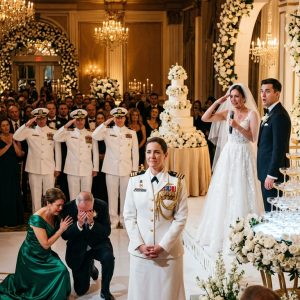
Foundations of Dust
Chapter 1: The Toast
He raised his glass and smiled. It wasn’t a smile of warmth or celebration; it was the kind of smile a wolf offers a lamb before the slaughter—sharp, predatory, and devoid of humanity.
“To Riley,” Walter Harrington boomed, his voice echoing off the vaulted ceilings of the ballroom. “May she finally have a stable family. Something her sister could never give her.”
Laughter rippled through the room. It was polite, hollow laughter, the sound of people who had been bought and paid for. I didn’t laugh. I sat perfectly still, my fingers tracing the rim of my water glass, feeling the cold condensation bleed onto my skin.
My name is Clarinda Peton. To the people in this room, I am merely the bride’s sullen older sister, a civil engineer with dirt under her fingernails and a chip on her shoulder. But Walter Harrington, the man currently humiliating me in front of two hundred of Denver’s elite, was about to learn a lesson in structural integrity.
For twenty years, I have carried the silence of a collapsed mine in my chest. I have carried the weight of two parents who walked into the earth and never walked out. Today, the ground beneath Walter’s feet was about to crack, and I would be the one holding the sledgehammer.
The ballroom shimmered under a massive glass atrium. Outside, the Aspen mountains loomed, jagged and white against a twilight sky. Inside, it was warm, smelling of expensive perfume and roast duck. The jazz band played something unobtrusive, a soundtrack for the wealthy to ignore. I sat at the farthest table, half-hidden behind a towering centerpiece of white hydrangeas and crystal, watching my sister.
Riley sat at the head table, looking radiant in white silk, but her smile trembled at the edges. She gripped the tablecloth, her knuckles white. She hated conflict. She hated that Walter, her future father-in-law, openly despised me.
Walter stood, all charm and command, the master of his domain. He swirled the red wine in his glass—a vintage that probably cost more than my first car—and let the light catch it. It looked like blood suspended in crystal.
“Yes,” Walter continued, basking in the attention. “We welcome Riley into the Harrington fold. A lovely young woman who survived a… let’s call it a chaotic upbringing. But stability is the Harrington promise.”
A ripple of uneasy laughter followed. Someone clinked a fork against china, a sharp, dissonant sound.
I stood up.
The movement was small, but the scrape of my chair against the marble floor sounded like a gunshot in the sudden silence. Two hundred heads turned.
“Mr. Harrington,” I said softly. My voice wasn’t loud, but it carried. Years of shouting instructions over the roar of excavators had taught me how to project. “Do you even know what stability costs?”
Silence swallowed the room. The jazz band stopped mid-note.
Walter blinked, his smirk faltering for a microsecond before reassembling itself into a mask of amused pity. “Ah,” he murmured, swirling his wine again. “The sister speaks. A bit early for the open mic, isn’t it, Clarinda?”
I didn’t look at him. I looked at Riley. Her eyes were wide, filled with a pleading fear. Please don’t, her eyes said. Please don’t ruin this.
I smiled at her—a sad, soft smile. Then I sat back down, calm as granite.
“He thinks this is about pride,” I thought, picking up my napkin. “He thinks I’m just an angry orphan lashing out at a billionaire. But this isn’t about pride. This is about foundation. And his is rotting.”
Somewhere in the distance, muffled by the layers of silk and wool, a phone buzzed. Then another. Then a third.
Walter frowned, reaching into the breast pocket of his tuxedo. He pulled out his phone, annoyed at the interruption. The glow of the screen illuminated his face, casting deep shadows into his wrinkles.
I watched him read the notification. I knew exactly what it said.
Denver Daily Investigations: Harrington Mining investigation reopened. Federal inquiry launched.
My smile didn’t fade. It simply deepened, settling into the corners of my mouth. Quiet. Certain. Inevitable.
Chapter 2: The Echo of the Collapse
The night the mine collapsed still claws at my memory, fresh as an open wound. I was seventeen. Riley was seven.
I remember the sirens first—a wailing chorus that cut through the winter air, louder than the wind. Then came the shouting, frantic and guttural. But mostly, I remember the smell. The metallic tang of coal dust, wet earth, and fear.
I stood behind the chain-link fence of the Harrington Ridge site, my hands frozen to the icy metal mesh. The floodlights turned the falling snow into blinding streaks of white. Ambulances screamed into the dark, red lights flashing against the black pit of the mine entrance.
“Stay back!” a foreman shouted, pushing against a wall of sobbing wives and children.
They said no one was left inside. They lied.
I knew my parents hadn’t made it out. My father was a shift supervisor; he wouldn’t leave his crew. My mother was the site medic; she wouldn’t leave the injured.
“The roof gave in!” someone shouted from the pit, their voice cracking. “The beams weren’t reinforced! I told them the timber was rot!”
I waited by that fence for three days. Riley slept in the cab of our truck, wrapped in blankets, clutching a stuffed bear. I didn’t sleep. I watched the mouth of the earth, waiting for it to spit them back out.
It never did.
The next morning, the Denver Post ran a headline that told a prettier story: Natural Tremor Causes Tragic Accident at Ridge Site.
I walked into the Harrington Mining corporate office three weeks later. I was a child, skinny and shaking, clutching that newspaper in a fist so tight my nails cut my palms.
The man behind the front desk didn’t even look up. “You should move on, kid,” he said, chewing gum. “Mr. Harrington paid the settlements. It’s generous. Don’t be greedy.”
He stepped away to grab a coffee. He didn’t see me reach over the counter. He didn’t see me snatch the internal incident report he had left sitting on top of a stack of files.
I ran out of the building and hid in an alleyway to read it. The ink was faint, stamped with the word DRAFT, but one line burned through the page like a brand.
Support Structure B: Failed inspection. Recommended reinforcement denied. Approved for cost reduction: W. Harrington.
That was the day I stopped believing in accidents. That was the day I stopped believing in God and started believing in gravity.
Gravity is honest. If you build something weak, it falls.
Years passed in fragments of steel dust and concrete. I put myself through engineering school on scholarships and sleepless nights. I worked double shifts to keep Riley in clothes that fit and fed her noodles and borrowed dreams. She learned to draw, to dance, to laugh. She grew up soft and hopeful because I took all the hard edges for myself.
I became a civil engineer. I specialized in forensic structural analysis. I became the person they call when a bridge falls down, and they want to know whose fault it is.
Now, a photo of our parents sits on my desk, the only thing in my stark, modern apartment that feels warm. Light flickers across their faces like fire trapped behind glass.
“If he built his empire on broken beams,” I whispered to the photo, “I’ll be the one to bring it down.”
My phone buzzed on the desk, snapping me back to the present. A message from Riley glowed bright against the dark screen.
Claire. Derek proposed! You have to meet him. You’ll love his family.
My hand tightened around the phone until my palm stung. She didn’t know. How could she? I had shielded her from the ugliness of the report. I had shielded her from the name Harrington.
She was marrying the son of the man who killed our parents.
Chapter 3: The Cracked Façade
The Harrington estate was a monument to ego. It sat on a cliff overlooking the valley, all glass walls and sharp angles, designed to dominate the landscape rather than blend with it.
I arrived for the engagement dinner two weeks later. The air inside smelled of polished wealth—sweet, sterile, and cold.
At the center of it all sat Walter Harrington. He looked exactly like his photos in Forbes, though age had thickened his neck and thinned his hair. He wore confidence as heavily as the gold watch on his wrist.
He studied me with that slow, assessing look people use when they’ve already decided you don’t belong in their tax bracket.
“A civil engineer, Riley tells me?” he asked, swirling a glass of scotch. We were standing by the fireplace, isolated from the rest of the party. “So, you build things.”
“Mostly I inspect things,” I corrected, meeting his gaze. “I determine why things collapse.”
His eyes narrowed slightly. “Is that so? And what’s the usual cause?”
“Human error,” I said evenly. “Or greed. Usually, it’s when people remove the supports to save a dollar, hoping the ground won’t notice.”
His smile froze. It didn’t drop, but it lost all warmth. We stood there, locking eyes, two predators recognizing each other in the tall grass.
“You have a cynical view of the world, Ms. Peton,” he said softly.
“I have an accurate view, Mr. Harrington.”
On the wall behind him hung a massive framed portrait. Walter, his late wife, and a teenage Derek. Behind them, the majestic peaks of the Rockies. Specifically, the ridge where the mine had caved in.
The chandelier’s reflection cut across the photo, a streak of light splitting the image like a fracture in glass. He’d put it there on purpose. A trophy. A silent declaration that he owned the mountain, and everything buried inside it.
Derek approached us then, smiling nervously. He was a softer version of his father—handsome, eager to please, completely oblivious.
“Dad, stop grilling her,” Derek joked, placing a hand on my arm. “Claire, come see the view from the terrace.”
I let him lead me away. Out in the cold night air, Derek leaned against the railing.
“He’s hard to deal with,” Derek admitted quietly, looking back at his father through the glass walls. “He demands perfection. But he’s not all bad. He built this family from nothing.”
I turned toward him, the wind whipping my hair across my face. “You’ve never seen the beams from the inside, have you, Derek?”
He frowned. “What?”
“Nothing,” I said. “Just… be careful where you stand.”
I left him there, the golden glow from the house spilling onto the snow like cracks spreading from a broken foundation.
That night, I went back to my apartment and opened my laptop. I logged into a secure server I used for work—and for other things.
I had a contact. Lennox, an investigative journalist who had been trying to nail Harrington for a decade but never had the smoking gun.
I began to dig. I pulled permits, I hacked into municipal databases, I traced shell companies.
And then I found it.
Site Report: Rocky Ridge Extension.
A new site. A new project. A new sin.
The blueprint glowed on my screen, intricate white lines on a blue void. I zoomed in on the support schematics. My engineer’s eye spotted it immediately.
Load-bearing capacity compromised. Reinforcement grade: Sub-standard.
And at the bottom, a digital signature. Authorized: W. Harrington.
He was doing it again. Twenty years later, and he hadn’t learned a thing. Or rather, he had learned that he could get away with it.
I sent the file to Lennox. His reply came three minutes later.
If this checks out, it’s homicide in the making. But we need the money trail. Proof he pocketed the difference.
That afternoon, Riley called me in tears.
“Why did you tell a reporter about Dad’s company?” she sobbed.
My stomach dropped. “Who told you that?”
“Derek heard rumors. People are asking questions. You’re trying to ruin him, aren’t you? You’re jealous!”
“I’m not ruining anyone, Riley,” I said, gripping the phone. “I’m rebuilding what they broke. He’s dangerous.”
“He’s family!” she screamed. “He’s paying for our honeymoon! He’s paying for the house! Why can’t you just be happy for me?”
“Because he’s buying your silence!” I shouted back, losing my cool for the first time. “Every dollar he spends on you is dirty, Riley. It’s blood money!”
She hung up. The silence that followed left a crater in my living room.
Hours later, Lennox’s email arrived.
Followed the money. 3.2 million vanished from the environmental safety fund for the new site. Transferred to a Bohemian account.
The account is in Riley’s name.
I stared at the screen, the breath knocked out of me. He hadn’t just bought her. He had framed her. He was laundering the money through his future daughter-in-law, using her as a human shield. If the Feds investigated, Riley would go down, not him.
I looked at the photo of my parents. “Justice always breaks something,” I whispered. “I just didn’t know it would break her.”
Chapter 4: The Blueprint of Justice
Three days before the wedding, I drove to the outskirts of Denver. I parked my car and walked a mile through the snow until I reached the chain-link fence of the old Harrington Ridge mine.
It was abandoned now. A scar on the landscape. The air was damp and bitter, filled with the smell of rust and old earth.
I ran my fingers over a faint engraving on a rusted metal beam, still clinging to the stone. Safety First.
“You forgot your own words, Walter,” I whispered.
Back at my apartment, my desk had turned into a war room. Blueprints, schedules, lines connecting faces, accounts, and dates. Every piece fit together like steel under tension.
I had to be surgical. If I released the info too early, Walter would shred the documents and blame Riley. If I waited too late, the new mine might collapse.
I needed a trap.
My laptop screen glowed as Lennox’s face appeared on a video call. He looked tired, surrounded by coffee cups.
“Are you sure about the timing?” he asked.
“He’ll raise his glass at 1:45 PM,” I said. “He loves the sound of his own voice. He’ll toast before the cake is cut. Make sure the world is watching.”
“The SEC is ready to move,” Lennox said. “But Claire… once we pull this trigger, there’s no going back. Your sister…”
“I know,” I said. “I’m saving her. She just won’t realize it until it’s over.”
That night, I unlocked my father’s old safe. I took out his favorite drafting pencil—a heavy, silver mechanical pencil he used to sketch bridges. I engraved three words onto the side of it: Build to Last.
I slipped it into my pocket.
Then, I prepared the gift.
I bought an elegant silver picture frame. I placed a generic photo of the Aspen mountains inside. But behind the glossy photo, faintly visible only if you looked closely at the texture, was an overlay of the bank transfer logs showing the money moving from the safety fund to the Bohemian account under Riley’s name.
And on the back of the frame, I engraved: Foundations don’t lie.
I sent it to Walter’s suite at the hotel with a note: For your collection.
The next morning—the day of the wedding—I received a text from Derek.
Can we talk?
I met him in the hotel lobby. He looked pale, dark circles under his eyes.
“I found a folder,” he whispered, looking around to make sure his father wasn’t nearby. “In his study. It had Riley’s signature on it. Bank documents. But… Claire, the dates are from three months ago. Riley was in Paris then. She couldn’t have signed them.”
I looked at him, seeing the crack in his loyalty. “He forged them, Derek. He’s setting her up.”
Derek ran a hand through his hair. “He’s my father. He wouldn’t.”
“He killed my parents for three million dollars in concrete savings,” I said coldly. “What makes you think he won’t sacrifice a daughter-in-law to save his own skin?”
Derek stared at me, the horror slowly dawning. “What do I do?”
“Stay silent,” I told him. “Let the ground collapse. And when it does… make sure you’re not standing next to him.”
Chapter 5: The Collapse
The wedding day was perfect. Cruelly perfect.
The sun blazed off the snow, blindingly white. The Aspen ballroom was a symphony of lilies and crystals.
I sat at my table, watching the clock. 1:43 PM.
Walter stood up. He adjusted his tuxedo jacket, looking every inch the king of the mountain. He picked up his wine.
“To Riley,” he began.
I let him speak. I let him insult me. I let him talk about stability.
And then I stood up.
“Mr. Harrington,” I said, my voice cutting through the perfumed air. “Do you even know what stability costs?”
As I sat back down, Walter made his snide comment about the open mic. He felt safe. He felt untouchable.
Then, the phones started buzzing.
It wasn’t a ripple; it was a wave. A synchronized cacophony of notifications.
Behind the head table, a massive screen had been set up to show a slideshow of the couple. Suddenly, the image of Riley and Derek flickered and died.
In its place, a news feed appeared.
BREAKING NEWS: HARRINGTON MINING RAIDED. CEO WALTER HARRINGTON INDICTED FOR FRAUD, EMBEZZLEMENT, AND GROSS NEGLIGENCE.
The room gasped. A collective intake of breath that sucked the oxygen out of the ballroom.
Walter turned, his glass slipping from his fingers. It hit the table, shattering. Red wine sprayed across the white tablecloth like a severed artery.
On the screen, documents flashed. The forged signatures. The safety reports. The email I had found authorizing the cuts.
“You used my name for this?” Derek shouted, standing up and shoving his chair back. He stared at his father with pure revulsion.
“Derek, wait,” Walter stammered, his charm evaporating instantly. “It’s a mistake. It’s a hack.”
“The FBI is in the lobby, Mr. Harrington,” I said.
I didn’t shout. I didn’t need to. I walked toward the head table, the sound of my heels rhythmic and steady.
“My parents died because you chose profit over safety,” I said, stopping in front of him. “You thought you buried the truth with them. But you forgot one thing, Walter.”
He stared at me, his face gray, sweat beading on his forehead. “What?” he whispered.
“You can’t build a legacy on a fault line.”
I turned to Riley. She was sobbing, her hands over her mouth.
“Walk away, Riley,” I told her softly. “Right now. Walk away.”
Riley looked at Walter. Then she looked at the screen, where her forged signature was displayed for the world to see. She looked at Derek, who was holding out his hand to her.
She stood up. She took off the diamond necklace Walter had given her—a heavy, glittering shackle—and dropped it into the puddle of spilled wine.
She took Derek’s hand, and they walked out of the ballroom.
The doors swung open, and federal agents poured in.
Cameras flashed. Guests scrambled. Walter slumped into his chair, a ruined king on a throne of lies.
As the handcuffs clicked around his wrists, I picked up his untouched glass of water. I raised it to the empty air.
“To stability,” I whispered.
Chapter 6: Earth Reborn
The fallout was nuclear.
The investigation revealed everything. The bribes, the cut corners, the laundering. Because I had exposed the forgery before the wedding, Riley was cleared. She was a victim, not a conspirator.
Walter Harrington was denied bail. He is currently awaiting trial in a federal penitentiary, facing twenty counts of fraud and two counts of involuntary manslaughter for my parents.
Derek renamed the company. He liquidated the assets, paid the fines, and set up a massive restitution fund for the families of the miners.
It took a year for the dust to settle.
A year later, I stood at the site of the old Harrington Ridge mine.
It wasn’t a scar anymore. It was a sanctuary. Wild grass covered what once was rubble. A marble monument stood at the entrance, simple and strong.
Peton Memorial Trust.
I knelt before the stone, laying a bundle of white lilies on the earth. The wind was soft, smelling of pine and new rain.
I pulled my father’s drafting pencil from my pocket. I traced the letters I had engraved on it.
“Do you regret it?”
I turned. Lennox was standing behind me, hands in his pockets. He had written the book on the Harrington scandal. It was a bestseller.
“No,” I said, looking back at the stone. “You can’t rebuild without breaking first.”
“Riley wanted you to have this,” he said, handing me a cream-colored envelope.
I opened it. Inside was a photo of a newborn baby girl, sleeping soundly. And a note in Riley’s looping handwriting.
We’re naming her Clara. After you. I want her to know what a true foundation looks like. Thank you for saving us.
My eyes stung. I wiped a tear away before it could fall.
“Derek and Riley are coming up the path,” Lennox said, smiling. “They want to see you.”
I watched them approach. Riley looked different. Stronger. She wasn’t the girl hiding behind a tablecloth anymore. She was a mother. She was a survivor.
She ran to me and hugged me, burying her face in my shoulder.
“I’m sorry,” she whispered. “I’m so sorry I didn’t see it.”
“It’s okay,” I said, holding her tight. “You see it now.”
As we walked away from the mine, the sun crested the mountains, spilling gold over the valley. The snow was melting, water tracing clean, new paths through the soil.
They called it revenge. I called it renovation.
The ground was finally stable.
Call to Action:
Have you ever had to stand alone to do the right thing? Have you ever had to break something to fix it? Share your story in the comments below. And if you enjoyed this story of justice and resilience, please like and share this post if you find it interesting.