The War at Home: A Major’s Final Mission
Chapter 1: The Gilded Cage
I spent fifteen years teaching Marines hand-to-hand combat, drilling one strict rule into their heads until it became muscle memory: never strike a civilian. Violence is a tool for protection, not aggression. It is a scalpel, not a hammer. That rule defined my career. It defined my honor.
But that rule shattered the moment I saw my daughter in the Emergency Room.
My name is Major Shirley Harris, United States Marine Corps, Retired. But in the sterile, beige hallways of Crestwood Meadows, I was just resident 404—an old woman expected to knit, take her pills, and die quietly.
How had I ended up here? How had a woman who once organized logistics for battalion movements in Kandahar been reduced to begging a nurse for an extra blanket?
The answer sat heavy in my stomach, a cold stone I couldn’t digest: Adam.
My stepson. He was smooth-talking, patient, and dangerous in a way that didn’t require a weapon. After my husband—his father—died of a sudden stroke three years ago, I was grieving. I was vulnerable. Adam had swooped in with casseroles and legal documents.
“It’s just a temporary Power of Attorney, Mom,” he had said, his smile practicing a warmth it didn’t feel. “Just in case something happens. You don’t want to worry about bills while you’re mourning.”
I signed. I trusted him. He was family.
Six months later, I was living in Crestwood Meadows, a luxury nursing facility that functioned more like a polite prison. My bank accounts were locked “for my protection.” My cell phone was monitored. My movements were controlled. Adam was draining my life savings to fund his gambling debts, and I was the prisoner paying for her own cell.
But Adam had made one fatal miscalculation. He assumed age meant weakness. He assumed that because my hair was gray, my mind was soft.
He was wrong.
At 0500 hours that Tuesday, I was awake. I followed the same routine I had kept since boot camp. I did push-ups against the bathroom counter. I worked my core on the floor. I practiced controlled breathing. My joints ached, yes, and I wasn’t as fast as I was at thirty, but the machine still worked. The instinct to survive never leaves you.
I was finishing my stretches when the landline in my room rang. It was the only line Adam allowed, because he could screen the logs.
“Mrs. Harris?” The voice was unfamiliar. A hospital administrator.
“Speaking,” I said, my voice clipping into command mode.
“Your daughter, Clara, has been admitted to St. Jude’s. The notes say she fell down a flight of stairs. She listed you as her emergency contact.”
The lie was insultingly obvious. Fell down the stairs. In my line of work, we call that a cover story, and a bad one at that. Victims always fall. They always trip. They are always clumsy.
“I’ll be there shortly,” I said.
I hung up and walked to the door. I knew what would happen.
The nurse at the station, a young woman named Brenda who looked terrified of her own shadow, stepped in front of me. “Adam left strict instructions, Mrs. Harris. You aren’t to leave the premises without his escort.”
I looked at her. I didn’t glare. I simply looked at her with the eyes of a woman who had stared down warlords.
“Brenda,” I said softly. “My daughter is hurt. If you stand in my way, I will remove you from it. And I won’t need to fill out an incident report to do it.”
She hesitated. She saw something in my posture—the set of my shoulders, the stillness of my hands—that triggered a primal flight response. She stepped aside.
I didn’t call a taxi. I called Pete.
Pete was the Chief of Staff at the hospital, but thirty years ago, he was a corpsman in my unit. He answered on the second ring.
“Major?”
“I need a extract, Pete. I’m at Crestwood. Pick me up. We’re going to your ER.”
He didn’t ask questions. He didn’t ask why. He just said, “ETA ten minutes.”
I wasn’t escaping a nursing home. I was redeploying.
Chapter 2: The Shattered Rule
“Who did this to you?”
I clenched the icy metal rail of the hospital bed until my knuckles turned white. The fluorescent lights overhead buzzed like angry hornets, drilling into my skull. The sharp sting of antiseptic filled my lungs, a scent that always brought back memories of triage tents and blood.
I stared at my daughter, and the warmth in my blood drained away, leaving nothing but frost.
Clara looked destroyed.
One eye was swollen shut, the skin bruised in deep purples and sick yellows. Her left arm was wrapped in fresh plaster. But it was her neck that made my breath catch—dark, unmistakable hand-shaped marks circled her throat.
She was thirty-two years old, a teacher, a mother. And she looked like a casualty of war.
When I entered, she hadn’t spoken—just stared at the ceiling tile with that hollow, thousand-yard stare I’d seen too many times on young soldiers fresh from the front lines.
But when I spoke, she shattered.
“Mom,” she rasped, her voice sounding like gravel grinding on glass. “It was Dustin. He lost at cards again. He came home angry. His mother… his sister… they were there. They held me down while he…”
She choked on a sob, unable to finish. She didn’t need to. I could fill in the blanks.
Dustin Miller. A cocky, wannabe MMA fighter I had disliked from the moment Clara introduced him. I had seen the red flags—the way he interrupted her, the way he isolated her, the way he sneered at anyone he deemed weak. But Clara loved him. She believed she could fix him.
“And Laya?” I asked, my voice deadly quiet. Laya was my granddaughter. Seven years old.
“She’s at the house,” Clara whispered, tears leaking from her good eye. “With them. Mom… Dustin said if I leave, his uncle will hurt us. His uncle runs the port authority. He has connections. Dustin says they are untouchable.”
The shock and grief I’d felt moments ago evaporated. In its place, something colder and sharper settled in. This wasn’t rage. Rage is messy. Rage burns out. This was precision. This was the calm certainty that something irreversible had just been set in motion.
“Alright,” I said softly, brushing a strand of matted hair from her uninjured cheek. “They have made a catastrophic mistake.”
Her remaining eye widened in terror. “Mom, stop. You don’t know them. They aren’t normal people. They’re animals. They’ll hurt you. Please—don’t go near them.”
I leaned close, my voice dropping into the command tone that once moved battalions.
“Trust me, Clara. I am not the fragile old woman they think I am. I spent a lifetime preparing men for war. They are about to find out where those men learned it.”
I kissed her forehead. “Pete is going to move you to a private room. Security will be posted. No one gets in but me.”
I turned and walked out of the ER. I didn’t limp. I didn’t hesitate. I walked with a cadence that echoed in the hallway.
I had a stop to make before I went to the house.
I drove Pete’s borrowed truck to Ironclad Gym. It was a warehouse in the industrial district, the kind of place that smelled of sweat, stale rubber, and unearned arrogance. It was where Dustin held court.
It was 8:00 PM. The parking lot was full.
I pushed open the metal doors. The sound of heavy bags being hit and the grunt of exertion filled the air.
Dustin was in the center ring, sparring with a partner. He was laughing. He looked fresh. He looked happy. He had just put his wife in the hospital, and he was laughing.
He saw me. He stopped, wiping sweat from his forehead with his taped hands. He nudged his sparring partner and pointed.
The gym went silent.
“Well, well,” Dustin sneered, leaning over the ropes. “Look who it is. Daddy came to visit. Or wait… is it Grandma?”
His coach, a bald man with a neck tattoo and eyes like a shark, stepped forward. “What do you want, lady? This is a private club. We don’t have a bingo night.”
I stayed calm. I walked right up to the apron of the ring.
“You laid hands on my daughter,” I said. My voice wasn’t loud, but it cut through the room.
Dustin laughed. “Your daughter is clumsy. She tripped. I tried to catch her. Maybe if you taught her how to walk instead of coddling her, she wouldn’t be hurt.”
The cruelty of the lie made my vision sharpen.
“Had to teach her some respect,” Dustin added, his voice dropping so only I could hear. “Just like I’m going to teach you if you don’t get your wrinkly ass out of my gym.”
His friends—three of them, thick-necked and grinning—began to circle me. They spread out, cutting off my exit. It was a pack tactic. Wolf behavior.
The coach smirked. “You leave, or we carry you out in a bag.”
I looked at the coach. Then I looked at Dustin. I smiled. It was a quiet, dangerous smile.
“I trained Force Recon, MARSOC, and over three thousand combat Marines in close-quarters battle,” I said clearly. “You boys rely on size and aggression. I rely on physics.”
I took off my jacket and folded it neatly over the turnbuckle.
“You’re going to need more than three guys to take me down.”
Dustin vaulted over the ropes, landing in front of me. “I’m going to enjoy this,” he hissed. He pulled back a fist, aiming a haymaker at my head.
He shouldn’t have done that.
Chapter 3: The Lion’s Den
The mistake amateurs make is telegraphing the strike. Dustin pulled his shoulder back, loaded his hips, and practically sent me a written invitation that a punch was coming.
I didn’t block it. I stepped inside it.
At sixty-five, I don’t have the mass to trade blows with a 200-pound steroid user. But I understand leverage.
As his fist occupied the space where my head used to be, I drove my forearm into his solar plexus—not a strike, but a spear. The air left his lungs in a wet whoosh.
Before he could double over, I swept his lead leg. He hit the mat hard.
His friends rushed me.
The first one reached for my shoulder. I grabbed his pinky and index finger, applying torque against the joint. He screamed and dropped to his knees to follow the pain. A swift kick to the vagus nerve in his neck put him to sleep.
The second one hesitated. That hesitation was his downfall. I used the momentum of the first man to pivot, driving my elbow into the second man’s nose. The cartilage crunched.
The coach stood there, his mouth open. The gym was dead silent.
Dustin was groaning on the floor, trying to suck in air. I walked over to him and placed my boot gently on his throat.
“This isn’t a fight, Dustin,” I said, leaning down. “This is an education.”
I applied a fraction of pressure. His eyes bulged.
“Where is Laya?”
“House,” he wheezed. “With Mom.”
I stepped off him. “If you come near the hospital,” I said, looking at the room of stunned fighters, “I won’t be as gentle next time. And next time, I won’t be using my hands.”
I picked up my jacket and walked out. No one stopped me.
But the adrenaline was fading, replaced by a colder dread. Dustin was just the muscle. The real danger was at the house.
I drove to the small, dilapidated ranch house in Dorchester. The lawn was overgrown. The windows were dark, save for the blue flicker of a television.
This was the lion’s den.
Inside, the house reeked of neglect—rotting food, stale cigarette smoke, and the sour smell of spilled beer.
Brenda Miller, Dustin’s mother, and her daughter Karen were lounging on the sagging couch. They looked up as I kicked the front door open.
“What the hell?” Brenda screeched, scrambling to sit up. “You can’t just walk in here!”
“Where is she?” I demanded.
“She’s sleeping,” Karen spat, lighting a cigarette. “Clara fell. Clumsy thing. We’re watching the kid.”
I ignored them and followed the sound of soft crying. It was coming from a cramped back room—what used to be a pantry.
I tore the door open.
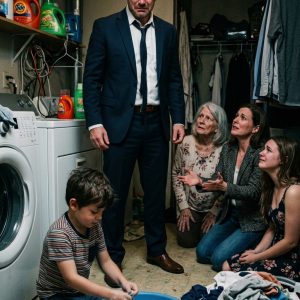
Laya sat on the floor, surrounded by piles of dirty laundry. She was clutching a doll with a missing head. Her eyes were hollow, dark circles under them that no seven-year-old should have.
“Grandma?” she whispered, terrified.
Before I could reach her, Karen stormed into the room. She grabbed the doll from Laya’s hands and threw it across the room.
“Shut up, brat!” Karen yelled. “Stop crying or I’ll give you something to cry about!”
I moved without thinking. The “never strike a civilian” rule was a distant memory now. These weren’t civilians. They were combatants.
I grabbed Karen by the hair and spun her around, slamming her against the wall. Not hard enough to break bones, but hard enough to rattle her teeth.
“Don’t,” I whispered in her ear. “Touch. Her.”
Brenda came at me with a heavy glass ashtray. I caught her wrist mid-swing. I squeezed the pressure point on her radial nerve. She shrieked and dropped the ashtray; it shattered on the linoleum.
“This house has new rules,” I told them, pushing Karen onto the couch next to her mother. “You sit. You stay quiet. And if you move before I leave, I will disassemble you.”
They sat. They trembled.
I picked up Laya. She buried her face in my neck, shaking.
“We’re going home, baby,” I said.
I carried her out to the truck. I buckled her in. My hands were finally shaking, the adrenaline crash hitting me.
But it wasn’t over.
As I started the engine, headlights swept across the driveway.
A black SUV blocked us in. Dustin had called for backup.
It wasn’t the police. It was Adam. My stepson.
He stepped out of the car, looking impeccable in his suit, holding a folder. He wasn’t here to fight. He was here to legally destroy me.
Chapter 4: The Accountant and the Soldier
Adam smiled as he walked toward the truck. He looked at the bruised women on the porch, then at me.
“Shirley,” he sighed, shaking his head. “Assault? Kidnapping? You’ve really lost it this time. The dementia must be progressing faster than we thought.”
He held up his phone. “I have the police on the way. I told them my elderly stepmother is having a violent psychotic break. They’re bringing restraints.”
He tapped the folder. “This goes back to the judge tomorrow. Full conservatorship. You’ll never see the outside of Crestwood again. And Clara? After this, Child Services will take Laya. You just destroyed your family.”
I stepped out of the truck, closing the door to shield Laya.
“You think you’ve won, Adam,” I said.
“I have won,” he replied. “I have the money. I have the law. You have… what? Karate chops?”
I reached into my pocket.
“I have this.”
I pulled out a small digital recorder. The red light was blinking.
Adam frowned. “What is that?”
“When I was at Crestwood,” I said, my voice steady, “I wasn’t just doing push-ups. I was listening. I befriended the night nurse—the one you underpay. I befriended the accountant you fired last month.”
I pressed play.
The audio was tinny but clear. It was Adam’s voice, recorded on a phone call.
“Yeah, shift the funds from the Harris account to the Cayman shell. The old bat doesn’t know. Just keep her sedated if she asks questions. And pay off Dustin to keep the daughter quiet. If Clara talks, threaten the kid.”
Adam’s face went white.
“That’s illegal wiretapping,” he stammered.
“Actually,” I said, “it was a voicemail you left on the accountant’s office line. He kept a copy. He gave it to me this morning before I left Crestwood. I sent a copy to the District Attorney’s office ten minutes ago.”
Sirens wailed in the distance. Blue and red lights flashed against the trees.
“That’s the police,” Adam said, trying to regain his composure. “They’re coming for you.”
“No,” I said, crossing my arms. “They’re coming for the man who embezzled two million dollars and conspired to commit elder abuse.”
The police cruisers screeched to a halt.
It wasn’t the local beat cops Adam thought he controlled. It was the State Police. Pete had made some calls, too.
The officer who stepped out recognized me immediately. He had served in the 2nd Battalion.
“Major Harris,” he nodded respectfully. Then he turned to Adam. “Mr. Harris, place your hands behind your back.”
Adam tried to run. He didn’t get far.
As they cuffed him, I walked over.
“You made one mistake, Adam,” I whispered. “You looked at the gray hair and saw a victim. You forgot to look at the eyes.”
Epilogue: The High Ground
The settlement was swift once the offshore accounts were named. The elder abuse case against Adam collapsed his world just as efficiently as he had tried to collapse mine.
His Power of Attorney was revoked. Restitution was ordered. He is currently serving eight to ten years in a facility that is definitely not Crestwood Meadows.
Dustin didn’t fare much better. The assault charges regarding Clara stuck, especially with the medical evidence Pete gathered. His “untouchable” uncle lost his re-election bid when the connection to Adam’s money laundering ring surfaced.
We moved.
We bought a house near the coast—me, Clara, and Laya. It’s filled with light. There are no dark corners.
Clara healed. Her arm is out of the cast. The bruises are gone. She’s teaching again.
Laya laughs now. She has a new doll, one that isn’t broken.
Yesterday, the billing department from Crestwood Meadows called. They wanted to know if I was ever returning to collect my knitting supplies.
I laughed.
“No,” I said. “You can keep them. I’m busy.”
“Busy doing what, Mrs. Harris?” the receptionist asked.
I looked out the window. Clara and Laya were planting a garden. The sun was shining. My family was safe.
“I’m busy holding the line,” I said.
I hung up.
I learned this much in war and in life: strength isn’t about violence. It’s about protection. Justice isn’t revenge—it’s reclaiming what was taken.
My name is Major Shirley Harris. And I answer to no one now.
Like and share this post if you believe grandmothers are the ultimate special forces.