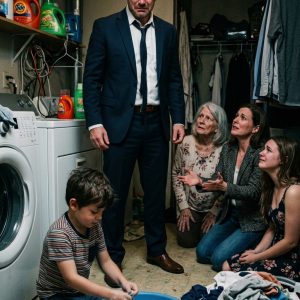
The Man Who Wasn’t There
My husband, Daniel Carter, didn’t just get sick; he faded. It wasn’t a flu or a fever, but a slow, agonizing desaturation of the man I had married. He used to be the kind of person who filled a room—loud laughs, heavy footsteps, an appetite that could clear a dinner table. Then, over the course of three months, he went hollow.
He stopped eating breakfast. He stopped joking. He stopped sleeping through the night. I would wake up at 3:00 AM to find the other side of the bed cold, and him sitting in the living room dark, staring at the streetlights through the blinds. The worst part was his eyes. They were present, biological organs that blinked and moved, yet the person behind them seemed to have retreated miles away.
“It’s just work stress, Sarah,” he insisted one morning, but his hands trembled so violently he couldn’t tie his laces. “The merger is killing me.”
I wanted to believe him. God, I wanted to believe him. But when I found him that Tuesday, sitting on the edge of the bed, breathing in shallow, terrified gasps, clutching his chest like an old man, I didn’t ask for permission. I grabbed the keys.
“We are going to the doctor,” I said. “Now.”
He didn’t fight me. He looked too weak to fight a breeze. I drove us to Lakeside Urgent Care in Naperville, just outside Chicago. The sky was a bruised purple, threatening snow, matching the knot of dread tightening in my stomach. I thought I was saving his life. I had no idea I was about to blow it apart.
The waiting room smelled of antiseptic and stale magazines. Daniel sat with his head down, his hoodie pulled low. He filled out the intake forms with agonizing slowness, the pen shaking in his grip. When he handed his ID to the receptionist, she typed his name, paused, and then looked up. It was a micro-expression—a flicker of confusion, maybe recognition—but she quickly masked it with a professional smile.
“Have a seat, Mr. Carter. We’ll be right with you.”
Daniel went back to staring at the beige wall, seemingly catatonic. I held his hand. It was cold and clammy.
“Sarah and Daniel?”
A nurse led us back to Exam Room 3. Daniel moved like he was wading through waist-deep water, dragging his feet. We waited five minutes before Dr. Anika Patel breezed in. She was young, efficient, with sharp eyes that missed nothing.
“Tell me what’s going on,” she said, her voice calm but authoritative.
I did the talking. I explained the weight loss, the insomnia, the tremors. Daniel sat on the crinkly paper of the exam table, shirtless, looking like a ghost. Dr. Patel listened to his chest, checked his pulse, and then asked him to roll up his left sleeve to check his blood pressure.
As he pulled the fabric up, exposing his forearm, Dr. Patel’s movements froze. It was for less than a second—a hitch in her breath, a tightening of her jaw—before she resumed the exam. She finished the check, her face suddenly unreadable.
“I’m not liking the arrhythmia,” she lied smoothly. “I want to run a full cardiac panel and blood work immediately.” She turned to the nurse. “Take Mr. Carter to the lab for a draw.” Then she turned to me. “Sarah, could I speak with you in my office for a moment? It’s just regarding insurance and billing protocols for cardiac tests.”
Daniel frowned, a spark of alertness cutting through his haze. “Why alone?”
“It’s standard privacy policy for billing disputes,” Dr. Patel said, not breaking eye contact with me. “It will take two minutes.”
The nurse, a sturdy woman who seemed to sense the doctor’s tension, gently guided Daniel by the elbow toward the lab down the hall. Daniel looked back at me, his eyes narrowing slightly, but he went.
Dr. Patel ushered me into a tiny office across the hall and shut the door. She didn’t just close it; she threw the deadbolt.
The professional mask vanished. She turned to me, her face pale, her eyes wide with urgency.
“You need to listen to me, and you need to not scream,” she whispered, her voice trembling. “You need to leave. Right now. Do not go back to that room. Do not let him know I spoke to you.”
My heart hammered against my ribs, a frantic bird trapped in a cage. “What? Is he dying? Is it cancer?”
“No,” she hissed. “This isn’t about his health. It’s about who he is.”
She pulled a tablet out of her lab coat pocket, her fingers flying across the screen. “Three years ago, I was a resident at Cook County Hospital working the ER. A man was brought in under heavy police custody. He had been stabbed in a prison riot. I treated him.”
She turned the screen toward me. “That man had a distinct, jagged surgical scar across his lower right ribs from a previous lung collapse. He had an improperly healed fracture on his left wrist that made the bone protrude slightly. And he had a small tattoo of a scorpion on his inner forearm, usually hidden by a watch.”
My mouth went dry, tasting of copper. “Daniel wears a watch. He always wears a watch.”
“I saw the scar when I listened to his heart,” she said. “I saw the wrist. I saw the tattoo when he rolled up his sleeve. Sarah, I saw those exact markers on your husband.”
“That’s impossible,” I stammered, my reality tilting on its axis. “Daniel is a structural engineer. We’ve been married two years.”
“It isn’t impossible,” she cut in. “That man’s name is Lucas Varga. He escaped during a transport transfer shortly after I treated him. The police bulletin warned he was extremely violent, highly intelligent, and a master manipulator who uses romantic relationships for cover. If he realizes I recognized him, if he thinks his cover is blown, he will panic. And he is dangerous.”
From the hallway, a voice cut through the heavy door. It wasn’t the weak, trembling voice of the sick man I’d brought in. It was sharp. commanding.
“Sarah? Where are you?”
Dr. Patel’s eyes flashed to the door handle. She grabbed my shoulders. “Run,” she whispered. “Go out the staff exit. Because three years ago, during his escape, he killed a nurse.”
The door handle jerked downward. Hard. Then again, violently, as if someone was trying to rip it off the hinges.
I didn’t think; survival instinct is a strange, ancient thing that bypasses the brain and hotwires the muscles. I didn’t answer him. I turned and sprinted.
I slipped past the nurses’ station, ignoring the startled look of the receptionist, and pushed through a heavy metal side door marked STAFF ONLY. I burst into the parking lot. The cold air hit my lungs like a slap, freezing the tears on my face. My keys bit into my palm.
Behind me, inside the building, I heard a commotion. A chair scraped loudly against tile. Then, the heavy thud of footsteps—fast, rhythmic, powerful. Not the footsteps of a dying man.
I ducked between two large SUVs, crouching low in the slush and gravel. My fingers shook so hard I dropped my phone twice before dialing 911.
“911, what is your emergency?”
“My husband,” I whispered, forcing the words through a throat that felt like it was closing up. “I’m at Lakeside Urgent Care on Ogden Avenue. A doctor just told me he’s an escaped prisoner. He’s inside. He’s… he’s coming out.”
“Ma’am, are you safe?”
“I don’t know,” I sobbed. “Please send someone.”
I heard the distant, mournful wail of sirens starting up, and for a second, I thought I might faint from relief. But then the front doors of the Urgent Care swung open.
Daniel stepped out.
He didn’t look sick. He stood tall, his spine straight, his shoulders squared. He scanned the parking lot with quick, efficient movements, his head snapping left, then right. The lethargy, the tremors, the shallow breathing—it was all gone. It had been a performance. A costume he had shed the moment it stopped being useful.
His eyes landed on my car. He stared at it for a second, calculating. Then he began to walk toward it. He wasn’t rushing. He moved with the terrifying confidence of a man who believes he owns the next few minutes of time.
“Ma’am,” the dispatcher said, her voice tinny in my ear. “Stay on the line. Officers are two minutes out.”
I slid lower behind the black SUV, pressing my cheek against the icy metal of the bumper. “He’s out,” I breathed. “He’s looking for me.”
Daniel reached my empty car. He tried the handle. Locked. He peered through the glass, his hands cupped around his eyes. Then he turned slowly, pivoting in a circle, searching the rows of cars. His face was blank. Not angry, not sad. Just empty. A shark scanning for a ripple in the water.
Suddenly, a patrol car whipped into the lot, lights flashing blue and red against the gray sky, tires crunching over salt and gravel.
Daniel froze. In an instant, the predator became the prey. He didn’t argue. He didn’t put his hands up. He pivoted and sprinted toward the far end of the lot, cutting behind the building with athletic speed. Two officers jumped out of the cruiser and took off after him, shouting commands that were swallowed by the wind.
Someone touched my shoulder.
I flinched so hard I nearly screamed. Dr. Patel was crouching beside me, without her coat, shivering.
“I’m sorry,” she said, her voice shaking. “I tried to stall him. I told the nurse to lock the lab door, but he… he kicked it open. Are you hurt?”
“No,” I managed, staring at the spot where my husband had just stood. “What… what happens now?”
“Now you tell them everything,” she said, looking toward the chaos at the corner of the building where the police had disappeared. “And you do not go home alone.”
The police station was a blur of fluorescent lights and bitter coffee. An hour later, I sat in an interrogation room across from Detective Elena Ramirez. She was a woman in her fifties with tired eyes and a steady, grounding voice. She listened without interrupting while I explained Daniel’s symptoms, the appointment, Dr. Patel’s warning, and the terrifying transformation I’d witnessed in the parking lot.
“Do you have any recent photos of him?” Ramirez asked.
I handed over my phone, my gallery open. She studied our anniversary picture from two months ago. We were at a pumpkin patch. Daniel was wearing a flannel shirt, smiling, his left arm draped over my shoulder, his heavy silver watch covering his wrist.
“He wears that all the time,” she noted, tapping the screen.
“Every day,” I said, nausea rolling in my stomach. “He even sleeps with it on. He said it was his father’s. I never thought about it.”
Ramirez handed the phone to a uniformed officer who took it out of the room. She turned back to her computer. “We’re running his prints from the clinic door handle now, but based on the doctor’s statement…”
She typed a few keys. The screen stayed stubbornly blank for a moment, then refreshed with a mugshot.
It was him.
The hair was shorter, the face harder, but the eyes were the same. Cold. Distant.
“Lucas Varga,” Ramirez read. “Escaped custody three years ago during transport to a maximum-security facility. Assault with a deadly weapon, armed robbery, and suspected involvement in two disappearances. The file includes a photo of his tattoos.”
She turned the monitor. There it was. A small, black scorpion on the inner forearm.
“He’s not sick,” I whispered, the reality finally cracking my denial. “He was acting. The shaking, the not eating…”
“Paranoia,” Ramirez corrected. “He’s been living under a stolen identity for years. The stress of maintaining the lie, the fear of being recognized—it wears on the body. He was cracking under the pressure. Or maybe he was planning to move on, and the ‘sickness’ was the setup for his disappearance.”
She pointed to a line in his file under Known Behaviors. “Targets vulnerable partners for stability; creates dependency; may become extremely violent when exposed.”
“He’s dangerous, Sarah,” Ramirez said. “We missed him at the clinic. He hopped a fence and vanished into the residential area. We have dogs out, but he’s ghosted.”
They moved me to a safe hotel under an alias—a Holiday Inn near the airport. They put an unmarked unit near my house. I insisted on calling my sister, then my boss. Then, out of sheer habit, my thumb hovered over Daniel’s name in my contacts.
I stared at the screen until the letters blurred. Husband. Monster.
That night, just after midnight, the unmarked officer called the hotel desk and patched me through to Ramirez.
“Sarah,” Ramirez said, her voice tight. “Your husband showed up at your house. He’s inside.”
My stomach dropped through the floor. “Is anyone there?”
“No,” she said. “We pulled everyone back to set a perimeter. We don’t want a hostage situation. But we have eyes on the house. He’s moving fast—opening drawers, checking closets. Like he’s looking for something specific.”
My voice came out thin, barely a whisper. “He’s looking for me.”
“Sarah, we can use this,” she said. “If he thinks you’re nearby, he’ll reach out. He needs to know where you are to feel safe. He’ll make a mistake.”
As if on cue, my phone buzzed on the nightstand. An unknown number.
I picked it up. A single text message glowed on the screen:
Where are you?
I stared at the message until my screen dimmed. My brain, traumatized and confused, kept offering the old reflex: Answer him. Calm him down. Keep the peace. That’s what I’d done for months without realizing it—adjusting my life to match his moods, walking on eggshells around his silences. But a wife can’t fix a lie she doesn’t even know she’s living in.
Detective Ramirez was still on the line. “Don’t respond yet,” she commanded. “We will handle this.”
Two officers were in the hotel room with me, quiet as statues. One took my phone, typed carefully, and showed me the draft before hitting send:
I’m at my sister’s. I needed space after today. I was scared.
The reply came fast. Too fast.
I’m sorry. The doctor scared you. I just want to talk. Come home.
Ramirez’s voice came through the officer’s radio. “He’s trying to anchor you. He wants you back in a place he controls. He’s checking the GPS on your iPad right now—we can see him in the living room.”
They traced the number to a prepaid burner phone bought at a gas station twenty minutes ago. The plan was simple and terrifying: keep him talking, keep him visible, keep him from disappearing again.
“If he calls,” Ramirez asked through the speaker, “can you keep your voice steady?”
“I don’t know,” I admitted, looking at my hands. They were shaking again.
“You can,” she said firmly. “Because you want to live. And you want him caught.”
An hour later, the phone rang.
Ramirez gave the signal. I put it on speaker.
“Sarah?”
His voice was soft, familiar. It was the voice that had whispered vows to me. It sounded like he was calling from the grocery store to ask if we needed milk.
“Sarah, where are you, really?”
“At my sister’s,” I said, forcing each syllable to land evenly. “I told you.”
A pause—then a slow exhale on the other end. “That doctor… she’s crazy, Sarah. She mixed up the charts. She scared you for no reason.”
“I needed space,” I repeated, sticking to the script.
He gave a short, humorless chuckle. It sent a shiver down my spine. “Space for what? To let strangers fill your head? We’re married. You trust me. Don’t you?”
Ramirez tapped her pen on her notepad in the command center, the sound echoing slightly. Keep him talking.
“Daniel,” I said, my voice trembling for real now. “What’s going on with you? You’ve been different for months. The shaking… was that real?”
Another pause. Longer this time. When he spoke again, the sweetness was thinner, stretched tight over something jagged.
“Pack a bag,” he said. “I’ll come pick you up.”
“Pick me up where?” I asked.
“You know where,” he snapped, and the mask fully slipped. The rage was there, naked and ugly. “Don’t make this hard, Sarah. Don’t make me come find you.”
The line went dead.
Ramirez’s voice cut through the silence of the room. “He’s escalating. He wants control back, and he wants it fast. We’re moving in.”
But they didn’t get the chance to breach the house. The unit reported the garage door opening. Daniel’s truck—our truck—roared out of the driveway. He had taken a duffel bag and pulled my passport from the little safe we kept in a shoebox.
He wasn’t coming for me. He was running. Again.
State police joined the pursuit on I-88, heading west away from the city. I watched a live feed in the command room, gripping a paper cup of water I wasn’t drinking, crushing the rim until my knuckles turned white.
On the screen, the truck weaved through traffic. But it wasn’t the erratic driving of a panicked amateur. It was deliberate aggression. No panic, no hesitation, just calculated risk. He cut through a gas station lot to bypass a roadblock, nearly clipping a family loading groceries.
Something inside me went ice-cold at the realization: the “sick” man I’d worried over, the husband I had nursed and fretted about, was a fiction. This man behind the wheel—this precise, violent force—was the real him.
“End it,” Ramirez said into her headset. “Before he kills someone.”
Spike strips went down a mile ahead near the Aurora exit.
The truck hit them at eighty miles per hour. The tires shredded instantly, exploding in clouds of black rubber. Daniel didn’t slam on the brakes. He pushed forward on the rims, sparks flying like fireworks against the asphalt, fighting the steering wheel with brute strength.
The truck fishtailed wildly, clipped the median, and slammed into the guardrail with a bone-jarring crunch. Smoke billowed from the engine.
Officers surrounded the vehicle, guns drawn. “DRIVER! HANDS OUT THE WINDOW!”
He stayed inside for a long moment. My heart stopped. Was he reaching for a weapon? Was he dead?
Then, the door creaked open.
Daniel stepped out slowly. He was bleeding from a cut on his forehead. He looked at the wall of police cruisers, the blinding lights, the weapons trained on his chest. He didn’t look afraid. He looked annoyed.
He raised his hands, not in surrender, but like he was directing a scene and expecting applause. He looked right into the dashcam of the lead cruiser, and for a second, I felt like he was looking right at me through the monitor.
Then he smiled. A cold, empty smile.
Officers tackled him to the ground.
When Ramirez told me he was in custody, I expected instant relief to wash over me. What I felt first was grief—sharp, humiliating grief—for the man I thought I’d married. Then anger. Then, finally, the smallest breath of safety.
In the weeks that followed, the truth arrived in clean, ugly paperwork.
The real Daniel Carter had been a man from Ohio who died in a construction accident five years ago. Lucas Varga had bought his Social Security number on the dark web and rebuilt the identity piece by piece. I wasn’t just his wife; I was his cover story. I was the camouflage he wore to look like a normal suburban citizen.
Even his “illness” had a plain explanation. The toxicology report showed massive amounts of caffeine and prescription stimulants in his system. He hadn’t been sleeping because he was terrified. He was living in constant fight-or-flight mode, his body cracking under the weight of the life he’d stolen.
He took a plea deal to avoid a life sentence, accepting thirty years without parole. I signed the divorce papers with a hand that finally, after months, stopped shaking.
I moved in with my sister for a while. I changed all the locks. I froze my credit. I learned how to sleep without listening for footsteps in the hallway.
Dr. Patel checked on me through Detective Ramirez. A month after the arrest, I wrote her a letter. It took me three days to write.
“Dear Dr. Patel,
You didn’t just do your job. You broke the rules to save a stranger. You saw the truth when I was too close to see it. Thank you for being brave enough to scare me.”
Life after that wasn’t a neat movie ending. It was therapy, paperwork, and the slow, painful work of rebuilding trust in my own judgment. But it was also small victories: shopping for groceries without scanning the aisles for threats, laughing with friends without feeling a shadow over my shoulder, waking up without that heavy dread in my chest.
Ordinary slowly returned. And after living with a monster disguised as a man, ordinary felt like a miracle.
If you’re reading this and you’ve ever had a gut feeling you tried to explain away—a detail that didn’t fit, a story that kept shifting, a moment when someone’s mask slipped—trust that signal. Instinct isn’t magic; it’s your brain noticing patterns before you can name them. If you enjoyed this story, please like and share it. You never know who needs permission to choose safety over politeness.