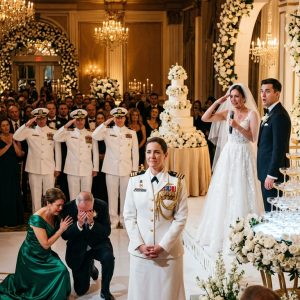
The Deed of Dignity
Chapter 1: The Gold-Wrapped Insult
My name is Elellanena Pierce, and for sixty-two years, I have walked through this world trying to be invisible. I was taught that a woman’s virtue was found in her silence, her ability to absorb the sharp edges of life without bleeding, and her skill at making everyone else in the room feel comfortable. But standing in the center of the Grand Dallas Ballroom, watching my only daughter freeze under the weight of a humiliation disguised as a wedding gift, I realized that invisibility was no longer a shield. It was a cage.
The ballroom was a testament to the Harrington family’s dynasty. It was a cavernous space of polished Italian marble and velvet drapery, illuminated by crystal chandeliers that hung from the ceiling like frozen, glittering tears. The air smelled of expensive lilies, truffle oil, and old money—a scent that was distinct, cloying, and designed to make people like me feel small.
I had spent the last year worrying about how Molly would fit into this world. Molly was soft edges and bright laughter, a kindergarten teacher who loved messy art projects and stray dogs. Robert Harrington, her new husband, was a hedge fund manager—handsome, polished, but with a spine that I feared was made of glass rather than steel.
The wedding had been perfect, in that terrifying, choreographed way that wealthy people confuse with intimacy. But the reception was where the cracks began to show.
It happened right after the champagne toasts. The best man had just finished a rambling anecdote about a yacht trip in St. Tropez, and the two hundred guests were chuckling, the sound brittle against the crystal glasses.
Constance Harrington, Molly’s new mother-in-law, rose gracefully from the head table. She was a woman carved from ice and diamonds, wearing a silver gown that looked less like clothing and more like armor. She didn’t tap her glass for attention; she simply stood, and the room fell silent out of habit.
She held a large box wrapped in shimmering gold paper.
“My dear Molly,” Constance announced, her voice projecting to the back of the room without a microphone. “Welcome to the family. We have traditions, you know. And I hope this gift helps you understand your new responsibilities as a wife.”
Molly stood up, her cheeks flushed with the innocent hope of a bride who still believes in fairy tales. She took the box. She smiled at Robert. She untied the silk ribbon.
She lifted the lid.
The air in the ballroom seemed to vanish.
Inside the box was a maid’s uniform. It wasn’t a joke costume; it was a heavy, navy blue polyester dress with a starch-stiff white apron. And there, embroidered across the chest in stark red thread, was the name: Molly.
A ripple of gasps moved across the room like a cold wind. Forks froze mid-air. The string quartet in the corner faltered, a violinist missing a note in sheer shock.
Molly’s smile didn’t just fade; it collapsed. I saw the light go out of her eyes. Tears welled up instantly, magnifying her horror as she touched the rough fabric with trembling fingers. She looked at Constance, waiting for the punchline, waiting for someone to say it was a gag.
But Constance just smiled—a cold, thin expression of triumph.
Before Molly could speak, Robert stepped up beside her. He looked at the uniform, then at his mother. He wavered for a second, glancing at the confused guests. Then, falling back on a lifetime of conditioning, he chuckled.
“Perfect, Mom,” he said, his voice loud enough to be heard by the front tables. “She’ll definitely need this at home. Someone has to keep the dust off the antiques, right?”
The room fell into a suffocating silence. Even the music stopped.
I watched my daughter’s heart shatter in front of two hundred strangers. I saw the humiliation burn her skin red. I saw her look at her husband, the man who had promised to cherish her ten minutes ago, and realize he was laughing at her.
And inside me, something old and quiet woke up.
It was a rage I hadn’t felt since I was a young woman. It was the fierce, guttural instinct of a mother bear whose cub is being baited.
I stood up slowly. My chair scraped loud and harsh against the marble floor—a jagged sound that cut through the silence.
Every head turned. Constance looked at me, her eyebrow raised in challenge.
“What an… interesting gift,” I said calmly. My voice didn’t shake. It was steady, anchored by sixty years of endurance.
I walked toward the head table. My heels clicked rhythmically on the marble. Click. Click. Click.
“Now,” I said, stopping in front of Molly and turning to face the room, “let me give her mine.”
I reached into my modest clutch purse and pulled out a small, unassuming box covered in blue velvet. I handed it to my daughter.
“Open it, sweetheart,” I said gently, wiping a tear from her cheek with my thumb.
Confused, shaking, Molly took the box. She opened it.
Inside were two folded documents.
She unfolded the first page. Her breath hitched. Her eyes widened, scanning the heavy legal bond paper.
“Mom…” she whispered, looking up at me. “Is this… is this real?”
Robert leaned forward, frowning, his smile fading. Constance stiffened, her fingers tightening around the stem of her champagne glass until her knuckles turned white. The guests leaned in, a collective inhalation of curiosity.
Molly looked from the paper to me, her face pale.
“Mom… why would you do something like this?”
Chapter 2: The Paper Shield
That question hung in the air, heavy and loaded. Why? Because I knew. Because I saw the way they looked at her. Because I knew that without ground to stand on, a woman can be blown away by the slightest breeze of cruelty.
“Read it, Molly,” I said softly, but with enough force that Robert flinched. “Read it out loud.”
Molly’s voice was barely audible at first, but it gained strength as she read the words that redefined her future.
“It’s a General Warranty Deed,” she read. “For the property at 42 Magnolia Street. Mom… this is a house. In my name. Only my name.”
The ballroom erupted into murmurs. Magnolia Street wasn’t in the gated community where the Harringtons lived, but it was a solid, historic neighborhood with oak trees and front porches. It was a real home.
Constance’s face drained of color. Robert’s jaw tightened, his eyes darting between me and the paper.
I placed a hand on Molly’s back, feeling the tension in her spine. “Read the second paper, sweetheart.”
She unfolded the thicker document.
“A Trust Agreement,” she read, her voice trembling. “Stating that the property is legally and solely mine. It is placed in a separate property trust. No one else—including my husband—can claim ownership, access, or equity without my express written consent.”
The whispers around us grew louder. A few guests—Molly’s friends, my cousins—began to clap quietly. One of Robert’s cousins, a woman who had been watching the maid uniform spectacle with a scowl, nodded at me approvingly.
Constance, however, was livid. She stood up, her silver dress rustling like snake scales.
“This is highly inappropriate!” she snapped. “Elellanena, you are making a scene. You are implying that my son would not provide for his wife. You are insulting this family on his wedding day!”
I met her glare. I didn’t blink.
“I’m ensuring my daughter never has to depend on anyone who thinks it is acceptable to hand her a maid’s uniform at her reception,” I said.
A wave of gasps filled the room again.
Robert stepped forward, his face flushed with embarrassment and anger. “Elellanena, why would you go behind our backs? Why make such a big gesture without consulting anyone? We’re supposed to be a team.”
“Because,” I said, looking him straight in the eyes, “while your mother was publicly teaching her future daughter-in-law how to ‘know her place,’ I was privately teaching mine how to never lose hers.”
He looked stunned—offended, even. “Are you saying I’d mistreat Molly?”
“I’m saying,” I replied softly, stepping closer so only he could hear the steel in my voice, “that I just watched you laugh. I saw you stand there and chuckle while your mother tried to strip your wife of her dignity. That tells me everything I need to know about how you define ‘team.’”
Constance scoffed. “She needs structure! She needs guidance! She comes from a different background. We run our households a certain way.”
“Your household,” I corrected sharply. “Not hers. Not anymore.”
The band had stopped playing. The servers had stopped walking. Not a fork clinked. The tension was a physical weight in the room.
Then, something unexpected happened.
William Harrington, Robert’s father—a man who had been a silent shadow all evening, a checkbook with a pulse—rose slowly from his chair.
At seventy-two, he moved with a stiffness that came from age and regret. He leaned heavily on his cane.
“That uniform,” he said quietly. His voice was gravelly, deep, and it cut through Constance’s indignation like a scythe.
Constance whipped around. “William? Sit down.”
He ignored her. He looked at the maid’s outfit lying on the table.
“That was cruel, Constance,” he said.
“William!” she warned, her eyes flashing.
He turned his gaze to Molly. “Molly,” he said gently, “you deserved better than that.” He glanced at me. “And your mother… has done something incredible.”
The room froze. Even Constance looked shocked. William Harrington never spoke against his wife.
Robert stared at his father, confused. “Dad…?”
But William wasn’t done.
He stepped closer, his cane tapping against the hardwood floor. Tap. Tap. Tap. Every eye followed him.
“I recognized that uniform,” he said quietly, addressing the silent room. “Not because it’s fashionable. But because I watched Constance give the same type of gift to another woman—twenty-five years ago.”
Constance stiffened. “William, don’t.”
He didn’t stop.
“My former daughter-in-law,” he continued. “Robert’s older brother’s wife. Sarah.”
A fresh wave of gasps spread through the room. The name hung in the air like a ghost. Sarah was a subject never discussed in the Harrington house.
Robert blinked. “Dad… what are you talking about?”
“That girl,” William said, his voice heavy with sadness, “left this family in tears because of the pressure your mother put on her. She was kind, like Molly. Gentle. She wanted to fit in. And instead, she was humiliated at every turn. Criticized for her fork placement, her accent, her clothes.”
He looked directly at Constance. “I stayed silent then. I let you drive her away. I let you break our son’s heart because I was too cowardly to stop you. I will not stay silent now.”
For once, Constance had no words. She paled, looking around the room as her social standing evaporated.
Robert’s expression shifted as the truth finally dawned on him. He looked at the uniform, then at his mother, seeing the cruelty for what it was.
He turned to Molly. “I… I didn’t know.”
Molly wiped her tears. She stood tall, clutching the deed to her chest.
“But you laughed, Robert,” she said, her voice shaking but clear. “You didn’t defend me.”
He swallowed hard. He couldn’t deny it.
I stepped closer to my daughter. “Sweetheart, marriage is hard enough. You cannot build a life where you’re not respected. You cannot live in a house where you are the help.”
William nodded. “She deserves a home where she is valued, not managed.”
Constance’s voice finally returned—sharp, trembling. “So you’re siding with them? Against your own family?”
William sighed. “I’m siding with decency.”
The room erupted into soft clapping—first a few guests, then more. It grew into a wave of applause. Constance, realizing she had lost the room, grabbed her purse and stormed out, humiliated in her own kingdom.
Chapter 3: The Foundation of Freedom
Robert stood frozen, torn between his mother’s toxic legacy and the woman he had just married. The applause faded, leaving a heavy, expectant silence.
Molly stood straighter than I’d ever seen her. For the first time that night, she looked strong.
She folded the deed carefully and turned to me. “Mom… thank you. For loving me enough to protect me even from what I couldn’t see.”
I kissed her forehead. “You will always have a home—not because someone gives it to you, but because you deserve it.”
Robert approached timidly. He looked at the maid’s uniform on the table, then picked it up and handed it to a passing waiter. “Burn this,” he muttered.
He turned to Molly.
“Molly,” he said, his voice cracking. “I want to do better. I want to unlearn what I grew up with. I don’t want to be like them.”
She held his gaze. She didn’t smile immediately. Trust had been fractured, and it would take time to reset the bone.
“Then start,” she said firmly, “by never letting anyone—yourself included—treat me as less. Not in public. Not in private.”
He nodded. Quiet. Humbled. “I promise.”
And just like that, the wedding continued.
It wasn’t the polished, icy affair it had been. The atmosphere was looser, warmer. People spoke honestly. The mask had slipped, and the reality underneath was messy but real.
I sat with William later that night. We watched Molly and Robert dance—not a choreographed waltz, but a slow, hesitant sway.
“You saved them,” William said.
“I just gave them a choice,” I replied.
Molly and Robert didn’t move into the Harrington estate’s guest wing as planned. They moved into the house on Magnolia Street. It needed a new roof and the garden was overgrown, but it was theirs. Robert learned how to mow a lawn. Molly learned that her voice had weight.
And I learned that sometimes, the most powerful gift a mother can give isn’t a set of china or a check. It is freedom. It is the keys to a door that only she can lock.
Like and share this post if you find it interesting.