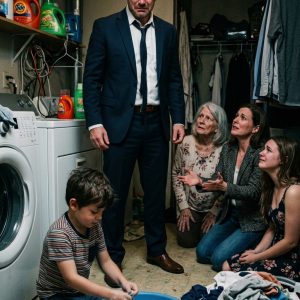
The Weight of Silence
The house looked exactly the same, a monument to a time when I was a daughter and not a secret. The white siding was still immaculate, the hydrangeas in the front yard were pruned to military precision, and the porch swing rocked gently in the autumn wind of suburban Ohio.
I sat in my car, gripping the steering wheel until my knuckles turned the color of old bone. Beside me in the passenger seat sat Leo. He was ten years old, with messy hair and eyes that held a wisdom far beyond his decade on earth. He was playing with the zipper of his jacket, the sound—zzzzzt, zzzzzt—the only noise in the suffocating silence of the car.
“Mom?” he asked, his voice small. “Are you okay?”
I took a breath that felt like inhaling broken glass. “I’m okay, Leo. I’m just… remembering.”
I was twenty-nine years old. I had a degree. I had a career. I had raised a child on my own in a state where I knew no one. But looking at that front door, I was nineteen again. I was the terrified girl holding a pregnancy test like a live grenade, waiting for the explosion that would shatter my world.
They had told me to get out. They had chosen their reputation over my safety.
“We don’t have to go in,” Leo said, sensing my hesitation.
I looked at him. He had his father’s jawline, but he had my heart. He had asked to meet them. He deserved to know where he came from, even if the roots of that tree were poisoned.
“No,” I said, unbuckling my seatbelt. “We do. It’s time they learned the truth.”
I grabbed the thick manila folder from the backseat. It contained ten years of silence, notarized and undeniable.
Chapter 1: The Grenade
The memory of the night I left was burned into my hippocampus, a scar that refused to fade.
I was nineteen, a sophomore in college, living at home to save money. I remember the smell of my father’s aftershave—pine and stale tobacco—filling the living room. My mother was knitting, the clicking of her needles a rhythmic counterpoint to the ticking clock.
I had walked in, my hands trembling so violently I had to clasp them together to keep them still.
“I’m pregnant,” I had whispered.
The silence that followed was absolute. It sucked the oxygen out of the room.
My mother’s eyes went wide, then narrowed into slits of disappointment. My father, Thomas, leaned forward in his recliner, his jaw tightening until a muscle feathered in his cheek.
“Who is he?” he asked, his voice devoid of warmth. It was a prosecutor’s question.
I froze. The name was on the tip of my tongue, heavy and toxic. But I couldn’t say it. I looked at the photos on the mantle—pictures of my father on fishing trips with him. Pictures of him at our backyard barbecues, smiling with a hand on my shoulder.
He was powerful. He was wealthy. He was my father’s business partner.
“I can’t say,” I stammered.
“What do you mean you can’t say?” my mother, Linda, snapped, dropping her knitting. “Are you protecting someone? Is he married? Is he a criminal?”
Yes, I thought. But not in the way you think.
“It’s… complicated,” I said, my voice cracking under the weight of the secret. “But I can’t get rid of the baby. I can’t. If I do, it’s not just me who’d be in trouble—we all would. This family would be destroyed.”
That was the wrong thing to say.
My father stood up so fast his recliner slammed against the wall. He loomed over me, six feet of righteous indignation.
“Don’t you dare pull that cryptic crap in my house!” he thundered. “This is a respectable home! You either get an abortion, or you pack your things! I will not have a bastard child paraded around this town while you play martyr!”
“Dad, please,” I begged, tears finally spilling over. “I can’t tell you now, but you have to trust me. Someday—”
“GET. OUT.“
He didn’t even let me explain. He didn’t ask why I was scared. He didn’t look at the terror in my eyes. He only saw the shame I was bringing to his doorstep.
Within an hour, I was standing on the porch with a duffel bag, a hundred dollars in my pocket, and nowhere to go. My mother stood behind the screen door, crying silently, but she didn’t open it. She watched me walk into the night.
I was nineteen. I was pregnant. And I was completely alone.
Chapter 2: The Wilderness
I moved to Indiana. It was close enough to drive if I ever needed to, but far enough that I wouldn’t run into anyone from the country club.
I changed my number. I found a studio apartment above a garage that smelled of gasoline and mildew. I got a job waiting tables at a diner where the tips were mostly loose change.
I named him Leo.
The years that followed were a blur of exhaustion and survival. I worked double shifts until my ankles swelled. I took night classes at the community college, typing essays with a sleeping baby strapped to my chest. I learned to stretch a box of pasta for three days.
It was hard. God, it was hard. But Leo was the light that kept me from drowning. He was smart. Calm. Unusually observant. He didn’t cry often; he just watched the world with those dark, intense eyes.
As he got older, the questions started. They were innocent at first.
“Where is my dad?”
“He’s not around, baby.”
“Where are Grandma and Grandpa?”
That one hurt the most. “They live far away.”
“Why don’t we visit them?”
“Because… they have a different life.”
How do you tell a child that his existence was considered a stain? How do you tell him that the people who should have protected his mother chose their pride instead?
I couldn’t face them. Not yet. I was still building my armor.
But on Leo’s tenth birthday, everything changed. He blew out the candles on his store-bought cake, looked me dead in the eyes, and asked, “Can I please meet them? Just once? I want to know who I look like.”
I looked at him—really looked at him. He was becoming a young man. He deserved to know his history, even if it was written in invisible ink.
“Okay,” I said, my heart hammering. “We’ll go.”
So, we packed a weekend bag. We got in the car. We drove eight hours back to Ohio, into the belly of the beast.
Chapter 3: The Ghost at the Door
We walked up the driveway. The leaves crunched under our feet, sounding like gunfire in the quiet afternoon.
I rang the doorbell.
It took a moment. Then, the heavy oak door creaked open.
My father stood there. He looked older. His hair was entirely white now, and his shoulders, once broad and intimidating, were slumped. He wore a cardigan I didn’t recognize.
He stared at me, blinking rapidly, as if his brain couldn’t process the image in front of him. He looked like he had seen a ghost.
“Emma?” he whispered. The word sounded foreign in his mouth.
My mother appeared behind him, wiping her hands on a dish towel. When she saw me, she gasped, her hand flying to her mouth.
Then, her eyes dropped to the boy standing beside me.
Leo stood tall, his hands clasped behind his back, watching them with a polite curiosity.
“Mom. Dad,” I said, my voice steady, forged in the fires of the last decade. “This is Leo.”
They didn’t move. They didn’t invite us in. They stood frozen in the threshold, trapped between the past they had chosen and the present that had arrived uninvited.
“We… we didn’t know you were coming,” my mother stammered.
“I know,” I said. “But I have something to say. And I’m not leaving until I say it.”
I looked at my father. “I need to tell you the truth about Leo. And I need to tell you why I couldn’t get rid of him. And why I couldn’t tell you who the father was ten years ago.”
My father’s eyes darted to the neighbors’ houses, checking for witnesses. Old habits die hard. “Come inside,” he hissed.
We stepped into the living room. It hadn’t changed. The same furniture. The same clock ticking on the mantle. But the air felt different. It was stale, heavy with the words that hadn’t been spoken for ten years.
We sat on the stiff floral sofa. My parents sat in their armchairs, looking at Leo like he was an exhibit in a museum—something rare and slightly terrifying.
My father broke the silence first. He narrowed his eyes, studying Leo’s face.
“He looks…” he started, then trailed off. “He looks familiar.”
I took a deep breath. This was it. The coup d’état. The moment the regime fell.
“He should,” I said, my voice cutting through the room. “Because you know his father. You know him very well.”
Chapter 4: The Shattering
My mother blinked, confused. “What are you talking about? Who is he? Some boy from high school?”
I shook my head. I reached into my bag and pulled out the manila folder. I placed it on the coffee table. It landed with a heavy thud.
I looked directly at my father. I locked eyes with him and refused to blink.
“Do you remember Robert Keller?”
The reaction was visceral.
My father’s face drained of color, turning a sickly shade of gray. His mouth opened, but no sound came out.
Robert Keller. My father’s business partner. The man who sat at this very dinner table every Sunday. The man who gave me graduation gifts. The man who was fifteen years older than me. The man who was “Uncle Rob.”
“You’re lying,” Dad whispered. It wasn’t an accusation; it was a plea. He was begging me to be lying.
“No,” I said coldly. “I am not.”
I opened the folder.
“Inside here,” I said, pointing to the documents, “are DNA test results. Notarized. I had them done when Leo was born. I kept a sample of the hair Robert left on his jacket the last time he… visited me. I also have a sealed court file from the consultation I had with a lawyer a year after I left.”
My mother covered her mouth, a strangled sob escaping her throat. “Oh my god… Emma…”
“I didn’t tell you then because I was scared,” I continued, my voice rising. “I was nineteen. He was thirty-four. He was your best friend. He was the wealthiest man in town. I knew what you would do. I knew you would protect your image. You would protect your business. You would have called me a liar to my face, just like you did ten minutes ago.”
“But he…” Dad’s voice cracked, tears welling in his eyes. “He was my friend. I trusted him with my life.”
“Exactly,” I said. “He was your friend. Not mine.”
My father slumped back into his armchair. He looked like he had been physically punched in the gut. The realization was washing over him—the predatory smiles, the times Robert offered to drive me home, the “interest” he took in my life. The pieces of the puzzle were clicking into place, forming a picture so grotesque he couldn’t look at it.
“You threw me out,” I said, allowing the bitterness to finally seep into my tone. “You stood right there and called me a liar. You threatened me. But you never once stopped to ask why I was so terrified to say his name. You never asked if I was okay. You just wanted the problem gone.”
Leo looked at me, confused by the tension. “Mom?”
I reached out and touched his shoulder gently. “You’re safe, baby. Nothing is your fault. This is grown-up business.”
My mother turned to my father. She hit his arm, hard. “Robert? Robert did this? You let that man into our house? You let him near her?”
My father put his head in his hands. He began to weep. Not a quiet cry, but deep, heaving sobs of a man realizing he had failed his primary duty in life: to protect his child.
“I didn’t know,” he choked out. “God, Emma, I didn’t know.”
“Because you didn’t ask,” I said. “You assumed I was reckless. You assumed I was a slut. You never assumed I was a victim.”
Chapter 5: The Reconstruction
The shame in the room was so thick you could taste it. It tasted like ash.
I hadn’t come for revenge. I hadn’t come to destroy them. But I wasn’t going to sugarcoat the truth to spare their feelings anymore. I had done that for ten years, and it had cost me everything.
“I’m not here for an apology,” I said, standing up. “I don’t need your money. I don’t need your approval. I built a life without it. I just wanted you to meet your grandson. And I wanted you to understand exactly why you lost ten years of his life.”
I motioned for Leo to stand up. “Come on, Leo. Let’s go.”
“Wait!”
My father scrambled out of his chair. He fell to his knees. My proud, stubborn, image-obsessed father was on his knees on the living room rug.
“Please,” he begged, reaching out a hand but not daring to touch me. “Don’t go. Please. I am so sorry. I am so, so sorry.”
My mother was sobbing openly now. “Emma, please. Stay. Let us… let us look at him. Let us fix this.”
I looked down at them. Part of me wanted to walk out the door and never look back. To leave them in the wreckage of their own making.
But then I felt a small hand slip into mine.
Leo looked at my father, then at me. “Mom? Can we stay for dinner? He looks sad.”
That boy. That beautiful, kind boy. He had more grace in his little finger than this entire house had held in twenty years.
I sighed, the anger draining out of me, leaving me exhausted.
“We aren’t staying overnight,” I said. “But… we can stay for dinner.”
The hours that followed were messy. There were tears. There were awkward silences. My mother cooked a meal with shaking hands. My father couldn’t stop looking at Leo, tracing the features of his face, looking for me, and perhaps, looking for the ghost of the man who had betrayed them all.
When we left that evening, my father hugged me. He held on tight, shaking.
“I will never forgive myself,” he whispered in my ear.
“I know,” I said. “But you have to try. For him.”
Epilogue: The Death of a Ghost
Over the next few months, things changed. Slowly. Tentatively.
My mother called every Sunday. My father wrote letters—long, handwritten letters where he talked about the weather, about his garden, about everything except the past. Then came the packages. Lego sets for Leo. Books. A scarf my mother knitted.
At first, I resisted. I had learned to be an island. But Leo wanted a relationship. He wanted grandparents. And I wasn’t going to punish him for their sins.
Eventually, I allowed supervised visits. They came to Indiana. They stayed in a hotel.
My father, now fully retired, seemed humbled. The arrogance was gone. He told Leo stories about fishing. He took him to minor league baseball games. He helped him with his math homework with a patience he had never shown me.
Still, I never forgot.
Robert Keller disappeared shortly after I filed that report years ago. I found out later that my father, after our visit, had gone to the police himself. He handed over business records. He exposed tax frauds he had previously ignored. He burned his own business to the ground to ensure Robert went down.
Robert fled the state. He lost his reputation, his money, and his friends.
One afternoon, three years after our reunion, my father handed me a newspaper clipping during a visit.
“Keller passed away,” he said quietly, not looking at me. “Heart attack. In a motel in Florida. He was 59.”
I took the clipping. I read the obituary. It was short. No mention of family. No mention of a legacy. Just a lonely end to a selfish life.
I felt nothing. Not joy. Not closure. Just… nothing.
Because closure didn’t come from his death. It didn’t come from a gravesite.
Closure came from the moment in the living room when my father fell to his knees. It came from finally being believed.
Leo grew up knowing the truth. I never lied to him. I told him that he was wanted, that he was never a mistake, and that his mother fought for him when the world told her to give up.
Last week, Leo turned eighteen. We were sitting on the porch of the house I finally bought—my own house, with my own mortgage.
He looked at me, a man now. “Mom,” he asked. “Would you do it all over again? Even if you knew they would kick you out? Even if you knew how hard it would be?”
I looked at him. I saw the kindness in his eyes, the strength in his shoulders.
“Yes,” I said, without a fraction of a second of hesitation. “A hundred times over.”
And for the first time, I think my father, watching us from the driveway, truly understood the cost—and the value—of silence.
If this story touched your heart, please like and share. You never know who is holding onto a secret that needs to be heard.