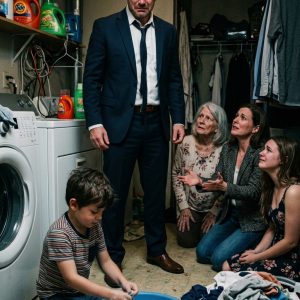
The Basement of Betrayal
PART I — THE SILENCE OF THE GRAVE
The flight from Vancouver to Toronto had been a redeye, the kind that leaves sand in your eyes and a dull ache in your lower back. I pulled my sedan into the driveway of our Leslieville home just past 8:00 p.m., the engine’s hum dying into the quiet of the street. I was exhausted, physically depleted from two weeks of sitting vigil at my mother’s bedside following her stroke. She was stable now—thank God—but my spirit was frayed.
All I wanted was Margaret.
My wife. My anchor. We had been married for forty years, and the last two had been a slow, heartbreaking waltz with her early-onset Alzheimer’s. Being apart from her for fourteen days felt like holding my breath underwater for an eternity.
I grabbed my suitcase from the trunk, the wheels clattering against the pavement. I looked up at the house, expecting the warm, amber glow of the living room lamps. Margaret never liked the dark; she said the shadows played tricks on her memory.
But the house was pitch black.
A cold prickle of unease danced down my spine. It was strange. Even if she had gone to bed early, the porch light should have been on. My daughter, Jennifer, who had volunteered to stay with her, knew the routine. Jennifer was meticulous—a CPA, organized to a fault.
“Jen?” I called out as I fumbled with my keys, the metal feeling clumsy in my tired fingers.
Silence answered me. Not the peaceful silence of a sleeping house, but a heavy, suffocating silence. The kind that hangs over a place where something is wrong.
I shoved the key into the lock and twisted. The door swung open, and I stepped into the foyer. “Margaret? Jen? I’m home early.”
That’s when I heard it.
It was a sound so faint I almost missed it over the thudding of my own heart. A rhythmic, dull thump. Then a pause. Then another thump.
It wasn’t coming from the bedrooms upstairs. It was coming from beneath my feet.
I dropped my suitcase. “Margaret?”
The thumping sped up. Thump-thump-thump. And then, a sound that froze the blood in my veins—a voice, hoarse and broken, whimpering a single syllable that sounded like help.
I didn’t walk; I ran. I sprinted through the darkened kitchen to the basement door. I reached for the handle, expecting it to turn, but it held fast.
I looked down and my mind refused to process what I was seeing.
A padlock.
A heavy-duty, industrial steel padlock was secured through a hasp that had been freshly screwed into the frame and the door. I stared at it, the absurdity of it warring with the horror. Why was there a lock on the outside of the basement door?
“Margaret!” I screamed, banging my fist against the wood. “Are you in there?”
From the other side, a weak, desperate cry clawed its way through the wood. “Thomas…?”
The sound of her voice—so frail, so terrified—shattered me.
“I’m here! I’m getting you out!” I shouted.
I spun around, scanning the kitchen for anything heavy. My eyes landed on nothing useful. I sprinted to the garage, tearing through the door, my engineering brain finally overriding my panic. Leverage. I need leverage.
I grabbed the red steel crowbar from my workbench.
I ran back inside, breathless, and jammed the claw of the bar behind the hasp. “Cover your eyes, Margaret!” I yelled, though I knew she couldn’t hear me through her confusion.
I pulled. The wood groaned. I pulled again, putting every ounce of my sixty-five years of strength into the motion. With a violent crack, the screws tore free from the frame, and the padlock clattered to the floor.
I ripped the door open.
The smell hit me first—a physical wall of stench. It was the acrid tang of old urine, unwashed bodies, and the sour musk of fear.
I flicked the light switch. Nothing happened. The bulb had been removed.
“Margaret!”
I pulled my phone from my pocket and turned on the flashlight, the beam cutting through the gloom as I descended the wooden stairs, skipping steps in my haste.
At the bottom of the stairs, huddled on a thin, filthy blanket, was my wife.
She shielded her eyes from the light, trembling violently. Her nightgown—one I had bought her for her birthday—was torn and stained. Her silver hair was matted against her skull. But it was her face that broke me. Her cheeks were gaunt, her lips cracked and bleeding, her eyes wide with a feral, uncomprehending terror.
She looked up at me, squinting. For a second, she recoiled, pressing herself against the cold concrete wall.
“Thomas?” she croaked, her voice like sandpaper. “Is that… is that really you?”
I dropped the phone and fell to my knees, scooping her into my arms. She felt terrifyingly light, like a bird made of hollow bones. She was ice cold despite it being September.
“I’m here, sweetheart. I’m here. I’ve got you,” I sobbed, rocking her as she clung to my jacket, her fingers digging in with desperate strength.
“Where is she?” Margaret whispered into my chest. “She said… she said I was bad. She turned off the lights.”
“Who, Margaret? Who did this?”
“Jenny,” she wept. “Jenny locked the door.”
My mind reeled. Jennifer? My daughter? The girl I had taught to ride a bike? The woman who had promised me, Dad, don’t worry about a thing, I’ll take care of Mom?
I carried Margaret up the stairs, my legs burning, my heart hammering a war drum against my ribs. I laid her gently on the living room couch and grabbed a blanket to cover her shivering form.
I dialed 911. My hands shook so badly I had to try twice.
“911, what is your emergency?”
“My wife,” I gasped. “I found her locked in the basement. She’s… she’s starved. Please, send someone.”
As I gave the dispatcher our address, I looked around the sunlit kitchen properly for the first time. The house felt wrong. Subtly, sickeningly wrong.
Margaret’s oversized pill organizer—the one that kept her tethered to reality—was gone from the counter.
There were boxes stacked in the corner of the dining room that I had never seen before.
And on the kitchen table sat a laptop I recognized. It belonged to Jennifer.
The paramedics arrived in minutes. They swarmed around Margaret, their voices calm and professional, checking vitals, starting an IV.
“Sir,” one of the paramedics asked, a tall woman with kind eyes. “She’s severely dehydrated and showing signs of hypothermia. When did you last see your wife?”
“Two weeks ago,” I choked out. “I was in Vancouver. My daughter… she was supposed to be watching her.”
The paramedic exchanged a dark, knowing glance with her partner. “We need to get her to St. Michael’s Hospital immediately.”
As they loaded Margaret onto the stretcher, I grabbed Jennifer’s laptop from the table. I didn’t know why, exactly. It was instinct.
I rode in the back of the ambulance, holding Margaret’s frail hand, whispering promises I wasn’t sure I could keep.
At the hospital, a nurse pulled me aside while the doctors worked on rehydrating my wife. “Mr. Holloway,” she said gently, “I need to ask—has your wife been locked in that basement for the entire two weeks you were away?”
The question hit me like a physical blow.
Fourteen days.
Fourteen days in the dark.
Fourteen days of wondering why her husband hadn’t come for her.
“I don’t know,” I whispered, the horror of it nearly bringing me to my knees. “I just found her like that.”
A police officer arrived an hour later. Detective Morrison from the Toronto Police Service’s Elder Abuse Unit. He was a grim-faced man who looked like he had seen the worst of humanity and was tired of it.
I sat in the sterile waiting room and told him everything. I told him about my career in civil engineering, about Margaret’s diagnosis two years ago, about the trip to Vancouver.
“And your daughter?” Morrison asked, pen poised over his notebook.
“Jennifer,” I said, the name tasting like poison. “She’s 38. A CPA. She’s married to Kyle. He calls himself a ‘business consultant,’ but he mostly talks about cryptocurrency and NFTs. I never liked him.”
Morrison nodded. “And during these two weeks, did you have contact with your daughter?”
“Every day,” I said, anger rising like bile. “For the first week, she answered calls. Said Mom was fine. Watching movies. Eating well. The second week… she stopped answering. Just texts. Said they were busy.”
Morrison closed his notebook. He looked me dead in the eye. “Mr. Holloway, did you give your daughter Power of Attorney over your wife’s affairs before you left?”
“No. Absolutely not.”
“Did your wife sign anything?”
“Not that I know of. Why?”
Morrison stood up. “Because this looks like more than neglect, Mr. Holloway. This looks like a takeover. We need to find your daughter.”
CLIFFHANGER:
I drove back to the house that night to meet the forensics team. While they dusted the padlock for prints, I opened Jennifer’s laptop. The password was autosaved. What I found in her “Sent” folder wasn’t just evidence of a crime; it was a roadmap of a betrayal so calculated it made me physically vomit in the kitchen sink. They hadn’t just locked her up. They were planning to vanish.
PART II — THE ALGORITHM OF EVIL
The house was a crime scene now. Yellow tape fluttered across the basement door. But I sat at the kitchen table, the blue light of the laptop illuminating my face, staring into the abyss of my daughter’s soul.
I am not a man who snoops. I respect privacy. But tonight, I was an archaeologist digging through the ruins of my family.
What I found in Jennifer’s files was methodical. It was precise. It was evil.
There was a folder labeled “Investment Opportunity – Kyle’s Fund.” Inside were scanned documents. My hands shook as I clicked through them.
First, a Power of Attorney document. It was dated the day after I left for Vancouver. Margaret’s signature was there—shaky, wandering, clearly signed under duress or confusion. It had been notarized by some strip-mall lawyer in Scarborough, miles from our family solicitor.
With that forged authority, Jennifer had gone to work.
She had drained our joint savings account—$75,000. That was the money for Margaret’s future care. The memory care facility. The nurses. Gone.
She had taken out a Home Equity Line of Credit (HELOC) against the house we had owned outright for twenty years. Another $100,000 withdrawn.
In total, $175,000 had been wired to a numbered corporation: Thornhill Capital Management.
A quick Google search confirmed my suspicion. Thornhill Capital was registered to Kyle Morrison. Its stated business purpose: Blockchain derivatives and high-yield cryptocurrency arbitrage.
My stomach churned. It was a crypto scam. They had liquidated my wife’s life to fund Kyle’s gambling addiction dressed up as a business.
But it was the text messages that broke me. I found a synced chat log between Jennifer and Kyle from day three of my trip.
Kyle: She keeps crying for your dad. The neighbors might hear. This isn’t going to work.
Jennifer: She’ll forget. Give it another day. The confusion helps. Just put her downstairs. She can’t find the door in the dark.
Kyle: What if someone checks on her?
Jennifer: Who? Dad’s in Vancouver dealing with Grandma. Mom’s friends haven’t visited in months. We’re fine. Stick to the plan.
The plan.
They hadn’t panicked. They hadn’t snapped. They had discussed locking a sixty-three-year-old woman with dementia in a basement as a logistical solution to a noise problem.
I called Detective Morrison immediately. “I found them,” I said, my voice eerily calm. “I know where the money went. And I know where they’re going.”
I had found one more document in the downloads folder. A PDF confirmation from TAP Air Portugal. Two one-way tickets to Lisbon, departing tomorrow night. And a six-month rental agreement for a villa in the Algarve.
Portugal. A country they likely believed would be a safe haven to spend my retirement money.
“They’re running,” I told Morrison. “They’re leaving tomorrow.”
“We’re on our way,” Morrison said.
I met the police at the station. They had secured a warrant for Jennifer and Kyle’s condo in Liberty Village. I didn’t go with them for the raid—I couldn’t bear to see it—but Morrison called me an hour later.
“The condo is empty, Thomas. They cleaned it out. Furniture, clothes, everything.”
“Did they make the flight?” I asked, panic flaring.
“No,” Morrison said. “We flagged their passports. But they aren’t at the airport yet. We have an APB out. We’ll find them.”
I went back to the hospital. Margaret was sleeping, her face pale against the white sheets. She looked so small. I sat by her bed, holding her hand, watching the rise and fall of her chest.
“Where’s Jenny?” she mumbled in her sleep.
I squeezed her hand. “She’s gone away, sweetheart.”
The next twenty-four hours were a blur of media trucks on my lawn and relentless updates from the police. My face was on the news. local Man Rescues Wife from Basement Dungeon. They made me sound like a hero. I felt like a failure. I was the shepherd who had let the wolves into the fold.
On day six, my phone rang. It was Morrison.
“We got them,” he said.
“Where?”
“Pearson Airport. Terminal 1. They tried to board a flight to London instead of Lisbon, thinking it would throw us off. Border Services grabbed them at the gate.”
I closed my eyes and let out a breath I felt like I’d been holding since I opened that basement door.
“Are they in custody?”
“Yes. They’re being processed at Toronto South Detention Centre now. Thomas… you should know. When we arrested them, Jennifer asked to call you.”
“What did she say?”
“She said it was all a misunderstanding. She said she was trying to protect Margaret from wandering.”
I laughed. A cold, dry sound. “Protect her? She left her in a bucket of her own filth for two weeks.”
“We know,” Morrison said softly. “The charges are heavy. Elder abuse, unlawful confinement, fraud over $5,000, forgery. We’re throwing the book at them.”
The legal machinery began to turn. I was introduced to Patricia Chen, the Crown Attorney assigned to the case. She was sharp, aggressive, and clearly disgusted by the file.
“Mr. Holloway,” she told me in her office, “this is one of the most egregious cases of familial exploitation I’ve ever seen. We are pushing for maximum sentences. Eight to twelve years for Jennifer. Ten to fifteen for Kyle because of the additional securities fraud.”
“And the money?” I asked. “The $175,000?”
Patricia’s expression softened. “Kyle’s ‘fund’ was a Ponzi scheme. He was paying off early investors with new money. The accounts are empty, Thomas. I’m sorry. The money is likely gone.”
I nodded. I expected that. But then came the twist I didn’t see coming.
A week before the preliminary hearing, Patricia called me again.
“Kyle’s lawyer reached out,” she said. “He wants a deal.”
CLIFFHANGER:
“A deal?” I asked, gripping the phone.
“Kyle is offering to testify against Jennifer,” Patricia said. “He claims she was the mastermind. He claims she forged the documents, she planned the confinement, and he just followed orders. He’s willing to hand over a hidden ledger of their finances—and voice memos he secretly recorded of Jennifer planning the abuse—in exchange for a reduced sentence.”
My son-in-law was going to destroy my daughter to save his own skin. And I was going to let him.
PART III — THE THEATER OF JUSTICE
The betrayal within the betrayal was almost poetic. Kyle, the man who spoke in buzzwords about “community” and “trustless ledgers,” turned on his wife the moment the handcuffs clicked.
I told Patricia, “Take the deal.”
I didn’t care about Kyle’s sentence. I wanted the truth about Jennifer on the record. I wanted the world to know that my daughter wasn’t a victim of a bad husband; she was the architect of her mother’s nightmare.
The trial began in June, eight months after I found Margaret.
Those eight months had been a slow attrition of the soul. Margaret was physically safe, but the trauma had accelerated her decline. Her neurologist called it “stress-induced progression.” She had stopped asking for Jennifer. In fact, she had forgotten Jennifer existed. It was a mercy, in a way, but it broke my heart every time I looked at family photos and realized she no longer recognized the girl in them.
I hired Christopher Walsh, a pitbull of a civil lawyer, to sue them for everything they would ever earn. “We will garnish their wages until the day they die,” Christopher promised. “They will never own a home, a car, or a credit card without us knowing.”
But the criminal trial was the main event.
I sat in the gallery, directly behind the Crown’s table. Jennifer sat with her defense team. She looked different. The expensive highlights were grown out. She wore a modest blouse, trying to look like the dutiful daughter. When she saw me, she mouthed, “Dad, please.”
I looked through her. I didn’t see my daughter. I saw the lock on the basement door.
Kyle took the stand first. He looked small, sweaty. He narrated the scheme with a detached cowardice.
“Jen said her parents had too much equity sitting uselessly in the house,” Kyle testified, avoiding my gaze. “She said with her mom’s condition, she wouldn’t notice the documents. She said… she said if we locked her downstairs, she wouldn’t wander off while we went to the bank.”
“And whose idea was the basement?” Patricia Chen asked.
“Jennifer’s,” Kyle said quickly. “She said the living room had too many windows. Neighbors might see.”
The jury looked ill.
But the nail in the coffin was the voice memo. Kyle had recorded it on his Apple Watch during an argument in their kitchen, weeks before the trip.
The courtroom fell silent as the audio played.
Jennifer’s voice, tinny but unmistakable: “Kyle, stop being a pussy. Dad is going to be in Vancouver for two weeks. It’s the perfect window. We get the HELOC, we transfer it to the fund, and by the time he gets back, we’re in Lisbon. Mom won’t remember a thing. She barely knows what year it is.”
The gasp in the courtroom was audible. Jennifer put her head on the table and sobbed. It was the sound of a trapped animal, not a remorseful child.
Then, it was my turn to testify.
I walked the jury through the timeline. The trust I had placed in her. The text messages reassuring me Margaret was fine. And then, the video.
The police crime scene video was played on the large screens. The dark, damp basement. The bucket in the corner. The scratch marks on the back of the door where Margaret had tried to claw her way out until her fingernails bled.
I watched the jurors. Two of them were wiping away tears. One looked physically angry, his jaw clenched tight.
Jennifer took the stand in her own defense. It was a Hail Mary pass, and she fumbled it.
Her lawyer tried to paint her as a victim of coercive control, claiming Kyle forced her. But on cross-examination, Patricia Chen destroyed her.
“Ms. Holloway,” Patricia said, holding up a printout. “You are a CPA. You graduated top of your class. You managed million-dollar portfolios. Are you telling this court that you didn’t understand what a Power of Attorney document was?”
“I… I was confused,” Jennifer stammered.
“Confused?” Patricia stepped closer. “You texted your husband: ‘She’ll forget. The confusion helps.’ You were banking on your mother’s Alzheimer’s to cover your tracks. You weren’t confused, Ms. Holloway. You were counting on her being confused. Isn’t that right?”
“I never meant to hurt her!” Jennifer wailed.
“You locked her in a dungeon for fourteen days without light!” Patricia roared, her voice echoing off the mahogany walls. “You left her to die so you could steal her retirement. That isn’t a mistake. That is a calculation.”
The jury deliberated for four hours.
Guilty on all counts.
The sentencing hearing was scheduled for two months later. I submitted a Victim Impact Statement. Five pages. I wrote about the trust that was broken. I wrote about the financial ruin—we were now paying a mortgage in our retirement, likely forcing us to sell the home Margaret loved. But mostly, I wrote about the time.
“My wife has a disease that steals time,” I wrote. “Every day is precious. My daughter didn’t just steal money. She stole fourteen days of sunlight. She stole my wife’s sense of safety. She stole the last shred of peace we had. That is a theft that cannot be repaid.”
CLIFFHANGER:
The judge, a stern woman named Justice Halloway (no relation), peered over her glasses at Jennifer. “Ms. Holloway, you have shown a depth of depravity that shocks the conscience of this court.” She paused, letting the weight of the moment settle. “Please stand for sentencing.”
PART IV — THE EMPTY CHAIR
“Twelve years,” Justice Halloway announced.
“For the counts of Elder Abuse, Unlawful Confinement, and Fraud Over $5,000, to be served concurrently, I sentence you to twelve years in a federal penitentiary.”
Jennifer collapsed. Her knees gave out, and the bailiffs had to hold her up. She looked back at me, her eyes wild. “Dad! Dad, help me!”
I sat stone still. I didn’t look away. I wanted her to see my face. I wanted her to see that the father who had protected her from monsters under the bed was gone. She was the monster.
Kyle received eight years, thanks to his plea deal.
As they were led away in handcuffs, the heavy oak doors closing behind them, I exhaled. It was over. The legal war was won.
But as I walked out onto University Avenue into the blinding summer sun, I didn’t feel triumphant. I felt hollow.
The aftermath wasn’t a movie ending. There was no windfall of returned cash. The civil suit resulted in a judgment of $375,000 against them, but as Patricia had warned, you can’t get blood from a stone. We put liens on everything—future earnings, inheritances, tax returns. If they ever made a dime, we would take it. But for now, the $175,000 was gone.
I had to refinance the house to consolidate the debt. At sixty-five, I was making mortgage payments again. I picked up some consulting work to make ends meet. It was hard, tiring work, but it was necessary.
Margaret’s decline accelerated, just as the doctors predicted.
Six months after the trial, on a snowy Tuesday, I was sitting with her in the living room. The Christmas tree was up—just a small one this year.
Margaret looked at the tree, then at the empty chair where Jennifer used to sit during the holidays.
“Is… is she coming?” Margaret asked. Her voice was thin, childlike.
My heart seized. She hadn’t asked in months.
“Who, love?”
“The girl,” Margaret said, frowning as she tried to catch the memory like a butterfly. “The one with the brown hair. She used to make the cookies.”
She didn’t remember Jennifer’s name. She only remembered the feeling of her absence.
I moved to the ottoman in front of her and took her hands. They were paper-thin now. “She’s away for work, Margaret. She can’t come this year.”
Margaret nodded slowly, accepting the lie. “That’s a shame. She was nice.”
I choked back a sob. She was nice. The Alzheimer’s had been kind in one cruel way—it had erased the basement. It had erased the terror. In Margaret’s fading mind, Jennifer was still the daughter who made cookies, not the jailer who left her to rot.
I decided then that I would protect that memory. I would carry the burden of the truth so she didn’t have to.
People often ask me if I regret going so hard on my own daughter. Twelve years, they say. That’s a long time.
And I tell them this:
Jennifer didn’t just break a law. She broke the sacred covenant between parent and child. We raise them, we protect them, and we hope that when we are weak, they will offer us a hand. Jennifer offered a cage.
Justice isn’t about revenge. It’s about balance. She took Margaret’s dignity; the court took her freedom. It’s a poor trade, but it’s the only one we have.
Last night, Margaret forgot who I was for the first time.
She looked at me with polite curiosity and asked, “Excuse me, sir, when is my husband coming home?”
It only lasted an hour before she recognized me again, but the clock is ticking. The darkness is coming for her mind, slowly and inevitably.
But this time, she won’t be facing it alone in a cold basement. She will be in a warm room, with soft lights, holding the hand of the man who loves her.
We are surviving. We are together.
Jennifer sits in a cell in Grand Valley Institution, staring at concrete walls. She wanted to steal our future to buy herself a villa in Portugal. Instead, she bought herself a decade in a cage.
As for me, I’m exactly where I need to be. Watching over Margaret. Always watching.
THE END
Like and share this post if you find it interesting.