Title: The Slap That Broke the Silence
Chapter 1: The Performance of Christmas
The Sterling family Christmas dinner had always been Vanessa’s show, a carefully curated performance where the rest of us were merely supporting actors. December 23rd was no different. She arrived two hours late, her white Tesla crunching aggressively on the gravel driveway, dragging in a crew of ring lights, tripods, and two camera operators she had hired to document her “authentic family Christmas experience” for her lifestyle blog, The Sterling Standard.
I stood in the kitchen doorway, bouncing Lucas gently against my shoulder. He was fussy, his six-month-old internal clock thrown off by the disruption of his afternoon nap. I watched my mother, Patricia, scurry around the dining room like a terrified stagehand, rearranging the entire layout to accommodate Vanessa’s lighting setup.
The house smelled of cinnamon, roasted turkey, and the acrid, metallic tang of stress.
My father, Robert, sat in his usual corner chair, scrolling through his phone with the desperate intensity of a man trying to disappear. He had perfected this art of selective blindness over the years, a survival mechanism honed by decades of managing the volatile weather system that was his eldest daughter.
Vanessa had been teasing this dinner on her social media for weeks, calling it her “Family Gratitude Special” and promising her hundred thousand followers an intimate look at our holiday traditions. What she hadn’t mentioned was that my husband, David, had just returned from a six-month deployment in Syria, or that we had driven three hours from Cedar Falls specifically to introduce our son to his grandparents for the first time.
None of that mattered. In the Sterling household, reality was whatever Vanessa decided to film.
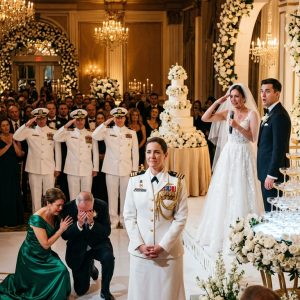
David emerged from the guest bedroom where he had been changing Lucas’s diaper. He looked sharp in his dress uniform, the fabric crisp and authoritative. Even off duty, he carried himself with a quiet, grounded power that came from years of leading soldiers through chaos. He caught my eye across the room and gave me one of those small, private smiles—an anchor in the storm.
It’s okay, his eyes said. We’ll get through this.
The dining room had been transformed into a set. Vanessa had moved our grandmother’s antique silver candlesticks to the sideboard to make room for her audio equipment. She had relocated the family photos to create “better angles” and swapped out the heirloom linen napkins for trendy, textured ones she had brought from Portland.
She directed her cameraman around the table like she was shooting a Super Bowl commercial.
“Mom, the turkey needs to be under the heat lamps,” she snapped, adjusting a light diffuser. “We need the steam to be visible on camera. Aesthetics, people!”
Patricia bustled around her, nodding fervently. “Of course, darling. Anything you need.”
I had learned long ago not to comment. Growing up, pointing out the absurdity of Vanessa’s demands was met with lectures about “supporting family dreams” and accusations of jealousy. The implication was always clear: I was small-minded for not appreciating Vanessa’s vision. I was the gray background to her Technicolor life.
David helped me set Lucas in the high chair we had brought—the same one that had belonged to David’s grandmother, Eleanor. It was solid oak, worn smooth by generations of children, and it looked stubbornly authentic amidst Vanessa’s staged perfection.
The meal began with Vanessa’s customary gratitude speech, delivered directly to the camera lens while the rest of us sat in awkward, frozen silence. She spoke for ten minutes about the “sacred bond of family” without once making eye contact with the actual family members at the table. She didn’t mention David’s service. She didn’t mention Lucas’s first Christmas.
When she finally signaled cut, the atmosphere shifted slightly, but the performance didn’t end.
Midway through the main course, Vanessa decided she needed “candid interaction footage.” She directed the cameraman to circle the table, instructing us to laugh naturally and pass dishes with “more energy.”
Lucas, meanwhile, was unraveling. The bright lights, the strangers with cameras, and the disrupted schedule were too much for him. His cheerful babbling turned into a low, fretful whimper.
“Can we take a break?” I asked, reaching for him. “He’s tired.”
“No, no, keep rolling!” Vanessa commanded, holding up a hand to stop me. “This is real life! The beautiful chaos of motherhood! It adds texture to the narrative.”
She began narrating to the camera over Lucas’s cries, talking about patience and the “messy joy” of holidays.
Lucas’s whimpering escalated into a full-blown wail. It was the desperate, overwhelmed cry of a baby who needed comfort, not content creation.
I stood up to get him.
“Sit down, Natalie!” Vanessa hissed, dropping the persona for a split second. “You’re ruining the shot. Just let him cry for a minute. It’s authentic.”
“He’s not a prop, Vanessa,” David said, his voice low and hard.
Lucas screamed, his face turning red, his tiny hands grasping at the air. The sound was piercing, cutting through Vanessa’s monologue.
And then it happened.
Vanessa, clearly frustrated that her audio was being ruined, leaned across the table. Her hand moved so quickly I barely registered it.
Crack.
The sound of her palm striking Lucas’s cheek echoed through the silent room like a gunshot.
Lucas stopped crying instantly, shocked into a terrifying silence. Then, a second later, he let out a scream of pure pain and betrayal that shattered my heart. A bright red handprint began to bloom on his soft skin.
Nobody moved. Patricia froze with her fork halfway to her mouth. Robert stared at his plate. The cameraman kept filming.
But David moved.
He stood up. It wasn’t a rush; it was the slow, terrifying unfoldment of a man who has identified a threat. He walked around the table, the sound of his dress shoes heavy on the hardwood.
“Turn off the camera,” he said. It wasn’t a request.
The cameraman scrambled to comply.
David picked up Lucas, soothing him against his chest, checking the red mark on his face. Then he turned to Vanessa.
“Get out,” he said.
Cliffhanger: Vanessa laughed, a nervous, tinkling sound. “David, don’t be dramatic. I barely touched him. I was just—” David didn’t blink. He didn’t raise his voice. He stepped into her personal space, radiating a cold, lethal calm. “You struck my son. You are leaving this house right now, or I am removing you. And if you ever come near him again, I will end you.”
Chapter 2: The Gaslight Parade
Vanessa packed her equipment in a flurry of slammed cases and muttered curses, playing the victim until the very second her Tesla peeled out of the driveway. Patricia chased after her, wringing her hands, apologizing to her—not to the baby who had been hit, but to the woman who had done the hitting.
David and I left ten minutes later. We didn’t wait for dessert. We didn’t wait for explanations. We packed Lucas into the car and drove home in a silence that felt heavy with things unsaid.
The war began three days later.
It started with a phone call while David was feeding Lucas his morning bottle. The red mark on Lucas’s cheek had faded to a faint pink shadow, but every time I saw it, I felt a fresh wave of nausea.
“Natalie, honey,” Patricia’s voice came through the phone, breathless and strained. “I know you’re upset, but we need to talk. Vanessa feels terrible. She hasn’t slept in two days.”
I held the phone away from my ear, staring at the Christmas tree I hadn’t had the heart to take down.
“Mom,” I said, my voice trembling. “She hit my baby. She slapped a six-month-old across the face because he was ruining her audio.”
“She barely touched him!” Patricia’s voice rose, the familiar defense mechanism kicking in. “You’re making this into something it wasn’t. She was stressed. She was trying to redirect his attention. It was a tap, Natalie. A tap!”
“It left a handprint, Mom.”
“Babies have sensitive skin! You’ve always been dramatic about these things. Ever since you were little, you blow everything out of proportion.”
There it was. The family mantra. Natalie is dramatic. Vanessa is misunderstood.
“David overreacted,” Patricia continued, gaining steam. “He humiliated her in front of her crew. He threatened her! That man is too rigid. He doesn’t understand how families work because he didn’t grow up with us. He treats everything like a military operation.”
I looked at David. He was burping Lucas, rubbing his back with infinite tenderness.
“David protected his son,” I said, my voice hardening. “That’s what fathers do. That’s what you should have done.”
I hung up.
An hour later, my father called. He used his “reasonable mediator” voice.
“Nat, listen. Vanessa says she didn’t mean to hurt him. She says it was a reflex. Intent matters, honey. She loves Lucas. She was just… overwhelmed. Can’t we just apologize and move on?”
“Apologize?” I laughed, a harsh, jagged sound. “You want me to apologize?”
“For the scene David caused. For ruining Christmas. It’s just… it’s tearing your mother apart.”
I realized then, with a clarity that was both liberating and devastating, that I was talking to strangers. These people didn’t see me. They didn’t see Lucas. They only saw the cracks in the mirror reflecting their perfect golden child.
David sat me down at the kitchen table. He placed his hand over mine.
“They are gaslighting you,” he said quietly. “They are trying to make you doubt your own eyes because the truth—that they sat there and watched a baby get hit—is too ugly for them to face.”
He was right.
That afternoon, Vanessa called. Her voice was thick with tears.
“Natty, I’m so sorry,” she wept. “I don’t know what happened. I just… I tried to touch his cheek to shush him, and I guess I moved too fast? And then David looked at me like he wanted to kill me, and I got scared. Please, you have to tell Mom it’s okay. She’s hysterical.”
For a second, I wavered. It was the sister I remembered from childhood—vulnerable, needing me.
“Vanessa,” I said slowly. “You hit him. I heard the slap. I saw his head snap back.”
“See? That’s what I mean!” Her voice changed instantly, sharpening into frustration. “You’re rewriting history. It wasn’t a slap. It was a gesture. You’re letting David brainwash you into thinking I’m some kind of monster.”
I hung up.
I sat there, shaking. I felt like I was losing my mind. Had I exaggerated it? Was I being too harsh?
Then my phone buzzed. It was a text from Chloe Martinez, our neighbor and friend.
Saw Vanessa’s Instagram story. Are you okay?
I opened the app.
Vanessa had posted a series of videos titled “Real Talk: Family Toxicity.”
She sat in her perfectly lit living room, looking mournful but brave.
“Guys, the holidays were really hard this year,” she told the camera. “I tried to create a beautiful memory for my family, but sometimes… sometimes people bring their own trauma to the table. I was physically threatened by a family member who has anger issues. I was kicked out of my own parents’ house because of a misunderstanding about… parenting styles. It’s heartbreaking when you try to help with a fussy baby and get accused of abuse. But I’m choosing forgiveness.”
The comments were flooding in.
“So brave, V!”
“Toxic family is the worst. Cut them off!”
“Military guys are always so aggressive. Stay safe, queen.”
She hadn’t just minimized the assault. She had monetized it. She had turned her crime into content and cast herself as the victim.
David watched the video over my shoulder. His face didn’t move, but his eyes went cold.
“She played you,” he said. “She used that phone call to gauge your reaction so she could spin the narrative first.”
My phone rang again. Patricia.
I ignored it.
Instead, I walked over to the desk and pulled out a notebook.
“What are you doing?” David asked.
“I’m documenting,” I said. “I’m writing down every word. Every timestamp. Every lie.”
I was done being the dramatic little sister. I was going to be the witness for the prosecution.
Cliffhanger: Late that night, I received a message from an unknown number. It was brief, cryptic, and terrified. I saw the Instagram story. I know who she’s talking about. This isn’t the first time she’s hurt a kid, Natalie. Call me. It’s Aunt Linda.
Chapter 3: The Pattern
Aunt Linda was the family black sheep. She had been estranged from my parents for a decade after a blowout fight at a reunion that no one ever talked about.
I called her immediately.
“Natalie,” she answered on the first ring. Her voice was rough, like she’d been smoking for forty years. “I didn’t think you’d call.”
“You said it wasn’t the first time.”
Linda sighed, a long exhale of old smoke and older secrets. “Do you remember your cousin Mark’s son? Timmy?”
“Vaguely. They moved to Arizona when I was twelve.”
“They didn’t move, honey. They ran.” Linda paused. “Ten years ago, at the lake house, Vanessa was babysitting Timmy. He was three. He broke one of her expensive sunglasses. She pushed him down the stairs.”
The air left my lungs. “What?”
“She claimed he tripped. But Timmy told his mom that ‘Nessa pushed.’ Your mother… Patricia covered it up. She said Timmy was imaginative. She paid for the ER bills and guilt-tripped Mark into silence. She said ruining Vanessa’s college prospects over an accident would be a sin.”
“Oh my god.”
“There were others,” Linda continued, the floodgates opening. “The neighbor’s dog she kicked when she thought no one was looking. The way she used to pinch you until you bruised when you were toddlers and then cry so you’d get in trouble. Vanessa has always been broken, Natalie. And your parents have spent her entire life sweeping up the glass so she never has to bleed.”
I hung up, feeling sick.
It wasn’t an accident. It wasn’t stress. It was who she was.
And my parents knew. They knew, and they let her hold my son.
The next morning, I went to war.
I didn’t scream. I didn’t post on social media. I went to the pediatrician. Dr. Walsh examined Lucas, documented the fading bruise, and listened to my story.
“I am mandated to report this,” she said gently. “But since the child is safe with you and the abuser is not in the home, it will likely just be a file. A paper trail.”
“I want a paper trail,” I said. “I want a mountain of paper.”
Then I went to a lawyer.
Janet Morrison specialized in family law. She listened to Linda’s story, looked at the Instagram screenshots, and nodded.
“We send a cease and desist for the defamation,” she said. “And we draft a restraining order. Not just for her, but for anyone who attempts to facilitate contact between her and the child.”
That meant my parents.
When the letters arrived, the explosion was nuclear.
Patricia called screaming. “You’re suing your own sister? You’re destroying this family!”
“I’m protecting my son,” I said calmly. “The family was destroyed the moment you chose a predator over a baby.”
Then came the text from Jessica Chen, a producer at the network Vanessa had been courting for a reality show.
Ms. Brooks, we received an anonymous tip about a police report regarding your sister and your son. We take these allegations very seriously. Can you confirm?
I didn’t know who sent the tip. Maybe Linda. Maybe Chloe.
I typed back: I can confirm there is an open investigation regarding an assault on a minor.
Vanessa’s show was cancelled the next day.
She showed up at our house that night.
It was raining. She stood on the porch, pounding on the door, mascara running down her face like black tears.
“You ruined my life!” she screamed. “Everything I worked for! My sponsors are dropping me! The network ghosted me! You jealous little bitch, open the door!”
David stood on the other side of the glass, his arms crossed. He didn’t open it. He just dialed 911.
“I’m recording this,” he said through the door. “Keep talking, Vanessa. Every word goes to the judge.”
“I barely touched him!” she shrieked, unraveling completely. “He was annoying! He wouldn’t shut up! I had to do something!”
And there it was. The confession.
The police arrived five minutes later. They trespassed her. They took the footage from our Ring camera.
Cliffhanger: As the squad car drove away, my phone pinged. It was a text from my father. I hope you’re happy. Your mother just collapsed. She’s in the hospital. If she dies, it’s on you.
Chapter 4: The Empty Table
I didn’t go to the hospital.
It was the hardest decision of my life. The old Natalie, the one trained to fix everything, wanted to rush to her mother’s side, to apologize, to beg for forgiveness for sins she hadn’t committed.
But David held my hand.
“If you go,” he said, “they pull you back in. They use her health to silence you. They use your guilt to erase what happened to Lucas.”
So I sent flowers. I sent a card. But I stayed home.
Patricia recovered. It was a panic attack, not a heart attack. A physical manifestation of her loss of control.
Six months passed.
Lucas took his first steps in our living room, stumbling into David’s arms. There were no cameras. No ring lights. Just us.
We built a new family. Not one of blood, but of choice. Chloe and her husband came over for Sunday dinners. Linda visited from Arizona, bringing stories and a genuine warmth I had never known.
We heard rumors about the Sterlings. Vanessa had moved to L.A., trying to rebrand. My parents were “downsizing,” selling the big house that had been the stage for so many performances. They were isolated, angry, and confused about why their dutiful daughter had become a villain.
Then, Christmas came again.
We stayed home. We cooked a ham. We played soft jazz.
There was a knock on the door around noon.
I froze. I expected Vanessa. I expected my parents.
I opened the door to find a delivery man holding a massive basket.
Inside were gifts for Lucas. Expensive, flashy toys. And a letter from my father.
Natalie, let’s put this behind us. Christmas is for forgiveness. We miss you. Mom is still fragile. Don’t be cruel.
It wasn’t an apology. It was a summons.
I looked at the basket. I looked at David, who was helping Lucas rip open wrapping paper on a simple wooden truck we had bought him.
“What do you want to do?” David asked.
I picked up the basket. I walked it out to the curb and set it down next to the recycling bin.
“I want to have Christmas,” I said.
Epilogue
We never reconciled.
Some people say that’s sad. They say life is too short to cut off family. They say blood is thicker than water.
But I learned that the blood of the covenant is thicker than the water of the womb.
David was right. That night at the dinner table, he didn’t just stand up to my sister. He stood up to a lifetime of conditioning. He showed me that love isn’t about enduring pain for the sake of appearances. Love is protection.
Lucas is three now. He doesn’t remember the slap. He doesn’t remember the aunt who used him for content.
He only remembers that he is safe.
And that is the only legacy I care about.
Like and share this post if you find it interesting.