The Silent Salute: How I Buried My Brother to Save My Grandfather’s Honor
My name is Daria Caldwell. I am forty-one years old, a recently retired Lieutenant in the United States Army. I gave seventeen years of my life to the service, surviving four tours in regions where the sand is so fine it works its way into your pores and never truly washes out. I spent more time in silence, waiting for the crack of a rifle, than I ever did around birthday cakes or Thanksgiving tables.
And yet, none of that prepared me for the moment I stepped back onto the cracked pavement of my hometown for the first time in five years, just to attend my grandfather’s funeral.
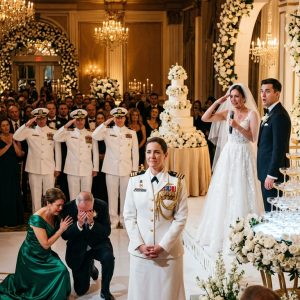
I wore my dress blues not because I wanted the attention, but because Colonel James Caldwell would have wanted it. He wasn’t just my grandfather; he was a Marine, marrow deep. When he saluted, the air around him seemed to snap to attention. When he died, the family didn’t fall into grief; they fell into a strange, vibrating quiet. It was a tightening, a bracing for the shockwave everyone knew was coming.
The Georgia sun hit the metal doors of the Barton Avenue Funeral Home, reflecting a sharp, blinding glare as I approached. My boots, polished to a mirror shine out of habit, echoed softly across the concrete.
Then I heard it—the voice that had been mocking me since I was ten years old.
“Well, well. The useless soldier finally came home.”
Julian, my older brother, stood by the entrance like he owned the building. He was wearing a suit that fit too tight across the shoulders and a smirk that fit even tighter across his face. His tone was casual, breezy, but I saw the flicker of contempt behind his eyes, ancient and sharp. He raised a glass of bourbon in a mock toast, as if I were a war criminal being paraded through judgment rather than a sister coming to bury her patriarch.
“Nice costume, Daria,” he sneered, loud enough for his entourage to hear. “Still playing G.I. Jane? Or did you just run out of civilian clothes?”
I didn’t flinch. I didn’t speak. Years in the service had taught me that silence, when weaponized correctly, slices deeper than any knife.
He turned back to his circle of admirers—old high school classmates, local business partners, people who had no idea who he really was. They never saw him call me “tin can” or “Army charity case” every time I walked into a room.
Inside the chapel, everything looked perfect. Polished pews, soft organ music, white roses. A picture of Grandpa James in uniform stood beside the casket—handsome, steady, the man I’d called every Sunday without fail, the man who never once asked me to come home until the week before he died.
As I stepped into the nave, the atmosphere shifted. It wasn’t just the stale air or the hush that followed me. It was the people.
Three rows ahead, a man in a black suit glanced over his shoulder for a fraction of a second. His eyes didn’t linger, but his hand twitched up toward his ear, the involuntary tick of someone adjusting a hidden earpiece. His posture was too stiff. The slight bulge beneath his jacket sleeve was too deliberate.
I scanned the room. Two more just like him. Well-dressed, too still. Not mourners. Observers.
I took a seat in the last pew and rested my white-gloved hands in my lap. But inside, my stomach knotted. Something was wrong. Viscerally wrong. I hadn’t come home to start a war, but it seemed the war was already here, sitting in the pews, watching my family like a hawk.
The service began. The pastor spoke gently, mentioning Grandpa‘s service record, his devotion to the country, and the way he always kept his boots polished, even in retirement. It was true; the man never let anything rust, not even his morals.
Julian sat up front, wiping away a tear that wasn’t real. I could tell by the way his eyes stayed dry and his hand moved just a second too late for the camera of a local reporter. Mom sat next to him, her face a mask of grief, but I’d seen that look before. It wasn’t mourning; it was denial.
My husband, Kyle, sat beside me. Former Army Intelligence, now working private sector cybersecurity. Steady. Grounded. The only person in the room I trusted.
I leaned in close, my lips barely moving. “We need to go. Now.”
He turned to me, confused, lips parting to speak, but I was already standing. I gripped his arm—hard—and guided us down the aisle. Slow, quiet, unobtrusive. Like a tactical retreat, not a scene.
We reached the rental car. Only then did I exhale. My hands trembled just enough to be noticeable.
Kyle shut the driver’s side door and looked at me. “What was that, Daria? We haven’t even paid respects.”
I looked straight ahead for a beat before turning to face him. The words came out low, measured. “You really didn’t see it, did you?”
He frowned. “See what?”
I reached into my coat pocket and pulled out my old secure device—still active, though barely legal to use in civilian life.
“I saw three men in that chapel with concealed weapons. One of them was wired. The other two kept their hands low, body language tight. And Julian… he knew they were there. He was performing for them.”
Kyle‘s expression changed from concern to calculation. “You think it’s connected to the call?”
I nodded once. “It’s not just a funeral, Kyle. It’s a cover.”
He started the engine. “Where do we go?”
I gave him the answer I’d rehearsed since the moment I saw that first movement in the crowd. “Somewhere safe. Then I make the call.”
End of Chapter 1.
The Goat Stew Protocol
Ten minutes later, I was on the phone. It took less than thirty seconds. No names, just the code.
“This is Lieutenant Daria Caldwell, 17 Delta. Barton Avenue Funeral Home. Suspected reactivation of Operation Peregrine. Immediate response required.”
They didn’t ask for more.
We sat in silence, parked in a quiet lot behind a closed diner, watching the minutes tick by. My mind drifted back to the catalyst of this entire nightmare.
Three months before the funeral, my phone had rung in the middle of a Friday night. Grandpa James wasn’t one for late calls unless the world was ending. I had just gotten back from a medical appointment—a routine post-retirement checkup—and was sitting in my car in the driveway, watching condensation slide down the windshield.
The screen read James Caldwell. I answered quickly, bracing myself.
“Grandpa?”
There was a pause, heavy with static, like he was checking to make sure the line was secure. Then his voice came through—not panicked, but cautious.
“Low, Daria. There’s something you need to know. It’s Julian.”
My heart clenched. “What about him?”
“He’s not who you think he is.”
I sighed, resting my head against the steering wheel. This wasn’t the first time Grandpa had raised concerns. He and my brother had been at odds for years—mostly about money, sometimes about politics, but often about values. Julian was a chaotic element; Grandpa was pure structure.
“Grandpa, did he borrow money again?”
But his next words stopped me cold.
“There’s something going on. Something is being reactivated.” His voice faltered, not from age, but from the weight of the secret. “Do you remember Operation Peregrine?”
I sat up straight. “That’s Cold War stuff. You said it was shut down before I was even in high school.”
“It was. Or it was supposed to be.” Another long pause. “They’re meeting again. Quietly. Under the radar. Barton, two weeks ago.”
I blinked. “Barton? That’s our family church. I thought that place hadn’t hosted anything since…”
“Exactly.” The line crackled. I could hear him shifting in his chair. “Daria, if something happens to me—don’t say that—you’ll know where to look.”
He didn’t elaborate. He didn’t need to. The Caldwell family wasn’t just military. We were intelligence adjacent. Discreet legacies. Hidden service. Grandpa had trained agents before most people knew the alphabet agencies existed.
“Are you in danger?” I asked carefully.
A small laugh escaped him, but it sounded hollow. “At my age, everything is dangerous. But yes. If Julian is involved, then this is bigger than resentment. Bigger than money.”
He stopped speaking for a long while. Then he added, “There are files in the workshop. But I’ve made backups. Just in case.”
“Should I come home?”
“No. Not yet. It’s not safe.” That word chilled me. Safe. He never used it lightly. “Just promise me something. If the signal comes, if anything strange happens… you don’t confront it head-on. You observe. You wait. And then you act.”
“I will,” I promised.
He hesitated once more, then offered a quiet closing line I didn’t understand at the time. “There’s more honor in knowing when to watch than when to charge.”
He hung up. The next day, I told Kyle. He said it sounded like paranoia, maybe early-onset dementia. I considered it. Grandpa was ninety. But his voice hadn’t been confused. It was calculated. A whisper behind enemy lines.
A week later, he was dead. “Natural causes.” Heart failure. No autopsy.
I buried the memory of that call until the day of the funeral. But standing in the reception hall later that afternoon, watching Julian hold court, the memory came screaming back.
The house was filling up. The Caldwell home always felt smaller when people came pretending to care. Neighbors, old church ladies, people who couldn’t remember if Grandpa was Navy or Marine.
But Julian stood by the fireplace, a tumbler of whiskey in one hand, smiling like this was a launch party.
“You know,” he said loudly, raising his glass. “I’ll never forget the story Grandpa told me about his time in Panama. The jungle, the humidity… that one lieutenant who couldn’t stomach the Goat Stew. That was real combat. Real grit.”
I froze mid-step.
Panama.
My eyes darted across the room. No one else reacted. Someone muttered, “Classic Jim.”
But Grandpa never spoke about Panama. Not to anyone except me. And certainly not about the “Goat Stew.”
That wasn’t a joke. It was a coded reference. A phrase tied to Operation Peregrine.
“Goat Stew,” he had told me once, “is how we spotted insiders. If they brought it up, we knew they’d read the wrong files. The decoy files.”
I moved closer to the edge of the room. Julian noticed me but didn’t flinch.
“And the mission they ran? Peregrine! Oh man,” Julian laughed. “Grandpa said it was the reason the Soviets backed off the Caribbean.”
Someone whistled. “Peregrine… that was Cold War, right?”
“Not officially,” Julian chuckled. “But yeah. He trusted me with that one.”
That was a lie. A bold, dangerous lie.
He wasn’t just repeating family myths. He was signaling. He was using classified references—stories Grandpa deliberately shielded—to see who would react. He was broadcasting to the room that he held the legacy. That he had the keys.
A woman next to him—curvy, dark-haired, vaguely familiar—laughed and touched his arm. “You always make everything sound like a movie.”
Julian turned to her, his voice dropping, smug. “Truth is stranger than fiction when you grow up in the right family.”
I stepped back, my fingers clenched. Kyle found me by the hallway.
“You look like you’re about to knock him out,” he whispered.
“I should,” I muttered. “He’s quoting files he never read. Kyle, that whole ‘Goat Stew’ thing? It’s a trap code. Grandpa set it up. Julian is either stupid enough to repeat it, or smart enough to know it’s bait.”
I watched Julian raise his glass again. “To James Caldwell. A man who kept secrets and built a legacy.”
He wasn’t toasting. He was staking a claim. The woman beside him handed him a file folder. No one else seemed to notice, but I caught the label: Property Titles – Caldwell Estate.
He wasn’t just burying our grandfather. He was hosting a transfer. A power shift. A message to those “Observers” that he was in control.
But he wasn’t. Because I had already been to the garage.
End of Chapter 2.
The Workshop Revelation
Three days before the funeral, I had landed in Georgia. The air was humid, the sky a dull gray. The front lawn of Mom‘s house hadn’t been mowed in weeks. Grandpa would have hated that.
Mom barely greeted me. “You’re staying in your old room. Don’t leave dishes in the sink.”
Julian wasn’t home. “He’s handling the arrangements,” Mom said.
That night, while Kyle helped sort boxes, I slipped out back to the garage. Grandpa‘s sanctuary.
The door was locked, but the spare key was behind the false brick. Inside, it smelled of engine oil and cedar. But something was off. A stack of drawers was half-open. The pegboard was missing three sockets and a wire cutter.
In the corner sat the gun safe disguised as a tool chest. I tapped in the code I had memorized by sound at seventeen: Four tones, twice, then silence.
It clicked open.
Inside, there were no weapons. Just folders. Dozens of them. I pulled one labeled Malta Ops, 1979. Then I saw it. A manila folder with the corner torn, stuffed in backward.
On the front, scrawled in blue ink: Project Peregrine – 1987.
My blood ran cold. I opened it carefully. But all I found were photocopies. Sloppy ones. Misaligned pages. Text cut off. No official seals.
Someone had replaced the originals.
I searched the rest of the safe. Nothing. The real files were gone.
I snapped a photo of the decoy folder, tucked it into my backpack, and left. Someone had been looking for what Grandpa hid, and I had just found the hole they left behind.
Back at the reception, the memory of that empty safe burned in my mind. Julian was raising his glass again, his hand trembling.
That tremor. I recognized it. I’d seen it in Afghanistan on fresh boots before patrol. That wasn’t grief. That was fear.
“He’s scared,” I whispered to Kyle. “He’s not in control. He’s spiraling.”
I looked across the room at the man pretending to carry the torch. He had no idea I held the match.
“What do we do?” Kyle asked.
“We wait,” I said. “And when the moment is right, I make the next call.”
I slipped away from the party and went to Grandpa‘s bedroom. It hadn’t changed in decades. The uniform jacket was hanging in the closet. I reached into the lining and found what I was looking for: a brass key ring with six keys, given to me by Grandpa nine months ago during my last visit.
He hadn’t said what they were for. He just pressed them into my palm.
I tried the desk drawers. Five keys didn’t fit. The sixth slid into a lock hidden beneath the bottom drawer—a false panel.
Inside: a single folder, a zip drive, and a handwritten note.
The document was a scanned roster for Project Peregrine. Active contact file. Revised 1999.
I read the names. Intelligence assets. Sleeper liaisons. And near the bottom: Julian Caldwell – Tier 3 Support – Unconfirmed.
I froze. Tier 3 Support. That implied logistics. Money laundering. Off-the-book facilitation.
Next to his name, Grandpa’s handwriting: Approached 2006. Potential Breach. Monitor.
Grandpa had been watching him. For years.
And tucked behind it all, wrapped in black tape: If you find this, he knows you’re close. Don’t stop. Don’t trust local law. Use the call sign: Black Birch.
I stepped back, the room spinning. This wasn’t just family resentment. My brother was a compromised asset in a reactivated intelligence network. And he had just walked into a funeral with men who looked like they killed for a living.
I closed the drawer. I had the evidence. Now I needed the cavalry.
End of Chapter 3.
Code 17 Delta
We sat in the car across from the funeral home. The ten-minute window I had requested from the Black Birch line was up.
“You sure?” Kyle asked, his hand on the door handle.
“I’d rather be wrong and alive,” I said.
Then I saw them.
Four black SUVs, lights off, silent approach. They swarmed the parking lot like oil spilling across water. Agents in tactical gear emerged—FBI, DOJ Task Force badges flashing. No sirens. Just suffocating presence.
They moved into the funeral home. Through the glass facade, I saw the room freeze. Julian was standing near the portrait, laughing. Then he saw the agents. He didn’t run. He stiffened, his hand going to his pocket—attempting to destroy something, maybe a drive.
An agent intercepted him. Fast. Efficient.
The crowd parted. My mother stood near the casket, her hands over her mouth.
“Why aren’t you going in?” Kyle asked.
“Because I’m not the one they need to see right now.”
They led Julian out. He wasn’t in cuffs yet, but the way the agents flanked him left no doubt. He scanned the parking lot, desperate. His eyes locked on our car. On me.
He didn’t look angry. He looked… relieved. Like the weight of the lie had finally snapped his spine, and he was glad to be done carrying it.
We stepped out. The silence in the parking lot was heavy. My mother saw me. Her face collapsed—not in grief, but in total, shattering confusion.
“What did you do?” she whispered as I approached.
“I didn’t turn against this family,” I said, my voice steady. “I turned against a traitor.”
“He’s your brother!”
“No,” I corrected. “He was your son. My brother died a long time ago when he sold his loyalty for leverage.”
That night, the house was a tomb. Mom sat in the kitchen, staring at a cold cup of coffee. I sat across from her and played the audio file I had decrypted from Julian’s drive.
Julian’s voice filled the kitchen. Arrogant. Transactional. “They want scans with seal stamps. Originals aren’t necessary… Transfer has been made. 17,000 in the first batch.”
Mom went pale. She sat on the edge of the chair, looking smaller than I had ever seen her.
“I thought I raised him better,” she whispered.
“You did,” I said. “He just made a different choice.”
The rain started then. A heavy Georgia downpour.
There was a knock at the door. David, one of Grandpa‘s old unit members, stood there. He was soaking wet, holding a plastic-wrapped folder.
“I figured you’d be the only one left who’d want the truth,” he said.
He laid it out on the kitchen table. Project Peregrine. The mole hunt in 1987. The suspicion that never went away.
“Your grandfather suspected someone inside,” David said. “He never found the leak. But Julian… he picked up the chain where someone else dropped it. He wasn’t the origin, but he became the conduit.”
I looked at the files. The betrayal spanned decades.
“Why didn’t you come forward sooner?” I asked David.
“Because silence was easier,” he admitted. “Until I saw what you did today. That took guts. You gave Jim justice, even if it came late.”
End of Chapter 4.
The Final Order
The sentencing hearing was three months later. The courtroom smelled of floor wax and old judgments.
Julian was sentenced to thirty-two months in federal prison for trafficking classified materials and obstruction of justice. They couldn’t stick treason—too many skeletons would have fallen out of the closet—but thirty-two months was enough to break the network.
When the judge asked if he had anything to say, Julian stood up. He didn’t look at the judge. He looked at me.
“You were right,” he said, his voice raspy.
The room went quiet.
“Grandpa chose you,” he continued. “Not because you were a soldier. Not because you outranked me. But because you didn’t stay silent. I wanted the legacy, but I wasn’t willing to earn it. You carried it. And I tried to sell it.”
He swallowed hard. “I’m not asking for forgiveness. I just wanted to say it out loud while I still had a name.”
He sat down. The gavel fell.
Outside, the reporters were waiting. I walked past them, Kyle shielding me from the flashes. I felt lighter. Not happy, but unburdened. The rot had been cut out. The wound could finally heal.
Three weeks later, I stood at the podium of the Officer Candidate School in Fort Benning. The floors gleamed. The cadets sat with straight backs, eyes forward.
I had been asked to speak on integrity. I brought only a folded note I had found in Grandpa‘s copy of Meditations.
A young cadet raised his hand during the Q&A. He looked barely twenty.
“Ma’am, if you had to choose again… between honoring the truth or protecting your family… would you still choose what you did?”
The room went dead silent. No shuffling. No coughing. Just the weight of the question.
I looked him in the eye. I thought of Mom crying in the kitchen. I thought of Julian in a cell. And I thought of Grandpa James, sitting in his garage, filing down keys for a granddaughter he hoped would be brave enough to use them.
“I didn’t choose to abandon my family,” I said clearly. “I chose not to let my family abandon honor. Blood can betray you. Honor doesn’t.”
The cadet nodded slowly.
When the session ended, I walked to the edge of the parade grounds. The sun was cutting through the clouds, casting long, clean shadows across the grass. Kyle was waiting in the car. He didn’t rush me.
I reached into my pocket and touched the brass keys one last time. Then I let go.
If this story resonated with you, and you believe that the truth is worth fighting for no matter the cost, please like and share this post.