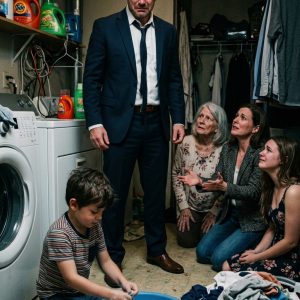
The Ledger of Ghosts
Chapter 1: The Banquet of Strangers
My life, as I knew it, snapped in half on a Sunday night. It didn’t happen with a car crash or a natural disaster. It started with a family dinner I never asked for, in a house that felt less like a home and more like a museum dedicated to people I wasn’t allowed to be.
My name is Harper. I am 27 years old, a UX designer by trade, and apparently, a “leech” by birthright.
When I walked into my parents’ suburban home just outside Austin, the air was thick with the smell of pot roast and judgment. Folding chairs were crammed into every corner of the living room. Thirty-three relatives, dressed in their Sunday best, turned to look at me. It wasn’t a warm welcome. It was the collective stare of an audience waiting for the villain to take the stage.
No one hugged me. No one offered a drink. My aunt Janine gave a tight, almost imperceptible nod from the corner, but she quickly looked away, as if making eye contact with me was a liability.
I sat at the only empty chair at the far end of the long, borrowed table. The food was passed around—platters of roast beef, bowls of mashed potatoes—skipping me entirely. I didn’t ask for a plate. I just sat there, my hands folded in my lap, listening to them trade stories of promotions, weddings, and grandbabies—the currency of the Brooks family, of which I had none.
Then, the performance began.
My mother, Diane, stood up. She is a senior loan officer at a local credit union, a woman who wears her financial acumen like a suit of armor. She walked over to the “Wall of Fame”—the hallway lined with perfectly curated family photos. With a calm, terrifying precision, she grabbed the frames containing my face and ripped them down.
Crash. Clatter.
Glass shattered on the hardwood floor. The room went dead silent.
“Trash,” she announced, her voice ringing clear as a bell. She tossed the broken frames into a wastebin she had positioned right next to the table for this exact moment. “Harper is nothing but a leech who would suck this family dry.”
My father, Gerald, co-owner of a successful HVAC company, didn’t flinch. He looked straight at me, his eyes cold and hard as ball bearings. “You will pay back every dollar we spent raising you,” he said. “You are a wasted investment.”
My sister, Mallory, the perfect guidance counselor with the perfect smile, shoved her chair back. She motioned toward the door with a flick of her wrist, like she was shooing a stray dog off the porch.
I didn’t cry. I didn’t scream. A cold numbness spread through my chest, freezing the tears before they could form. I picked up my bag, walked out of the house that had just erased me, and called a ride.
They thought that was the end. They thought they had discarded me. They had no idea I had been quietly tracking the strange decay of my financial life for months. They had no idea that this dinner wasn’t an ending—it was the catalyst.
I got back to my apartment, my hands shaking so hard I could barely unlock the door. I didn’t turn on the lights. I walked straight to my kitchen table, opened my laptop, and typed one sentence in a blank document:
THIS IS NOT ABOUT HURT FEELINGS. THIS IS ABOUT MY NAME.
I started rewinding the tape. The “joint account” Diane insisted I open at 19 to “build credit.” The way she demanded my mail be sent to their house for “safety.” The cryptic letters from banks I’d never heard of, thanking me for loans I never applied for. The sudden, inexplicable drop in my credit score despite my perfect payment history.
I pulled my credit reports from all three bureaus. As the files downloaded, I held my breath.
When the PDFs opened, it was like someone had turned on a blacklight in a hotel room. The screen was littered with accounts I had never touched. Personal loans in cities I’d never lived in. A maxed-out line of credit rolled into a consolidation loan. A store card for a home improvement chain.
And the common denominator? The mailing address was my parents’ house. The contact number was Diane’s cell.
I stared at the glowing screen, the blue light reflecting in my eyes. My parents hadn’t just rejected me. They had been cannibalizing me. They were feeding on my future to fund the illusion of their perfect present.
I created a new folder on my desktop labeled “The Ledger.” I dragged every file, every screenshot, every photo of a suspicious envelope into it.
Then, I opened my design software. If I was going to burn their house of cards down, I wasn’t going to use a match. I was going to use a spotlight.
Chapter 2: The Architect of Ruin
The next morning, my phone was a graveyard of notifications.
5:00 AM: Gerald Brooks (12 missed calls).
7:00 AM: Mallory Brooks (20 missed calls, 8 texts).
10:00 AM: Diane Brooks (4 missed calls).
The texts from Mallory were frantic: You embarrassed us. Mom is crying. Fix this.
The texts from Diane were manipulative: We need to talk calmly. Pick up just once.
I didn’t pick up. I took screenshots of every single notification and dragged them into The Ledger.
I drank my coffee black, staring at the infographic I had designed the night before. It was clean, brutal, and anonymous. Simple icons showed how identity theft happens within families. Bold numbers highlighted the financial devastation. A quiet line at the bottom read: “This happened to me.”
I uploaded it to a popular finance subreddit and LinkedIn, stripping away any identifying names. The title was simple: “My Family Used My Identity for Years. Here’s What I Wish I Had Noticed Sooner.”
I hit post. I wasn’t looking for sympathy. I was setting a trap.
By noon, the comments were rolling in. Horror stories, advice, solidarity. But one direct message made my blood run cold.
User: J_Accountant88
Harper? Is this you? This looks… exactly like what my sister has been doing.
I stared at the screen. Only one person called my mother “sister” and knew about finance. Janine. My aunt. The one who had nodded at me at the dinner.
We moved to a secure messaging app. Janine’s voice was shaking even through the text.
She helped me restructure my debt two years ago, Janine wrote. I signed a stack of papers. She said it was a consolidation. But recently… letters started coming. Loans I didn’t take. Diane told me it was a clerical error. Told me to ignore it.
My stomach twisted. It wasn’t just me.
Send me everything, I typed. Every letter. Every email. Every ‘clerical error.’
Janine sent a deluge of files. I cross-referenced them with my own credit report. The lenders matched. The dates matched. The pattern was undeniable. Diane would find a family member in a vulnerable moment—a new job, a debt crisis, a move—and offer to “handle the paperwork.” She would collect signatures, divert mail, and open parallel lines of credit to fund… what?
I needed one more piece. I needed Mallory.
Two days later, Mallory texted. Coffee? Please. It’s about Mom.
We met at a hipster cafe downtown. Mallory looked wrecked. Her perfect guidance counselor facade was cracking; dark circles bruised her eyes. She ordered a tea she didn’t drink.
“I’m sorry about the dinner,” she whispered, picking at a loose thread on her cardigan. “It got out of hand. But… Harper, you have to stop ignoring them. Dad is losing his mind.”
I didn’t say a word. I reached into my bag and slid a manila folder across the table.
Mallory opened it. She saw the highlighted credit reports. She saw the address—our parents’ address—listed next to $40,000 in loans in my name. She saw the timestamped emails from Janine.
“She’s doing it to you, too, Mal,” I said softly. “The ‘cosign’ for your refinance? The paperwork you signed when you started your new job?”
Mallory went pale. “No. Mom helps us. That’s what she does.”
“She helps herself,” I corrected. “Look at the dates. Grandma Marion sells her house, and suddenly Dad gets a new work truck. You sign for a refinance, and they remodel the kitchen. I go to college, and they open a line of credit.”
Mallory stared at the papers, her denial warring with the math. She was a guidance counselor; she knew how to spot a lie. She just never thought to look for one at her own kitchen table.
“Grandma…” she breathed. “Mom handled everything when Grandma moved to the home. She said the money… she said it went to fees.”
“Did you ever see the receipts?”
Mallory shook her head, tears welling up.
“I need your help, Mal. I’m filing with the FTC. I’m talking to a lawyer. If you want to protect yourself—if you want to protect Grandma—I need everything you have.”
Mallory looked out the window, watching the traffic blur by. Then, she reached into her purse and pulled out her phone.
“I have the emails,” she whispered. “From the refinance. I forwarded them to you.”
The puzzle was complete. I had the motive, the method, and the victims.
But the real storm broke a week later, when my mother showed up at my office.
“There’s a woman here,” the receptionist messaged me. “Says she’s your mother. She looks… intense.”
I walked into the lobby. Diane was standing there, clutching her leather portfolio like a weapon. She smiled when she saw me—that terrifying, public smile.
“Harper,” she said, her voice dripping with artificial warmth. “Can we talk?”
“Right here,” I said, planting my feet.
She stepped closer, dropping the voice. “I saw your post. The infographic. People are talking, Harper. At the bank. At church.”
“Good.”
Her eyes flashed. “You have no idea what you’re doing. I fixed things for this family. I managed the money so you didn’t have to. I built your credit!”
“You stole my identity, Diane. You forged my signature. You used Janine. You used Grandma.”
She scoffed. “It’s called leverage. It’s how the world works. I can fix this. I can make a few calls, move some balances. But you need to take that post down. Now.”
“No.”
“If this blows up,” she hissed, leaning in so close I could smell her expensive perfume, “it will take us all down. Do you want to be the reason your father loses his business? The reason I lose my license?”
“I’m not the reason,” I said, my voice steady. “You are.”
She stared at me, searching for the compliant daughter she had raised. She didn’t find her. She found a stranger with a paper trail.
“You’re making a mistake,” she spat. Then she turned on her heel and marched out, the click of her heels echoing like gunshots.
I watched her go. My boss, Trevor, stepped out of a conference room nearby. He had heard enough.
“Everything okay?” he asked.
“No,” I said. “But it’s about to be over.”
That night, I received a notification from my bank. A new inquiry. Someone was trying to access the frozen accounts.
They were desperate. And desperate people make mistakes.
Chapter 3: The Deposition of Saints
The unraveling wasn’t a singular explosion; it was a slow, agonizing crumble.
It started with a letter from the State Banking Regulator. My attorney had forwarded my dossier—The Ledger, Janine’s emails, Mallory’s refinance documents—to the compliance department of Diane’s credit union. They didn’t just see a family squabble. They saw a liability.
They placed Diane on administrative leave. “Pending internal investigation,” the email read. In the world of finance, that’s a polite way of saying, “Pack your box.”
Then came the civil suit. Janine, emboldened by my findings, hired an attorney for Grandma Marion. We filed jointly: fraud, identity theft, financial exploitation of the elderly.
I refused to attend the preliminary hearings. I signed my affidavits in a sterile office, swearing under oath that I had not authorized $50,000 in loans.
But I heard about the deposition.
Mallory went. She texted me afterward: It was awful. Mom tried to say it was all verbal agreements. But they showed her the login logs. Her user ID was accessing our accounts at 2:00 AM from her IP address.
The digital footprint doesn’t lie. Diane had gotten sloppy. She thought because we were family, we wouldn’t check. She thought she owned us.
My father called me the night before the settlement talks. He sounded drunk.
“You happy now?” he slurred. “We’re selling the truck. We’re selling the house. Your mother… she can’t even show her face at the grocery store.”
“I didn’t make her sign those papers, Dad,” I said, tired.
“We did it for you!” he shouted. “To give you a good life! To build the business so you’d have something!”
“You called me a wasted investment,” I reminded him. “You called me a leech. You didn’t do it for me. You did it for the image of you.”
He hung up.
The settlement was brutal. To avoid criminal charges—which were looming like a thunderhead—my parents agreed to full restitution. They liquidated everything.
The suburban house with the perfectly manicured lawn? Sold.
The HVAC company? Gerald was forced to sell a controlling stake to a competitor to raise the cash. He was no longer the boss; he was an employee in his own building.
Diane’s license? Revoked. She would never work in finance again.
But the final blow didn’t come from a judge. It came from Grandma Marion.
A week after the settlement, I received a letter. It was written in shaky, cursive handwriting on floral stationery.
My Dearest Harper,
Thank you for being brave when I was too tired to be. I always knew something was wrong, but I didn’t want to believe it of my own daughter. You saved me. Enclosed is something that belongs to you.
Inside was a check for $5,000. It wasn’t much compared to what they stole, but it was everything she had saved from her new, protected account.
Use this for your art, the note finished. Be the artist they said you couldn’t be.
I cried then. For the first time since that Sunday dinner, I put my head down on my desk and wept.
But the story wasn’t over. My parents, stripped of their assets and their reputation, moved into a small rental apartment on the edge of town. The silence from them was deafening.
Until Thanksgiving.
I hadn’t planned on doing anything. I was going to stay in my apartment, order takeout, and work on my website—the resource hub I had built for victims of familial financial abuse.
Then Mallory texted.
I’m not going to their place this year. Janine invited us to her house. Grandma will be there. She wants you to come.
I hesitated. The thought of family still made my chest tight. But Janine… Janine had fought beside me.
I drove to Janine’s. It was a modest house, cluttered and warm, smelling of cinnamon and dogs. When I walked in, there were no folding chairs. No borrowed tables. Just a mismatched collection of sofas and a TV playing the parade.
Janine hugged me so hard I lost my breath. Grandma Marion, sitting in a recliner, reached out a frail hand and patted my cheek.
“There she is,” Grandma whispered. “The whistleblower.”
We ate turkey on paper plates. We laughed about things that weren’t promotions or salaries. It was messy. It was imperfect. It was real.
Halfway through dessert, my phone buzzed. A text from an unknown number.
I opened it. It was a photo.
A picture of a small, sad turkey sitting on a card table in a beige apartment with bare walls. No people in the frame. Just the stark, lonely evidence of a meal eaten in defeat.
The caption read: Hope it was worth it.
It was from my dad.
I looked around Janine’s living room. I looked at Mallory teaching Grandma how to use an iPad. I looked at Janine laughing at a joke I didn’t hear.
I typed back: It was.
Then I blocked the number.
Chapter 4: The Clean Slate
Six months later, I walked into a bank. My own bank.
I sat down across from a loan officer—a woman named Sarah who didn’t know my mother, didn’t know my history, and didn’t look at me like a liability.
“So, Harper,” she said, reviewing my file on her screen. “You’re looking to buy a condo?”
“Yes,” I said. “A small place downtown. Loft style.”
She hummed, scrolling. My heart hammered against my ribs. The freeze was lifted for exactly 24 hours to allow this check.
“Well,” Sarah said, looking up with a smile. “Your credit report is impeccable. No debt. Excellent payment history. The fraud alerts are noted and cleared. You’re pre-approved.”
I let out a breath I felt like I’d been holding for a year. “Thank you.”
I walked out into the bright Austin sunshine. I checked my phone. My website had 10,000 hits this week. I had an inbox full of emails from people asking for advice, sharing their stories, finding the courage to check their own reports.
I wasn’t just a UX designer anymore. I was an architect of boundaries.
I stopped at a crosswalk. Across the street, I saw a woman who looked like my mother. Same blonde bob, same sharp blazer. My stomach dropped.
But as she turned, I saw it wasn’t her. Just a stranger.
My mother was likely scanning groceries or answering phones at a temp agency, living in the reality she had created. She was no longer the gatekeeper of my life. She was just a footnote in my credit history.
I walked to the condo building I was hoping to buy. It had huge windows and exposed brick. It needed work. It needed a new kitchen, better lighting, a fresh coat of paint.
But it had good bones. And most importantly, the deed would have exactly one name on it.
Mine.
Like and share this post if you think I did the right thing.