The Rolling Oath: A Legacy Reclaimed
Part 1: The Hollow Garage
My grandfather, Command Master Chief John W. Hayes, gave me the keys to his pride and joy on his deathbed. It was a 1968 Navy staff car, steel blue, polished to a mirror shine, with an engine that didn’t just run; it hummed like a hymn. For twenty years, that car was his silhouette against the horizon. When I enlisted, it became my anchor.
When I returned home from my third deployment, my boots still smelling of salt and JP-5 fuel, I expected to see that familiar chrome grille waiting in the garage. I needed to see it. Coming home is a dislocation of the soul; you need landmarks to remind you who you were before the world tried to harden you.
Instead, I found an empty space.
The garage had been remodeled. New epoxy floors, bright LED lights that felt sterile, and a void where 35 years of naval history used to sit. The air left my lungs in a rush. I ran a hand over the empty space, my fingers trembling.
“Where is it?” I whispered, though no one was in the room.
“Oh, that old thing?”
I spun around. My father was standing in the doorway, holding a ceramic mug of coffee, looking aggressively casual. He was wearing a polo shirt that cost more than my first car, looking at me with the mild annoyance one reserves for a misbehaving pet.
“I sold it,” he said, taking a sip.
The world tilted on its axis. “You what?”
He shrugged, walking past me to inspect a set of golf clubs leaning against the wall. “Your brother needed $150,000 for the wedding. He’s finally marrying into that investment family, the Vanderbilts. It’s a strategic move for us. The venue, the catering… these things add up. We needed liquid assets.”
I stared at him, my vision blurring at the edges. “You sold Grandpa’s staff car? You sold a piece of history for… for canapés and a tent?”
“It was just sitting here, kiddo. You’re never home. It’s time to let go of the past. Besides, the guy paid cash. No questions asked.”
I felt something inside me fracture. It wasn’t just sadness; it was a hot, white rage that started in my gut and worked its way up to my throat. “Grandpa left that car to me. He put the keys in my hand.”
“And I’m the executor of the estate until probate fully clears,” my father said, his voice hardening. “It was a depreciating asset. I turned it into a future for your brother.”
My mother appeared in the doorway, wiping her hands on a dish towel, her eyes refusing to meet mine. “Honey, don’t start a fight. Your father thought it was best.”
Then my brother, Mark, strolled in. He was holding fabric swatches for tuxedos, looking smug and untouched by the gravity of what he’d done. “Relax, Sis. It’s just metal. You can buy a Prius or something. Better mileage.”
I looked at them—this family that measured worth in stock options and social climbing—and realized I didn’t know them at all.
“That car,” I said, my voice shaking, “was the only thing in this house that had a soul.”
I turned on my heel and walked out. I didn’t scream. I didn’t throw things. I just left. I drove my rental to the edge of the naval base and sat in the parking lot until the sun went down, clutching the brass key Grandpa had given me. It was the spare, the one he said was for “emergencies only.”
I whispered into the dark, “You were right, Grandpa. You said it would protect me.”
But protect me from who? My own blood?
Three days of silence followed. I stayed in the base officers’ quarters, ignoring my father’s texts about “being dramatic.” Then, the phone rang.
“Ma’am?” The voice was male, gravelly, and hesitant. “Is this Commander Hayes?”
“Speaking.”
“This is Officer Daniels from Harborview Auto. You need to come down here. We have… we have a situation with a vehicle brought in by a Mr. Robert Hayes.”
My grip tightened on the phone. “What kind of situation?”
“We found something inside, Ma’am,” he said, his voice dropping an octave. “Your grandfather left something in the car. And frankly, after seeing it, I stopped the sale paperwork. You need to come now.”
The air in the room seemed to freeze. Harborview Auto was twenty minutes away. I didn’t know it then, but that phone call was the first thread pulling apart a tapestry of lies my family had been hiding behind for decades.
Part 2: The False Bottom
Harborview Auto wasn’t a luxury dealership. It was a low-slung cinderblock building near the docks, smelling of ozone and tidal mud. A string of faded plastic pennants snapped in the wind. This was the real America—the one that fixed things instead of replacing them.
A man in a mechanic’s jumpsuit was waiting by the chain-link fence. He straightened up when he saw my uniform.
“Officer Daniels?” I asked, stepping out of my car.
“Just Daniels, Ma’am. I was a Petty Officer 2nd Class back in the day.” He shook my hand with a grip like a vice. “Thank you for coming. I know this is messy.”
“Where is it?”
“In the back bay. I pulled it off the line when I saw the bumper tag.”
He led me through the garage, past sedans on lifts and the screech of pneumatic drills. And there, in the back corner under a flickering fluorescent light, it sat.
The 1968 staff car.
It was dusty, and someone had scuffed the whitewalls, but it was still magnificent. The Navy bumper sticker—USN RETIRED—caught the light. I felt a lump form in my throat so large I couldn’t swallow.
“Your father and brother brought it in,” Daniels said, wiping his hands on a rag. “Wanted a rush job. Quick sale to a collector in Jacksonville. Didn’t even want us to inspect it.”
“Why did you call me?”
“Because of the glove box.” He walked over and handed me a Ziploc bag. Inside was a scrap of yellowed paper. “Found this taped to the back of the owner’s manual.”
I took the bag. The note was in Grandpa’s blocky, unmistakable handwriting: If sold without my granddaughter present, call this number immediately. It listed my base extension.
“He knew,” I whispered. “He knew they would do this.”
“That’s not all,” Daniels said. “Come around to the trunk.”
We walked to the rear of the car. Daniels popped the trunk latch. It opened with a familiar thunk. The interior was immaculate, the spare tire cover pristine.
“Looks normal, right?” Daniels asked. “But tap on the floorboard.”
He rapped his knuckles on the carpeted floor. It sounded hollow.
“False bottom,” he said. “Professional work. Agency grade. I’ve only seen this on diplomatic security cars. I figured you should be the one to open it.”
I reached into my pocket and pulled out the brass key. It had a second, smaller tooth I had always assumed was a manufacturing error. I scanned the trunk floor until I saw a tiny, almost invisible slot near the jack mount.
I inserted the key. It turned.
With a soft pneumatic hiss, a panel lifted.
My knees nearly gave out. Beneath the floorboard, nestled in custom-cut foam, was a heavy wooden box made of dark mahogany. Burnt into the lid were three letters: J.W.H. And below that, a single word: HONOR.
“I’ll give you a minute,” Daniels said softly, stepping back into the shadows.
I lifted the box. It was heavy—heavier than wood should be. I undid the brass latch and opened the lid.
The smell of old paper and pipe tobacco wafted out, hitting me with a wave of nostalgia so potent it made my eyes water. Inside, there were no jewels or gold bars. There were envelopes. Dozens of them. And medals—not just his, but others I didn’t recognize.
On top lay a letter addressed to me.
Kiddo,
If you are reading this, it means someone in this family forgot what matters. Don’t get angry. Anger burns fast and blinds good people. Honor doesn’t shout. It endures.
The car isn’t just a car. It was my office. It was my ambulance. It was my hearse. The Navy retired me, but they didn’t retire the mission. Look under the driver’s seat. What you find there will explain why your father can never possess this vehicle.
Drive straight.
– Chief
I wiped my eyes, my hand trembling. “Daniels,” I called out. “We need to check the driver’s seat.”
Part 3: The Rolling Mission
We found the second compartment taped under the seat springs. It was a small, galvanized tin box, the kind you used to keep first-aid kits in.
Inside was a flash drive, a stack of photographs, and an envelope stamped DEPARTMENT OF THE NAVY – RESTRICTED Access.
“Restricted?” Daniels whistled. “Ma’am, I don’t want to know what’s in there if it puts me in the brig.”
“It’s dated 1989,” I said, tearing the seal. “I think the statute of limitations has passed.”
I pulled out a document on official Navy letterhead. I read the first paragraph, and the world seemed to stop.
Authorization for Command Master Chief John W. Hayes to maintain custody of the Navy Relief Car Project… a confidential civilian assistance operation…
I looked at Daniels. “Did you know about this?”
“The Relief Car Project?” Daniels frowned, scratching his chin. “I heard rumors back in the day. Old salts talking about a ‘Ghost Fleet.’ Cars that would show up when a veteran was in trouble—when the VA backlog was too long or the pension check didn’t arrive. They said these cars delivered cash, medicine, sometimes just a ride to a funeral. But I thought it was a myth.”
“It wasn’t a myth,” I said, holding up a photograph from the tin. It showed my grandfather standing by this very car, handing a thick envelope to a young widow holding a folded flag. “He was the Ghost Fleet.”
The flash drive contained the ledger. I plugged it into my laptop right there on the workbench. It was a spreadsheet of thousands of names, dates, and amounts.
Paid rent for Sergeant Miller. 1977.
Covered surgery for Seaman Ortiz’s daughter. 1982.
Job placement for Petty Officer Lewis. 1995.
He hadn’t just been driving around on Sundays. He had been running a shadow charity, using his own pension and donations from other silent partners to hold the local veteran community together.
And my father—his own son—had sold this legacy for a wedding tent.
“I need to verify this,” I said, my voice steel. “If this is what I think it is, the car is historically significant. The Navy can block the sale.”
“You need a lawyer,” Daniels said.
“I have the base legal liaison,” I replied. “But first, I need to know if the mission is over.”
I scrolled to the bottom of the list. There was one entry, dated just two weeks before Grandpa died.
Final Route: Delivery pending. Lt. Robert Thompson, Clearwater Shores. Recovery of Lost Valor.
“Clearwater Shores is an hour north,” I said, closing the laptop. “Daniels, keep the car here. Don’t let my father near it. If he shows up, tell him it’s under federal review.”
Daniels grinned, crossing his arms. “I’d love to see him try to take it. Go. Finish the mission.”
Part 4: The Lost Valor
The drive to Clearwater Shores felt like moving through a dream. The sun was setting, painting the marshlands in hues of violet and gold. I drove my rental, but in my mind, I was behind the wheel of the staff car, feeling the heavy steering, smelling the old vinyl.
I found the address at the end of a dirt road. It was a small, weathered bungalow with a wheelchair ramp and a flag that had seen better days.
An old man answered the door. He was frail, leaning heavily on a cane, but his eyes were sharp.
“Sir,” I said, standing at attention. “I’m Commander Hayes. Granddaughter of Chief John Hayes.”
The man’s face crumbled. He dropped his cane and reached out, gripping my hand with surprising strength. “Johnny’s girl? Lord, I never thought I’d see the day.”
He invited me in. The house was modest, filled with ceramic figurines and the smell of boiled tea.
“Your grandfather,” Lt. Thompson said, sinking into his armchair, “was the only reason I didn’t put a bullet in my head in 1994.”
I sat opposite him, holding the wooden box I had taken from the trunk. “He had a delivery listed for you. ‘Recovery of Lost Valor.'”
Thompson nodded, tears spilling onto his cheeks. “My Navy Cross. I sold it to a pawn shop to pay for my wife’s chemo. I hated myself every day since. Your grandfather found out. He promised me he’d get it back.”
I opened the wooden box. There, nestled in the velvet, was the Navy Cross.
Thompson sobbed. It was a raw, guttural sound that tore at my heart. He held the medal to his chest, rocking back and forth. “He kept his word. Even from the grave, that stubborn son of a gun kept his word.”
“He was running a relief network,” I said softly. “The car was his vessel.”
“The car was his church,” Thompson corrected, looking up. “And he was the finest preacher I ever knew.”
Driving back to the city that night, the anger I felt toward my father changed. It wasn’t hot anymore. It was cold. Calculated. My father hadn’t just sold a car; he had attempted to liquidate a monument to human decency.
My phone buzzed. It was a text from Mom.
Wedding rehearsal is tomorrow at 2 PM. Please come. Your father is upset, but he wants to make peace.
I stared at the screen. Make peace? No. I was going to make war.
Part 5: The Wedding Crasher
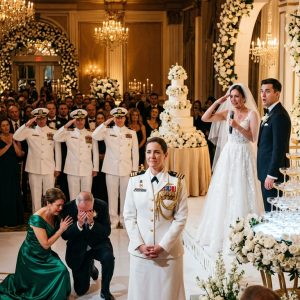
The wedding rehearsal was held at the Gilded Anchor Yacht Club, a place that smelled of old money and desperation. My brother and his fiancée were standing under a floral arch that probably cost more than Lt. Thompson’s house. My father was holding court near the bar, laughing loudly, playing the part of the benevolent patriarch.
I walked in. I was wearing my Dress Blues. Not the mess dress for parties, but the service dress—ribbons, warfare devices, the works. The sound of my heels clicking on the marble floor cut through the chatter.
The room went quiet. A few guests turned. My father’s smile faltered.
“Sarah,” he said, stepping forward, his voice a mix of warning and fake cheer. “I didn’t think you were coming. And in uniform? A bit dramatic, isn’t it?”
“We need to talk, Dad.”
“Not now,” he hissed, grabbing my elbow. “Don’t embarrass me in front of the Vanderbilts.”
I pulled my arm away. “You embarrassed yourself the moment you signed that bill of sale.”
I walked past him, straight to the table where the wedding gifts were being displayed. I placed the rusty tin box and the official Navy documents on the white tablecloth, right next to a crystal vase.
“What is this?” my brother asked, annoyed.
“This,” I said, my voice projecting to the back of the room, “is the legacy you sold for a catering budget.”
I opened the document. “This 1968 staff car was a sanctioned Navy Relief vehicle. It holds the classified records of over three hundred veterans that Grandpa helped when the government failed them. It is designated as historical property.”
My father laughed, a nervous, jagged sound. “It’s a car, Sarah. Stop living in a fantasy world.”
“Is it?” I turned to the crowd. “Is there a Captain Miller here? Or a Sergeant O’Malley?”
Two older men near the back stood up, looking confused.
“My grandfather’s ledger says he paid your mortgage in 1989, Captain. And Sergeant, he drove you to Walter Reed for six weeks straight when you lost your license.”
The room went deathly silent. The Captain’s face went pale, then red. “Chief Hayes did that? I never knew… I thought it was an anonymous grant.”
“It was him,” I said. “And my father just sold the vehicle that made it possible to a private collector so he could pay for this.” I gestured to the opulent tent.
My father looked around, sweat beading on his forehead. “I didn’t know,” he stammered. “It was just an asset…”
“An asset?” The Captain walked forward, his cane thumping against the floor. He stopped in front of my father. “You sold John Hayes’ car? The Ghost Fleet car?”
“I… I…”
“You hold your tongue,” the Captain barked. “You aren’t fit to hold that man’s wrench, let alone his keys.”
My brother looked at his fiancée. She looked horrified. The Vanderbilts were whispering. The illusion of the “perfect family” my father had tried so hard to build was crumbling, brick by brick, under the weight of the truth.
“I have retrieved the vehicle,” I announced. “Officer Daniels at Harborview Auto stopped the sale. The title is being transferred to the Veterans Heritage Museum, with me as custodian. The $150,000 you took? You’ll be refunding that to the dealer by Monday, or the JAG Corps will be filing charges for the trafficking of stolen military historical property.”
My father sank into a chair. He looked small. Defeated. Not by me, but by the weight of his own greed.
Part 6: The Long Drive Home
The aftermath was quiet. The wedding happened, but it was subdued. The shine was gone. My father wrote the check to the dealer. He had to liquidate some stocks to do it, and the irony wasn’t lost on me.
A week later, I stood in the parking lot of Harborview Auto. The car was polished, the engine idling with that deep, throaty purr.
Daniels handed me the keys. “She’s ready, Commander.”
“Thank you, Daniels. For everything.”
“Just doing my duty, Ma’am.”
I opened the driver’s side door. But before I got in, I heard a car pull up. It was my father.
He got out of his Mercedes and walked over. He looked older than he had a week ago. He stopped a few feet away, looking at the car like he was seeing it for the first time.
“I read the letters,” he said quietly. “The ones in the box.”
“Did you?”
“I didn’t know, Sarah. I really didn’t. He never told me.”
“You never asked,” I said. “You were too busy trying to get away from where you came from to notice what he was building right there in the garage.”
He nodded, swallowing hard. He reached out and touched the chrome fender. “He was a great man.”
“He was.”
“I… I’m sorry.”
It wasn’t enough. Not yet. But it was a start.
“I’m taking it to the museum next week,” I said. “But today… today I’m taking it for a drive. To the pier. Where he used to take me.”
My father hesitated. “Can I… can I come?”
I looked at him. I saw the regret etched into his face. I remembered Grandpa’s letter: Anger burns fast… Honor endures.
“Get in,” I said.
We drove in silence for the first few miles. The car handled like a dream, floating over the asphalt. The wind roared through the open windows, smelling of salt and redemption.
As we neared the coast, I pulled the brass key from my pocket—the one that opened the secrets—and placed it on the dashboard. It rattled softly, a rhythm against the engine’s hum.
“He left a note for you, too,” I said, keeping my eyes on the road.
“He did?” My father sounded terrified.
“Yeah. It was in the very bottom of the box.” I recited it from memory. “If your father ever forgets what honor is, remind him not with anger, but with truth. Then, offer him a ride.”
My father began to weep. Quietly at first, then harder. He cried for the father he missed, for the son he hadn’t been, and for the hollow space he had tried to fill with money.
I just kept driving. I drove us toward the ocean, the sun glinting off the hood, the Ghost Fleet riding with us one last time. The car wasn’t just metal and rubber. It was a bridge. And finally, after all these years, we were crossing it together.
Like and share this post if you believe honor is worth more than any price tag.