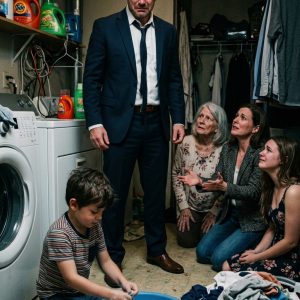
“Get out! I’m done paying for your mistakes!”
Those were the last words my father spoke to me as a parent. He didn’t know that the price of his rage would be his own son, and the currency would be a lifetime of regret.
The wind howled outside, a mournful, high-pitched shriek that rattled the old windowpanes of our farmhouse. The weathermen on the radio had been screaming about the “Storm of the Decade” all afternoon, predicting two feet of snow and temperatures that would freeze your breath in your lungs. Inside, the air was even colder.
We were sitting at the dinner table—my father, Frank; my older sister, Chloe; and me. The silence was heavy, thick with the kind of tension that precedes an explosion. Frank was staring at his plate, his jaw working as he chewed, but he wasn’t tasting anything. He was stressed. The mortgage was due, the heating bill was overdue, and the envelope of cash he kept in the antique tin on the mantelpiece—six hundred dollars, scraped together from overtime shifts at the mill—was gone.
I looked down at my mashed potatoes, my stomach churning. I discreetly checked the insulin pump clipped to my belt. My blood sugar was trending low—75 mg/dL and dropping. Stress always did that to me. It burned through my glucose reserves faster than I could replenish them. I was fourteen, Type 1 Diabetic, and tired. Tired of the yelling, tired of the poverty, but mostly, tired of being the convenient target for everything that went wrong in this house.
“Six hundred dollars, Leo!” Frank slammed his fist onto the table, making the silverware jump. The sound cracked through the room like a gunshot. “Where is it?”
I looked up, meeting his eyes. They were bloodshot, desperate. He wanted a villain, and I was the only one casting a shadow.
“I didn’t take it, Dad,” I said, my voice quiet but steady. “I haven’t been near the mantel. Ask Chloe.”
Across the table, Chloe gasped. It was a masterclass in theatrical victimhood. At sixteen, she was the golden child—the varsity cheerleader, the straight-A student (on paper), the one who looked like our late mother. But beneath the blonde curls and the practiced smile lay a cruel streak wide enough to drive a truck through.
“How could you?” Chloe whispered, her eyes filling with instant, fake tears. “After I defended you when you failed math? After I helped you with your injections last week? You’re going to blame me?”
She wiped a tear from her cheek, her hand trembling just enough to look authentic.
Frank turned to me, his face turning a dangerous shade of purple. He didn’t see a son; he saw a burden. He saw the medical bills piling up on the counter. He saw the expensive insulin vials in the fridge. He saw a drain on his resources, while Chloe was his pride, his hope.
“Don’t you dare lie to me, boy,” Frank growled, standing up. His chair scraped violently against the linoleum. “I checked your backpack. The envelope was in there. Empty.”
My blood ran cold. Chloe must have planted it. She needed money for concert tickets—I had heard her whispering on the phone about it last night.
“Dad, she put it there!” I pleaded, standing up, my legs feeling shaky from the dropping sugar. “Please, just think about it. Why would I steal? Where would I go?”
“You’re a thief and a liar,” Frank spat. “I’ve worked my fingers to the bone for you. I’ve sacrificed everything to keep you alive, and this is how you repay me?”
He marched around the table. He grabbed my arm, his fingers digging into my bicep hard enough to bruise.
“I’m done listening to your lies,” he roared, dragging me toward the back door.
“Frank, wait!” I cried, trying to dig my heels in, but he was a large man fueled by rage, and I was a skinny, hypoglycemic teenager.
In the chaos, my eyes locked on the kitchen counter. There, sitting next to the fruit bowl, was my blue nylon case marked LEO – MEDICAL. It contained my emergency glucagon, my spare insulin, and my glucose tabs.
It was ten feet away. It might as well have been on the moon.
The back door flew open, and the storm rushed in to greet us.
The cold hit me like a physical blow, sucking the air from my lungs. It was a wall of white noise and biting wind. Frank shoved me hard. I stumbled backward, my sneakers slipping on the icy porch steps. I fell into a snowbank, the powder already knee-deep and rising.
“Dad! My kit! Please!” I screamed, the wind tearing the words from my mouth. “I need my insulin!”
Frank stood in the doorway, silhouetted by the warm yellow light of the kitchen. He looked like a giant, a gatekeeper to a paradise I was being expelled from.
“Get out! I’m done paying for your mistakes!” he shouted over the howling wind. “You want to act like a criminal? Go live like one. Don’t come back until you have my money.”
“Frank! I’m crashing! My sugar is low!” I begged, scrambling to stand up, but my limbs felt heavy, uncoordinated.
He didn’t hear me. Or maybe he chose not to. He grabbed the heavy oak door and slammed it shut.
The deadbolt slid home with a final, metallic clack.
I scrambled up the steps and pounded on the wood. “Dad! Dad! Open the door!”
I pressed my face against the frosted glass pane. I saw his shadow turn away. I saw Chloe standing by the window, watching. For a second, her face flickered—not with triumph, but with a sudden, dawning realization of what she had done. But she didn’t move. She didn’t unlock the door. She turned and walked away.
I was alone.
I checked my pockets—no phone, no wallet. Just lint and a gum wrapper. My continuous glucose monitor (CGM) beeped an alarm from my belt, muffled by my jacket.
BEEP. BEEP. BEEP. LOW GLUCOSE. URGENT.
I pulled it out. The screen glowed red in the darkness: 55 mg/dL. Two arrows pointing down.
Panic, cold and sharp, pierced through the fog in my brain. I wasn’t just freezing; my body was beginning to shut down. Without sugar, my brain would starve. I would get confused, then lethargic, then unconscious. And in this temperature—negative ten with the wind chill—unconsciousness meant death.
I looked around. The world was a swirling vortex of white. I couldn’t see the barn. I couldn’t see the road.
The nearest neighbor, the Millers, lived two miles away through the woods.
I looked at the house one last time. It looked so warm. So safe.
I turned toward the dark tree line. I started walking, not because I thought I’d make it, but because stopping meant sleeping, and sleeping meant dying.
Back inside the kitchen, the silence was deafening.
Frank walked to the counter, his hands shaking. He poured himself a glass of whiskey, needing to dull the edge of his anger. He took a long swallow, the burn grounding him.
“He’ll be back in ten minutes,” Frank muttered to the empty room. “Begging. He needs to learn.”
He set the glass down. His eyes wandered to the fruit bowl.
He froze.
There, sitting innocently next to the bananas, was the blue nylon case.
LEO – MEDICAL.
The realization hit him harder than the whiskey. He hadn’t just kicked his son out into a storm. He had sent him out without his life support. He remembered the beep he had heard earlier—the low sugar alarm.
Frank’s heart hammered against his ribs. The anger evaporated, replaced instantly by a cold, sickly dread.
He grabbed the doorknob and twisted the deadbolt open. He threw the door wide.
“Leo!” he screamed into the night.
The only answer was the wind. The snow had already filled in my footprints.
He turned to run back inside for his coat, but the phone on the wall rang.
Frank stared at the phone. It rang again, a shrill, demanding sound that seemed to slice through the house.
He picked it up, his hand trembling. “Hello?”
“Mr. Vance?” The voice on the other end was low, stripped of all warmth. “This is Deputy Miller from the County Sheriff’s Department.”
Frank’s knees buckled. He hit the linoleum floor hard, clutching the receiver with both hands.
“Is he… is he okay?” Frank gasped. “Did he make it to your house?”
There was a pause on the line. A silence so heavy it felt like a judgment.
“We found him, Mr. Vance,” the deputy said. “My son saw something in the snowbank by the creek. Leo is unconscious.”
“Oh god,” Frank sobbed. “Is he…?”
“He is in a diabetic coma, Mr. Vance,” the deputy continued, his voice hardening into steel. “His core temperature was 94 degrees when the paramedics arrived. His blood sugar was 32. He’s alive, but barely. They are transporting him to St. Mary’s now.”
Frank scrambled to his feet. “I’m coming. I’m coming right now. I… I was just teaching him a lesson. He stole money. I didn’t mean—”
“Save it,” the deputy interrupted. “We also found the money, Mr. Vance.”
Frank froze. “What?”
“We are at your front door. Open it. Now.”
Frank dropped the phone. It dangled by its cord, swaying gently.
He walked to the front door like a man walking to the gallows. He opened it.
Deputy Miller stood there, flanked by two other officers. The swirling red and blue lights of the cruisers painted the snow in violent colors.
Miller held up a plastic evidence bag. Inside was the envelope of cash, crumpled and wrapped inside a receipt for two VIP tickets to a pop concert.
“This was in your daughter’s vanity drawer,” Miller said coldly. “Chloe confessed the moment we told her Leo might die. She planted the empty envelope in his bag.”
Frank looked back into the house. Chloe was standing at the top of the stairs, her face pale, tears streaming down her face.
“Daddy, I’m sorry!” she wailed. “I didn’t think you’d kick him out! I just wanted the tickets!”
Frank looked at his “golden child.” The illusion shattered. He didn’t see perfection anymore. He saw the monster he had helped create.
“Mr. Vance,” Miller said, stepping forward. “You are under arrest for child endangerment and criminal negligence.”
They cuffed him. The metal was cold against his wrists.
As they led him down the walkway, he saw the ambulance pulling away from the edge of the woods. Through the back window, he caught a glimpse of a paramedic lifting an oxygen mask from a small, pale face.
“Leo!” Frank screamed, the name tearing from his throat. “Leo, I’m sorry!”
The ambulance didn’t stop. It accelerated, its siren wailing a mournful song, disappearing into the white void of the storm.
Frank slumped in the back of the cruiser. He watched his house disappear. He watched Chloe standing on the porch, crying—not for her brother, but because she realized her safety net was gone.
The doors locked.
It would be fifteen years before Frank Vance saw his son again.
Fifteen Years Later
The office was a fortress of glass and steel, towering forty stories above the frozen city of Minneapolis. It smelled of espresso and expensive leather.
I sat behind a desk made of reclaimed mahogany, looking out at the snow falling gently on the skyline. I was thirty-one years old now. I was no longer Leo, the scared boy who froze in the woods. I was Leonard Vance, Senior Partner at Sterling & Vance, specializing in corporate restructuring and asset liquidation.
I was rich. I was successful. And I was cold.
The cold from that night had never really left me. It had settled into my bones, into my personality. I built walls around myself that were higher and thicker than any drift. I managed my diabetes with the precision of a machine. I managed my life the same way. No surprises. No vulnerabilities.
My assistant buzzed the intercom. “Mr. Vance? Your 2:00 PM appointment is here. The tenants from the Riverside property.”
“Send them in,” I said, spinning my chair around.
The door opened.
A young woman pushed a wheelchair into the room. She looked haggard, her blonde hair thinning and pulled back into a messy bun. Her cheap coat was frayed at the cuffs. She looked older than her thirty-one years.
In the wheelchair sat a man who was a shell of a human being. He was frail, his skin papery and gray. His legs were covered by a thin blanket.
It took me a moment to recognize them.
Frank and Chloe.
They didn’t recognize me. Why would they? The last time they saw me, I was a scrawny kid being loaded into an ambulance. Now, I was a man in a three-thousand-dollar suit with a jawline sharpened by years of discipline.
“Mr. Vance,” Frank rasped, his voice weak. “Thank you for seeing us.”
“State your business,” I said, keeping my face impassive. I tapped my pen on the desk—a rhythmic click, click, click.
Chloe stepped forward, wringing her hands. She tried to summon some of her old charm, a smile that flickered and died.
“Please, sir,” she said. “We know we’re behind on rent. Three months. But it’s been a hard winter. My father… he’s sick.”
“Illness is not a currency I accept,” I said flatly. “You are in breach of contract. The eviction notice stands.”
“Please!” Chloe begged, tears filling her eyes—real tears this time, born of desperation. “He needs his medication. He has Type 2 diabetes. If we get evicted, we have nowhere to go. We can’t afford his insulin.”
The word hung in the air. Insulin.
I stopped tapping my pen.
I stood up and walked to the floor-to-ceiling window, my back to them. I watched the snow swirl.
“Insulin is expensive,” I said, my voice low and dangerous. “I remember someone once telling me that he was done paying for my mistakes.”
Silence filled the room. A thick, suffocating silence.
I turned around slowly.
Frank squinted at me, his cloudy eyes widening. The realization dawned on him like a slow horror. He looked at my face. Then, he looked at my wrist.
There, gleaming in silver against the cuff of my shirt, was a medical alert bracelet.
TYPE 1 DIABETIC.
“Leo?” Frank whispered, the name cracking in his throat like dry wood.
Chloe gasped, her hand flying to her mouth. “Leo? Is that… is that you?”
I didn’t smile. My face was a mask of ice.
“My name is Leonard,” I said. “And the eviction notice stands.”
Frank tried to stand up, his arms shaking as he pushed against the armrests of the wheelchair. He collapsed back down, sobbing.
“My boy,” he wept. “My boy, you’re alive. We thought… after you went into foster care… the state wouldn’t tell us where you went. I tried to find you, Leo. I swear.”
“Did you?” I asked, walking back to my desk and leaning against it. “Or did you just drink until you forgot?”
“I was wrong!” Frank cried. “I was a fool! I didn’t know about the money! Chloe lied to me!”
“I was a child!” Chloe screamed, stepping between us, her defensive instinct kicking in. “I didn’t think you’d die! I just wanted the tickets! It was a mistake!”
I looked at her. I didn’t feel anger. I didn’t feel hate. I felt… nothing. She was pathetic.
“A mistake is forgetting to take out the trash, Chloe,” I said calmly. “Planting evidence on your brother and watching your father throw him into a blizzard is attempted murder.”
“I… I was scared,” she stammered.
“And I was freezing to death,” I countered. “My core temperature dropped to 88 degrees before Deputy Miller found me. They had to restart my heart in the ambulance. Did you know that? Did you know I died for two minutes?”
Frank let out a wail of anguish. “God, forgive me.”
“God might,” I said. “I’m busy.”
I walked around the desk and sat down. I pulled a checkbook from the drawer.
“I am going to help you,” I said.
Frank looked up, hope lighting his eyes. “Leo… son…”
“Not because you are my father,” I interrupted. “But because I refuse to be you.”
I wrote a figure on the check. It was a large number. Enough to cover a year of care in a decent nursing home for Frank, and a deposit on a small apartment for Chloe.
I tore the check out and held it up.
“This is the cost of admission,” I said. “Admission to the rest of your lives.”
“Thank you,” Chloe breathed, reaching for it.
I pulled it back.
“There are conditions,” I said, my voice hard as granite. “This is a severance package. Frank, you will go into the Green Briar facility. They handle diabetic care well. I have already arranged it. Chloe, you will take this money and start over.”
I leaned forward.
“But you will never contact me again. You will not come to my office. You will not call my home. You will not tell people we are related. As far as the world is concerned, Leo Vance died in that snowbank fifteen years ago.”
I slid the check across the polished mahogany.
“Take it,” I said. “And get out.”
Chloe looked at the check. Her greed warred with her shame for a split second. Greed won. It always does with people like her. She snatched the check.
She grabbed the handles of the wheelchair and turned it around.
At the door, Frank looked back. His eyes were filled with a desperate, clawing longing to be recognized. To be absolved.
“I’m proud of you, son,” he choked out. “Look at you. You’re a king.”
I looked down at my paperwork, picking up my pen.
“I know,” I said without looking up. “That’s the tragedy, isn’t it? You’re proud of the man I became in spite of you, not because of you.”
The door clicked shut.
I sat in the silence of my office for a long time. The check was gone. The ghosts were gone.
I felt a tightness in my chest loosen. The anger that I had carried like a shield for fifteen years… it felt lighter. It wasn’t gone, but it wasn’t driving the car anymore.
I packed my briefcase. I checked my blood sugar—110 mg/dL. Perfect.
I drove home.
My house wasn’t a cold glass tower. It was a warm, sprawling colonial in the suburbs. Lights glowed from every window.
I walked through the front door. The smell of pot roast and cinnamon filled the air. My wife, Elena, was in the kitchen. She smiled when she saw me, wiping her hands on a towel.
“Hey,” she said, kissing me. “You’re home early. Tough day?”
“Just closed a long-standing account,” I said, hugging her.
Then, a crash came from the living room. The sound of porcelain shattering.
I flinched. The old instinct—Frank’s instinct—rippled through me. The cost. The mess. The anger.
I walked into the living room.
My six-year-old son, Sam, was standing over the shards of a blue antique vase. He looked terrified. His lip was trembling, his eyes wide with the expectation of a scream. He curled his shoulders in, bracing for impact.
“I’m sorry, Dad!” Sam cried. “I was running! It was an accident! Please don’t be mad!”
I looked at the broken vase. It was expensive.
Then I looked at my son. I saw the fear in his eyes—the same fear I had felt at that dinner table.
I looked out the window. The snow was falling heavily now, coating the world in white. But inside, it was warm.
I knelt down amongst the shards, ignoring the sharp edges near my suit pants. I brought myself to his eye level.
I reached out. Sam flinched.
I gently checked the insulin pump on his belt. Habit.
Then, I smiled.
“It’s just a vase, buddy,” I said softly.
Sam blinked, tears stuck in his lashes. “It is?”
“Yeah,” I said. “We can buy a new vase. We can’t buy a new you.”
I pulled him into a hug. He melted against me, burying his face in my neck, sobbing with relief. I held him tight, feeling the warmth of his small body, the steady beat of his heart.
I was safe. He was safe. The cycle was broken.
Later that night, after Sam was asleep and the house was quiet, I swept up the last of the shards.
Among the white porcelain, I found a single piece of blue glass from the vase’s rim.
I held it up to the light. It was the exact same shade of blue as the nylon medical case I had left on the kitchen counter all those years ago.
I looked at it for a moment, acknowledging the memory, acknowledging the boy who froze so the man could burn bright.
I threw the shard into the trash bin. I tied the bag shut with a double knot.
I walked out to the curb and dropped the bag into the bin. The wind bit at my face, but it didn’t hurt anymore.
I turned back to my house, to the warmth, and closed the door. The storm was over.
If you want more stories like this, or if you’d like to share your thoughts about what you would have done in my situation, I’d love to hear from you. Your perspective helps these stories reach more people, so don’t be shy about commenting or sharing.