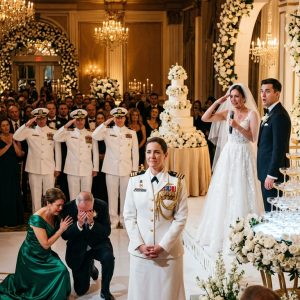
Title: The Phantom of Fort Benning: A Silent Reckoning
Chapter 1: The Shearing of the Wolf
They cut my hair like I was nothing. Like I was just another fragile thing that had wandered into a world built for iron and blood, a world they believed I didn’t deserve to inhabit.
I stood at parade rest, my boots locked into the red Georgia clay that looked disturbingly like dried blood under the relentless morning sun. The heat rose in shimmering waves off the asphalt of the training ground, distorting the tree line in the distance until it looked like a watercolor painting left out in the rain. My name is Staff Sergeant Lenox Thorne. I am twenty-eight years old, leaned down to wire and muscle from six years of continuous deployment cycles that most people only see in movies.
But the three corporals circling me didn’t see the deployments. They didn’t see the scar tissue knitting the knuckles of my right hand together—a souvenir from a close-quarters fight in a mud hut in Helmand. They didn’t know that the call sign Phantom wasn’t a nickname given by friends over beers; it was whispered by enemy combatants who had watched their positions go silent without ever seeing the shooter.
They saw a woman. They saw soft features. They saw weakness.
Corporal Vance stepped behind me. I felt his rough hand grab the thick braid I had worn since jump school. It was heavy, dark hair that had survived Ranger School, SERE training, and nights in the Hindu Kush where the cold bit deeper than any blade.
“You won’t need this where you’re going, sweetheart,” Vance sneered, his voice dripping with the kind of arrogance that only exists in men who haven’t yet been truly tested.
I didn’t flinch. I didn’t blink. I stared straight ahead at the rusted water tower on the horizon, focusing on a single bolt head, breathing in a slow, four-count rhythm. In for four. Hold for four. Out for four.
Snip.
The sound was small, almost insignificant against the hum of the cicadas. But the feeling was visceral. A weight dropped from my head. A chunk of my history fell into the dust between my boots.
The other two, Corporal Matsuda and Corporal Penn, laughed—a low, cruel sound. They thought this was tradition. They thought they were initiating a transfer into the “real” Army culture. They had no idea they were shearing a wolf.
Behind them, First Sergeant Devon Mlin watched with his arms crossed over his chest. He was a dinosaur, a relic of an infantry that believed standards were eroding because people like me were allowed to wear the uniform. He hadn’t ordered this hazing explicitly, but his silence was a deafening endorsement. He wanted to see if I would break. He wanted tears. He wanted a complaint he could use to transfer me to a desk.
He would get neither.
I kept my hands clasped behind my back, my right thumb unconsciously tracing the raised ridge of a scar on my left wrist. It ran in a perfect, jagged line—a memory from a field tourniquet I had applied to myself and kept on for thirty-eight minutes while coordinating a casualty evacuation with a compound fracture in my forearm.
Vance stepped back, holding up the severed braid like a trophy. “Much better. Now you might actually fit in a helmet.”
I turned my head slowly. My eyes met Mlin’s. I didn’t speak. I didn’t have to. The look I gave him was flat, dead, and utterly devoid of fear. It was the look of someone who had negotiated with warlords and buried friends in rocky soil.
Mlin’s expression faltered for a fraction of a second. He had expected anger. He had expected sadness. He hadn’t expected the cold, calculating assessment of a predator deciding if the prey was worth the energy.
“Fall in,” Mlin barked, his voice tight. “PT starts in five.”
I walked toward the formation. My head felt light, strangely exposed. But as I moved, the morning sun caught the skin behind my left ear, illuminating a small, faded tattoo that had been hidden by my hair for three years.
It was a mark that didn’t exist in official Army regulations. A mark given by a retired operator in a dusty shop near Fayetteville, free of charge, after I answered a single question honestly.
Mlin didn’t see it. Vance didn’t see it. But they would learn. Oh, they would learn.
Because today wasn’t just another training day. Today was a lesson. And I was about to take them to school.
Chapter 2: The Weight of Silence
The rumors started before lunch. The new female Staff Sergeant was getting smoked. The betting pool in Third Platoon had me quitting before mile eight of the afternoon ruck march.
I sat alone in the latrine, staring at my reflection in the scratched mirror. The haircut was brutal—uneven patches where the scissors had bitten too close to the scalp. I looked like a recruit again. Raw. Unfinished.
I ran my hands under the cold water and pressed them to my cheeks. The shock of the cold brought me back to a different time.
I was twenty-three. A newly promoted sergeant in Afghanistan. We were attached to a Special Forces team conducting village stability operations. It was supposed to be routine. Talk to the women. Map the supply roads. Leave.
But war doesn’t do routine.
We walked into an ambush on the edge of a poppy field. The air turned into a storm of snapping lead and shouting. Captain Matthew Brooks, the team leader, took shrapnel to the neck in the first thirty seconds. I dragged him behind a mud wall, my hands slick with his blood, trying to pack a wound that wouldn’t close.
“Get them home, Lenox,” he had rasped, his eyes locking onto mine as the light faded from them. “Promise me.”
I picked up his rifle—an M4A1 with an ACOG optic—and I became something else. I became the Phantom. I engaged seven targets at ranges up to four hundred meters. I didn’t feel the fracture in my arm until hours later. I didn’t feel the fear until I was back at the firebase, washing Brooks’s blood out from under my fingernails.
That day earned me a Bronze Star with Valor. It also earned me an invitation from a Colonel in a suit who offered me a job that didn’t exist on paper.
And now? Now I was being mocked by boys who thought a 12-mile ruck march was the height of suffering.
I pulled my assault pack from my locker. Standard combat load was thirty-five pounds. I loaded forty-five. I added extra water, a trauma kit, a spare radio battery.
If Mlin wanted to test me, I would give him a test he couldn’t pass.
At 1300 hours, the heat was a physical weight. The humidity wrapped around us like a wet wool blanket. Alpha Company, ninety-three soldiers strong, formed up on the parade ground.
First Sergeant Mlin walked the lines, inspecting gear. He stopped in front of me. He yanked on my pack straps, checked my boots, looked for a loose lace, a dull patch on my weapon. He found nothing.
“Staff Sergeant Thorne will set the pace,” Mlin announced, his voice booming. “Twelve miles. Combat load. No falling out. If you can’t keep up with her, we run it again tomorrow.”
A ripple of laughter went through the ranks. They thought he was setting me up to fail. They thought I would crumble after the first mile, and they would get an easy stroll back to the barracks.
I stepped off at exactly 120 steps per minute.
The first three miles were easy. I let my mind drift, finding the rhythm. Left, right, left, right. The sound of ninety pairs of boots hitting the gravel was hypnotic.
By mile four, the laughter had stopped. The formation was stretching. Corporal Vance, running in the second rank, called out, “Hey, slow it down! We’re losing people!”
I didn’t turn around. I didn’t slow down.
By mile five, we hit the pine forest. The air was stagnant here, trapped under the canopy. The heat index was pushing 105 degrees. I heard the first soldier fall out—a heavy thud followed by the call for a medic.
First Sergeant Mlin ran up beside me. He was sweating heavily, his face flushed. “Thorne, ease up. You’re burning them out.”
I turned my head slightly, keeping my pace steady. “You said combat load, First Sergeant. You said no falling out. I’m setting the standard.”
He glared at me, but he didn’t order me to stop. He couldn’t. Not without admitting that his “test” had backfired.
Mile eight was the creek crossing. The water was high, murky with runoff. I hit it without breaking stride, the water soaking my boots, adding weight. Behind me, I heard splashing, cursing. Someone went down hard.
I kept moving.
Mile ten. The company was broken. We had lost eighteen soldiers to the “sag wagon”—the Humvee trailing us. The ones left were hurting. Their breathing was ragged, wet gasps for air.
I wasn’t tired. I was angry. And anger is a fuel that burns cleaner than anything else.
By mile eleven, we hit the final hill. It was a long, gradual slope that turned legs into concrete. I leaned into it. I thought about my father, Marcus Thorne, a Vietnam-era Ranger who taught me to shoot before I could read. He taught me that the only way out is through.
When we finally marched back onto the parade ground, sixty-two soldiers remained. They were shattered. They dropped their packs and collapsed onto the grass, gasping, groaning.
I stopped. I unclipped my pack and set it down gently. I didn’t sit. I stood at parade rest, staring at Mlin.
He looked at me. He was heaving, his uniform soaked dark with sweat. For the first time, I saw something in his eyes that wasn’t contempt. It was fear. He had just watched a woman—the woman he had allowed his men to humiliate—break his entire company without saying a word.
And then, the black SUV arrived.
Chapter 3: The General’s Dragon
It moved with a purpose that civilian vehicles don’t possess. Black, tinted windows, government plates. It tore down the main road, kicking up a cloud of red dust, and screeched to a halt ten meters from where Mlin stood.
The rear door opened.
Major General Raymond Kessler stepped out.
Every soldier who was still conscious snapped to attention. Kessler was a legend. Commander of the Maneuver Center of Excellence. A man who didn’t visit company training grounds unless something had gone very wrong, or very right.
He walked straight to Mlin.
“Where is she?” Kessler demanded. His voice was low, dangerous.
Mlin pointed a shaking hand at me.
Kessler turned. He looked at my hair—the jagged, uneven mess. He looked at my uniform, stained with salt and sweat. He looked at my face.
“Show them,” Kessler said.
I didn’t ask what he meant. I knew.
I turned my back to the formation. I reached up and unbuttoned my collar. I pulled the fabric down, exposing the skin behind my left ear and the top of my shoulder blade.
A collective gasp went through the ranks.
There, inked in black that had faded slightly but remained perfectly sharp, was a symbol. A coiled dragon, balancing on one claw, holding a lightning bolt.
It wasn’t a unit patch. It wasn’t something you found in a brochure. It was the unofficial insignia of a Joint Special Operations Task Force that operated in denied areas. It was a mark that said, I have been where you cannot go. I have done what you cannot do.
Vance turned white. Matsuda stepped back as if I had pulled a weapon.
“Staff Sergeant Lenox Thorne,” General Kessler announced, his voice projecting across the silent field. “Spent the last three years attached to a Task Force conducting operations that are classified at the highest levels. She is a recipient of the Bronze Star with Valor. She is a Purple Heart recipient. Her call sign is Phantom.”
He walked over to me, stopping inches away.
“Who cut her hair?” Kessler asked.
Silence.
“I asked,” Kessler roared, “who cut this soldier’s hair?”
Vance raised a trembling hand.
Kessler looked at him with a disdain that could peel paint. “You think you’re hard, Corporal? You think you’re the standard? This woman has forgotten more about combat than you will ever learn.”
He turned to Mlin.
“First Sergeant. Did you authorize this?”
Mlin swallowed hard. “No, sir. But I… I allowed it.”
“You allowed it,” Kessler repeated. “You allowed your NCOs to haze a soldier who has operated alone in hostile territory for months at a time? A soldier whose former commander called me personally to tell me she is the most lethal asset he has ever lost?”
Mlin stared at the ground.
“Staff Sergeant Thorne is taking over as the Senior Instructor for your Advanced Tactical Training program,” Kessler announced. “Effective immediately. Anyone who has a problem with that can route their complaint directly to my office. Do I make myself clear?”
“Yes, sir!” Mlin barked.
Kessler looked at me. His eyes softened, just for a second. “Good to see you, Phantom.”
“Good to see you, sir,” I replied.
He got back in his SUV and drove away, leaving behind a company of men who were suddenly realizing that they were standing in the presence of a predator they had mistaken for prey.
Chapter 4: The Quiet Classroom
Three weeks later, the atmosphere in Third Platoon had changed. It wasn’t friendly—not yet. But it was respectful.
I stood at the front of the range, demonstrating a shooting position from behind a barrier. My hair was growing back, a short, neat pixie cut that framed my face.
“Watch the angle,” I told them, my voice carrying easily over the wind. “If you expose your elbow, you expose your life. Tuck it in.”
Specialist Vance sat in the front row. He had been demoted. He had been stripped of his team leader status. But he was there. Every day. Taking notes. Watching.
After the class, First Sergeant Mlin approached me. He had been assigned as my assistant instructor—a punishment from Kessler that was both brutal and brilliant. He had to stand there and watch me teach his men things he didn’t know.
“Sergeant Thorne,” Mlin said. He looked tired. Humbled.
“First Sergeant.”
“That technique for clearing the malfunction,” he said, gesturing to the rifles. “I haven’t seen that before. Where did you learn it?”
I looked at him. I could have been cruel. I could have rubbed his nose in his own ignorance. But that wasn’t the mission. The mission was to get them home.
“A guy in a valley near Kandahar,” I said. “He taught me that if you can’t fix your weapon with one hand, you’re already dead.”
Mlin nodded slowly. “I… I was wrong,” he said. The words tasted like ash in his mouth, I could tell. “About you. About the standards.”
“We all carry assumptions, First Sergeant,” I said. “Until reality forces an adjustment.”
He looked at the tattoo peeking out from behind my ear. “What does it mean? The dragon?”
I touched the ink unconsciously. “It means we walk in the dark so others can stand in the light.”
That evening, I sat in my small apartment off-base. It was quiet. I poured a glass of water and sat by the window, looking at a framed photograph on the sill. It was Captain Brooks, smiling in full kit, dust on his face, alive.
I had kept my promise. I had brought the team home. And now, I was keeping a new one.
I wasn’t here to be liked. I wasn’t here to be accepted. I was here to make sure that the next time these boys walked into a poppy field, or a city street, or a dark valley, they would have the skills to walk back out.
They had tried to cut me down. They had tried to shame me. But they forgot the most important lesson of warfare.
You don’t judge the blade by the scabbard. You judge it by the cut.
Like and share this post if you believe true strength doesn’t need to shout to be heard.