I never expected to cry at my stepson’s wedding. Not like this, anyway. Weddings are supposed to be about tears of joy, about the culmination of a journey, but as I stood there clutching my purse, the tears threatening to spill were born of a sharp, humiliating sting.
“Only real moms get a seat in the front.”
The words hung in the air, fragrant with the scent of white roses and expensive perfume. They were spoken softly, almost gently, which made them cut deeper than if they had been shouted. Melissa, the bride—beautiful, poised, and utterly ruthless—smiled at me with a sweetness that didn’t reach her eyes.
I froze. My hand, which had been reaching out to smooth a wrinkle on the tablecloth of the reception sign-in table, dropped to my side.
“I… I beg your pardon?” I stammered, my voice sounding foreign to my own ears.
Melissa leaned in closer, her voice dropping to a conspiratorial whisper, as if she were doing me a favor. “It’s just tradition, Victoria. My parents are in the front. Nathan’s dad has passed, obviously. So, the front row on the groom’s side is… well, it’s reserved for biological family. It’s for the pictures. You understand, right?”
I looked at her—really looked at her. I saw the perfect makeup, the expertly coiffed hair, the iron-clad determination to have a “Pinterest-perfect” day where everything fit into neat, biological boxes. And then I looked past her, toward the empty chair in the front row where I had assumed I would sit. The chair closest to where Nathan would stand.
The humiliation washed over me like a cold wave. I could feel the eyes of the wedding planner on me. I saw a bridesmaid freeze mid-adjustment of a flower arrangement, pretending not to listen. No one said a word. No one stepped in.
I was being erased. Seventeen years of packed lunches, midnight fevers, parent-teacher conferences, and driving lessons were being swept aside by a single adjective: Real.
I didn’t want to cause a scene. I didn’t want to be the wicked stepmother ruining the bride’s big day. I swallowed the lump in my throat, a bitter mixture of pride and sorrow.
“Of course,” I managed to whisper, forcing my lips into a trembling smile. “I understand.”
I turned away from the front of the venue, away from the altar, and began the long walk to the very back row. Every step felt like a concession. Every step took me further away from the boy I had raised.
As I sat down on the folding chair in the last row, hidden behind a large pillar and the distant cousins, I clutched the small gift box in my lap like an anchor. Inside were silver cufflinks I had spent months picking out.
How did we get here? How did seventeen years of love dissolve so quickly in the face of protocol? My mind began to drift, pulled back by the gravity of memory to the very beginning, to a rainy afternoon that changed my life forever.
I first met Nathan when he was just six years old. It was my third date with Richard, a man whose gentle eyes and quiet demeanor had already begun to dismantle the walls I’d built around my heart. He had told me he was a widower, that he had a son, but hearing about a child and seeing the reality of one are two very different things.
We were at Richard’s small apartment. The rain was hammering against the windowpane, creating a cozy, enclosed world.
“Nathan,” Richard said softly, crouching down. “This is Victoria. The lady I told you about.”
I looked down. Hiding behind Richard’s leg was a creature made of big eyes and skinny limbs. He looked terrified. He looked fragile, like a porcelain doll that had already been dropped once and glued back together. There was a profound sadness in his posture, a wariness that a six-year-old shouldn’t have to possess.
My heart didn’t just melt; it broke for him.
I didn’t loom over him. I knew instinctively that he didn’t need another adult telling him what to do. He needed an ally. I knelt down, ignoring the creak in my knees, until I was eye-level with him.
“Hi, Nathan,” I said, keeping my voice low. “Your dad says you like dinosaurs. I brought you something.”
I reached into my bag and pulled out a gift. It wasn’t a toy. Toys are easy; toys are distractions. I wanted him to know I saw his mind, his curiosity. It was a heavy, illustrated encyclopedia of paleontology.
He hesitated. His small hand reached out, fingers trembling slightly, and he took the bag. He didn’t smile—that would have been too much to ask—but he held the book against his chest like a shield.
“Thank you,” he whispered.
Later that night, after Nathan had gone to bed, Richard walked me to the door. He looked tired but relieved.
“He slept with the book,” Richard told me, a smile tugging at the corners of his mouth. “He put it right under his pillow. He hasn’t done that with anything since… well, for a long time.”
That was the beginning. It wasn’t a fairy tale of instant love. It was a slow, steady construction project. The child needed stability, and I was determined to be the bedrock he could stand on.
I didn’t rush. I didn’t force hugs. I didn’t try to be “Mom.” I just tried to be Victoria—the woman who showed up.
Six months later, when Richard asked me to marry him, the ring was beautiful, but the proposal wasn’t complete until I had one more conversation.
I found Nathan in the kitchen a few days later. We were making chocolate chip cookies—our Saturday tradition. He was sitting on the counter, swinging his legs, licking batter off a wooden spoon.
“Nathan,” I said, wiping flour off my hands. “I need to ask you something important.”
He stopped licking the spoon and looked at me with those serious, dark eyes.
“Would it be okay,” I started, my heart hammering harder than it had when Richard proposed, “if I married your dad? If I lived here with you guys forever?”
He considered this with the gravity of a Supreme Court judge. He looked at his dad in the other room, then back at the cookie dough, and finally at me.
“Will you still make cookies with me?” he asked. “Even if you’re my stepmom?”
I smiled, blinking back tears. “Every Saturday. That’s a promise.”
“Okay then,” he said, going back to his spoon. “You can stay.”
It seemed so simple then. A promise of cookies. A permission granted. But as the years went by, I learned that “staying” was the hardest thing I would ever do.
Richard and I married in a small ceremony. Nathan’s biological mother had been gone for two years by then. There were no phone calls, no birthday cards, no surprise visits. Just a gaping, silent absence that a child couldn’t comprehend. Richard never spoke ill of her, but the damage was visible in the way Nathan would sometimes stare out the window, waiting for a car that never came.
I never tried to fill that void. You can’t replace a ghost. Instead, I carved out my own space. I was the “Bonus Mom,” the “Victoria,” the constant.
I was there for the first day of second grade, clutching his Star Wars lunchbox when he was too scared to walk through the gates. I was there for the fifth-grade Science Olympiad, helping him glue together a bridge of popsicle sticks until two in the morning. When it held fifty pounds—more than any other in the class—I cheered louder than anyone in the gymnasium.
And I was there for the heartbreak. The middle school dance where his crush danced with the captain of the football team. I sat on the floor of his room in my pajamas, listening to him cry, telling him that one day, a girl would be lucky to just stand next to him.
Richard and I never had children of our own. We talked about it, certainly. But time slipped away, and honestly, Nathan filled our home. He was enough. He was everything.
But love doesn’t prevent the storms of adolescence.
When Nathan turned thirteen, the anger he had suppressed about his biological mother began to surface. It came out sideways, directed at the safest target available: me.
It happened on a Tuesday. I had received a call from the school—Nathan had skipped classes to hang out at the arcade. When he came home, I was waiting.
“You’re grounded,” I said firmly. “No video games for two weeks.”
He exploded. His face flushed red, his fists clenched. “You can’t tell me what to do!” he shouted, his voice cracking. “You’re not my real mom! You’re nothing!”
The words hit me like physical blows. The air left the room.
I stood there, trembling, watching this boy I loved more than life itself use the one weapon he knew would destroy me. I wanted to scream. I wanted to list every sacrifice, every tear, every moment I had put him first.
But I didn’t. I took a deep breath.
“No,” I said, my voice shaking but steady. “I’m not. But I am really here. And I am not going anywhere.”
He stared at me, chest heaving, and then turned and slammed his bedroom door so hard the pictures on the wall rattled.
I cried myself to sleep that night. I wondered if I was fooling myself. Maybe biology was everything. Maybe I was just a placeholder.
The next morning, however, I woke up to find a piece of notebook paper slipped under my bedroom door. On it, in scrawled, messy handwriting, was a drawing of a dinosaur. And next to it, a single word: Sorry.
We never spoke of it again. But the dynamic shifted. We both acknowledged the elephant in the room—we weren’t bound by blood. We were bound by something harder. We were bound by choice.
And then, five years ago, the world ended.
Richard passed away from a massive stroke. He was fifty-three. One minute he was laughing at a joke on TV, and the next, he was gone.
Our house, once filled with laughter and the smell of cookies, became a tomb. Nathan was eighteen, just weeks away from starting college.
I remember sitting in the living room after the funeral, the silence deafening. Nathan walked in, looking like that six-year-old boy again. Small. Terrified.
“What happens now?” he asked.
He wasn’t asking about the mortgage or the funeral arrangements. He was asking: Are we still a family without the man who connected us?
I stood up and crossed the room, taking his large hands in mine.
“Now,” I said fiercely, “we figure it out together. Nothing changes between us, Nathan. You are my son. I am your mother. Period.”
And I kept that promise. I paid his college application fees. I proofread his essays. I sat in the stands at his college graduation, screaming his name as he walked across the stage.
That day, he handed me a small velvet box. Inside was a silver necklace with a pendant that read: Strength.
“You never tried to replace anyone,” he told me, his eyes shining with the same warmth his father used to have. “You just showed up and loved me anyway.”
I wore that necklace every single day. I was wearing it now, sitting in the back row of his wedding, feeling the cool metal against my skin, wondering if he knew I was even here.
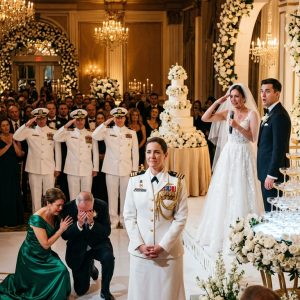
The music started—Pachelbel’s Canon. It was beautiful, haunting. The guests in the rows ahead of me rose to their feet, craning their necks.
From my vantage point in the back, obscured by the crowd, I saw the groomsmen take their places. And then, Nathan.
My breath hitched. He looked so handsome in his tuxedo. He looked so much like Richard that for a second, I thought I was seeing a ghost. He had his father’s broad shoulders, his easy stride.
He walked to the altar with confidence. He looked ready. He looked happy.
It’s okay, I told myself, wiping a rogue tear from my cheek. This is his moment. As long as he is happy, it doesn’t matter where I sit. It doesn’t matter if I’m invisible.
He reached the front. He stood next to the officiant. The music swelled, signaling the imminent arrival of the bride.
And then, inexplicably, Nathan stopped moving.
He didn’t turn to face the aisle where Melissa would appear. He didn’t look at the groomsmen. He just… froze.
The officiant leaned in, whispering something, making a subtle gesture with his hand. Turn around. Get ready.
But Nathan didn’t turn toward the bride’s entrance.
Instead, he turned slowly, deliberately, toward the audience.
His eyes were scanning the crowd. He looked at the front row—the empty seat next to his best man. He looked at Melissa’s parents, who smiled encouragingly. He scanned the second row. The third.
His brow furrowed. He looked confused, then concerned, and finally, determined.
The music continued to play, but the atmosphere in the vineyard shifted. People began to murmur. Heads turned. Why wasn’t the groom looking at the bride’s entrance? What was he looking for?
He was looking for me.
My heart hammered against my ribs like a trapped bird. Don’t do it, I thought. Don’t make a scene, Nathan.
“Before I get married,” Nathan announced, his voice projecting clearly over the confused whispers of the crowd, “I need to do something. Because I wouldn’t be here today if someone hadn’t stepped in when no one else would.”
The murmurs turned into gasps. Melissa’s mother looked like she was about to faint.
Nathan stepped off the altar.
He began to walk. Not toward the exit, but down the center aisle. He walked past the front row. Past the confused cousins. Past the college friends.
He walked with purpose, his eyes locked on the shadowy back corner where I sat.
I tried to shrink into my chair. I felt exposed, raw. But he didn’t stop. He walked all the way to the back, until he was standing right in front of me.
The entire wedding—two hundred people—turned in their seats to watch.
Nathan stood before me, his eyes glistening with unshed tears. He looked at the necklace around my neck—the Strength pendant. Then he looked at my face, seeing the damage the last hour had done to my spirit.
He held out his hand.
“You’re not watching this from the back,” he said, his voice thick with emotion but loud enough for everyone to hear. “You’re the one who raised me. You’re the one who stayed.”
He swallowed hard, and then he said the six words that changed everything. The words I had waited seventeen years to hear.
“Walk me down the aisle, Mom.”
Mom.
Not Victoria. Not Stepmom. Mom.
The world stopped spinning. The background noise fell away. There was only him, his outstretched hand, and the overwhelming, crushing weight of love.
“Nathan,” I whispered, my legs trembling as I stood up. “Are you sure? Melissa… the plan…”
His grip on my hand tightened, pulling me out of the shadows. “I’ve never been more sure of anything in my life.”
Gasps echoed through the venue as I took his arm. Someone’s camera flashed, blindingly bright. I felt lightheaded.
We turned together to face the altar.
The walk back up the aisle was a blur of faces. I saw Melissa’s family, their expressions a mixture of shock and reluctant respect. I saw the wedding planner, mouth agape. But mostly, I felt Nathan. I felt the strength of the man I had helped build.
Every step felt like a victory lap. A victory for every cookie baked, every tear dried, every “you’re not my real mom” forgiven.
When we reached the front, Nathan didn’t just leave me there. He stopped at the very front row—the row reserved for “real” family.
He walked over to the empty chair—the one Melissa had forbidden me from taking—and pulled it out.
“You sit here,” he said firmly, his voice echoing slightly in the stunned silence. “Where you belong.”
I looked over at the entrance where Melissa was waiting. She had seen the whole thing. Her face was pale, her perfect smile faltering. But as she looked at Nathan—at the fierce love and loyalty in his eyes—she seemed to realize something. She realized that to love Nathan was to accept the woman who made him who he was.
She gave a small, almost imperceptible nod. It wasn’t an apology, not yet, but it was a surrender.
I sat down in the front row. I smoothed my dress. I took a deep breath of the rose-scented air.
The officiant, clearly scrambling to regain control of the ceremony, cleared his throat. “Now that everyone who matters is here… shall we begin?”
The ceremony proceeded. It was beautiful. I watched through happy tears as Nathan and Melissa exchanged vows. I prayed they would build a life as meaningful as the one Richard and I had shared. I prayed that Melissa would learn that family isn’t about whose DNA you share, but about who holds your hand when the world falls apart.
The reception was a blur of lights and music, but the tension had broken. The act of defiance at the altar had changed the energy in the room. People looked at me differently. Strangers came up to shake my hand.
When it was time for speeches, Nathan stood up. He clinked his glass, and the room fell silent.
He looked at Melissa, smiling lovingly, but then he turned his gaze to me.
“I have a lot of people to thank,” he began. “But there is one person who stands above the rest.”
He raised his glass high.
“To the woman who never gave birth to me… but gave me life anyway.”
The room erupted. It wasn’t polite applause; it was a roar. The entire room rose to their feet. I saw Melissa’s father standing up, clapping vigorously. Even Melissa stood, tears in her eyes, catching my gaze and offering a genuine nod of respect.
I wept. I wept for Richard, wishing he could see this. I wept for the scared little boy hiding behind a leg. And I wept for the joy of being seen.
Later that night, the DJ slowed the music down. It was time for the parent dances.
Nathan walked over to my table. He bowed slightly, a playful grin on his face—the same grin he used to have when we baked cookies.
“May I have this dance?”
I took his hand, and he led me onto the dance floor. It was the song Richard and I used to dance to.
As we swayed to the music, I closed my eyes. I could feel Richard’s presence so strongly it was as if his hand were resting on my shoulder, guiding us both.
“Dad would be so proud of you,” I whispered into Nathan’s lapel.
“He’d be proud of us both,” Nathan replied, pulling back to look me in the eyes. “And I want you to know something, Mom.”
“What is it?”
“I’ve had a lot of people walk in and out of my life,” he said, his voice steady and sure. “People who were supposed to stay, but left. But you… you’re the one who stayed. Blood doesn’t make a mother, Victoria. Love does. And you are the best mother I could have ever asked for.”
I held him tight, the “Strength” necklace pressing between us.
Sometimes, the people who try to diminish your place in someone’s life don’t understand the depth of the connection you’ve built. They don’t see the quiet moments. The ordinary days that, strung together, create an unbreakable bond.
And sometimes, the people you’ve loved quietly and fiercely, year after year, surprise you. They see you. They remember.
And when the moment finally comes, when it matters most, they turn around.
If you want more stories like this, or if you’d like to share your thoughts about what you would have done in my situation, I’d love to hear from you. Your perspective helps these stories reach more people, so don’t be shy about commenting or sharing.