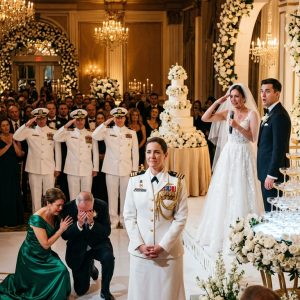
The disintegration of the Brennan family dynasty didn’t begin with a scream, a lawsuit, or a drunken brawl. It began with a shutter click. It began the moment my brother, Roland, looked at my twelve-year-old daughter, Meadow, and decided that her wheelchair was a blemish on his carefully curated reality.
I used to believe that silence was a form of currency. I thought if I hoarded enough of it, if I swallowed enough insults and smiled through enough indignities, I could buy my daughter a seat at the table. I was wrong. Ten days ago, sixty-seven professional photographs were uploaded to the cloud—sixty-seven images of “family perfection” that erased my disabled child completely.
My name is Gwendolyn Brennan, though the world now knows me simply as the mother who struck the match. I am thirty-eight years old, a dental hygienist who spends her days scraping tartar from the teeth of suburban Ohio, and for most of my life, I have been the family’s designated shock absorber. When my mother’s narcissism flared, I absorbed the heat. When my siblings bickered over their inheritances before our father was even cold in the ground, I smoothed the waters.
But the reunion at the lake house changed the chemical composition of my blood. It taught me that keeping the peace often means allowing a war to be waged against the innocent.
Meadow is the sun around which my quiet life orbits. She was born with spina bifida, and since the age of three, she has navigated the world on wheels. But to Meadow, she doesn’t use a wheelchair. She pilots a purple chariot she christened “Violet.”
Violet is not just medical equipment; she is an extension of Meadow’s vibrant soul. The spokes are laced with iridescent beads that click softly like rain when she moves. The backrest is a collage of stickers from every aquarium and art museum we’ve visited, a chaotic map of her joy. And Meadow herself? She is an artist in the truest sense. Her art teacher, Mrs. Pensky, once told me that Meadow sees the world in colors most people ignore. Our refrigerator is a testament to this—watercolors of the neighbor’s overgrown garden, charcoal sketches of our cat, Whiskers, and intricate doodles of a world where everyone fits.
My family, however, sees the world in beige.
My mother, Francine Brennan, calls herself “professionally successful,” a phrase she wields like a weapon. She is sixty-five, a retired elementary school principal who irons her jeans and views a smudge of lipstick on a glass as a moral failing. Then there is Roland, forty-two, a regional sales manager at Hutchinson Industries. He is a man who smells of expensive cologne and desperation, constantly clawing his way toward an executive suite that remains just out of reach. And finally, Tamara, thirty-five, a real estate agent who deals in “aspirational properties”—homes that function more as stage sets than shelters.
We gather every five years at the family lake house in Michigan, a sprawling estate my mother inherited. It is a place of wrap-around porches and lawns so manicured they look artificial, as if nature itself is afraid to grow out of turn in Francine’s presence.
This year was different. The stakes were higher. Roland had invited his CEO, Mr. Hutchinson, and his family to stay in the guest cottage. It was a naked power play to secure a promotion. Tamara was documenting the weekend for her twelve thousand Instagram followers, treating our bloodline as content. And Francine had hired a photographer named Harrison, a man who typically shot high-society weddings in Detroit, to capture the “Brennan Legacy.”
I should have seen the warning signs. They were flashing like neon lights in the dark.
Weeks before the trip, Tamara texted me: Maybe keep the decorations on Meadow’s chair simple this year? Roland’s boss is coming. We want a clean look.
Then came Francine’s call, her voice dripping with that faux-concern she had perfected over decades. “Gwen, darling, does Meadow really need to bring the chair everywhere? It scratches the hardwood floors.”
I swallowed my rage. I told myself it was just their anxiety talking. I told Meadow that everyone was excited to see her.
We packed the night before, Meadow vibrating with anticipation. She had marked the days off on her calendar with purple hearts. She had chosen a dress specifically for the portrait—a deep violet silk with silver threading that shimmered when she moved. She spent hours hot-gluing tiny crystals to Violet’s wheel covers to match.
“Mom,” she asked, her green eyes wide with hope, “do you think Grandma Francine will let me be in the front row this year? Since I’m sitting down, I won’t block anyone.”
“Of course, baby,” I lied. “You’ll look beautiful.”
The drive to Michigan was six hours of Meadow sketching in a new book titled Brennan Family Memories 2024. She drew pictures of what she imagined: cousins playing tag, baking cookies with Grandma, laughter around the fire pit.
When we pulled up the long gravel driveway, our Honda Civic looked like a intruder amidst the lineup of BMWs and Mercedes. Francine met us at the door, wearing a cream pantsuit that cost more than my car. Her smile was tight, a fissure in a porcelain mask.
It faltered the moment she saw Violet. The purple wheels caught the afternoon sun, the LED lights Meadow had programmed pulsing gently.
“Oh, Gwendolyn,” my mother sighed.
In that sigh, I heard the entire history of my life. The disappointment. The embarrassment. The wish that we could just be… normal.
Roland emerged from the living room, a scotch in hand. “You made it,” he said, his eyes sliding over Meadow like she was a piece of misdelivered furniture. “And the little artist is here. Why don’t you go find the other kids by the water?”
We settled in, but the air in the house was thin, hard to breathe. The weekend was a performance, and Meadow and I were forgetting our lines. But I told myself to hold on. Just get through the photos. Just keep the peace.
I didn’t know that by Sunday, there would be no peace left to keep.
Saturday afternoon arrived with a sky so blue it looked painted. Harrison, the photographer, was a thin man dressed entirely in black, directing his assistants as they set up reflectors and tripods on the south lawn. It looked less like a family gathering and more like a military operation.
The dress code, dictated by Tamara via a three-page PDF, was “Navy, Cream, and Subtle Gold.” Meadow looked radiant in her dress, a bloom of purple in a sea of corporate neutrals.
As the family—forty-three of us in total—began to assemble, Roland grabbed my elbow. His grip was tight, his knuckles white. He steered me toward the garden shed, behind a trellis of climbing roses, away from the others.
The smell of his cologne was suffocating.
“Gwen, we need to handle the elephant in the room,” he said, keeping his voice low but urgent. He gestured vaguely toward the dock where Meadow was showing her sketches to her cousins, Atlas and Phoenix.
“You mean my daughter?” I asked, my voice trembling slightly.
“The wheelchair, Gwen. Look at it. It’s… loud. It’s going to be the only thing people see. Mr. Hutchinson is watching. These photos are going on the company website for their ‘Family Values’ initiative. We need them to look polished. Seamless. Aspirational.”
I felt the word hit me like a physical slap. Aspirational.
“What exactly about my daughter isn’t aspirational, Roland?” I hissed, the heat rising in my chest. “She’s a survivor. She’s brilliant.”
Before he could answer, Tamara joined us, her heels sinking into the soft earth. She adjusted her designer sunglasses, refusing to make eye contact.
“Roland has a point, Gwen,” she said, her voice breezy and dismissive. “Maybe Meadow could sit on a regular bench? Or we could position her… you know… to the side? So she’s included, but not the focal point.”
“The focal point?” I choked out. “She is twelve years old!”
“Let’s start with the grandchildren!” Harrison shouted from the lawn. “All grandkids, front and center!”
Meadow’s face lit up. She spun Violet around, the purple spokes blurring, and rolled eagerly toward the group. She positioned herself right in the middle, between her cousins, her smile wide and genuine. For a second, it was perfect.
Then Francine walked onto the grass.
My mother moved with the authority of a woman who had silenced cafeterias with a single look. She wore her pearls like armor. She stopped in front of the group, blocking the camera’s view of Meadow.
“Meadow, sweetheart,” she said, her voice projecting loud enough for Mr. Hutchinson to hear from the porch. “Why don’t you be our special helper today?”
Meadow’s smile froze. “What?”
“We need someone to watch the purses,” Francine said, smiling benevolently. “And Harrison needs someone to hold his light meter bag. You can make sure everyone looks good from the sidelines.”
“But Grandma,” Meadow said, her voice small. “I want to be in the picture. I made my chair match my dress.”
Roland stepped in, smooth as oil. “It’s a technical thing, honey. The metal on the chair reflects the sun. It ruins the exposure. You understand, right? You’re an artist. You get lighting.”
I watched my daughter’s face crumble. It was a slow demolition, the light leaving her eyes, her shoulders slumping. She looked at me, tears welling in those green eyes.
“Mom?” she whispered. “Is that true? Does Violet ruin the picture?”
Time stopped.
Forty-one family members stood watching. Mr. Hutchinson and his wife were sipping lemonade on the porch. Roland was glaring at me, a silent threat in his eyes—a reminder that he had secured my job reference, that he held influence over my life. Tamara looked annoyed. Francine looked expectant.
Every cell in my body screamed to burn it down. To scream. To take my daughter and leave.
But I was the peacekeeper. I was the one who smoothed things over.
“Just for a few shots, baby,” I heard myself say. The words tasted like ash. “Why don’t you sit over by that bench? You can see everything from there.”
Meadow didn’t argue. She didn’t throw a tantrum. She just nodded, turned Violet around, and wheeled herself thirty feet away, to the edge of the frame.
For the next four hours, sixty-seven photos were taken. The grandchildren. The siblings. The three generations of women. The grand finale.
And in every single one of them, my daughter sat alone, holding a pile of Gucci purses, watching her family smile without her.
That night, the guilt was a living thing in the room with me. We were staying in the smallest bedroom, the attic space I had occupied as a child. Meadow was asleep, the moonlight washing over her tear-streaked face.
She hadn’t eaten dinner. She hadn’t drawn. She had just gone to bed.
Unable to sleep, I wandered out to the porch at 2:00 AM. The house was silent, save for the hum of the refrigerator. I saw Meadow’s sketchbook sitting on a wicker chair, forgotten.
I opened it, expecting to see the lake.
Instead, I found a drawing that stopped my heart.
She had drawn the photo session. She had drawn Uncle Porter’s crooked smile, Cousin Beth’s braids, Atlas’s posture. The detail was incredible. But in every drawing, she had drawn a thick, black line separating the group from a small figure in a wheelchair in the corner.
Under her self-portrait, she had written in careful cursive: The Special Helper.
On the next page was a drawing of the main group photo. She had drawn herself behind the black line again, but this time she wasn’t alone. She had drawn other children—kids with crutches, kids with hearing aids, kids with visible differences.
Under this army of the excluded, she had written: The People Who Ruin Pictures.
I closed the book. My hands were shaking so hard I almost dropped it.
I pulled out my phone. Roland had just posted the gallery to the family WhatsApp group.
Roland: “Nailed it. Great work everyone. Harrison really captured the vibe. Timeless.”
Tamara had already reshared them to Instagram. #Blessed #Legacy #BrennanStrong.
I looked at the photos. Sixty-seven of them. Beautiful lighting. Perfect teeth. Coordinated colors.
And a hole where my daughter should be.
I opened Facebook. I hadn’t posted in six months. The cursor blinked at me, a rhythmic taunt.
What would people think?
What would this do to my mother?
What would happen to Roland’s career?
Then I looked at the sketchbook again. The People Who Ruin Pictures.
My daughter didn’t ruin pictures. My family did.
I started typing.
I didn’t write with sadness. I wrote with the cold, clinical precision of a surgeon cutting out a tumor.
These are the 67 “perfect” family photos taken at our reunion this weekend, I typed. Notice anyone missing? That’s because my brother, Roland Brennan, said my daughter’s wheelchair was “ruining the aesthetic.” My mother, Francine Brennan, made her sit thirty feet away holding purses for four hours. My 12-year-old daughter with Spina Bifida wasn’t in a single photo because her medical equipment didn’t fit the “aspirational” vision. Instead, she spent the afternoon drawing pictures of the family she apparently isn’t photogenic enough to belong to.
I attached the photos. All sixty-seven of them. Then, I took a picture of Meadow’s drawing—the one with the black line—and added it as the sixty-eighth image.
I started tagging. Roland Brennan. Tamara Brennan Williams. Francine Brennan. Every aunt, uncle, and cousin who had stood there and smiled while my child withered.
My finger hovered over the “Post” button.
This wasn’t keeping the peace. This was a declaration of war. This was burning the bridge while I was still standing on it.
I pressed it.
The timestamp read 2:47 AM.
I turned off my phone, crawled into the twin bed beside Meadow, and wrapped my arms around her. For the first time in years, I slept soundly.
I woke up to a dead battery. When I finally plugged my phone into the charger in the kitchen, it didn’t just turn on; it exploded.
The phone vibrated so violently it nearly buzzed off the counter. Notifications were cascading down the screen in a blur of text.
847 Shares.
2,341 Comments.
143 Missed Calls.
My breath hitched. I had expected a local stir. I had expected angry texts from my mother. I hadn’t expected… this.
Someone had taken screenshots and posted them to Twitter. The hashtag #AbleismInFamilies was trending. Bethany Newcomb, a disability rights advocate with nearly three million followers, had quote-tweeted it.
Her caption read: This is violence. This is why we need to talk about the cruelty of “aesthetics.” Note: The brother works for Hutchinson Industries. The mother is a retired principal. Accountability matters. These are the people shaping your children’s futures.
At 9:00 AM, the landline in the kitchen rang. It was Roland.
I picked up. I didn’t say hello.
“Take it down,” he screamed. There was no greeting, just raw panic. “Take it down right now, Gwen! Mr. Hutchinson is calling an emergency board meeting. Do you have any idea what you’ve done? My career is hanging by a thread!”
“No,” I said calmly.
“Gwen, please! I’ll pay you. I’ll buy Meadow a new chair. Just delete it!”
“The only thing that needs deleting is your attitude, Roland.”
I hung up.
Ten minutes later, Tamara called. She sounded hysterical.
“My Yelp page,” she sobbed. “Gwen, they’re destroying my Yelp page. Three hundred one-star reviews in an hour. People are calling me a bigot. Jerome’s gym members are canceling. You have to fix this!”
“I can’t fix who you are, Tamara,” I said, and ended the call.
Then came Francine.
For the first time in my thirty-eight years, I heard my mother cry. It wasn’t a manipulative cry; it was the sound of an empire crumbling.
“The school board is reviewing my pension,” she gasped, her voice ragged. “Thirty years, Gwendolyn. Thirty years of service. They’re asking if I discriminated against disabled students. The Children’s Hospital board wants my resignation by noon. The news vans are outside the lake house gate. How could you?”
“Did you?” I asked quietly.
“Did I what?”
“Did you discriminate against students, Mother? Or did you just save that special cruelty for your own granddaughter?”
She hung up on me.
By noon, we were trapped. The local news had a drone flying over the lake house. Roland was pacing the living room, gray-faced. Tamara was locked in the bathroom.
But the most important call didn’t come to them. It came to me.
My cell phone rang. Unknown Number.
“Hello?”
“Mrs. Brennan? This is Arthur Hutchinson.”
My stomach dropped. Roland’s boss.
“Mr. Hutchinson,” I stammered. “I’m so sorry about the…”
“Don’t you dare apologize,” his voice was deep, older, and trembling with suppressed emotion. “I am calling to tell you that I am appalled. Beyond words.”
I waited for him to fire Roland, to yell at me.
“I have a nephew with cerebral palsy,” he continued softly. “He is the light of my life. If I had known what was happening on that lawn… if I had known why Meadow was sitting over there…”
“Roland said…”
“Roland told me you requested it,” Mr. Hutchinson said, his voice hardening. “He told me you were sensitive about her appearance. That you didn’t want her photographed. He lied to me, Mrs. Brennan. He used my presence as a weapon against his own niece.”
Tears pricked my eyes. “He did.”
“I am placing Roland on unpaid administrative leave effective immediately,” he said. “But that’s business. This is personal. Mrs. Brennan, I would like to pay for a professional photo session for Meadow. Just her. Any photographer, anywhere in the world. And if she is willing… I want to feature her art in our next global campaign. Paid, of course.”
I looked over at Meadow. She was sitting on the floor, drawing in her sketchbook. She looked up and smiled—a real smile, unburdened by the need to hide.
“I think she’d like that,” I whispered.
The real surprise came the next week. Maria Santos, an Emmy-winning documentary filmmaker, contacted me. She wanted to include us in a piece called The Special Helper.
When I asked Meadow, she thought for a long moment.
“Only if they film me in Violet,” she said firmly. “And I want to say that wheelchairs don’t ruin photos. People’s attitudes do. And… can I show my happy drawings too? Because being disabled isn’t just about sad things. It’s about purple wheels and glitter.”
“You can show whatever you want, baby,” I told her.
The family reunion was over. But the revolution had just begun.
Six months later, the landscape of my life looks entirely different.
The documentary premiered at Sundance to a standing ovation. Meadow stole the show, rolling onto the stage in Violet, her spokes gleaming under the lights. She told the audience, “Every family has photos on their walls. Make sure everyone is in them.”
The drawing titled The People Who Ruin Pictures was displayed at the Michigan Contemporary Art Museum. An anonymous buyer purchased it for $15,000—money Meadow immediately donated to a Spina Bifida research fund.
The fallout for my family was absolute.
Roland kept his job, barely. Hutchinson Industries stripped him of his management title and mandated two hundred hours of disability sensitivity training. He works in a cubicle now, far away from the executive suite. He sent me one text three months ago: I hope you’re happy.
I replied: I hope you’re learning.
Tamara’s journey was surprising. After her business tanked, she hit rock bottom. Her own seven-year-old daughter, Penelope, refused to speak to her. “If you did that to Meadow,” Penelope had asked, “what would you do to me if I got sick?”
That question broke something in Tamara. She started taking classes on accessible home design. Last week, she sent me a listing for a house with a beautiful, integrated ramp. No apology text, just the photo. It’s a start.
Francine lives a quieter life now. She resigned from her boards in disgrace. We haven’t spoken, but Cousin Beth told me she saw Mom volunteering at a community center for adaptive sports. She’s scrubbing floors, not leading meetings. Perhaps humility is finally finding her.
But the real victory isn’t their punishment. It’s Meadow’s joy.
Her business, Too Bright to Hide, launched last month. She sells custom wheelchair decoration kits—spoke guards, LED strips, waterproof stickers. Mr. Hutchinson was her first investor. We’ve sold three thousand kits already.
Last week, a package arrived from a woman in Texas. Inside was a photograph of a large family reunion. Front and center, beaming at the camera, was a little girl in a bright pink wheelchair covered in Meadow’s stickers.
The note read: Because of Meadow, my family learned to see the whole person, not just the chair. Thank you for putting us in the frame.
I sat on my porch, holding that photo, watching Meadow race Violet down the driveway, her laughter echoing in the evening air.
I used to be a peacekeeper. I used to think my job was to make myself small so others could feel big. But I learned the hard way that peace purchased with silence is just a layaway plan for chaos.
I picked up my phone and opened the gallery. There was a new photo from yesterday. Me and Meadow, messy hair, no makeup, laughing so hard our eyes were squeezed shut. Violet was right there in the foreground, shiny and purple and taking up space.
It wasn’t perfect. It was better. It was real.
Meadow wheeled back up the ramp and stopped beside me. “Mom? Are you crying?”
“Happy tears, baby,” I said, kissing her forehead.
“Good,” she grinned. “Because purple wheelchairs make every photo better. That’s just science.”
I looked at the photo from Texas again. That is the legacy of those sixty-seven exclusionary photos. Not the ruin of the Brennan name, but the illumination of thousands of others. We didn’t just step back into the frame; we built a bigger one.
And this time, no one gets left out.