The Invisible Daughter
Chapter 1: The Empty Aisle
“Marrying a plumber. How embarrassing.”
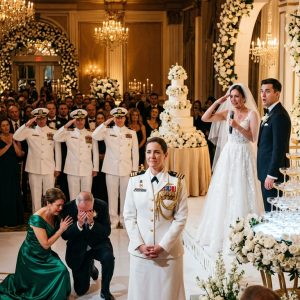
Those were the last words Patrice Vance, my mother, said to me before she turned her flawlessly manicured back. My sister, Kesha, laughed—a sharp, brittle sound like breaking glass—and asked who would be caught dead at a wedding like that. They walked away, their heels clicking against the marble floor of my parents’ foyer, leaving me to walk down the aisle alone.
I stood there in my white dress, trembling, while my phone buzzed against my hip with a notification that would shatter my heart. But they had no idea that within twenty-four hours, my humble husband would be the face on every news channel in America. They had no idea that the man they called a disgrace was about to become the most powerful person they knew. And when the truth came out, I would wake up to one hundred and twenty-nine missed calls.
My name is Nia, and I am twenty-eight years old. I work as a landscape architect in Atlanta, designing spaces where people can find peace, even if I could never find it in my own home. For my entire life, I was the invisible daughter, the one who was never quite ambitious enough, never quite elite enough for my parents, Desmond and Patrice. They belong to the upper echelon of Atlanta society, a world where your last name, your address, and your job title matter more than your character.
Yesterday should have been the happiest day of my life. Instead, it became the day I realized that to my family, my happiness was less important than their reputation.
The air in the garden at Willow Creek was thick with the scent of jasmine and magnolia. I had designed this space myself, transforming a small, neglected plot of land into a sanctuary. It was modest, but it was ours. The string quartet began playing the opening notes of Pachelbel’s Canon in D, a melody I had dreamed of walking to since I was a little girl. My hands were shaking so hard I could barely hold my bouquet of wild orchids.
I stood at the top of the stone path, hidden by a trellis covered in ivy, taking a deep breath to steady my nerves. This was it—the moment every bride waits for. I stepped out from behind the greenery and looked down the aisle.
The sight that greeted me nearly made my knees buckle.
On the right side, the groom’s side, every single chair was filled. There were about twenty people there, mostly friends of Marcus. They were a diverse group—some in simple suits, others who looked surprisingly distinguished for friends of a plumber—but they all wore warm, encouraging smiles.
But then I looked to the left. The bride’s side.
It was a sea of empty white folding chairs. Row after row of vacant seats staring back at me like jagged teeth in a grinning skull. My parents were not there. My sister Kesha was not there. My aunts, my uncles, my cousins—none of them. I had invited forty family members. Not a single one had shown up.
The silence on that side of the aisle was louder than the music. It was a physical blow, a punch to the gut that sucked the air right out of my lungs. I froze, my foot hovering over the first paving stone, unable to take a step.
My phone, which I had tucked into the hidden pocket of my dress for emergencies, buzzed against my hip. I knew I should ignore it. I knew I should just keep walking. But a sick feeling in the pit of my stomach, a cold dread coiling like a snake, told me I needed to see it.
I pulled it out, my fingers trembling so badly I almost dropped the device. It was a text message from my mother, Patrice. I opened it, hoping against hope for an emergency—a flat tire, a sudden illness, anything that would explain this abandonment.
But the message was clear and cruel. It read simply:
“Nia, I am sorry, but I cannot lower myself to be seen sitting in a backyard with a blue-collar crowd. It would be social suicide. Your father and I are at the yacht party with Brad and Kesha. We have an image to maintain. Good luck with your life of mediocrity.”
I stared at the screen, the words blurring as hot tears welled up in my eyes. Mediocrity. That was the word she used to describe the love of my life. Social suicide. That was how she viewed my wedding.
They were on a yacht. Right now, at this very moment, while I stood alone in a garden, they were drinking champagne and laughing on a boat belonging to my sister’s fiancé. They had chosen a party over their daughter’s wedding.
A sob escaped my throat, loud and ugly. The music faltered. The guests on Marcus’s side shifted uncomfortably, exchanging worried glances. I felt naked, exposed. The shame burned my skin like fire. I wanted to turn around and run. I wanted to disappear into the earth. How could they do this to me? How could they be so heartless?
Then I saw him. Marcus.
He was standing at the altar under the oak tree we had picked out together. He was not wearing his usual work boots or his coveralls. He was wearing a charcoal suit that fit him perfectly, though I assumed he had rented it. He looked handsome, strong, and steady. But it was his eyes that saved me.
He was not looking at the empty chairs. He was not looking at the confused guests. He was looking only at me.
He stepped down from the altar, ignoring tradition, ignoring the gasps of the officiant. He walked down the aisle, his strides long and purposeful, until he reached me. He took my phone from my hand, looked at the screen for a second, and then slid it into his own pocket.
He took both my hands in his. His palms were warm and rough—the hands of a man who worked hard.
“They do not deserve you, Nia,” he whispered, his voice fierce and low. “Look at me. They are not here because they are small people chasing small things. But I am here, and I am not going anywhere. Today is about us. Just us. Do not let them steal this moment from you.”
I looked into his dark eyes and saw a depth of love that my parents had never shown me in twenty-eight years. I realized then that family is not whose blood runs in your veins, but who stands by your side when the world falls apart.
I took a shuddering breath and nodded. “I am ready,” I whispered.
Marcus tucked my hand into the crook of his arm. He did not go back to the altar to wait for me. He walked me down the aisle himself, filling the empty space my father should have occupied. As we walked past the empty rows of chairs, I felt a strange sensation. The grief was still there, heavy and sharp. But underneath it, a cold anger began to harden. They thought they could break me. They thought their absence would ruin me.
But they were wrong.
We reached the front, and the ceremony continued. I spoke my vows through tears, but they were tears of defiance now. I promised to love this man, this plumber who treated me like a queen. I promised to build a life with him, a life far away from the toxicity of the people who had birthed me.
But as we stood there, I noticed something strange. The guests on Marcus’s side, the ones I thought were just his drinking buddies or fellow contractors, were whispering. I caught snippets of conversation that didn’t make sense.
“Is that him? It looks just like the magazine cover.”
“No, it cannot be. He is supposed to be in Silicon Valley.”
I did not pay it much mind. I was too focused on the ring Marcus was sliding onto my finger. It was a simple gold band, or so it seemed. I did not know then that it was vintage platinum, and that the diamond he had proposed with was not a cubic zirconia, as my sister had sneered, but a flawless, rare stone he had won at a private auction.
I did not know a lot of things. I did not know that the man holding my hand, the man my parents had dismissed as a dirty laborer, was actually the founder and CEO of Hydroflow Tech, a company that had just patented a revolutionary water filtration system. I did not know that he had just signed an $800 million contract with the federal government.
And I certainly did not know that tomorrow morning, while my parents nursed their hangovers on that yacht, they would turn on the television and see my husband’s face on every major news network.
Chapter 2: The Dinner from Hell
To understand the sheer magnitude of the disrespect that led to this empty garden, you have to go back. You have to go back six months to the night I first introduced Marcus to my family. The night the dinner from hell changed everything.
It was a humid evening in Atlanta when I made the mistake of thinking my family might look past appearances. My parents, Desmond and Patrice, live in a gated community where the lawns are manicured with scissors and the neighbors judge you by the year of your luxury car. I had warned Marcus. I told him to wear his best suit, to pretend to be something he was not just for one night.
But Marcus, being the man he is, refused to be fake. He had spent the entire day at a site inspecting a massive water treatment facility that was failing, and he came straight to my parents’ house to make our dinner reservation. He arrived in his work clothes. He was wearing heavy-duty coveralls with a name tag on the chest and steel-toed boots that still had mud from the construction site on the soles. There was a smudge of grease on his right hand and the faint smell of industrial solvent clinging to him.
To me, he looked like a hard worker. To my parents, he looked like the help.
When we walked through the double mahogany doors, the silence was deafening. My father, Desmond, stood in the foyer wearing a silk smoking jacket, holding a crystal glass of cognac. He looked at Marcus like he was a stain on his expensive Persian rug.
Marcus extended his hand, a warm, friendly gesture, and a smile that could light up a room. “Mr. Vance, it is a pleasure to finally meet you,” Marcus said, his voice deep and respectful.
My father just looked at the hand. He looked at the small spot of grease on Marcus’s thumb, then looked at me with pure, unadulterated disgust. He did not shake his hand. He did not even nod. He turned his back and walked into the dining room, throwing a comment over his shoulder.
“Patrice, remind me to have the maid wipe down the doorknobs and sanitize the entryway tomorrow. It smells like manual labor in here.”
I felt my face burn with shame. I squeezed Marcus’s hand silently, begging him to forgive them, but he just gave me a reassuring wink. We followed my father into the dining room where the rest of the tribunal was waiting.
My sister Kesha was there, glowing in a designer dress that cost more than my car. Next to her was Brad, her fiancé. Brad comes from old money, or at least that is what he tells everyone. He works in finance on Wall Street and has a smile that looks like a shark sensing blood.
The dinner was an exercise in torture. My mother sat at the head of the table asking questions that were actually insults wrapped in polite tones. She asked Marcus if he knew how to read the wine list. She asked if he felt comfortable using the silverware. Every time I tried to steer the conversation to Marcus’s ambition or his work ethic, they cut me off.
Then came the moment that made me want to burn the house down. We were eating filet mignon when Brad decided to make his move. He had been whispering with Kesha, giggling behind their hands like school children. He looked at Marcus’s work boots and cleared his throat loudly.
“So, Marcus,” Brad said, his voice booming across the table. “Nia tells us you deal with pipes for a living.”
Marcus nodded politely, putting down his fork. “Yes, I specialize in fluid dynamics and infrastructure systems.”
Brad laughed, a cruel, barking sound that made my skin crawl. “Fluid dynamics. Wow, fancy words for a plumber. Hey, listen buddy. The guest toilet on the second floor has been acting up all week. It is a bit backed up, if you know what I mean. Since you are already dressed for the sewer, why do not you go up there and take a look? I will even throw in a fifty-dollar tip for your trouble.”
The table erupted. My mother covered her mouth to hide a giggle, but her eyes were dancing with malice. Kesha smirked openly. My father nodded approvingly as if Brad had just made a brilliant point.
I stood up, ready to scream, ready to flip the table. But Marcus placed a calm hand on my arm. He did not get angry. He did not raise his voice. He simply picked up his wine glass, swirled the liquid gently, and looked Brad dead in the eye with an intensity that silenced the room.
“Actually, Brad,” he said, “based on the age of this house and the slope of the terrain, the issue likely isn’t the toilet itself. It is probably a ventilation deficit in the main stack causing a vacuum lock in the drainage system. Throwing fifty dollars at it won’t fix a negative pressure differential. But if you want, I can recommend a contractor who charges two hundred dollars an hour for a basic consultation. He knows how to fix problems that money cannot hide.”
The silence returned instantly, but it was different this time. Brad’s smile vanished. He looked confused, unable to process that the “plumber” had just outsmarted him with physics. For a second, he looked small. But my family did not see the intelligence. They only saw the audacity.
My mother slammed her fork down on the fine china. “How dare you?” she hissed, her face twisting into a mask of fury. “How dare you speak to Brad with such disrespect in my house? You come in here smelling like grease and dirt and think you can lecture a finance executive? This is exactly what I was afraid of, Nia. He is not just blue-collar. He is arrogant and rude. He has no idea of his place.”
My father pointed a shaking finger at the door. “Get out. We do not tolerate insolence from people of your station. Nia, if you leave with him, do not bother coming back until you have found someone worthy of this family.”
Marcus stood up gracefully, pulling out my chair for me. “We are leaving, Mr. Vance. And do not worry. I would not want to stay in a house where the plumbing is broken and the people are even more broken.”
We walked out, leaving them fuming in their mansion. I was shaking with rage and humiliation, but Marcus was calm. He held me as we walked to his truck, and that was when I knew. I knew I would choose him over them every single time.
But I had no idea that the man who just diagnosed their plumbing with a glance was hiding a secret that would soon turn their world upside down.
Chapter 3: The Sabotage and The Secret
The months that followed were a blur of budget spreadsheets and quiet desperation. My father’s ultimatum wasn’t an idle threat. He cut off communication, and with it, any hope of financial help for the wedding.
I sat at our small kitchen table one evening, surrounded by receipts and brochures for budget venues. The cheapest floral package I could find was still more than my rent. I rubbed my temples, feeling the familiar prickle of a stress headache. My parents’ voices echoed in my head, telling me I was settling, telling me I was destined for mediocrity. I refused to let them be right. But looking at the cost of catering for just fifty people, I felt a wave of despair.
Marcus walked in, fresh from the shower, smelling of soap and the faint metallic scent of copper pipes. He saw my face, saw the red ink on the ledger, and immediately pulled up a chair next to me.
“Baby, put the calculator away,” he said softly. “We do not need to stress about this. I have some savings. Let me pay for the wedding. I can cover the venue, the food, the dress, whatever you want.”
I looked at him, my heart swelling with love, but also a fierce protectiveness. I knew how hard he worked. I pictured him crawling into crawl spaces, dealing with sewage backups, working late nights and weekends to build his plumbing business. I thought about the physical toll his job took on his body. There was no way I was going to let him drain his hard-earned savings on a party just because my father was a tyrant.
“No, Marcus,” I said, squeezing his hand back. “I cannot let you do that. We are in this together. I know how hard you work for your money. I am not going to let you burn through your emergency fund for flowers and tablecloths. We will figure this out. We will do something small, something within our means.”
He looked at me with an intensity that made me pause. He opened his mouth as if to say something, to explain something, but then he closed it. I saw a flicker of emotion in his eyes that I could not quite place. It looked like relief mixed with a profound sadness.
“You really mean that? Do not you?” he asked quietly. “You really care about the money that much?”
“I care about you,” I insisted. “I am marrying you, not a bank account.”
He pulled me into a hug, burying his face in my neck. He later told me that it was in that exact moment—when I refused his money to protect his imaginary struggle—that he decided to keep his secret just a little longer. He needed to be sure that I was the one person in the world who loved Marcus the man, not Marcus the millionaire.
So, we went scrappy. We found a hidden gem on the outskirts of the city called Willow Creek Gardens. It was an old nursery converted into an event space. The best part was the price. The owner, an elderly woman named Mrs. Higgins, charmed by our story, offered us a cancellation rate that fit perfectly within our meager budget.
For the first time in months, I felt a spark of genuine excitement. I made the mistake of posting a single photo of the gazebo on my social media, simply captioned, “Found the place.”
I should have known that my sister Kesha watched my feed like a hawk. Even though Kesha had secured the most expensive ballroom in Atlanta for her own upcoming nuptials, she could not stand the idea of me having even a sliver of happiness.
My mother, Patrice, called the venue owner and leveraged the family name. She told Mrs. Higgins that the Vance family did not sanction this union and that if she wanted to keep the contract for the upcoming charity gala hosted by my father’s firm, she would need to clear her calendar of any “unauthorized events” involving her wayward daughter.
I received the call from the venue three days later. The manager sounded pained. “I am so sorry, Nia,” he stammered. “But we have a scheduling conflict. We have to cancel your reservation.”
My heart stopped. “But we signed a contract,” I pleaded. “I paid the deposit.”
“I am sorry, kid,” he whispered. “Mrs. Higgins cannot afford to lose the Vance account.”
I hung up the phone and put my head in my hands. They had taken the one thing I had managed to secure. When Marcus came home that evening, I told him everything through jagged sobs. Instead of screaming, he went very still. His jaw tightened, and his eyes turned a shade of steel gray I had never seen before.
“I need to make a call about a part for a job tomorrow,” he said, his voice terrifyingly calm. He walked out onto the balcony. I watched him through the glass. He stood tall, looking out at the city skyline, holding his phone to his ear with an air of command that seemed at odds with his worn T-shirt.
Twenty minutes later, my phone rang. It was the venue manager again. His voice sounded different this time—shaking and breathless.
“Miss Vance, I am so sorry about the confusion earlier,” he said quickly. “There was a terrible administrative error. Not only is your date still available, but the new silent partner who just acquired a majority stake in the gardens has reviewed the situation. He insists that we honor your contract. In fact, as an apology, he wants to upgrade you to the Grand Pavilion at no extra cost.”
I was stunned. I looked at Marcus, who was chopping vegetables with a small, satisfied smile playing on his lips.
“That was a miracle,” I whispered.
“Good things happen to good people, baby,” Marcus shrugged.
I didn’t know then that the “miracle” was actually a wire transfer from a holding company in the Cayman Islands that Marcus controlled. He had bought the venue—not just to save our date, but to ensure that no one in this town could ever close a door in my face again.
But the war wasn’t over. My father had one final blow to deliver.
The night before the wedding, I drove to my parents’ estate, desperate for peace. I walked into the living room where they were sipping scotch.
“Daddy, please,” I begged. “Just walk me down the aisle. That is all I ask.”
Desmond Vance stood up. He walked over to the mantelpiece where I had placed a cream-colored envelope—my wedding invitation. He picked it up, holding it by the corner as if it were contaminated. He walked over to the trash can in the corner of the room. He did not look at me. He looked at the invitation with a mixture of boredom and disgust.
Then he dropped it.
“You chose your path, Nia,” my father said, his voice void of emotion. “You chose a life of mediocrity and dirt. You chose him over us. As far as I am concerned, I have only one daughter, and her name is Kesha. To me, you are dead.”
I walked out of that house an orphan. I didn’t know that by throwing me away, they had accidentally set me free.
Chapter 4: The Revelation
Back in the garden, as the ceremony ended, Marcus kissed me. It wasn’t just a kiss; it was a seal on a contract written in blood and sweat. He lingered close to my ear, his breath warm against my skin.
“Get ready, Mrs. King,” he murmured. “You think today was hard, but tomorrow is going to be harder in a different way. Tomorrow morning, the entire world is going to know exactly who you are. And those people on that yacht? I promise you, Nia, by noon tomorrow, they will be on their knees begging for your forgiveness.”
I pulled back, confused. “Happiness is the best revenge,” I whispered.
He looked at me with a dangerous light in his eyes. “Happiness is good. But justice is better.”
The next morning, while Marcus and I were waking up in our small apartment, my parents were waking up on the yacht. My cousin Dante, who had been there to drop off paperwork, told me exactly what happened.
They were nursing hangovers on the deck, surrounded by smoked salmon and crystal carafes of orange juice. The large flat-screen TV mounted on the wall was tuned to a national news network.
“We have a massive exclusive for you this morning,” the anchor announced, her voice crisp. “For the past five years, the tech world has been buzzing about a mysterious startup that has quietly revolutionized water purification technology: Hydroflow Tech.”
My father sat up straighter. “I tried to get a meeting with their board last year,” he muttered. “They are a ghost operation.”
“They have just signed a historic contract with the federal government valued at over $800 million,” the anchor continued. “And for the first time ever, the elusive founder and CEO is stepping out of the shadows. Please welcome the CEO of Hydroflow Tech, Mr. Marcus King.”
My mother dropped her coffee cup. It shattered against the patio stone, splashing hot liquid over her legs, but she did not even flinch.
On the screen, my husband sat in a Tom Ford suit that fit his broad shoulders perfectly. He didn’t look like a plumber. He looked like a king.
“Mr. King,” the anchor asked, “why choose this moment to reveal your identity?”
“I chose today because yesterday was the most important day of my life,” Marcus said, his voice smooth and deep. “Yesterday, I married my best friend. Her name is Nia. She is the only person who saw me when I had nothing to show but calloused hands and a dream. When we met, I was working in the field, testing our systems in the muck. I looked like a blue-collar worker because I am one at heart.”
He paused, looking directly into the camera lens.
“But Nia’s family did not see it that way. They saw a plumber, and they treated me like the dirt on my boots. They refused to attend our wedding because they were too ashamed to be seen with a man they thought was beneath them. They left her to walk down the aisle alone.”
On the yacht, Kesha screamed. “No! That is not him! That is Marcus the plumber!”
“They made a mistake,” Marcus continued on screen. “They thought they were rejecting a plumber. They did not know they were rejecting the man who just bought the company their mortgages are held by. They did not know that the respect they refuse to give a worker is the same respect they are now desperate to get from a CEO.”
Then, he delivered the final blow.
“I want to take a moment to thank my in-laws, Desmond and Patrice Vance. Thank you for staying away. Your absence was the greatest gift you could have given us. It allowed us to start our marriage surrounded only by people who value love over status.”
The silence on the yacht was shattered by ringing phones. First my mother’s. Then my father’s. Then Kesha’s. It was a digital avalanche. The elite society they worshiped was calling to laugh at them.
Brad, face pale and sweating, stood up. “Desmond, you have to fix this. My firm is leveraged against the tech sector. Hydroflow just saved the market. If I don’t cover my positions by Monday, I’m done. I’m talking federal investigation done.”
They were drowning. And they realized the only life raft left was the daughter they had thrown away.
Chapter 5: The Coup de Grâce
My phone exploded with messages. Mom misses you. We need to talk. We are family.
I turned it off.
The next morning, Marcus agreed to see them. Not at our home, but at Hydroflow headquarters.
They arrived at the gleaming glass tower, looking small. Security made them strip off their belts and watches, scanning them like common visitors. When they were finally escorted to the top-floor conference room, I was waiting.
I wasn’t wearing the sale-rack dress. I was wearing a cream-colored power suit and the vintage diamond earrings Marcus had given me. Marcus sat at the head of the table, cold and detached.
“You have thirty minutes,” he said.
“We just want to be a family again,” my mother sobbed, reaching for my hand. I pulled it back.
“You are only here because you are scared,” I said calmly.
Brad leaned forward, sweating grease. “Marcus, brother, I have a business proposition. My portfolio—”
Marcus slid a blue file folder across the mahogany table. “I looked at your portfolio, Brad. Sterling Capital Fund does not exist. It is a shell company for a Ponzi scheme.”
The room went dead silent.
“And the worst part,” Marcus continued, “is that he stole from you, Desmond. That five million dollars you liquidated from your retirement? Gone.”
Before Brad could stutter a lie, the doors burst open. Federal agents swarmed the room. As they dragged Brad out in handcuffs, screaming for help, my parents sat frozen. Their retirement was gone. Their golden boy was a felon.
Marcus turned to my parents. “You spent your lives worshiping status. Well, I have one last piece of news. The Sapphire Hills Country Club? I bought it this morning. My first act was to revise the bylaws. We no longer accept members who abandon their children or enable fraud. Your memberships are revoked.”
My mother wailed. They were not just broke; they were exiles.
“Nia, please!” she screamed as security guards lifted them by their elbows. “We love you!”
I stood up, smoothing my suit. “I do not need your apologies, Mom,” I said, my voice steady. “Because they are not real. You are only sorry because you lost.”
I watched from the floor-to-ceiling window as three small figures were escorted out of the building onto the cold sidewalk below. They had no car, no home to go back to, and no reputation. They stood huddled together, stripped of their arrogance.
I felt a weight lift off my shoulders. I squeezed Marcus’s hand.
“Let’s go home,” I said.
Marcus smiled, pulling me close. “Let’s go home.”
This story serves as a powerful reminder that true worth is never defined by a job title, bank account, or social standing, but by character and integrity. Nia’s parents chased the shallow illusion of status and lost everything, while Nia found a king disguised in work boots because she valued his heart, not his wallet.
If you believe that character matters more than status, like and share this post if you find it interesting.