The Silent Architect of Justice
Chapter 1: The Accusation of the Sun
The afternoon sun sliced through my windshield like a jagged accusation, blinding me to everything but the weight of my own failures. I gripped the steering wheel of our SUV, my knuckles white and bloodless, trying to tune out the sound that was currently shredding my soul. Behind me, in the backseat, my five-year-old son, Owen, was sobbing. These weren’t the cries of a child who had lost a toy or scraped a knee; these were the rhythmic, breathless gasps of genuine, unadulterated terror.
“Daddy, please… please don’t leave me there,” he whimpered. His small voice cracked, a fragile sound in the cabin of the car. “I’ll be good. I promise I’ll be so good. I won’t make any noise, Daddy.”
My jaw was so tight I feared my teeth might crack. I risked a glance at Marsha, my wife of seven years, sitting in the passenger seat. I looked for a flicker of maternal softeness, a moment of hesitation, or even a wince at our son’s distress. Instead, her face was a mask of granite, her lips curled in a sneer of pure irritation.
“Stop babying him, William,” she snapped. Her voice was sharp enough to cut glass. “He’s five years old and he cries like a toddler. He needs to toughen up. My mother will straighten him out for the weekend. God knows you’re too soft to do it.”
I had met Marsha when she was auditing my psychology course on childhood development at the community college. Looking back, the irony was a bitter pill to swallow. I had mistaken her coldness for strength, her dismissiveness for pragmatism. Having grown up in the foster care system—a world where kindness was a rare currency and cruelty was common—I had been drawn to what I thought was her stability. By the time I realized that her heart was a void, we were married and Owen was a reality.
“Grandma scares me,” Owen’s scream pierced through my introspection. He had unbuckled his seatbelt and was lunging toward the front seat, his small, sticky hands grasping desperately at my shoulder. “Don’t make me go!”
“Owen, sit back—” I started, but Marsha whipped around. Her hand shot out like a viper, her fingers digging into Owen’s tiny wrist. The boy let out a sharp yelp of pain.
“Marsha!” I swerved the car slightly, my heart hammering against my ribs.
“Sit. Down. Now,” she hissed, her voice dripping with venom. She released him, leaving angry red marks on his pale skin.
Owen collapsed back into his seat, defeated. He didn’t cry anymore. Instead, he stared out the window with a look of resignation—a thousand-yard stare that no five-year-old should ever possess. A cold dread coiled in my gut. I told myself I was being paranoid. I told myself that Sue Melton, my mother-in-law, was just a “strict” retired military nurse. But as we pulled into the driveway of the peeling colonial in Hartford, I realized my instincts were screaming a truth I was too terrified to face.
As Sue stepped onto the porch, her gray hair pulled back so tight it seemed to stretch the skin of her forehead, she looked less like a grandmother and more like a warden. I watched Marsha drag Owen from the car, his legs buckling as she hissed instructions into his ear.
“I’ll stay for a bit to help him settle,” Marsha told me, her eyes flat. “You go home, William. You have papers to grade. I’ll Uber back later.”
I hesitated. Every fiber of my being told me to grab Owen and drive until the gas ran out. But I was tired—tired of the constant arguments, the accusations of being “controlling,” the endless war of our marriage. I nodded, hating myself, and drove away.
I didn’t know then that the next time I saw my son, he would be transformed.
I turned the corner, catching one last glimpse of Owen in the rearview mirror as the heavy oak door of Sue’s house slammed shut, sealing him inside a nightmare I had helped facilitate.
Chapter 2: The Midnight Call
The house in West Hartford felt like a tomb. I tried to focus on my research into childhood trauma responses—a cruel joke given the circumstances—but the words blurred on the screen. I checked my phone every five minutes.
6:47 PM. A text from Marsha: Fine. Stop hovering.
I tried to breathe. I paced the kitchen, the silence of the house amplified by the ticking of the wall clock. I was a professional. I was a man who helped others navigate the darkest corners of the human psyche. And yet, I felt utterly powerless in my own home.
At 8:30 PM, my phone shrieked on the granite counter. It was an unknown number.
“Hello?”
“Is this William Edwards?” A woman’s voice, breathless and vibrating with fear, came through the line.
“Yes. Who is this?”
“My name is Genevieve Fuller. I live next door to Sue Melton. Your son…” she paused, a sob catching in her throat. “Mr. Edwards, your son just ran to my house. He’s… oh God, he’s covered in blood.”
The world tilted on its axis. The air left my lungs as if I’d been struck in the solar plexus. “What? Is he okay? Where is he?”
“He’s hiding under my bed,” Genevieve whispered. “He won’t let me touch him. He squeezed through a gap in the fence. He just keeps saying, ‘Don’t let them find me.’ I’ve called 911, but you need to get here. There’s so much blood, Mr. Edwards.”
I didn’t hang up. I grabbed my keys and sprinted for the door. I drove like a man possessed, running red lights, my vision tunneling. Blood. So much blood. The words looped in my mind like a macabre chant. My mind raced through the horrors—an accident? An attack? Had Marsha’s “discipline” finally broken his small body?
When I screeched to a halt in front of Genevieve’s house, the street was already a kaleidoscope of red and blue lights. An ambulance was backing into the driveway. I vaulted over the low fence, ignoring the officer who tried to intercept me.
“That’s my son! Let me through!”
Inside the house, the atmosphere was thick with the scent of copper and old floral perfume. Genevieve was wringing her hands in the hallway, her face ashen. She pointed toward a bedroom at the end of the hall.
I dropped to my knees by the bed. In the shadows beneath the frame, I saw him. Owen was curled into a ball, his favorite Spider-Man shirt soaked in a deep, wet crimson.
“Owen,” I choked out, my voice breaking. “Buddy, it’s Dad. I’m here. I promised I’d come back, remember?”
A ragged sob came from the darkness. “They’ll be mad,” he whimpered. “They said… they said I can never tell.”
“No one is going to be mad at you, Owen. You’re safe. I will never, ever let them touch you again. Please, come to me.”
Slowly, agonizingly, he crawled out. I braced myself for the sight of a gaping wound, a shattered limb. But as the paramedics moved in with their flashlights, a collective gasp filled the room.
“Sir,” the lead paramedic said, his voice hushed with disbelief. “He’s not injured. There are no lacerations. No puncture wounds.”
I looked at my son’s face, at the splatters of gore across his cheeks. “Then whose blood is this, Owen?”
Owen looked at me with eyes that seemed to have aged a century in four hours. “I fought back, Daddy,” he whispered. “Like you taught me. When someone hurts you… you fight back.”
Just then, a detective stepped into the room, holding a cell phone. Her face was the color of parchment. “Mr. Edwards,” she said, her voice trembling. “We just saw the neighbor’s security footage. You need to see this now.”
Chapter 3: The Secret in the Shed
The footage from Genevieve Fuller’s backyard camera was grainy, but the horror was crystal clear. The timestamp read 8:17 PM.
The video showed Sue Melton dragging a limp Owen toward a small, windowless tool shed at the back of her property. He wasn’t walking; she was hauling him by one arm like a sack of refuse. She threw him inside and clicked a heavy padlock into place. She stood there for a moment, adjusting her sweater, and then walked calmly back to the house.
Five minutes passed. Then, the shed door began to vibrate. Owen was trying to kick his way out. Suddenly, the door burst open—the hinges were old and rotted. Owen stumbled out, but he didn’t get far. Sue came charging from the house, her face contorted with rage. She raised a heavy hand to strike him, but Owen—driven by a primal survival instinct I had only read about in textbooks—grabbed a garden spade from the dirt.
He swung it with everything he had. The metal blade caught Sue across the face. She went down like a felled tree. Owen didn’t look back; he scrambled through the fence and disappeared into the neighbor’s yard.
“Where is my wife?” I demanded, my voice a low, dangerous growl.
“She’s at the house, sir,” the detective, Alberta Stark, replied. “Officers are with her now.”
I didn’t wait. I marched across the lawn to Sue’s house. Marsha was standing on the porch, her arms crossed, looking more annoyed than distraught. When she saw me, her eyes narrowed.
“What did you tell him to do, William?” she shrieked. “Look at what he did to my mother! He’s a monster! He needs to be institutionalized!”
I stopped a foot away from her. I had never felt a rage this cold, this absolute. “What was in that shed, Marsha?”
She blinked, her mask flickering for a fraction of a second. “I don’t know what you—”
“WHAT WAS IN THAT SHED?”
Detective Stark stepped in, guiding us toward the backyard. The police had already cut the lock on the shed. As the door swung open, the smell hit me first—a mix of old sweat, urine, and the metallic tang of fear.
The walls were padded with old moving blankets. A metal ring was bolted to the floor, attached to a short, heavy chain. But it was the writing on the walls that broke me. In thick, black marker, the walls were covered in a “code of conduct.”
Rules for Bad Boys.
No crying.
No talking back.
No telling Daddy.
Punishment makes you strong.
Mommy knows best.
Beside the door, a calendar was taped to the wall. Every weekend for the last eight months was marked with the initials OT—Owen Time.
“Eight months,” I whispered, the realization shattering my heart into a million jagged pieces. “You’ve been doing this for eight months.”
“It was for his own good!” Marsha yelled, her voice cracking as the police moved in to handcuff her. “He was weak! We were making him a man!”
As she was led away, she leaned toward me, her eyes burning with a terrifying zeal. “You think you’ve won, William? You’re just like him. Weak. And I’ll make sure everyone knows you’re the one who failed him.”
I watched the police cruiser pull away, but as I turned back to the house, I saw a detective emerging from the basement holding a locked metal box. “Sir,” he called out to Detective Stark. “You’re going to want to see this. It’s not just the boy. There are photos. Lots of them.”
Chapter 4: The Symposium of Truth
I didn’t sleep for the next forty-eight hours. While Owen was in the hospital under observation, I transformed my home office into a war room. I was no longer just a father; I was a man orchestrating a systematic dismantling of the people who had hurt my child.
My attorney, Wendell Kaine, sat across from me, his expression grim as he looked over the files I had compiled. “The DA is pushing for child abuse and false imprisonment, William. But Marsha’s lawyer is already spinning a story about ‘unorthodox discipline’ and claiming you’re a paranoid father who manipulated Owen’s memory.”
“Then we change the narrative,” I said, my voice as cold as the morgue.
I didn’t just want a divorce. I wanted an execution—socially, legally, and professionally. I used my credentials to organize an emergency public symposium at the college titled The Invisible Scars: Recognizing Institutionalized Abuse in the Modern Family.
I invited the press. I invited local legislators. I invited every parent in the district.
When I took the stage three weeks later, the room was packed. I didn’t start with my own story. I started with the science. I showed brain scans of traumatized children. I spoke about the “pedagogy of cruelty.” And then, I projected the photos of the shed onto the 40-foot screen.
The collective gasp of 200 people sounded like a physical blow.
“This,” I said, my voice echoing through the silent hall, “is what happened in a quiet suburb of Hartford. This happened to my son while I was teaching psychology three miles away. I missed the signs because I trusted the person I shared a bed with. I ignored my gut because I was told I was ‘overprotective.'”
Then, I dropped the final bomb. Through a digital investigator, I had uncovered Marsha’s secret life on extremist parenting forums. Under the pseudonym ToughLove2019, she had shared “tutorials” on the shed, on ice-cold baths, and on using fear as a tool for “soul-rebuilding.”
“They weren’t just disciplining him,” I told the horrified crowd. “They were experimenting on him. And as we discovered from the files in the basement, my son wasn’t the first. He was just the first one who fought back.”
The story went national overnight. The “Shed Case” became a rallying cry for child welfare reform. Marsha’s employer fired her. Sue’s church congregation publicly denounced her. They were pariahs before they ever stepped foot in a courtroom.
But the real battle was yet to come. In the hallway after the symposium, a woman approached me. She was in her late thirties, her hands shaking.
“Dr. Edwards?” she asked. “My name is Tabitha. I was in Sue Melton’s care thirty years ago when she was a nurse. I thought I was the only one. I thought I deserved it.”
She handed me a small, faded photograph of a different shed, in a different state, years ago. “There are more of us,” she whispered. “And we’re ready to talk.”
Chapter 5: The Verdict of the Broken
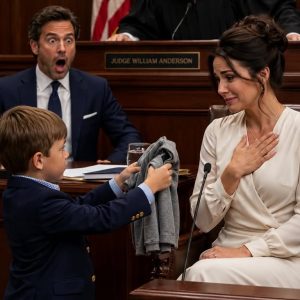
The trial began in September. The courthouse was a media circus, but inside, it felt like a sanctuary of reckoning. I sat in the front row, my hand resting on a small drawing Owen had made for me—a picture of a superhero with a shield.
Vince Sutton, Marsha’s “defend-the-indefensible” lawyer, tried to paint me as a mastermind. “Isn’t it true, Dr. Edwards, that you used your knowledge of trauma to ‘coach’ your son? That you saw an opportunity to become a celebrity at the expense of your wife’s reputation?”
I looked him dead in the eye. “I saw an opportunity to save my son’s life from a woman who saw him as a project rather than a human being.”
The turning point came when Tabitha and six other adults took the stand. One by one, they told the same story: the coldness, the isolation, the “Rules for Bad Boys.” They described Sue Melton as a woman who collected children’s spirits like trophies.
Marsha took the stand in her own defense, draped in a conservative dress, playing the role of the martyr. “I was raised this way,” she sobbed. “It made me strong. I was only trying to give Owen the same strength.”
“Strength?” the prosecutor asked, holding up the heavy padlock from the shed. “Is this how you measure strength, Mrs. Edwards? In pounds of steel used to cage a five-year-old?”
The jury took less than four hours.
Guilty. On every single count.
Sue Melton was sentenced to 25 years—effectively a life sentence for a woman her age. Marsha received 15 years. As the bailiffs led her away, she finally looked at me. There was no more calculation in her eyes, only a hollow, terrifying emptiness.
I walked out of that courtroom and didn’t look back. I had a son to raise.
Chapter 6: The Language of Flowers
Five years have passed since the door of that shed was kicked open.
Owen is twelve now. He’s tall, with a quick laugh and a deep love for science. He still has nightmares sometimes. He still flinches if someone moves too quickly. But he is thriving. We live in a house filled with light, music, and the “unnecessary” kindness Marsha always despised.
Every year on the anniversary of his escape, we visit Genevieve Fuller. We bring her flowers—yellow ones, for friendship.
“You know, Dad,” Owen said to me recently as we were driving home from her house. “I’m glad you didn’t listen to them. I’m glad you fought for me.”
“I’ll always fight for you, Owen. That’s the only job that matters.”
I published my book, The Architecture of Silence, and the foundation we started has helped remove hundreds of children from abusive environments. But the greatest victory isn’t the book or the foundation.
It’s the sight of my son standing in the backyard, the sun no longer a jagged accusation, but a warm glow on his shoulders. He isn’t afraid of the shadows anymore. He knows that he isn’t “broken” or “weak.” He knows that he is a survivor.
And I know that sometimes, love means burning down the world to make sure your child has a safe place to stand.
Like and share this post if you find it interesting.