They say the heart breaks in a million ways, but mine didn’t shatter. It crystallized. It turned into a sharp, unforgiving shard of sub-zero clarity the moment the heavy steel of my parents’ garage door groaned upward, revealing the hollow darkness within. I didn’t find a child asleep in a warm bed, dreaming of popcorn and cinematic heroes. I found a casualty.
My eight-year-old son, Beckett, was curled into a tight, fetal ball on the unforgiving concrete. In the 40-degree Ohio dampness, the garage had become a refrigerator, a stone-walled vault designed for lawnmowers and forgotten holiday decorations, not for a little boy with a penchant for dinosaurs and a heart that still believed in the goodness of grandparents. He had ballasted his small frame against the cold by wadding up his light jacket as a pillow. His breath came in shallow, ragged hitches, his teeth chattering with a rhythmic, metallic sound that will haunt my silence until the day I die.
His lips weren’t the vibrant pink of childhood anymore; they were a haunting, translucent lilac. When my flashlight beam—a trembling finger of light from my phone—swept over him, he didn’t jump. He merely squinted, his eyelids heavy with the onset of lethargy.
“Mommy?” he croaked, the word barely a thimbleful of sound. “Is movie night over?”
The visceral ache that tore through my chest was suppressed by a sudden, terrifying stillness. I didn’t scream. I didn’t fall to my knees and wail. Instead, I felt a strange, cold armor plating my soul. I scooped his shivering, ice-block body into my arms, feeling the dampness of the concrete through his thin dinosaur pajamas. As I carried him to the car, my mind replayed the text message I had received less than an hour prior—a message sent from a thousand miles away, from a place where Mickey Mouse ears and firework displays were currently masking the scent of abandonment.
“Change of plans,” my mother, Gwendolyn Peton, had written with the casual indifference of someone updating a grocery list. “Took Hadley, Juno, and Mercer to Disneyland for a surprise trip. Beckett is in the garage. Door is unlocked. Pick him up tomorrow when you get a chance.”
When I got a chance.
The casual cruelty of those five words acted as a catalyst. I realized then that my parents, the pillars of the suburban community, the church-going darlings of the neighborhood barbecue circuit, had finally stripped away the mask. They hadn’t just forgotten him. They had filed him away.
As I blasted the heat in my sedan, watching the color slowly return to my son’s cheeks, I knew I wouldn’t be calling them. I wouldn’t be leaving the hysterical, tear-filled voicemails they expected—the ones that would allow them to sigh and tell my sister, Trina, that I was “overreacting” again. No, I was going to do something they never prepared for. I was going to treat them like the strangers they had become.
I gripped the steering wheel until my knuckles turned white, realizing that by morning, the Peton family legacy would be nothing more than a crime scene.
To understand the garage, you have to understand the house that preceded it. I grew up in a residence where love was a limited resource, carefully rationed and distributed according to a hierarchy I never quite ascended. My sister, Trina, four years my senior, was the sun around which my parents’ planet orbited. She was the “Golden Child,” a title she wore with the effortless grace of a pageant queen.
My parents, Gwendolyn and Randall, were architects of appearance. Everything was about the “Peton Brand.” We were the family that showed up to church in coordinated pastels. We were the family with the manicured lawn and the overachieving elder daughter. Trina received the brand-new cars, the country club weddings, and the constant, suffocating adoration of a pair of parents who saw her as their primary achievement.
I was the “peacekeeper.” I was the pediatric dental hygienist who spent her days soothing the fears of other people’s children, while my own needs were habitually smoothed over and tucked away like a wrinkled rug. I was conditioned to swallow my feelings, to show up with a smile, and to accept the scraps of affection that fell from Trina’s table.
When Trina married Gregory, a wealthy orthodontist, and produced three “angelic” children—Hadley, Juno, and Mercer—the divide became a canyon. My parents’ social media feeds were a shrine to those three. Photos were captioned with “Grandma’s whole heart” and “Our perfect legacy.”
Then there was Beckett. My son, born of a marriage that dissolved when his father, Derek, decided a career in Seattle outweighed the responsibility of a child. Beckett was the quiet observer, a boy of gentle empathy who dinosaur-danced his way through life. To my parents, he was an asterisk. He was the recipient of late birthday cards containing a twenty-dollar bill and a joke about dating that was clearly meant for a teenager. He was the child whose zoo trips were cancelled at the last minute because Gregory had secured box seats at a baseball game for the “real” grandkids.
I made excuses for them. I told myself it was because Trina lived closer. I told myself it was because Derek was gone. I gaslit myself for eight years to protect the myth of “Family First.”
But as I sat in my quiet kitchen that night, watching Beckett sleep under a mountain of blankets on my sofa, the myth was dead. I looked at his sketchbook, which I had retrieved from the garage floor. The pages were filled with vibrant drawings of Brachiosauruses—gentle giants. One page was damp where his tears had hit the paper before he’d fallen asleep in that cold, dark vault.
I didn’t reach for my phone to call my mother. Instead, I reached for a legal pad. I began to list names: Dr. Helen Pharaoh, our pediatrician. Arlene Cosgrove, the neighbor with the sharp eyes and the retired teacher’s sense of justice. Rowan Shelby, the attorney who didn’t believe in “smoothing things over.”
The Petons thought they had left a child in a garage; they had actually left a witness to their own undoing.
The invitation had arrived with a rare, honeyed warmth in my mother’s voice. “Movie night!” she had chirped over the phone on Friday. “Sleeping bags, popcorn, the whole grandparent experience. Bring Beckett over at five. It’ll be a memory for the books.”
I wanted to believe her. I was starving for that memory. I spent Saturday watching Beckett vibrate with excitement. He picked out his favorite fleece pajamas—the ones with the glow-in-the-dark Velociraptors. He packed his sketchbook, hoping to impress Mercer, who usually ignored him. I dropped him off at the Peton residence, kissing his forehead and watching him wave from the porch, his sleeping bag tucked under his arm like a soldier’s bedroll.
The betrayal, I later learned through a CPS investigation, was clinical in its execution. At 6:00 p.m., while Beckett was supposedly in the basement setting up the “fort,” the black SUV was being packed. Gregory and Trina arrived with their children, the three “angels” already decked out in matching Disney t-shirts.
My mother told Beckett to “wait in the garage” for a moment while they “checked the car’s tire pressure.” She told him to be a good boy, to stay quiet, and that they’d be right back to start the movie. Then, they simply closed the door. They locked the interior entrance. They backed out of the driveway, the children’s laughter muffled by luxury upholstery, and drove to the airport.
Beckett had waited. He told me, with that heartbreakingly honest eight-year-old logic, that he’d knocked on the door after the first hour. When no one answered, he thought he was being “tested.” He thought if he was patient enough, the door would open and the popcorn would be waiting. He didn’t want to be “difficult.” He didn’t want to give Grandma a reason to cancel.
As the sun set and the temperature in the uninsulated garage plummeted, his sketchbook became his only companion. He eventually lay down on the concrete because his legs were shaking too hard to stand. He watched the shadows of the lawnmower grow long and monstrous, wondering what he had done to make them go away.
By the time I received that text message at 8:47 p.m., my parents were likely boarding their flight, sipping ginger ale and discussing the itinerary for Tomorrowland. Beckett was an afterthought, a logistical glitch they had solved by putting him in “storage.”
The absolute lack of remorse in that text was the final nail. I wasn’t just Beckett’s mother anymore. I was his prosecutor.
Monday morning didn’t involve a confrontation; it involved a clinical collection of evidence. My supervisor at the dental clinic, a woman who knew the value of a steady hand, gave me the week off without a second thought.
I took Beckett to Dr. Helen Pharaoh. I didn’t want a “check-up.” I wanted a medical record. Dr. Pharaoh, a woman of sharp intellect and zero patience for child neglect, examined Beckett with a grim intensity. She documented the mild hypothermia, the scrapes on his knees from the rough concrete, and the hollow, haunted look in his eyes when he described the sound of the car driving away.
“Karen,” she said, her voice dropping into a register of somber professional duty. “This is child endangerment. By law, I have to report this. But more importantly, as a human being, I want to report this.”
“Do it,” I said, my voice as steady as a surgeon’s. “I want the paper trail to be a mile long.”
Next, I visited Arlene Cosgrove, the neighbor. Arlene had been a fixture on that street for twenty years. She was the one who saw everything but said little—until now.
“I saw them loading up, Karen,” Arlene told me, her face pinched with disapproval. “They were in such a hurry. I saw Trina’s kids, all giggling. I didn’t see Beckett. I assumed he was already at your house. If I had known… if I had known that poor boy was in that dark box…” She didn’t finish the sentence. She sat down and wrote a three-page statement, her handwriting a sharp, cursive indictment.
Then came the meeting with Rowan Shelby. His office was filled with the scent of old paper and the quiet hum of a legal mind at work. I laid the evidence on his desk like a hand of winning cards: the text message, the medical report, Arlene’s statement, and photos I had gone back to take of the garage—the cold, grey slab where my son had shivered.
“They’ll claim it was a mistake,” Rowan said, leaning back. “They’ll say they thought someone else was picking him up. They’ll use their ‘pillars of the community’ status as a shield.”
“The text message says ‘pick him up tomorrow,’” I countered. “They intended for an eight-year-old to spend a sub-freezing night on a concrete floor. There is no ‘misunderstanding’ that accounts for a locked interior door and a thousand-mile flight.”
Rowan nodded, a predatory smile touching his lips. “Under the Ohio Revised Code, this is a first-degree misdemeanor for child endangerment. Possibly more, given the exposure. But there’s also the CPS angle. They won’t just get a slap on the wrist. They’ll get a permanent stain on that ‘brand’ they love so much.”
I left his office feeling a strange sense of peace. I wasn’t angry anymore. I was an avalanche, and my parents were standing at the bottom of the mountain.
Five days after the incident, the “Golden Grandparents” returned. They arrived back from California, likely tanned and laden with Mickey Mouse plushies, ready to regale the neighborhood with tales of their generosity.
They didn’t receive a phone call from me. They didn’t receive an invitation to dinner. At 3:00 p.m. on Friday, they received two uniformed officers of the Franklin County Sheriff’s Department.
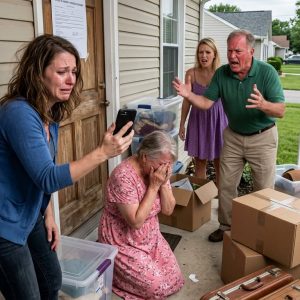
I wasn’t there to witness it, but Arlene was. She told me later, with a certain grim satisfaction, that my mother had answered the door in her favorite silk robe. Her face had gone through a kaleidoscope of emotions—confusion, then indignation, and finally, a hollowed-out terror as the officers handed over the summons.
Randall had tried to bluster, Arlene said. He’d tried to pull the “I coached Little League for fifteen years” card. The officers didn’t care. They were there for Beckett Waverly, the boy who had been left in the dark.
Within an hour, my phone exploded. The silence I had maintained was a vacuum they were desperate to fill with their own narrative.
“Karen, pick up the phone this instant!” my mother’s first voicemail shrieked. “What on earth have you done? The police were at our door! Do you have any idea how embarrassing that was? We were only gone for a few hours! Beckett was perfectly safe!”
Safe. In 40-degree weather. Alone. For six hours.
Then came Trina. Her texts were a masterclass in gaslighting. “You’ve lost your mind, Karen. You’re destroying the family over a simple miscommunication. Beckett is fine! You’re just jealous because we took the other kids to Disney. You’ve always been so sensitive and dramatic. If you don’t drop this, you will never see us again.”
I read the message and felt… nothing. The threat of never seeing them again was like a promise of a clean, quiet room after a lifetime spent in a construction zone.
I didn’t reply. I forwarded every text, every voicemail, and every frantic email to Rowan Shelby and the CPS caseworker, Dileia Hang. Dileia, a woman who had seen the worst of humanity, was particularly moved by Beckett’s interview.
“He told me he tried to be a ‘good dinosaur’ and wait,” Dileia told me, her voice trembling slightly. “Miss Waverly, your son’s resilience is a testament to you, but your parents’ actions are a testament to a profound lack of empathy. We are recommending full prosecution.”
The Petons were about to find out that the ‘Golden Child’ couldn’t help them in a court of law.
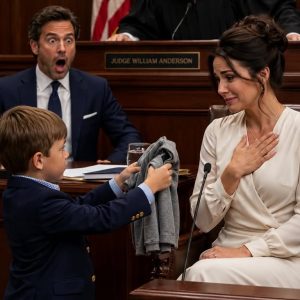
Three weeks later, the facade of the Peton family met the reality of the Franklin County Municipal Court. My parents arrived dressed for a gala, not a criminal hearing. They had hired an expensive defense attorney, a man who spoke in soothing tones about “unfortunate lapses in judgment” and “loving grandparents who simply got caught up in the excitement.”
I sat in the gallery, my spine a pillar of ice. I didn’t look at Trina, who was glaring at me from the front row. I didn’t look at my mother’s performative tears. I focused on Judge Carmen Overreet.
The prosecution was surgical. They played the recording of Beckett’s interview. The sound of his small, thin voice filled the room. “I thought maybe they forgot me by accident. I tried to stay on my sleeping bag, but it was too slippery on the floor.”
The silence in the courtroom after that recording was deafening. Even the defense attorney looked at his shoes.
The prosecutor then presented the text message. She had it blown up on a digital screen. “Pick him up tomorrow when you get a chance.”
“Your Honor,” the prosecutor said, her voice echoing. “This was not a lapse. This was a disposal. They treated a human child like a piece of luggage they had decided not to bring on the trip. They locked him in a garage in sub-freezing conditions and flew to another state. If the temperature had dropped another ten degrees, or if the mother hadn’t arrived early, we might be here on far more serious charges.”
Judge Overreet didn’t wait long. She leaned over the bench, her eyes fixing my parents with a look of visceral disgust that no amount of church-going service could deflect.
“I have seen neglect born of addiction,” the Judge began, her voice a low, rolling thunder. “I have seen neglect born of poverty and desperation. But what I see here is neglect born of pure, unadulterated cruelty. You did not forget this child. You excluded him. You locked him in a cold box because he didn’t fit into the ‘angelic’ image of your trip. That is not a mistake. That is a choice.”
The sentence was a death knell for their reputation. Ninety days in jail, suspended on the condition of 200 hours of community service—not coaching Little League, but working in a homeless shelter. A $2,500 fine each. Three years of probation. And the one that made my mother gasp: No unsupervised contact with any grandchild under the age of 12.
Trina let out a muffled sob. My father went grey. As the gavel came down with a sound like a thunderclap, I stood up.
My mother tried to intercept me in the hallway. “Karen! Karen, please! We can fix this! We’re family!”
I stopped and looked at her. I didn’t see the woman who had raised me. I saw a stranger who had left my son to freeze. “You destroyed the family, Mom,” I said, my voice barely a whisper but audible enough to make her flinch. “I just stopped pretending you hadn’t.”
I walked out of that courthouse and into the bright, cold Ohio sun, finally breathing air that didn’t taste like secrets.
Six months have passed since the night the garage door opened. In the world of the Petons, the “catastrophe” is still being whispered about. I heard through mutual friends that Gwendolyn and Randall are social pariahs at their church. They tell everyone I’m a “vindictive daughter,” but no one wants to invite the couple who locks their grandkids in garages to the neighborhood barbecue anymore.
Trina and I are ghosts to one another. I blocked her, Gregory, and my parents on everything. The “Golden Child” chose her side, and it was the side of matching t-shirts and fireworks over the safety of her nephew. I don’t miss her. I miss the sister I thought I had, but she was never real.
Beckett, however, is blooming.
He saw a therapist, Dr. Simone Kelly, who helped him navigate the “Big Sad” that followed the garage. He still has nightmares occasionally—dreams of dark places where the doors don’t have handles. But he is resilient. He has a new protector in his life: Aunt Margot, my best friend, who shows up for every soccer game and never forgets a dinosaur’s name.
One Sunday afternoon, we were sitting on the living room floor, surrounded by his drawings. He had moved on from Brachiosauruses to the T-Rex. He was drawing a massive mother dinosaur with her tail curled protectively around a smaller one.
“The big one is the Mommy-Saurus,” Beckett explained, his tongue poking out in concentration. “She has the sharpest teeth in the world, but she only uses them to bite the monsters that try to touch the baby.”
I felt a lump in my throat that I didn’t try to swallow. “That’s right, buddy. She’ll bite the whole world if she has to.”
He looked up at me, his brown eyes clear and full of a quiet, profound trust. “I know. You came and got me. You always come and get me.”
That is my new legacy. Not coordinated pastels or suburban standing. My legacy is a child who knows that his mother is an avalanche, a shield, and a sanctuary. I didn’t “burn the family down.” I cleared away the rot so my son could finally grow in the sun.
We are a small family now—just me, Beckett, and the people who actually show up. Friday nights are our movie nights. We make caramel corn, we build forts out of every blanket in the house, and we lock the doors—not to keep anyone in, but to keep the peace we’ve finally earned.
The Petons made their choice on a cold Saturday in November. They chose Disneyland. I chose my son. I will choose him every single time. And as I watch him sleep, safe and warm in a room filled with glow-in-the-dark stars, I know with absolute, icy clarity: it was the only choice that ever mattered.