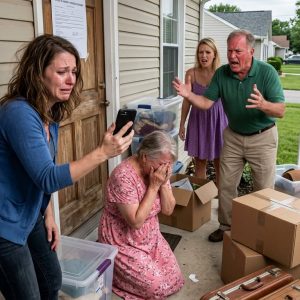
I was holding the pen, the ink hovering just millimeters above the signature line that would sign my life’s work away, when the accident happened. Or rather, the “accident.”
My daughter-in-law, Ever, had just handed me a steaming cup of coffee with a smile that could have melted a glacier. My maid, Rosa, stumbled. Her elbow clipped my arm, the cup tipped, and the dark liquid splattered across the Persian rug.
As Rosa knelt to scrub the stain, her face mere inches from my knee, she whispered five words that froze the blood in my veins.
“Don’t drink. Just trust me.”
My name is Evelyn Whitmore, and at sixty-four years old, I arrogantly believed I had witnessed every shade of betrayal life could offer. I was wrong. The worst was yet to come, disguised as a family meeting on a crisp Tuesday morning in October, served with a smile and a cup of coffee that was meant to be my last.
I had been at the helm of Whitmore Industries for fifteen years, ever since my husband Charles collapsed from a massive coronary on the ninth hole of his favorite golf course. It wasn’t easy stepping into his shoes—shoes that many whispered were too big for a widow who had spent most of her marriage organizing charity galas and hosting dinner parties. But grief is a powerful fuel. I managed to grow our small manufacturing company into an entity worth twelve million dollars.
My son, Carlton, thirty-nine and possessing all of his father’s height but none of his warmth, had been working at the company for five years. I won’t lie to you—he wasn’t exceptional. He was adequate. But he was family, and in the Whitmore code, that meant everything. His wife, Ever, had joined us two years ago as Marketing Director. She was efficient, charming, and possessed a chameleon-like ability to make everyone feel like her oldest friend. Including me.
That Tuesday, Carlton had called with a tone of rehearsed gravity. “Mom, we need to discuss some important changes about the company’s future. Ever and I have been thinking about succession planning.”
I agreed, of course. At sixty-four, it was only logical to discuss who would captain the ship when I finally decided to disembark. I assumed we would discuss timelines, training programs, perhaps a five-year transition plan.
I was fatally naive.
The meeting was set for 10:00 AM at my home in Beacon Hill. The living room, with its dark wood paneling and stone fireplace, felt safe. It was Charles’s favorite room. I sat there, reviewing quarterly reports that showed record profits, waiting for my son to arrive.
Carlton walked in at 10:00 sharp, wearing a suit that cost more than my housekeeper made in six months. “Good morning, Mom,” he said, pecking my cheek with a dry, perfunctory kiss. “Ever should be here any minute. She stopped to pick up those pastries you like.”
“That was thoughtful,” I replied, though a tiny alarm bell rang in the back of my mind. We weren’t having a tea party; we were discussing the fate of a multi-million dollar corporation. Why the pastries?
Ever arrived fifteen minutes later, a vision in a cream-colored blazer, carrying a white bakery box and an insulated coffee carrier.
“Evelyn, darling!” she exclaimed, hugging me a beat too long, her perfume cloying and sweet. “I brought some fresh roast from that new artisanal place on Newbury Street. I know how much you love trying new blends.”
I smiled and accepted the blue porcelain cup—my favorite, the one from my mother’s set. Ever knew I preferred it. She was always so attentive. Or so I thought.
Carlton settled into the wingback chair. Ever sat on the sofa, positioning herself to watch us both. Her eyes flicked back and forth like a spectator at a tennis match.
I took a sip. It was bitter. Metallic.
“You mentioned succession planning,” I said, setting the cup down.
“Yes, Mom,” Carlton leaned forward, clasping his hands. “Ever and I think it’s time for you to step back. You deserve to enjoy your retirement. We’ve been developing ideas for expansion… new markets.”
As he droned on about international partnerships, I felt a strange warmth bloom in my chest. My head began to swim. I attributed it to the strong roast.
“The thing is, Mom,” Carlton said, reaching into his briefcase, “we need you to sign some paperwork today to start the process. Just formalities. Transfer of authority forms.”
He slid a thick stack of documents across the coffee table.
I reached for them, but my hand felt like it belonged to someone else. Heavy. Numb.
“I think… I think I need to review these,” I mumbled, my voice sounding distant.
“Of course,” Ever said, standing up abruptly. “But finish your coffee first. You look pale.”
That was when Rosa appeared.
Rosa Martinez had been our housekeeper for twenty years. She was invisible to Carlton and Ever—just part of the furniture. But she saw everything. She came in carrying a tray of silverware we didn’t need. As she passed me, she stumbled.
Crash.
The tray hit my arm. My cup tipped. The “special blend” soaked my skirt and the antique rug.
“Oh no, Mrs. Whitmore! I’m so sorry!” Rosa cried out, dropping to her knees.
“Rosa, you clumsy idiot!” Carlton shouted, jumping up.
But amidst the chaos, Rosa looked directly into my eyes. The terror in them was real. And then came the whisper that saved my life.
“Don’t drink. Just trust me.”
A chill that had nothing to do with the spilled coffee raced down my spine. In twenty years, Rosa had never broken a saucer, let alone spilled a tray. This was theater. Desperate theater.
“It’s fine,” I said, my mind racing through the fog in my brain. “Accidents happen.”
“Here,” Ever said instantly, grabbing her own cup. “Share mine. You haven’t had your morning caffeine yet.”
She moved to pour her coffee into a fresh mug. But Rosa, still on the floor, ‘stumbled’ again as she tried to stand, bumping hard into Ever’s legs.
Ever’s cup flew. Coffee splashed everywhere—drenching the legal documents on the table.
“For God’s sake!” Carlton roared. “What is wrong with you today?”
I watched Ever. She wasn’t looking at the mess. She was staring at the ruined papers with a look of pure, unadulterated rage. And then, disappointment.
“Well,” Ever said, her laugh brittle. “Maybe we should reschedule. Once we get new copies.”
“Actually,” I said, the adrenaline beginning to clear the fog in my head. “I’d like to see the wet ones. Coffee stains and all.”
Ever froze. She reached for the coffee pot to refill her cup, her hand shaking violently.
“Are you feeling alright, Ever?” I asked.
“I’m fine,” she snapped. “Just… tired.”
But she wasn’t fine. Her face was flushing a deep, unhealthy red. She sat down heavily on the sofa, pressing a hand to her temple.
“I feel… strange,” she whispered. “Spinning.”
Rosa stepped back, her face grim. She knew.
“Mrs. Ever,” Rosa said, her voice steady. “Did you eat anything this morning?”
“Just… tasted the coffee,” Ever slurred.
Suddenly, Ever’s body went rigid. Her eyes rolled back, and she began to convulse.
The ambulance ride to Boston General was a blur of sirens and feigned concern.
I sat in the back, watching the paramedics work on my daughter-in-law. Carlton held her hand, chanting, “You’re going to be okay, baby.” But his voice… it was wrong. It lacked the frantic, ragged edge of true panic. It sounded like a performance.
At the hospital, they rushed Ever behind double doors. Carlton and I were left in the sterile purgatory of the waiting room.
“I should call her parents,” Carlton said, pacing. “They’ll want to know.”
“What will you tell them?” I asked, watching him.
“The truth. She collapsed.”
But that wasn’t the truth. The truth was that Ever had collapsed after drinking the coffee meant for me.
An hour later, a doctor appeared. Dr. Martinez. “She’s stable, but we’re running toxicology screens. Her symptoms suggest toxic ingestion. Did she consume anything unusual?”
“Nothing,” Carlton said quickly. “Just coffee.”
“We’ll need to test any remaining food or drink,” the doctor noted. “Police protocols.”
Carlton’s jaw tightened. “Of course.”
The moment the doctor left, Carlton pulled out his phone. “I need to call Rosa. Have her clean up the mess before the police arrive.”
“Actually,” I said, my voice sharp. “I think we should leave everything exactly as it is.”
He whipped around. “Why?”
“Because if someone tried to poison Ever, the evidence is in that room.”
I saw the calculation in his eyes. He realized he was trapped. If he insisted on cleaning, he looked guilty. If he didn’t, the evidence remained.
“I’m going to the restroom,” I said.
I walked straight out the front doors and called Rosa.
“Mrs. Whitmore?” Her voice was shaking.
“She’s alive, Rosa. No thanks to the coffee.”
Silence. Then, “I couldn’t let you drink it. I’ve been watching them for months.”
“Meet me,” I commanded. “Marley’s Café. Twenty minutes.”
When I arrived at the dim, cinnamon-scented café, Rosa looked ten years older. She slid a small black notebook across the table.
“I started writing things down three months ago,” she said. “Ever started coming over early on days you had meetings. She insisted on making your coffee. On those days, you got sick. Dizzy. Confused.”
She flipped the pages. Dates. Times. Symptoms. It was a log of my slow murder.
“Six weeks ago, I saw her put drops from a clear vial into your cup,” Rosa whispered, tears tracking down her cheeks. “I was too scared to speak. Carlton threatened to fire me if I kept ‘snooping.’ But this morning… she emptied half the vial. I knew it was the end.”
“You saved my life,” I said, reaching for her hand.
“There’s more,” Rosa said. “I found papers in Carlton’s study. Life insurance policies on you. Five million dollars. And bank transfers. He’s been moving money out of the company accounts.”
Two hundred thousand dollars stolen. A murder plot. My son.
“Rosa,” I said, my voice steel. “Go to the police. Take this notebook. Take everything. Don’t go home.”
I returned to the hospital to find Carlton with a man in a shark-skin suit. David Richardson, the family attorney.
“Mom,” Carlton said. “David is here to ensure we aren’t unfairly blamed for Ever’s… accident.”
Just then, Dr. Martinez returned. “It’s arsenic,” she said bluntly. “A massive dose. Police are on their way.”
Carlton turned pale. “Arsenic?”
“We’ll need to question everyone,” she said.
Carlton’s phone rang. He stepped away, and I watched his face go from worry to sheer panic.
“They arrested Rosa,” he hissed to the lawyer when he returned. “They think she did it.”
My heart stopped. He was framing her.
“I need to go to the station,” I said calmly.
“Why?” Carlton asked.
“To give a statement.”
I walked into the police station an hour later. Detective Sarah Chen led me to an interview room.
“Detective,” I said, sitting down. “Rosa Martinez is innocent. In fact, she is the only reason I am alive to speak to you right now.”
I spent the next two hours laying out the entire sordid tale. The coffee. The dizziness. Rosa’s warning. The notebook.
“Mrs. Whitmore,” Detective Chen said, “We executed a search warrant on your son’s home an hour ago. We found the arsenic vial in Ever’s desk. And we found the bank records.”
“So you believe me?”
“We believe you. And we believe Rosa. She’s been wearing a wire for the last week.”
I gasped. “What?”
“She recorded them,” Chen said. “Discussing the dosage. Discussing your will. Discussing how they couldn’t wait for the ‘old hag’ to die.”
The room spun. My son. My little boy.
“What happens now?”
“We arrest your son.”
I stayed at the Four Seasons downtown. My home was a crime scene; my memories were tainted.
The next morning, Detective Chen knocked on my door. She held a newspaper.
LOCAL HEIR ARRESTED IN MATRICIDE PLOT.
“We got him,” she said. “Attempted murder. Conspiracy. Embezzlement.”
“And Ever?”
“She’s awake. And she’s talking. She’s trying to cut a plea deal. Says Carlton forced her.”
I laughed, a dry, humorless sound. “Forced her? She was the chemist.”
“Rosa is free,” Chen added, handing me a note. Mrs. Whitmore, I am sorry. You have my loyalty always. – Rosa.
Weeks turned into months. The trial of Commonwealth v. Carlton Whitmore became a circus.
I sat in the front row, forcing myself to look at him. He wore an orange jumpsuit now, stripped of his Italian suits and his arrogance. He looked small.
The prosecution played the tapes.
“One more week,” Ever’s voice crackled through the courtroom speakers, light and conversational. “Then her heart gives out. Natural causes.”
“I can’t wait,” Carlton’s voice replied. “She’s so controlling. Once she’s gone, we sell the company for parts.”
The jury looked sick. I just felt empty.
Ever’s defense was that she was a victim of coercive control. But the prosecution destroyed that narrative with her own handwritten journals—detailed logs of toxicity levels, graphing my decline like a science project.
When it was my turn to give a Victim Impact Statement, I walked to the podium. I didn’t look at the judge. I looked at Carlton.
“My name is Evelyn Whitmore,” I began. “Carlton is my only child. For thirty-nine years, I believed that bond was sacred. I believed that no matter what, we would protect each other.”
I paused. Carlton refused to meet my eyes.
“He didn’t just try to kill my body. He killed my history. He poisoned every memory I have of him. Every Mother’s Day card, every hug, every ‘I love you’—he turned them all into lies. He valued my money more than my breath.”
I took a deep breath.
“I forgive you, Carlton. Because carrying hatred would poison me faster than any arsenic. But I will never trust you again. You are a stranger to me.”
The jury deliberated for three days.
Guilty. On all counts.
Life in prison without parole. For both of them.
As the bailiffs led him away, Carlton finally looked at me. His mouth opened, perhaps to beg, perhaps to scream. But I turned my back.
I walked out of the courtroom and found Rosa waiting on the steps.
“It’s over,” she said.
“No,” I replied, taking her arm. “It’s just beginning.”
A week later, I stood in the empty halls of my Beacon Hill home. The “For Sale” sign was already on the lawn. I couldn’t live here. The ghosts were too loud.
I found a photo album in Carlton’s old room. Pictures of a smiling boy with a missing tooth. I closed it and left it on the bed. That boy was gone.
That evening, I called Rosa.
“Rosa, I’m starting a foundation,” I said. “Dedicated to protecting the elderly from financial and physical abuse. I want you to run it with me.”
“Mrs. Whitmore, I’m just a housekeeper,” she stammered.
“You are a detective,” I corrected. “You are brave. And you are the only person in the world I trust. I’m offering you a partnership. Executive Director.”
Silence. Then, a tearful, “Yes.”
Six months later, the Whitmore-Martinez Foundation opened its doors.
We weren’t just a charity; we were a task force. We worked with banks to spot irregular transfers. We trained nurses to spot signs of poisoning. We created a safe house for seniors who had been betrayed by their kin.
Our first case was a ninety-year-old woman whose grandson was forging her checks. Our second was a man whose daughter was withholding his heart medication to speed up her inheritance.
Every case broke my heart. Every case healed it a little bit more.
Ten years have passed since that cup of coffee spilled.
I am seventy-four now. I live in a sun-drenched colonial in Wellesley, a safe distance from the shadows of Boston. Rosa lives in the guest house, though we share the main kitchen every morning.
We sit in the garden, watching the sunrise. I drink my coffee—black, always prepared by my own hands or Rosa’s—and we discuss the day ahead.
The Foundation has grown. We have offices in twelve states. Rosa is a force of nature, terrifying fraudsters and comforting victims with equal intensity. She jokes that she’s the only Executive Director who still does her own grocery shopping because “you can’t trust anyone with the produce.”
I never visited Carlton. He wrote letters for a few years—whiny, self-pitying scrawls blaming Ever, blaming the lawyers, blaming me. I returned them unopened. Eventually, they stopped.
Ever died in prison three years ago. A fight over cigarettes. A waste of a life that had so much potential for good, twisted by greed.
People ask me if I’m lonely. If I miss having a “family.”
I look at Rosa, laughing as she tells me about her granddaughter’s graduation. I look at the hundreds of letters on my desk from people we’ve helped—people like Margaret, a 78-year-old woman we saved from a predatory nephew, who now volunteers at our front desk.
“Family,” I tell them, “is not about whose blood runs in your veins. It’s about who would spill their own blood to save yours.”
Carlton tried to steal my life. Instead, he gave me a better one. He gave me clarity. He stripped away the illusions and left me with the truth: that love is an action, not an obligation.
The coffee that was meant to end my life became the fuel for my greatest act.
I am Evelyn Whitmore. Survivor. Mother to a chosen family. And every morning, as I take that first sip of coffee, I taste victory.