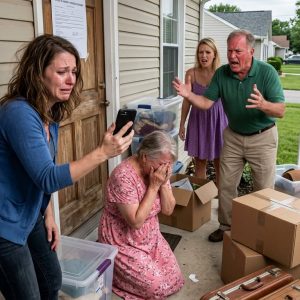
I learned exactly where I ranked in my family on a Tuesday night, the kind of humid July evening where the air feels heavy enough to swallow you whole. My dad lifted his glass at dinner, the condensation dripping down his knuckles, and said, “Congrats. Here’s your car, son.”
Everyone clapped. My mom beamed, her hands pressed together like she was praying. My brother, Jason, grinned that easy, effortless grin of his, the one that got him out of speeding tickets and missed deadlines.
Then my dad turned to me. He lowered his voice, the warmth draining out of his eyes, and handed me a folded piece of paper instead of a smile.
“Rent due by Sunday,” he murmured. “Nine hundred.”
In that moment, years of quiet favoritism snapped into focus like a camera lens finally finding its subject. I smiled, swallowed the bile rising in my throat, and said nothing. But something inside me quietly packed its bags.
What happened next didn’t explode at the table. It unfolded later, a slow-motion demolition that left my entire family unraveling.
My name is Sarah. On paper, I look like the kid parents are supposed to brag about. I work in social services, a job where you sit across from people on the worst days of their lives and try to steady the ground under their feet. I learned early how to stay calm, how to listen, how to hold things together when emotions run high.
Funny thing is, I learned most of that skill set at home.
Our house always looked solid from the outside—neatly trimmed lawn, family photos lined up in matching frames on the mantle, Sunday dinners that started promptly at six. My dad built his construction business with his hands, turning long days and stubborn pride into a company that paid the bills and demanded respect. My mom taught kindergarten, coming home smelling faintly of crayons and coffee, believing peace was something you preserved by not poking at the cracks in the foundation.
And then there was Jason.
He’s younger by three years, charming in an effortless way, the kind of person people forgive before he even asks. Growing up, it felt like we lived under the same roof but played by different rules. When he struggled, the house leaned toward him to catch his fall. When I succeeded, it was treated like background noise—expected, already accounted for.
I don’t remember anyone ever sitting me down to say, “We expect more from you.” They didn’t have to. It was in the silences. In the way my straight-A report cards were skimmed while his passing grades were celebrated. In the way my choices were questioned while his were encouraged.
I became the reliable one. The helper. The problem-solver. The person who filled in the gaps without being asked.
After college, I moved back home with a plan: save money, get experience, apply to graduate programs. It wasn’t freeloading. I paid for groceries almost every week. I covered the utility bills when “things were tight.” I fixed the leaky faucet in the guest bath and repainted the deck last summer.
Living there wasn’t meant to be permanent. It was supposed to be practical, a temporary landing pad.
My mom liked to say, “Your dad just trusts you more, Sarah.” As if trust explained why responsibility only flowed in one direction. As if being capable meant you no longer needed support.
I told myself it didn’t bother me. I told myself families are complicated, that love shows up in different forms. I believed that if I stayed steady long enough, things would even out. That someday, my dad would look at me and see not just the dependable daughter, but someone worth celebrating, too.
That belief is what I carried into the summer of Jason’s college graduation. The heat, the long days, the feeling that something was shifting beneath the floorboards, even if I didn’t yet know how sharply the ground was about to break.
I walked into that dinner still thinking I belonged.
The weeks leading up to Jason’s graduation felt off in a way I couldn’t quite name. The house buzzed with a frantic, planning energy, but none of it included me in any meaningful way.
My mom talked non-stop about the guest list and menu ideas, flipping through stained recipe cards at the kitchen counter. My dad disappeared into the garage more often than usual. The door was always shut, his voice dropping to a conspiratorial whisper whenever I walked past holding a basket of laundry.
When I asked simple questions—”What time are people coming?”, “Do we need more chairs?”—I got vague answers. “We’ve got it covered.” “Don’t worry about it.”
I told myself I was imagining things. I told myself I was being sensitive.
The day of the graduation arrived hot and bright, the kind of summer Saturday that makes everything feel amplified. I helped clean the house from top to bottom, wiped down the dining table until it gleamed, and arranged the hydrangeas my mom insisted were necessary. Jason paced around in his cap and gown, nervous but excited. I straightened his collar without thinking, the same way I had done a hundred times before big moments in his life.
At the ceremony, my dad clapped louder than anyone when Jason’s name was called. He stood up halfway, beaming like this was a personal victory he had snatched from the jaws of defeat. I clapped too, genuinely proud, even as a small, familiar ache settled in my chest. I remembered my own graduation three years ago—how my dad had shown up, technically present, but checking his email by the time my name was announced.
Back home, the house filled quickly. Relatives, neighbors, family friends. Laughter bounced off the walls. Plates clinked. Someone turned on the stereo. I floated between rooms, refilling drinks, answering polite questions about my job, smiling when people congratulated my brother.
The garage door stayed closed the entire time, like it was guarding a state secret.
Dinner was loud and crowded. My dad stood at the head of the table, glass raised, waiting for the room to settle. He talked about hard work. About perseverance. About how not everyone has it easy, but the ones who push through deserve recognition.
I noticed the way his words leaned toward Jason, how his hand rested heavily on my brother’s shoulder.
Then, he reached into his pocket.
“You’ve earned this, son,” he said.
He pulled out the keys. They caught the light when he held them up—silver metal flashing, unmistakable.
A car key.
The garage door rumbled open, revealing a charcoal gray sedan. Brand new. Leather seats. A big red bow on the hood. It was worth more than I had ever spent on myself at once.
The room erupted. Chairs scraped back. People cheered. Jason’s face froze for a second before breaking into pure, unadulterated shock.
“Dad… no way,” he breathed.
I clapped. I smiled. My hands did exactly what they were supposed to do. I was the good sister. The supportive daughter.
After the noise died down, after people drifted toward the garage to see the car up close and kick the tires, my dad caught my eye. He nodded toward the hallway. Just a quick conversation, the look said. Nothing dramatic.
In the quiet of the kitchen, away from the applause, his tone changed. It was practical, measured, like we were discussing a construction schedule.
“You’ve been here a while, Sarah,” he said, leaning against the counter.
“Yeah, almost a year,” I replied, grabbing a water bottle.
“It’s time you start paying rent,” he said. “Nine hundred. By Sunday.”
For a moment, I honestly thought he was joking. The timing was so surreal it didn’t register as real.
“What?” I asked, a nervous laugh escaping my lips.
“Nine hundred,” he repeated, his face stone. “You’re working full time. You’re an adult. It’s time to pay your way.”
I looked past him toward the garage, where my brother was laughing, his hands gripping the steering wheel of a brand new car that my father had just gifted him. A gift worth twenty thousand dollars.
And he was asking me for rent.
Something clicked into place then. Not anger yet. Not heartbreak. Just clarity. Cold, hard clarity.
This wasn’t a misunderstanding. It wasn’t a joke. It was a line being drawn in the sand. And for the first time, I realized I had been standing on the wrong side of it my entire life.
“Okay,” I said softly.
“Good,” he said, turning back toward the party. “Sunday.”
The rest of the night moved around me like I wasn’t really in it. People laughed. Someone popped open another bottle of champagne. Jason kept saying, “I can’t believe this,” over and over, like repeating it might make it permanent.
I stood near the kitchen sink, rinsing plates that didn’t need rinsing, nodding when someone spoke to me, waiting for the feeling in my chest to pass.
It didn’t.
When the house finally quieted down and the last car pulled out of the driveway, I sat on the edge of my bed and stared at the wall.
Nine hundred dollars. By Sunday.
The number echoed in my head, not because I couldn’t afford it, but because of what it meant. It wasn’t about money. It was a verdict. It was a tax on my existence.
I thought about all the payments I’d covered without being asked. Groceries. Repairs. The internet bill that mysteriously landed on my plate because I was “better with technology.” None of that had been rent. Apparently, rent was something reserved for moments like this. Moments when I needed to be reminded of my place.
Sleep didn’t come. Sometime after midnight, I opened my laptop and pulled up my bank account. Years of careful savings stared back at me.
Enough to move. Enough to breathe. Enough to stop negotiating my worth, one quiet favor at a time.
In the morning, the house was already buzzing again. My dad and Jason were making plans for a drive to the lake to test out the car. My mom hovered, cheerful in that brittle way she got when she wanted things to feel normal, frying bacon like grease could fix the tension in the air.
No one mentioned the conversation from the night before. That silence told me everything I needed to know. It was business as usual.
I waited until they left. The quiet that followed was heavy but clean.
I started with my closet, folding clothes into neat piles. Each decision felt oddly calm. What to take. What to leave. I skipped the things tied to old versions of myself—the high school yearbooks, the sentimental trinkets from family vacations where I had sat in the middle seat.
I packed only what I needed. My laptop. My documents. My clothes.
At my desk, I paused with a pen in my hand, staring at a blank piece of paper. I didn’t write an essay. I didn’t argue my case. I kept it simple, honest, final.
I’m moving out. I’m taking responsibility for my life fully. Please don’t look for me until I reach out.
I folded the note once and placed it on the fridge, held down by a magnet shaped like a pineapple that had been there for years.
Then I carried my bags to my car—my paid-off, ten-year-old Honda—and I didn’t look back.
The pushback didn’t come right away. It started as silence. Then a text from Jason asking if this was some kind of joke. Then missed calls from my mom.
By the time I pulled onto the highway, my phone buzzed again and again in the passenger seat. I didn’t answer. Not because I was angry. Not because I wanted revenge. But because for the first time, I was choosing not to explain myself to people who had already decided what I was worth.
And that choice changed everything.
I didn’t go far that first night. I drove until the streetlights blurred together, then parked in a grocery store lot that stayed open late. I sat there with my hands on the steering wheel, breathing in short bursts, trying to understand how a single sentence could hollow out so many years at once.
Nine hundred by Sunday.
It replayed in my head, tangled with the image of my brother’s smile in the garage.
My phone lit up again. Jason’s name.
Are you okay? Mom’s freaking out. Dad says you overreacted.
I stared at the screen for a long time before locking it and setting the phone face down.
I didn’t owe anyone an immediate version of myself. Not tonight.
I stayed with my best friend, Elena, that first week. She didn’t ask many questions. She just handed me a spare key, cleared out a drawer in her guest room, and said, “Stay as long as you need.”
The simplicity of it almost made me cry. No lectures. No conditions. Just space.
The messages kept coming. Mostly from my mom. Long voicemails that swung wildly between worry and accusation. She wanted to talk this through. She wanted me to come home so we could be a family again. She never mentioned the rent, never mentioned the car, as if ignoring the catalyst might erase the explosion.
My dad didn’t call at first. When he finally did, three days later, it was brief, controlled.
“This is unnecessary, Sarah,” he said to my voicemail. “Adults don’t storm off.”
I almost laughed at that. I hadn’t stormed. I had packed quietly. I had left a note. If anything, it was the calmest decision I’d ever made.
A few days later, Jason called. Not texted. Called.
“Can we talk?” he asked. His voice sounded thinner than usual, less sure of itself.
We met at a coffee shop halfway between Elena’s place and the house. Neutral ground.
He showed up early, tapping his foot, phone in hand like a lifeline. He looked tired.
“I didn’t know,” he said as soon as I sat down. “About the rent thing. Dad didn’t say anything until you were gone.”
“I know,” I said, and I meant it. None of this was his doing. He was just the golden child; he didn’t build the pedestal.
He leaned back, rubbing his face. “Everything’s weird at home. Mom keeps crying. Dad’s mad all the time—like, really mad. And now they’re asking me about stuff you used to handle.”
“Like what?”
“Bills. Appointments. The internet went out yesterday and Dad handed me the router manual. I don’t even know where the account number is.”
I watched him process that out loud. Watched the confusion creep in. For the first time, the cushion under him was gone.
“I’m not disappearing, Jase,” I told him. “I’m just not doing it for everyone anymore.”
He nodded slowly, like the idea scared him but also made sense.
That conversation stayed with me because it was the moment I understood the real shift had already happened. I didn’t have to do anything dramatic. The system was unraveling on its own because I had removed the one piece that held it all together: me.
The real confrontation came later. Not at the dinner table, not in the garage, but on a quiet Tuesday afternoon when my dad showed up at Elena’s apartment complex unannounced.
I opened the door and found him standing there, hands in his pockets, jaw tight. He looked around the hallway like the beige carpet offended him.
“Can we talk?” he asked.
I stepped aside. We sat across from each other at Elena’s small kitchen table, the space between us charged with everything that had been left unsaid for twenty-five years.
He didn’t waste time.
“You embarrassed us,” he said. “You made a scene.”
“I left quietly,” I replied, my voice steady. “That’s not a scene.”
“You blindsided us.”
I held his gaze. “You handed me a rent demand at my brother’s celebration, Dad. That was the blindside.”
He waved it off, dismissive. “That’s business. You’re an adult. Adults pay their way.”
“And yet,” I said, “you bought him a car worth more than I’ve ever spent on myself. You pay his insurance. You paid his tuition.”
“That’s different,” he snapped.
“How?”
I waited. Let the silence do the work.
He looked away, his jaw working. “He needed encouragement. He needed a start.”
“And I don’t?”
“You’ve always been fine on your own, Sarah.”
There it was again. The familiar script. The curse of competence.
“So, because I handle things, I get less?” I asked.
He sighed, like I was exhausting him. “You’re comparing apples and oranges.”
I leaned forward. “No. I’m comparing effort and reward. I’m comparing responsibility and support. And I’m asking why those only flow one direction in our house.”
He hesitated. Just for a second. His eyes flickered to the window.
Then he said it.
“Because he’s worth it.”
The words landed heavy and clean, with no apology wrapped around them. He didn’t mean to say more than you, but the implication hung in the air like smoke.
For a moment, I felt something crack open inside me. Not pain. Relief.
Because the question I’d been asking my entire life finally had an honest answer.
I stood up.
“I’m not here to argue with you,” I said. “I just needed to hear that.”
“Hear what?” he snapped, standing up too.
“That I was never going to win,” I said calmly. “Not by being responsible. Not by being patient. Not by staying.”
He frowned, confusion clouding his anger. “You’re twisting this.”
“No,” I said. “I’m accepting it.”
I walked him to the door. He looked stunned, like he’d expected tears or yelling. He expected me to fight for my place. He didn’t expect me to simply leave it.
“You’re really going to do this?” he asked, stepping into the hall. “Walk away over money?”
I shook my head. “I walked away over clarity.”
After that, the calls escalated. My mom called sobbing, begging me to be reasonable. Jason texted in all caps, panicking about things falling apart—the dog needed the vet, the gutters were leaking, Mom was depressed.
And then my dad started calling every number he had for me. Over and over. From his phone. From my mom’s. From the house line.
I let them ring. Not out of spite. Out of necessity.
In the weeks that followed, I watched the consequences unfold from a distance.
Jason struggled. Without me smoothing things over, reminding him of deadlines, explaining expectations to our parents, he floundered. He called me late one night, voice tight, admitting he felt overwhelmed. Not angry. Not entitled. Just scared. For the first time, he was standing where I had always stood—expected to figure things out without applause. I helped him with advice, but I didn’t step back into the role of buffer. That space stayed empty on purpose.
My mom changed more slowly. She stopped leaving frantic voicemails and started sending short messages instead. Apologies slipped in between updates about the house. She didn’t name the favoritism outright, but she no longer pretended everything was fine. When we met for coffee weeks later, she looked tired in a way I hadn’t seen before. Quieter. More honest. I realized my absence had forced her to sit with the discomfort she’d spent years avoiding.
My dad was the last to adjust.
Losing control didn’t make him softer right away. It made him smaller. He ran out of orders to give. He ran out of consequences to threaten. Without my reliability to lean on, his authority stopped working the way it used to. He reached out less often, and when he did, his words were careful, measured, like he was learning a language he’d never bothered with before.
As for me, life stabilized in ways I hadn’t expected.
I found a small apartment in the city. It wasn’t a house with a lawn, but it was mine. My days felt lighter. My work felt meaningful instead of draining because I wasn’t coming home to a second shift of emotional labor. I paid my own bills, on my own terms, in a space that belonged to me.
People around me didn’t praise my endurance. They respected my boundaries.
I didn’t get an apology that fixed everything. What I got was something quieter and more permanent. I got my sense of self back. And that turned out to be the most lasting consequence of all.
I didn’t go back to being the daughter who held everything together at her own expense. I also didn’t cut my family off like a dramatic ending in a movie. What I chose was something harder and quieter.
I chose distance with intention.
Over time, the rules changed. Conversations slowed down. Expectations softened. My dad no longer spoke in ultimatums because they stopped working. My mom learned that peace built on silence eventually collapses. My brother grew into his own responsibilities, not because he was pushed, but because there was no one left to carry them for him.
And me? I stopped measuring my worth by how useful I was to people who never planned to protect me the same way.
I built a life that didn’t require permission. One that felt steady, honest, and fully mine.
Looking back, that dinner wasn’t the moment my family broke. It was the moment the illusion finally did.
Sometimes walking away isn’t about punishment. It’s about refusing to keep shrinking so others can stay comfortable.
If this story hit close to home, I want you to know: you’re not weak for wanting fairness, and you’re not selfish for choosing yourself.
You are simply charging the right price for admission to your life.