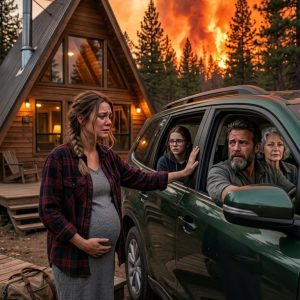
I used to believe that safety was a physical place. For me, it was the two-story Craftsman on Elm Street, with its wrap-around porch and the oak tree that scraped against the master bedroom window when the wind blew from the Rockies. I believed safety was the heavy thud of the front door closing at 6:00 PM, signaling that Daniel Reid, my husband, was home.
I was a nurse in the neonatal ICU at Denver General. My days were spent monitoring the fragile, hummingbird heartbeats of premature infants, navigating the thin line between life and tragedy. Because my professional life was defined by chaos and alarms, I craved a personal life defined by predictability. Daniel, with his sturdy shoulders and his small but successful construction business, felt like bedrock.
When the pregnancy test turned positive—two pink lines that rewrote my entire universe—I thought my life had reached its zenith. I was thirty-two. We had the house. We had the savings. We were ready.
But the erosion of a marriage doesn’t happen with an earthquake; it happens with wind and rain, slow and unnoticed until the cliffside collapses.
It started in the second trimester. Daniel, who used to rest his hand on my stomach while we watched TV, became scarce. He started coming home late, his clothes carrying the faint, metallic scent of the city—and something else. A perfume. Santal 33 and stale tobacco. Not me. Never me.
“Site issues,” he would say, turning his back to me in bed. “The permits are a nightmare, Emily. You wouldn’t understand.”
I wanted to believe him. I wanted to protect the peace I had built. So, I swallowed the bile rising in my throat and focused on the nursery, painting the walls a soft, hopeful yellow.
The truth arrived on a Tuesday, disguised as a mundane clerical error. I opened a credit card statement that had been mailed to the house instead of his office. My eyes scanned the rows of lumber and hardware purchases until they snagged on a line item that didn’t fit: The Maven Hotel, Midnight. Room Service. Champagne.
I sat at the kitchen table, the paper shaking in my hand. The baby kicked—a flutter against my ribs—and I felt a wave of nausea that had nothing to do with pregnancy.
When Daniel came home, I didn’t scream. I laid the paper on the granite island.
He didn’t deny it. He didn’t drop to his knees and beg for forgiveness. Instead, he looked at the statement, then at me, with a cold, irritated expression—as if I were a nagging employee who had pointed out a minor typo.
“It’s just stress relief, Em,” he said, opening the fridge. “Don’t make this into a Greek tragedy.”
I cried that night, alone in the nursery, surrounded by unopened boxes of diapers. But through the tears, a steel rod of resolve formed in my spine. I would not let this destroy my child’s life. I would make it work, or I would leave.
I didn’t know then that leaving was exactly what Vanessa Pierce wanted.
I learned her name later. She was twenty-four, an interior designer Daniel had hired for a project. She was everything I wasn’t at that moment: unburdened, glamorous, and predatory. Friends would later tell me they had seen them arguing in parking lots. They heard her screaming that she didn’t want a part-time lover. She wanted the ring, the house, the life. She told him that a baby would be a “ball and chain.”
Daniel, desperate to keep his trophy and too cowardly to face a divorce, began to listen. And the man I thought was my bedrock turned into quicksand.
The evening of November 14th was unseasonably warm for Colorado. The air held a static charge, dry and brittle.
I was twenty-eight weeks pregnant. My ankles were swollen, and my back ached with a dull, persistent throb. Daniel came home early, whistling. It was the first time in months he had seemed… attentive.
“You look exhausted, Em,” he said, his voice smooth, like oil on water. “Why don’t you lay down on the couch? I’m going to run out and pick up Thai food. Your favorite.”
I looked at him, surprised. The coldness of the past few weeks seemed to have evaporated. “That would be nice,” I said, a foolish spark of hope igniting in my chest. Maybe he was coming back to us. Maybe the affair was over.
He helped me settle onto the plush velvet sofa, tucking a blanket around my legs. He kissed my forehead. His lips felt dry.
“I won’t be long,” he whispered.
I heard the front door close. I heard the lock click. Then, I heard the deadbolt slide home.
I closed my eyes, drifting into a light doze.
I don’t know how much time passed—ten minutes? Twenty? I was woken not by sound, but by smell. It wasn’t the savory scent of basil and chili. It was acrid. Chemical. The smell of melting plastic and scorching wood.
My eyes snapped open. A grey tendril of smoke was curling under the hallway door like a serpent.
“Daniel?” I called out, struggling to sit up. The baby shifted heavily, pushing against my bladder.
I waddled toward the hallway. The moment I opened the door, a wall of heat slammed into me. The far end of the corridor, where the linen closet stood, was an inferno. The flames weren’t behaving naturally; they were climbing the walls with terrifying speed, fueled by something unnatural.
Panic, cold and sharp, pierced through the fog of sleep.
I turned and ran—as fast as I could waddle—to the front door. I grabbed the handle. Locked. I twisted the deadbolt thumb-turn. It wouldn’t budge.
That’s impossible, I thought. It works from the inside.
I twisted harder, skin tearing on the metal. It was jammed. Mechanically jammed.
“Help!” I screamed, pounding on the heavy wood. “Fire! Help!”
I ran to the back door, coughing as the smoke thickened, turning from grey to an oily black. I grabbed the sliding glass door handle. It was blocked. I looked down. A piece of wood had been wedged tightly into the track—too tight for me to dislodge with my fingernails.
The windows.
I rushed to the living room window. I tried to slide it up. Stuck. I saw the screws. shiny, new screws driven into the frame, sealing the sash shut.
The realization hit me with more force than the heat. This wasn’t an accident. The jammed locks. The screws. The accelerant smell.
He did this.
I stumbled back, coughing violently. The living room was filling with smoke. The heat was becoming a physical weight, pressing down on my lungs. My pulse thundered in my ears, drowning out the roar of the fire.
I dragged myself to the kitchen window, the only one that looked out onto the driveway. Through the haze, through the distortion of the heat rippling off the house, I saw them.
Two figures standing at the end of the driveway, illuminated by the streetlamp.
Daniel. And a woman with long, dark hair. Vanessa.
They weren’t calling 911. They weren’t screaming for help. They were standing side-by-side, watching my house—my tomb—burn. Daniel’s arms were crossed. He looked like a spectator at a fireworks show.
A primal scream tore from my throat—not of fear, but of pure, molten rage. He wasn’t just killing me. He was killing his son.
I looked at the kitchen window. It was sealed too. But the glass… the glass was the only thing between me and life.
The kitchen was getting hotter. The cabinets were blistering. I could feel the hair on my arms singeing. I needed something heavy.
My eyes darted around the counter. The knife block? No. The toaster? Too light.
Then I saw it on the drying rack. My grandmother’s cast-iron skillet. Ten pounds of seasoned iron.
I grabbed the handle. It was hot to the touch, but I didn’t care. I gripped it with both hands, planting my feet wide, ignoring the searing pain in my back.
For Oliver. The name I had picked out in secret. For Oliver.
I swung the skillet with every ounce of hysterical strength I possessed.
CLANG.
The impact vibrated up my arms, rattling my teeth. The glass cracked, a spiderweb fracturing the view of the monsters outside.
I drew back and swung again. A grunt of effort escaped my lips.
SMASH.
The center of the pane gave way, showering the sink with shards. But the hole wasn’t big enough. The smoke was suffocating me now; I was breathing in darkness. I felt my knees buckling.
One more. Just one more.
I screamed a soundless cry and swung a third time, aiming for the wooden muntins. The frame splintered. The glass shattered outward, clearing a jagged exit.
I didn’t hesitate. I couldn’t. I hoisted myself up onto the counter, my belly scraping against the granite. I shoved my upper body through the broken window. A jagged shard of glass sliced into my forearm, deep and hot, but the pain felt distant.
I tumbled out onto the hydrangeas below, landing hard on my side. The air outside was cool and sweet. I gasped, sucking it in, coughing up black soot.
The house behind me roared. The windows I had just escaped blew out from the pressure, sending a fireball into the night sky.
I dragged myself across the grass, away from the heat. My vision was tunneling, black spots dancing at the edges.
“Oh my god! Emily!”
I heard heavy footsteps sprinting across the lawn. Not Daniel.
It was Lucas Hayes, the neighbor from two doors down. He was an off-duty firefighter, a man I had only exchanged pleasantries with over the fence.
He scooped me up as if I weighed nothing, running me toward the street, away from the collapsing roof.
“I’ve got you,” he shouted, his voice rough. “Stay with me, Emily! Breathe!”
He laid me down on the cool grass of his front yard. I grabbed his shirt, staining it with soot and blood. My voice was a rasp, destroyed by the smoke.
“He… he locked me in,” I wheezed. “Daniel. He locked the doors.”
Lucas’s face went rigid. He looked up toward my driveway.
I turned my head. Daniel and Vanessa were still there. They hadn’t moved. But now, as the sirens wailed in the distance, I saw Daniel’s face change. He saw me.
He didn’t look relieved. He looked like he had seen a ghost. His jaw dropped. Vanessa cursed, her hand flying to her mouth.
Lucas stood up, his posture shifting from rescuer to protector. “Stay here,” he ordered.
He marched toward the driveway just as other neighbors began to pour out of their houses. Phones were out. Cameras were recording.
“Hey!” Lucas bellowed, pointing a finger at Daniel. “Don’t you move! You get away from that truck!”
Daniel tried to step toward his pickup, panic finally setting in. Vanessa was pulling at his arm, urging him to leave. But the court of public opinion had already convened. The neighbors formed a semi-circle, blocking the driveway.
“She said you locked her in!” Lucas shouted, loud enough for the gathering crowd to hear. “I saw the windows! Screwed shut!”
Daniel stammered, his hands shaking. “No! She… she panicked! She did it herself! I didn’t know she was inside!”
“Liar!” I tried to scream, but it came out as a whisper.
Then the cavalry arrived. Fire trucks, ambulances, and police cruisers flooded the street, bathing the scene in chaotic red and blue light.
The next week was a blur of sterile white walls and the rhythmic beeping of fetal monitors.
I lay in a hospital bed at Denver General, my skin scrubbed raw to remove the soot, my arm stitched and bandaged. The doctors told me I was lucky. Five more minutes of smoke inhalation, and Oliver’s oxygen supply would have been cut off.
I wasn’t just recovering; I was giving statements.
Detective Miller was a woman of few words, with eyes that missed nothing. She sat by my bed, a notepad on her knee.
“His story is falling apart, Mrs. Reid,” she told me on the second day. “First he said he was getting food. Then he said he was at the hardware store. But we pulled the GPS data from his truck.”
“He was outside,” I whispered, my throat still raw. “He was watching.”
“We know,” Miller said softly. “A neighbor’s Ring camera caught everything. It shows him exiting the house, locking the door, and waiting at the end of the driveway for six minutes before the smoke became visible. He never called 911. The first call came from Lucas Hayes.”
But the nail in the coffin wasn’t the video. It was the phone.
Vanessa had been stopped three blocks from the scene, trying to flee. Police seized her phone. What they found in the text threads was a roadmap to murder.
Miller showed me the transcripts. I read them, feeling a cold horror that was worse than the fire.
Vanessa (4:30 PM): Do it tonight. I’m done waiting. If that baby is born, you’ll never leave her.
Daniel (4:32 PM): I’m scared, Ness.
Vanessa (4:35 PM): Don’t be a coward. A clean break. The insurance will set us up in Cabo. Just make sure the latch is tight.
“Insurance?” I asked, looking up at Miller.
“He took out a secondary life insurance policy on you ten days ago,” Miller confirmed. “Double indemnity for accidental death. Including fire.”
I closed my eyes. The man who had vowed to protect me, who had once held my hand during ultrasounds, had priced my life against a condo in Cabo.
When I was discharged, I didn’t go back to the suburbs. I couldn’t look at the charred skeleton of my home. I moved into a temporary apartment downtown, aided by a victim’s assistance fund.
Daniel and Vanessa were denied bail. The charges were severe: Attempted First-Degree Murder, Arson, Conspiracy, and Insurance Fraud.
I sat in that apartment, rubbing my belly, feeling Oliver kick. I wasn’t a victim anymore. I was the primary witness. And I was going to burn their world down with the truth.
The trial captivated Colorado. The headlines were sensational: The Burning House Plot, The Mistress and the Match.
I attended every single day. I was nine months pregnant now, huge and uncomfortable, but I refused to stay home. I wanted the jury to see me. I wanted Daniel to see the life he tried to extinguish.
Lucas sat with me most days. He didn’t say much, just offered me water or helped me stand up when the bailiff announced the judge. He had become a quiet pillar in my life—proof that for every monster like Daniel, there was a man like Lucas.
The prosecution was ruthless. They walked the jury through the timeline. They showed the charred remains of the door jam. They played the Ring camera footage where Daniel checked his watch while smoke billowed from our home.
But the climax was Vanessa’s testimony. In a desperate bid for a plea deal, she turned on Daniel.
“He told me he hated her,” Vanessa sobbed on the stand, looking small and pathetic in her prison jumpsuit. “He said she was boring. He said the baby was a mistake. It was his idea to use the accelerant in the hallway.”
I watched Daniel at the defense table. He didn’t look at her. He stared straight ahead, his jaw clenched. The charm was gone. The mask had fallen, revealing the hollow, rot underneath.
When it was my turn to testify, I waddled to the stand. I placed my hand on my stomach.
“He told me to rest,” I told the jury, my voice steady and clear. “He tucked me in. He kissed my forehead. And then he walked out and locked the door. He didn’t just want me dead. He wanted me to suffer.”
I saw the jurors’ faces. A woman in the front row wiped away a tear. A man in the back looked at Daniel with pure, unadulterated disgust.
The deliberations lasted four hours.
When the jury returned, the courtroom was silent. A pin drop would have sounded like a gunshot.
“We find the defendant, Daniel Reid, Guilty on all counts.”
Attempted Murder. Arson. Conspiracy.
Daniel closed his eyes. He didn’t cry. He just slumped, defeated.
Vanessa was convicted of Conspiracy and Accessory to Attempted Murder.
The judge sentenced Daniel to forty years. Vanessa got twenty-five.
As the bailiffs led Daniel away, he paused and looked back at me. I thought he might say something—an apology, a curse. But he just looked at my stomach, then at my eyes.
I held his gaze. I didn’t flinch. I watched him disappear through the side door, and for the first time in months, I took a full, deep breath.
Three weeks after the verdict, Oliver Lucas Reid came into the world.
He was screaming, red-faced, and perfect. When the doctor placed him on my chest, I felt a love so fierce it terrified me. I checked his fingers, his toes, his breath. He was here. We had won.
I dropped “Reid” from my name the day the divorce was finalized, but I kept it for Oliver, simply because changing it felt like too much paperwork. But he is a Carter, through and through.
I live in a small apartment now, not far from the old neighborhood. It doesn’t have a wrap-around porch, but it has big windows that I keep unlocked, and a fire escape I check every week.
Lucas comes by on Sundays. He brings groceries and helps me fix things—a leaky faucet, a squeaky crib. He holds Oliver with a gentleness that makes my chest ache. We aren’t together, not really. I’m not ready for that. I don’t know if I ever will be. But he is a friend, and for now, that is enough.
Therapy is hard work. There are nights I wake up smelling smoke, grabbing Oliver from his crib and running to the door before I realize I’m safe. The trauma of betrayal is a scar that doesn’t fade easily. It rewires you to doubt kindness, to look for the trap in every open door.
But then I look at Oliver. I look at the way he grabs my finger. I look at the sunrise over the Denver skyline, painting the mountains in gold and pink.
I survived.
I learned that the person you share a bed with can be a stranger. I learned that evil is often mundane, hiding behind a handsome smile and a credit card bill.
But I also learned that I am made of cast iron. I can take the heat. I can break the glass. And I can carry myself, and my son, out of the fire.
If you are reading this, and you feel that prickle on the back of your neck—that intuition whispering that something is wrong—listen to it. Don’t silence your inner voice to keep the peace. Sometimes, the peace is a lie, and the only way to survive is to burn the illusion down before it burns you.
My name is Emily Carter. I am a mother. I am a survivor. And I am finally, truly, free.
If you’ve read this far and felt something — disbelief, anger, hope, or even admiration for Emily’s courage — don’t keep it to yourself. Share your thoughts, hit the like button, or tell me what part of her story struck you the most. Your voice keeps stories like hers alive.