My name is Sonia Fairchild, and last Christmas, my sister told her new boyfriend’s family that I still hadn’t “figured out” what I wanted to be when I grew up.
At that precise moment, the irony was thick enough to choke on. Only three hours prior, I had been coordinating emergency evacuation protocols for a compromised embassy in Kinshasa, listening to the crackle of localized gunfire over a secure sat-link. Yet, as I sat there poking at a dry slice of turkey, I realized that the absurdity of my existence had become my primary source of entertainment.
I am forty-one years old. For the past sixteen years, I have been an operative for the Diplomatic Security Service (DSS), the federal law enforcement and security arm of the U.S. Department of State. I hold a GS-15 classification. In practical terms, this means I am responsible for the lives of American diplomats, the sanctity of embassies, and the management of threat assessments across multiple high-risk regions. I have coordinated protective details for three Secretaries of State. I carry a Top Secret clearance. I have been shot at in four different countries and have survived two bombing attempts.
My family, however, thinks I deliver meal kits.
I never explicitly told them this. I never actually uttered the words, “I drive a van and drop off boxes of pre-portioned risotto.” But somewhere in the fifteen-year game of telephone that defines my family dynamic, “She works for the government” devolved into “She works in logistics,” which eroded into “She does delivery,” and eventually crystallized into the current, unshakable narrative: Sonia drives around dropping off ingredients to people too lazy to grocery shop.
The beautiful, twisted thing is that I stopped correcting them years ago. Not out of defeat, but out of a morbid fascination. My job requires me to read people, to deconstruct their motivations, to observe what they reveal when they believe they are unobserved. My family became an ongoing case study in willful blindness. There is a dark, distinct amusement in watching them construct an entire fictional version of my life while I stand right in front of them, a ghost in plain sight.
But I am getting ahead of myself. To understand the explosion that occurred last September, you have to understand where the fuse was lit.
My sister, Kaye, is two years younger than me. For as long as I can remember, she has been locked in a gladiatorial competition that I never agreed to enter.
When we were children, her grades had to be superior—not because she harbored a love for learning, but because she needed to secure the win. When I was accepted into Georgetown, she applied to Princeton solely because the rankings were marginally higher. When I joined the State Department, she became a corporate lawyer, driven by the axiom that lawyers generate more revenue than civil servants.
The existential crisis for Kaye was that I never played the game. I didn’t care about her metrics. I chose my career because I believed in the mission, not the margin. That indifference drove her into a state of quiet madness. If I wasn’t competing, how could she truly win?
So, she rewrote the rules. She decided that my refusal to brag, my inability to discuss the specifics of my work, and my vague answers about “government security” were actually code for failure. She decided I must be embarrassed. She decided I was stuck in a dead-end job I was too proud to admit to.
Once she drafted that narrative, she sold it to the family with the dedication of a prosecutor closing a capital case. It started with micro-aggressions at Sunday dinners.
“Sonia is always so mysterious about her work,” she would say, pouring wine. “Must not be very interesting.”
“Still doing that government thing, Sonia? That’s… nice.”
My parents, bless their hearts, were complicit. My father is a retired accountant who measures success in concrete, quantifiable terms: salary, job title, 401(k) matching. My mother is a guidance counselor who worships at the altar of “traditional careers” and has never quite forgiven me for not becoming a teacher. They didn’t mock me openly, but they never defended me when Kaye’s commentary sharpened into shivs.
The “Meal Kit” narrative was born two Thanksgivings ago. Kaye’s then-boyfriend asked what I did. Before I could inhale to answer, Kaye interjected.
“Sonia works in delivery services. You know… logistics.”
My father, missing the dismissive frequency of her tone, nodded sagely. “That’s right. Keeping things moving. Very important.”
“What kind of delivery?” the boyfriend pressed.
Kaye shrugged, a gesture of practiced indifference. “Groceries, I think. Meal kits. One of those app-based companies. You know how it is. Flexible hours. No real commitment. Very… independent.”
She delivered the word independent like it was a slur.
I could have corrected her. I could have said, Actually, I am a federal law enforcement officer authorized to commandeer local resources in eighteen countries. But I didn’t. I wanted to see how far she would take it.
The answer was: all the way to the precipice.
Over the following months, the lie calcified into fact. My parents accepted it because it filled the vacuum of their understanding. I traveled frequently? Obviously, different delivery zones. I couldn’t answer my phone? Hands on the wheel, safety first. I was vague about my day? Well, dropping off boxes isn’t exactly prestigious, is it?
I played along with minimalist effort. When my mother asked if the job paid well, I said, “I make enough.” When Kaye asked, with a predatory gleam, if I enjoyed driving around all day, I smiled and said, “It has its moments.”
Every vague answer was a Rorschach test, and they saw exactly what they wanted to see: a lesser sibling, a cautionary tale that made their own successes shine brighter.
The cognitive dissonance reached absurd heights. Last April, I was in Nairobi, managing security for a volatile bilateral meeting, when my mother called. She wanted to know if I could “swing by” my cousin’s house to drop off a discount code for the meal kits.
“I’m a little tied up, Mom,” I said, watching a monitor where Kenyan Intelligence was tracking a potential hostile vehicle.
“You’re such a good girl,” she sighed. “Even if the job isn’t what we hoped for you.”
I hung up and went back to briefing the Ambassador on terrorist activity patterns in the Horn of Africa. The duality was objectively hilarious, but I won’t lie—it stung. There is a specific, hollow pain in dedicating your life to the protection of others, bearing the weight of life-and-death decisions, only to have your own blood dismiss you as a glorified courier.
But the real storm began six months ago. Kaye got engaged.
His name was Preston Whitley. He was exactly the archetype Kaye would manifest: handsome in a generic, catalog way; successful in Venture Capital; and hailing from a family with “serious money” and Washington connections.
“Preston’s family is very prominent,” my mother gushed after the announcement. “His father knows everyone in D.C.”
That piqued my professional interest. “What does his father do?”
“He’s a consultant,” Kaye said quickly. “Government relations. That sort of thing.”
Government relations. A consultant who “knows everyone.” That could mean anything from a legitimate policy advisor to a bag-man for a lobbying firm. I made a mental note to run a background check later. Old habits die hard.
The engagement party was scheduled for mid-September at my parents’ house. A garden party. Black tie optional. Very elegant. Kaye was in full wedding-planner mode, which meant everything had to be perfect, impressive, and superior to anything I had ever achieved.
“You’ll come, won’t you?” she asked me three weeks out. We were having coffee—or rather, she was holding me hostage with caffeine while she monologued.
“Of course,” I said.
“Great.” She paused, her voice taking on that sharp, manicured edge. “And Sonia… maybe dress nicely? I know you’re usually in your… work clothes. But I’ll wear something appropriate.”
“I have dresses, Kaye.”
“Right. And please… don’t talk about your job too much. Preston’s parents are very accomplished. Gerald and Patricia Whitley. I don’t want them to think…” She trailed off, but I finished the sentence in my head. I don’t want them to think we are the kind of family where one daughter delivers groceries for a living.
“I’ll be on my best behavior,” I promised, hiding a smile behind my cup.
I had no intention of discussing my job. I never did. But Kaye’s anxiety confirmed that she had already poisoned the well. She had briefed the Whitleys on her version of my life, and she was terrified I would go off-script.
The two weeks leading up to the party were a blur of high-stakes compartmentalization. A situation was deteriorating in Pakistan—not my direct region, but all senior RSOs (Regional Security Officers) were on deck for contingency planning. I was bouncing between secure facilities and late-night conference calls with State Department leadership.
Simultaneously, my phone was blowing up with texts from my mother: Pick up the flowers. confirm the caterer. Did you RSVP? Kaye is stressed.
I responded to the texts with efficient, non-committal pleasantries while reviewing evacuation routes for American personnel in South Asia.
Then came the morning of the party.
I was at home, staring at my dress hanging on the closet door, when my phone buzzed. Jerry Oaks. My supervisor. A twenty-three-year veteran of the DSS with a voice like gravel in a blender.
“Fairchild. I know you’re off rotation, but I need you on standby.”
My stomach tightened—a Pavlovian response. “What’s the situation?”
“The Secretary is making an unscheduled stop in Maryland this evening. Personal visit. Very low profile. But we need local assets available. You’re the closest qualified RSO.”
“Where in Maryland?”
“Chevy Chase area. Near Bethesda. He’s visiting an old friend, a retired State hand. It should be a nothing-burger, but protocol is protocol.”
I checked my watch. 10:00 AM. “Timeline?”
“He’s on the ground from 1800 to 2000 hours. Stay reachable. Keep your comms up. If things go sideways, I need you mobile in fifteen.”
“Understood.”
I hung up and looked at the map. The party was in Chevy Chase. The Secretary’s location was perhaps twenty minutes away. I could make an appearance at Kaye’s coronation, keep my radio in the car, and slip out if the world caught fire.
It was tight. It was risky. But it was my life.
I arrived at my parents’ house at 4:45 PM. The garden had been transformed into something out of Town & Country magazine. White tents, tasteful string lights, waiters circling with trays of unrecognizable hors d’oeuvres. My mother had outdone herself.
“Sonia! Finally.” My mother rushed over, vibrating with anxiety. “Kaye has been asking where you were.”
“I’m early, Mom. Guests haven’t even arrived.”
“Preston’s parents are here. They arrived twenty minutes ago.”
Of course they did. Power move.
I was herded into the garden where Kaye held court. She stood next to Preston and an older couple who radiated old money. Gerald Whitley was tall, silver-haired, with the posture of a man who expects doors to be held open for him. Patricia was a study in beige elegance—understated jewelry that cost more than my car, and a smile that didn’t reach her eyes.
“Sonia!” Kaye’s smile was bright and brittle. “Come meet Preston’s parents. This is Gerald and Patricia Whitley.”
I shook hands. Gerald’s grip was firm, assessing. He was categorizing me. Patricia’s hand was like a cold bird.
“The famous sister,” Gerald said. His tone was jovial, but his eyes were scanning me for flaws.
“Infamous, perhaps,” I replied lightly.
Kaye let out a laugh that was a decibel too loud. “Sonia is always so modest. She works in… delivery services.”
There it was. The opening salvo. She had preemptively defined me to establish the hierarchy. Kaye: The Lawyer. Sonia: The Courier.
“Delivery services?” Patricia repeated. Her tone was polite—the weaponized politeness of the upper crust.
“Yes,” my father chimed in, joining the circle with a scotch in hand. He was oblivious to the subtext. “Sonia works very hard. Independent job. Flexible hours. She delivers those… meal kits. You know the ones. Very popular.”
I watched the Whitleys. There was a flicker of surprise—a micro-expression of judgment—masked quickly by social grace.
“How… interesting,” Patricia said. “That must be fulfilling.”
“It has its moments,” I recited.
“Sonia is very independent,” Kaye added, desperation leaking into her voice. “She’s never been one for a traditional career path. She likes the… freedom.”
Translation: Please don’t judge us. She’s the black sheep, but the rest of us are respectable.
Gerald nodded slowly. “Well, everyone finds their own path.” He said it with a kindly condescension, the way one speaks to a child who has presented a drawing of a horse that looks like a potato. “It is important to find something that makes you happy, regardless of… stature.”
He then smoothly pivoted, asking my father about his portfolio. I had been dismissed. Categorized. Discarded.
I drifted toward the bar, checking my phone. No messages from Jerry.
The party swelled. Kaye and Preston worked the room like politicians. My mother fluttered. I stood on the periphery, sipping club soda. Several of Kaye’s lawyer friends descended on me—women with sharp haircuts and expensive shoes.
“You’re the sister!” one exclaimed. “Brittany, right?”
“Sonia.”
“Right! Kaye said you’re in delivery? Like Uber Eats?”
“Similar concept,” I said, bored.
“That is so cool,” she said, with aggressive, patronizing enthusiasm. “Not everyone needs a career-career. Some people are just happier with less structure. Less stress.”
Less structure. I thought about the eighteen-hour shifts coordinating counter-terrorism protocols. I thought about the rigid chain of command that governed my every breath.
“It works for me,” I said.
They drifted away, bored by my lack of ambition.
I checked my phone. 6:47 PM. Still quiet.
Preston’s father found me by the drinks table around 7:15. He was looser now, the scotch doing its work.
“Sonia, right?” He smiled. “I wanted to ask… this delivery business. Do you own the fleet? Or do you drive?”
“I work for an organization,” I said carefully. “I don’t own it.”
“And you enjoy it? The driving? The… logistics?”
“The logistics can be complex,” I said truthfully. “But yes, I find it engaging.”
He nodded, filing me away permanently. Nice girl. Simple.
“Well, good for you,” he said. “It takes courage to step off the ladder.”
The vibration against my hip was violent.
I excused myself instantly, pulling the phone from my clutch as I walked toward the shadows of the house.
Jerry Oaks.
“Fairchild. We have a situation.”
My spine straightened. “Go.”
“The Secretary’s motorcade was involved in a traffic incident. Minor collision, but the lead vehicle is disabled. No injuries, but we are exposed. We are activating local assets for immediate perimeter control while we transfer to the backup package.”
“Location?”
“Intersection of Wisconsin and Western. How fast can you get there?”
I did the math. “Eighteen minutes. Maybe fifteen if I ignore the laws of physics.”
“Make it fifteen. The Lead Agent is requesting an RSO on-site to interface with Metro PD and keep the press back. We have lookie-loos with cameras.”
“On my way.”
I hung up. I moved through the house like a ghost, grabbing my “Go Bag” from the hall closet where I’d stashed it—force of habit. I walked out the front door, stripping off my heels as I reached the driveway.
My mother intercepted me.
“Sonia? Where are you going? They haven’t cut the cake.”
“I have to leave, Mom. Emergency.”
“Emergency?” Her face scrunched up. “What kind of emergency could there possibly be with meal kits?”
I didn’t have the time. I opened my car trunk. Inside, next to the spare tire, was my tactical hard case: body armor, encrypted comms, my badge, and my Sig Sauer P229.
“I’ll explain later,” I said. “Tell Kaye I’m sorry.”
I slammed the trunk and got behind the wheel. As I peeled out of the driveway, I saw my mother standing there, bewildered.
I made it to the scene in fourteen minutes.
It was controlled chaos. Two blocks of Wisconsin Avenue were flashing red and blue. The Secretary’s limousine had been clipped by a delivery truck—ironic—and was boxed in against the median. Metro Police were trying to set a perimeter, but civilians were pressing in with phones raised.
I slapped my magnetic strobe on the roof of my sedan, threw my badge around my neck, and clipped my radio to my dress strap. I didn’t have time to change.
I badged my way past the first uniform. “Fairchild, DSS. Who’s in charge of the outer ring?”
A panicked Metro sergeant pointed me toward the chaos. I found Agent Torres, the Detail Leader, shouting into her wrist mic.
“Torres!”
She whipped around, relief flooding her face when she saw me, even in my cocktail dress. “Fairchild! Thank God. I need you on the North Perimeter. Coordinate with Metro PD. Get these civilians back five hundred feet. Secure the transfer corridor.”
“Done.”
For the next ninety minutes, I didn’t exist as Sonia the Meal Kit Girl. I was RSO Fairchild. I orchestrated the movement of thirty police officers. I established a sterile zone. I managed the extraction of the Secretary of State into the backup SUV. I physically blocked a paparazzo who tried to rush the line.
When the Secretary was finally secure and the motorcade sped away, the adrenaline began to ebb, replaced by the dull throb of exhaustion.
My phone had twenty-two missed calls. Fifteen from Mom. Seven from Kaye.
I listened to the last voicemail as I drove back toward the party. Kaye’s voice was pure venom.
“I can’t believe you left. On the one night that was supposed to be about me. You couldn’t even stay for the toasts? What kind of meal kit emergency is that important, Sonia? You are unbelievable.”
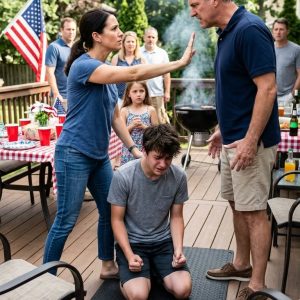
I pulled up to my parents’ house at 9:30 PM. The party was winding down, but the core group—my parents, Kaye, Preston, and the Whitleys—were gathered in the living room.
I walked in. I was barefoot, holding my heels. My dress was rumpled. I smelled like exhaust fumes and stress.
The room went silent.
“Where have you been?” Kaye’s voice was ice.
“Work emergency,” I said.
“A work emergency,” she repeated, tasting the words like sour milk. “You abandoned my engagement party for a delivery?”
“I couldn’t discuss it,” I said wearily.
“Can’t discuss it?” She laughed, a harsh, jagged sound. “Right. Because your job is so top secret. God, Sonia, do you know how embarrassing this is? Preston’s parents were asking.”
Gerald Whitley stepped forward. He looked disappointed. “Kaye, I’m sure Sonia had a reason. Perhaps a shift manager needed help?”
“She delivers food, Gerald!” Kaye shouted, her composure shattering. “She drives a van! What kind of emergency requires you to run out on your family?”
The room was thick with humiliation—mine, hers, everyone’s.
Then, a cell phone rang.
It wasn’t mine. It was Gerald’s.
He frowned, pulling it from his jacket pocket. He looked at the screen, and his eyebrows shot up. The color drained from his face.
“I… I need to take this,” he stammered. He turned away, answering with a sudden, rigid formality. “Mr. Secretary?”
The room froze. My father’s mouth opened. Kaye went still.
“Yes, Mr. Secretary,” Gerald said. His voice was trembling. “Yes, I… I understand.”
He turned slowly. He was looking at me. His eyes were wide, witnessing something he couldn’t process.
“Yes, sir. She… she is standing right here.”
Silence. Absolute, suffocating silence.
“I understand. Of course. It is an honor. Yes, I will tell her.”
Gerald lowered the phone. His hand was shaking. He looked at me like I had just grown a second head.
“That was…” Gerald swallowed hard. “That was the Secretary of State.”
“What?” My mother whispered.
Gerald didn’t look at her. He kept his eyes locked on me.
“He called to personally thank me for hosting Officer Fairchild this evening. He wanted to apologize for pulling you away from the festivities for the security emergency in Bethesda.”
Every head in the room swiveled toward me.
“Officer?” my father croaked.
“He said…” Gerald seemed to be struggling to recall the exact phrasing. “He said you handled the perimeter with… ‘typical efficiency and professionalism.’ He said the Department is in your debt.”
Kaye looked at Preston, then at Gerald, then at me. The hierarchy she had built—the fortress of her own superiority—was crumbling brick by brick.
“But…” Kaye stammered. “You said… meal kits.”
“I never said meal kits, Kaye,” I said softly. “You said that. I just didn’t correct you.”
“But the driving… the van…”
“Armored vehicles,” I said. “Diplomatic motorcades. Not delivery vans.”
My father sat down heavily on the sofa. “Diplomatic Security Service? That’s… Federal Law Enforcement.”
“Yes.”
“You’re an agent?”
“I’m a Regional Security Officer with a GS-15 classification,” I said, the words feeling strange in this living room. “I protect diplomats. I secure embassies. Tonight, I coordinated the response to an attack on the Secretary’s transport.”
“Why didn’t you tell us?” my mother asked. There were tears in her eyes. “Why did you let us think…?”
“Because you wanted to think it,” I said. It wasn’t an accusation, just a fact. “It made sense to you. It fit the story you wanted to tell. And honestly? After a while, it was easier than fighting to be seen.”
Kaye was crying now. Not the pretty tears of a bride-to-be, but the hot, ugly tears of humiliation.
“You let me make a fool of myself,” she whispered. “In front of Preston’s family.”
“You did that yourself, Kaye,” I said. “I just stood there.”
Gerald cleared his throat. The dynamic in the room had shifted violently. The power was no longer with the venture capitalist or the lawyer. It was with the woman in the rumpled dress who had the Secretary of State on speed dial.
“I think… perhaps Patricia and I should go,” Gerald said. He looked at me with a mixture of shock and a newfound, terrified respect. “Officer Fairchild… it was an honor to meet you. Truly.”
He offered his hand. I took it.
They left quickly. The silence they left behind was deafening.
My father looked at me, really looked at me, for the first time in fifteen years.
“Meal kits,” he murmured. “We thought… meal kits.”
“I know, Dad.”
“Are you… are you safe? In your work?”
“As safe as I can be,” I said. “I’m good at what I do.”
“I believe you,” he said. And he sounded like he meant it.
I looked at them—my family, standing in the wreckage of their assumptions. I didn’t feel triumph. I didn’t feel vindicated. I just felt… light. The burden of their condescension was gone.
“I’m going to go,” I said. “Congratulations on the engagement, Kaye.”
I walked out into the cool September night. The air was crisp. My phone buzzed again. A text from Jerry Oaks.
Nice work tonight. Secretary was impressed. Drinks on me next week.
I smiled, typing back: You’re on.
I got into my car, started the engine, and drove away from the house, leaving the meal kits behind forever. Tomorrow there would be questions. Tomorrow there would be apologies. But tonight, for the first time in a decade, I wasn’t a ghost. I was just Sonia. And that was enough.