Chapter 1: The Neck Brace
I was still wearing the rigid plastic neck brace from my car accident when my stepsister decided to make her point.
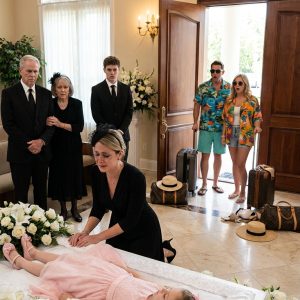
We were at my father’s house, a sprawling colonial in the suburbs that smelled of lemon polish and funeral lilies. It was two days after we had buried him. The air in the house was stifling, thick with the performative grief of people who had been waiting for this moment for years.
I was in the hallway, arranging a vase of hydrangeas that a neighbor had sent over, trying to make myself useful, trying to disappear. I didn’t hear Catherine walk up behind me. The hallway runners were thick, expensive wool—Janet’s taste, paid for with my father’s money—and they swallowed the sound of her footsteps.
I didn’t see her hands coming.
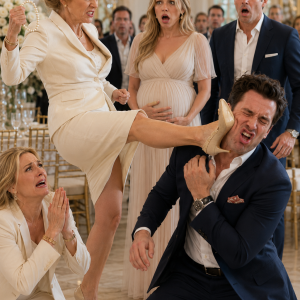
She didn’t grab my arm or my shoulder. She grabbed the brace itself. Her manicured fingers hooked into the plastic scaffolding holding my cervical spine in place, and she twisted. Hard.
I gasped, a wet, choking sound as the plastic edge dug into my windpipe. My airway closed. My vision blurred at the edges, dissolving into static.
“A stepchild like you thinks you can fight me for the inheritance?” she hissed into my ear. Her breath was hot against my skin, smelling of peppermint and malice. “You’re delusional, Lindsay.”
I clawed at the brace, desperate for air, my fingernails scraping uselessly against the polymer. My knees buckled. I hit the floor hard, the impact jarring my injured neck, sending a spike of white-hot pain down my spine.
And then, the room erupted. Not in screams, not in calls for help.
They laughed.
My stepmother, Janet, stood in the doorway of the living room, a crystal wine glass in her hand. Her sister, my cousins—they were chuckling. A low, rippling sound like an audience reacting to a pratfall at a dinner theater. No one moved to help me. Not one person.
I lay there on the cold tile, gasping for breath, tears streaming down my face, looking up at the people who were supposed to be my family. This is what I am to them, I thought, the realization colder than the floor. I am not a daughter. I am not a sister. I am a punchline.
But what Catherine didn’t know—what none of them knew as they stood over me with their sneers and their wine—was that my father had left something behind. A failsafe. A ghost in the machine that would change the trajectory of all our lives in exactly one week.
Have you ever been humiliated by the people who were sworn to protect you?
My name is Lindsay Donovan. I am thirty-five years old, a forensic financial analyst who has spent the last decade building a career investigating fraud. I learned early that relying on others, especially the ones sharing my last name, was a poor investment strategy.
When my father passed away, I drove six hours to attend his funeral. Part of me, the foolish, childish part, hoped that death might do what life never could: bring us together. I was wrong.
Janet, my stepmother of twenty-two years, met me at the front door like I was a solicitor selling pest control. There was no embrace. No shared tears. Just a thin, razor-wire smile.
“Your old room has been converted to storage for Catherine’s winter wardrobe,” she said, blocking the entrance slightly before stepping aside. “You can sleep in the guest room. The one in the basement.”
I stood in the doorway of the house where I’d spent my childhood, holding my overnight bag, and understood immediately. The funeral arrangements consumed the first day, but dinner that evening revealed the family dynamics in full, ugly color.
Janet sat at the head of the table—my father’s chair, I noticed with a pang of resentment—and held court. Catherine positioned herself at Janet’s right hand, her green eyes scanning the room with barely concealed satisfaction.
I had always found it strange that Catherine looked nothing like my father. Her auburn hair and fair complexion were starkly different from the dark, olive tones my father and I shared. But I assumed genetics were just rolling dice.
“We were here every single day caring for him,” Janet announced to the table, her voice pitched loud enough for the back row. “Feeding him. Bathing him. Managing his medications. It was exhausting.” She paused, letting her gaze drift to me, heavy with accusation. “Some of us had other priorities, of course.”
“Some people only show up when there’s something to gain,” Catherine jumped in, buttering a roll with aggressive precision.
I felt my face burn. Years of a carefully constructed narrative had convicted me in absentia. Lindsay the absent daughter. Lindsay the career-obsessed robot. Never mind that Janet had barred the doors, intercepted the calls, and claimed the house was “too crowded” every Christmas.
I excused myself from the table, needing air. As I walked down the hallway, I noticed something odd.
Security cameras.
They were small, sleek, black domes mounted in the corners of the ceiling. My father had hated technology. He was a man who refused to own a smartphone and wrote checks at the grocery store. Why would he suddenly install a high-end surveillance system inside his own home?
The next morning, the assault happened. Catherine’s hands on my throat. The laughter.
Lying in the guest room that night, ice pressed against my swollen neck, I replayed Catherine’s words. Not “You don’t deserve the money,” which would be standard greed. No, she had said something else.
“You were never really part of this family.”
It felt less like an insult and more like a diagnosis. A fact she held in her pocket.
I returned to my apartment after the funeral, but the atmosphere of that house followed me. I went back to work, analyzing spreadsheets and hunting for hidden assets in corporate fraud cases, but my mind was elsewhere.
Then the phone calls started.
My cousin Margaret called first. “Lindsay, I just wanted to check on you. Janet mentioned you’ve been having… episodes since your accident. She said you were acting erratic at the funeral.”
A few days later, my Uncle Robert. “Are you sleeping, Lindsay? Janet said you seemed unstable.”
I understood the strategy. It was a hostile takeover of my reputation. Janet was planting seeds of doubt about my mental state so that when I inevitably challenged the will, I would look like the desperate, crazy stepdaughter.
I felt cornered. I considered giving up. Maybe the emotional ROI wasn’t worth the fight.
Then I ran into Helen.
Chapter 2: The Dead Man’s Switch
It happened at a grocery store three weeks after the funeral. I was in the tea aisle, staring blankly at Earl Grey, when a soft voice said my name.
“Lindsay?”
I turned to see a woman in her sixties, gray hair pulled back in a sensible bun, wearing a thick wool coat. It took me a moment. Helen Morrison. She wasn’t a relative, despite the last name; she had been my father’s caregiver for fifteen years.
“Helen,” I breathed. “I didn’t see you at the funeral.”
“I wasn’t invited,” she said quietly, glancing around the aisle as if checking for surveillance. “Janet fired me two months before he passed. She said they didn’t need outsiders anymore.”
Helen steered me toward the pharmacy section, a quiet corner near the blood pressure machines. “I’ve been praying I’d run into you. I tried calling, but your number had changed.”
“Helen, what happened?”
“Your father was changing in those last months,” she whispered. “He wasn’t just sick, Lindsay. He was scared. He started hiding things. He insisted on installing those cameras in the hallway and his study because he thought someone was going through his papers while he slept.”
My heart began to hammer against my ribs. “Did he say who?”
“He didn’t have to.” Helen leaned in closer. “The week before Janet let me go, he grabbed my hand. He was lucid—more lucid than he’d been in weeks. He said, ‘Helen, if anything happens to me, make sure Lindsay knows to check under my desk. The false bottom. Make her repeat it.'”
I felt the floor shift beneath my feet.
“I promised him,” Helen said, her eyes filling with tears. “I loved your father, Lindsay. He was a good man trapped in a bad situation. Whatever Janet and Catherine are doing, he didn’t want it. I know that.”
I thanked her, my hands shaking as I took her number. I drove straight to my father’s house.
I parked three streets over and waited. I sat in my car for three hours, watching the driveway through binoculars like a private investigator. Finally, the garage door opened. Janet’s Mercedes backed out, followed by Catherine’s SUV. They were likely heading to their Wednesday spa appointment—a ritual they never missed.
I approached the house using the spare key I had kept hidden in my wallet for a decade, praying Janet hadn’t changed the locks. The tumblers clicked. The door swung open.
The house was silent. I went straight to the study. It smelled of pipe tobacco and old paper—the scent of my father. I knelt beside the heavy mahogany desk. I felt along the underside of the drawer unit, my fingers brushing against rough wood until I found a small, metallic latch.
Click.
A panel dropped open. Inside lay a single, silver USB drive.
I pocketed it and left immediately, locking the door behind me.
Back in my apartment, I plugged the drive into my laptop. It contained several audio files and one video file that was password-protected. I played the audio first.
My father’s voice filled the room, tired and strained.
“I don’t know who to trust anymore. They keep changing my medications. I feel foggy all the time. Janet keeps bringing me papers to sign, telling me they are for insurance. But I see the headers. Property transfers. Power of attorney.”
I couldn’t crack the video file. It was encrypted. But I had enough to know that the official story of my father’s death was a lie.
The next morning, I visited an estate lawyer named David Chen. He was a shark in a tailored suit, known for tearing apart fraudulent wills. I handed over the USB drive.
“Get into that video,” I told him. “And while you do that, I’m going to the police.”
I filed a formal assault report about the neck brace incident. I provided my medical records showing the tracheal bruising. I mentioned the security cameras.
“If the system records on a loop,” I told the officer, “the footage might still be there.”
Janet found out about the lawyer within forty-eight hours. Her next phone call was different. Gone was the condescension. In its place was a jagged, desperate edge.
“Whatever you think you’re doing, Lindsay, it won’t work,” she snapped. “Everyone knows you abandoned him. No judge will believe your word over ours.”
“We have documentation proving Dad wanted us to handle everything,” Catherine chimed in from the background. “You have nothing but desperation.”
But beneath the threats, I heard it. Fear.
That night, David Chen called me.
“Lindsay,” he said. His voice was grim, stripped of its usual professional detachment. “I accessed the video file. You need to come to my office tomorrow morning. Clear your schedule. And Lindsay… lock your doors tonight.”
Chapter 3: The Will Reading
The will reading was scheduled for 2:00 PM on a rainy Tuesday.
I arrived early at David Chen’s office. I sat in the conference room alone, a thick folder of documents beside me. Everything I had gathered was in there: medical records, Helen’s affidavit, the police report number, and the financial analysis I had run on Janet’s spending habits.
Janet and Catherine arrived precisely on time. They were dressed in expensive black mourning clothes that looked like they belonged in a Vogue editorial. Catherine slid into the chair across from me. She reached over and patted my hand—the same hand she had nearly broken my neck with weeks ago.
“Lindsay,” she said, her voice dripping with theatrical sympathy. “I really hope we can put our differences aside and honor Dad’s true wishes today.”
“I intend to,” I said, pulling my hand away.
The lawyer, David, entered with a paralegal. He didn’t sit. He stood at the head of the table, his face unreadable.
“Janet,” David began, skipping the pleasantries. “You submitted a will for probate dated three months ago. A will that leaves ninety percent of the estate to yourself and Catherine, disinheriting Lindsay almost entirely.”
Janet nodded, confident. “That was Robert’s wish. He was heartbroken by Lindsay’s absence.”
“We have a problem with that document,” David said. “Specifically, we have medical proof that at the time of signing, Mr. Donovan lacked the cognitive capacity to execute legal documents. His dementia diagnosis makes that will invalid.”
Catherine shot to her feet. “That’s a lie! He was fine!”
“Sit down, Miss Donovan,” David said. His voice was like a whip crack. “The last legally binding will—signed two years prior, when your father was fully lucid—leaves seventy percent of the estate to his daughter, Lindsay.”
The room went silent. I watched Janet’s face. The mask didn’t slip; it shattered.
“Furthermore,” David continued, “we commissioned a handwriting analysis. The signature on your version shows clear signs of ‘guided writing.’ Someone physically moved his hand.”
“This is ridiculous,” Janet spat. “We’re leaving.”
“I wouldn’t do that,” David said. He picked up a remote control and pointed it at the wall-mounted screen. “The USB drive Lindsay provided contained a video file. We’ve unlocked it.”
The screen flickered to life.
My father appeared. He was sitting at his desk, looking frail and terrified. Catherine entered the frame. She snatched papers from his trembling hands. She shoved a pen at him.
Janet walked into view. She stood behind him, arms crossed.
“Just sign it, Robert,” Janet’s voice rang out from the speakers, cold and impatient. “Stop stalling.”
“Where is Lindsay?” my father asked, his voice breaking. “I want to talk to Lindsay.”
“She doesn’t care about you, Dad!” Catherine yelled in the video. “She abandoned you! Now sign the damn paper!”
I watched, tears streaming down my face. Not for the money. For him. They had weaponized his love for me against him. They had convinced him I was the villain while they picked his pockets.
The video ended. In the silence of the conference room, Catherine’s phone began to buzz against the mahogany table. She glanced at the screen, and the blood drained from her face.
“I need to answer this,” she stammered.
“That’s the police,” David said calmly. “They are downstairs. The assault report Lindsay filed has been corroborated. Remember those security cameras you installed, Janet? You forgot to wipe the cloud backup. The footage of Catherine choking Lindsay is quite… graphic.”
Catherine looked like she was going to be sick.
“And finally,” David said, turning a page in his file, “the finances. Janet, you owe two hundred thousand dollars in gambling debts. Catherine, eighty thousand in credit cards. You weren’t protecting the estate. You were looting it.”
Janet stared at the table, her hands clenched into fists. Her empire was dust.
David reached into his briefcase. “There is one more thing. Your father left a sealed personal letter for Lindsay. To be opened only after the legal matters were resolved.”
He slid a plain white envelope across the table to me.
Chapter 4: The Genetic Truth
I took the envelope. My name was written in my father’s familiar, shaky script.
While Catherine was escorted out by building security to meet the waiting officers, and Janet sat in stony, defeated silence, I opened the letter.
My dearest Lindsay,
There is something I should have told you twenty years ago. I was a coward. I thought silence was protection, but I see now it was just fear.
Shortly after Catherine was born, I found evidence of an affair Janet had with a colleague. I arranged for a DNA test. Catherine is not my biological daughter.
I stopped reading. The air left my lungs.
I looked up at Janet. She wasn’t looking at me. She was staring out the window, her jaw set. She knew. She had always known.
I went back to the letter.
I confronted Janet. She begged me not to destroy Catherine’s life. She said the child was innocent. So, I made a deal with the devil. I stayed. I raised Catherine as my own. But Janet… she hated you for it. You were the living proof of her infidelity. You were the only one who truly belonged to me.
That is why she pushed you away. That is why she poisoned our relationship. She was terrified that if I loved you too much, I would leave her and expose her lie.
You were always my true daughter, Lindsay. Inheriting my values, my character, my blood. Forgive me for not being strong enough to protect you from them.
I sat there, the paper trembling in my hands.
Everything made sense. The cruelty. The exclusion. It wasn’t just greed; it was existential dread. I was the threat. I was the biological reality they couldn’t erase.
Janet looked at me then. Her eyes were empty. “He told you, didn’t he?”
“He did,” I said.
“It doesn’t matter,” she whispered. “He’s dead.”
“He is,” I replied, standing up. “And you’re going to prison.”
The legal fallout was swift and brutal.
Janet and Catherine took plea deals. The evidence—the video, the financials, the assault footage—was insurmountable. Janet was sentenced to three years for elder abuse, fraud, and coercion. She forfeited all claims to the estate.
Catherine received two years of probation and community service for the assault and fraud, largely because her lawyer argued she had been manipulated by her mother her entire life.
In the hallway after the sentencing, Catherine cornered me. She looked broken, stripped of her designer armor.
“What did the letter say?” she demanded. “Why did he leave everything to you?”
I looked at her. Really looked at her. I saw the fear of a woman who didn’t know who she was.
“He told me the truth,” I said quietly. “About your father.”
“My father is dead,” she snapped.
“Robert Donovan raised you,” I said. “But he wasn’t your biological father. Janet had an affair. He kept the secret to protect you.”
She screamed at me. She called me a liar. But deep in her eyes, I saw the flicker of recognition. The mismatch in features. The weird tension that had always hummed through the house.
I walked away. I didn’t need her to believe me.
Chapter 5: The Solvency of Self
Six months later, I stood in the sunlight outside a small brick building in downtown Chicago.
Above the door, a modest sign read: The Robert Donovan Foundation.
I had sold the house. I couldn’t live in that museum of deception. But I kept the desk. I used the inheritance to start a non-profit dedicated to legal and financial support for victims of elder abuse.
Helen was my first hire. She serves as our senior advisor, helping families spot the signs of coercion that I had missed.
I sat on a bench nearby, watching the city move. My phone buzzed. It was a text from my Aunt Ruth—my father’s sister, who had re-entered my life once Janet’s blockade was lifted.
Coffee? I found old photos of your dad. You have his exact smile.
I smiled, feeling a lightness in my chest that had been missing for decades.
Lindsay’s story teaches us something vital: Silence is not peace, and endurance is not strength.
For years, I thought that if I just took the abuse, if I just stayed quiet, I would eventually earn my place in the family. I thought love was a transaction where I paid in compliance.
But some people aren’t interested in your worth; they are only interested in your silence.
If you recognize yourself in this story—if you are the one walking on eggshells, the one being gaslit, the one made to feel crazy for seeing the truth—please listen. You deserve better. You deserve a seat at the table that doesn’t require you to shrink yourself.
Walking away from toxic family is not betrayal. It is an act of profound self-respect.
My father stayed silent for twenty years to “keep the peace,” and it led to a war. The truth is painful, yes. It burns. But it is the only foundation upon which you can build a life that actually belongs to you.
I finally have a family now. It’s small. It’s imperfect. But it’s real. And for the first time in my life, I am not just an asset to be managed. I am free.