The Champagne Tower
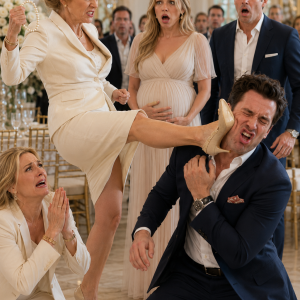
The sound of a $200 bottle of Dom Pérignon shattering on the tiled floor didn’t scare me as much as the manic look in my sister Cassie’s eyes. She screamed that my black wheelchair looked like an ugly lump of coal, ruining her perfect engagement photo. Then she shoved me straight into the glass tower of champagne, blood mixed with sparkling wine. I couldn’t move my legs to stand up. But Cassie had made a fatal mistake. She didn’t know that the elegant woman who had just crossed the lawn and rushed over to stabilize my neck with the professional motion of a top expert was Dr. Helena Kingsley, the groom’s aunt. She was also the very person who had drilled eight screws into my spine 24 months ago. And this time, Dr. Kingsley wasn’t using a scalpel. She was using the law.
But I’m getting ahead of myself. To understand how a biological sister could be so cruel, I must take you back to an hour prior.
Chapter 1: The Pastel Nightmare
When the wrought iron gates of Magnolia Springs Botanical Garden first swung open, they revealed what could only be described as a pastel fever dream. Pink roses, mint-green hydrangeas, and cream-colored lilies spilled from every available surface. Gossamer ribbons twisted around white columns. A string quartet played something baroque and expensive-sounding near a marble fountain.
This was Cassie’s vision of perfection. And I was about to become the single black mark on her pristine canvas.
The mandatory dress code was spring pastel, baby pink, or mint green, the invitation had specified in looping calligraphy. No exceptions.
I had complied by wearing a pale pink silk dress that I’d found on sale at Nordstrom Rack, the kind of dress that made me feel almost pretty despite everything. The fabric draped nicely over my atrophied legs, and I’d even done my hair in soft waves that fell past my shoulders.
But my ultralight carbon wheelchair was matte black, a specialized piece of equipment worth $5,000 that I had saved forever to buy. Every penny from my disability payments, every birthday check from distant relatives, every dollar I could scrape together from freelance editing work had gone into this chair. It weighed only 18 pounds, and moved like a dream compared to the clunky, hospital-issued one I’d used for the first six months after the accident. This chair was my freedom, my independence, my ability to navigate the world without asking for help every five minutes.
I didn’t think Cassie would care about the color. I was wrong about a lot of things back then.
I rolled myself up the accessible ramp—thank God the venue actually had one—and scanned the crowd for my sister. She stood near the champagne fountain, a vision in ivory lace that probably cost more than my entire year’s worth of medical supplies. Her blonde hair was swept into an elaborate updo, and her makeup was magazine-perfect. She was laughing at something Greg, her fiancé, had said, her hand resting possessively on his arm.
Greg was a good guy, as far as I could tell from the three times I’d met him. He was an architect, soft-spoken and kind, with an easy smile that seemed genuine. I’d wondered more than once what he saw in Cassie. But then again, Cassie had always been good at showing people only what she wanted them to see.
I approached with total sincerity, wheeling myself through clusters of guests who politely stepped aside. My heart hammered in my chest. Despite everything, despite the two years of cold silence, despite the way she’d rewritten history to make herself the victim—I still hoped. I still believed that somewhere inside my sister was the girl who used to braid my hair before dance recitals, who used to sneak me cookies when mom put me on those horrible pre-performance diets.
“Cassie!” I called out, my voice bright with forced cheer.
She turned, and for just a moment, I saw something flicker across her face. Annoyance? Disgust? It was gone so quickly I might have imagined it.
“Matilda,” she said, her smile not quite reaching her eyes. “You made it.”
The way she said it—you made it—as if she’d expected me to fail, or perhaps hoped I would. I swallowed the hurt and held out a small gift box wrapped in vintage rose-patterned paper. Inside was a pair of vintage pearl earrings that I’d found after weeks of searching through antique sites and estate sales.
Cassie had said, years ago when we were still close, when the Jeep hadn’t yet crashed into the tree, when I could still stand on my toes and execute 32 perfect fouettés, that she loved vintage pearls. They reminded her of grandma’s jewelry, she’d said. The pearls grandma wore in her wedding photos, the ones that had been lost when she passed.
To buy these earrings, I had to withdraw money from my emergency medication savings fund, the account I kept for when insurance inevitably denied coverage for something essential. But I’d wanted to give Cassie something meaningful, something that said I still love you, even though you’ve made it clear you don’t love me back.
I naively waited for a smile, or at least a nod of acknowledgement. Cassie took the box with two fingers, as if it might contaminate her. She opened it without ceremony, glanced at the pearls nestled in tissue paper, and her lip curled.
“Second hand?” She said it like a diagnosis. “It looks old. This doesn’t match my Vera Wang dress at all.”
She carelessly dropped the gift box onto a nearby cocktail table, barely looking at it, before her attention shifted back to her phone. Her thumb scrolled, probably checking how many likes her engagement announcement had gotten on Instagram.
My heart tightened, a physical sensation like someone had reached into my chest and squeezed. But I swallowed my tears for the sake of the family peace my parents always forced me to maintain. Don’t rock the boat, Matilda. Your sister is going through a stressful time. Be the bigger person, Matilda. She didn’t mean it that way.
Except she did. She always did.
It was then that Cassie’s gaze dropped to my wheelchair, and her entire demeanor shifted from dismissive to outright hostile.
“What is that?” she hissed, stepping closer.
“My wheelchair,” I said slowly, confused by the venom in her tone. “Cassie, you know I…”
“That pitch-black chair looks like the Grim Reaper in the Garden of Eden,” she whispered, leaning down so only I could hear. Her breath smelled like champagne and spite. “You did this on purpose, didn’t you? You couldn’t just let me have one perfect day.”
“Cassie, I didn’t… This is my chair, I need it to…”
But she was already walking away, her heels clicking sharply against the stone pathway. I watched as she made a beeline for a nearby service station, where extra linens and supplies were stacked on a folding table. She snatched a spare tablecloth—white, of course, pristine—and snapped it open with a sound like a whip crack.
She marched back to me, the tablecloth billowing behind her like a cape. “Cover this pile of junk up right now,” she said, her voice low and dangerous.
Before I could respond, she tried to drape the tablecloth over my legs, over the chair, as if I were a piece of furniture that didn’t fit her aesthetic. As if I were something shameful that needed to be hidden away.
For the first time in two years—two years of accepting blame for an accident I didn’t cause, two years of enduring her cold shoulder and her pointed comments and her revised version of history—I fought back.
I grabbed the tablecloth and pushed it away. “No.”
Such a small word. Such enormous consequences.
Cassie’s face went red, blotchy patches appearing on her neck and cheeks. She yanked the tablecloth back and stormed away, but not before I heard her mutter, “Ungrateful bitch.”
Chapter 2: The Shatter
For the next hour, I watched from the periphery as Cassie worked the crowd, her charm turned up to maximum wattage. I watched her whisper to guests, watched them glance in my direction with expressions ranging from pity to suspicion. I knew what she was doing, I’d seen her do it before. She was controlling the narrative, getting ahead of whatever story might emerge from our interaction.
Later, I would learn exactly what she’d been telling people. That I had Munchausen syndrome, that I just loved sitting in that wheelchair for pity, but I was actually fine. That the accident from two years ago, the accident SHE caused while driving the Jeep and texting her ex-boyfriend before hitting a tree, wasn’t nearly as bad as I made it out to be. That I was dramatic, attention-seeking, jealous of her happiness.
She was using my tragedy to paint me as a liar in everyone’s eyes. And the worst part? Some of them believed her.
The engagement party continued around me like I was a rock in a stream—guests flowing past, occasionally glancing over, mostly pretending I wasn’t there. I parked myself near the rose garden, away from the main festivities, and watched my sister float from group to group like some kind of pastel butterfly. Greg caught my eye once and started to come over, but Cassie intercepted him smoothly, threading her arm through his and redirecting him toward an elderly couple near the fountain.
I wondered if he knew. If she’d told him the real story about the accident, or if he’d gotten the sanitized version, the one where I was the reckless one, the drunk one, the one who’d ruined everything.
About an hour after the party started, a photographer appeared—some hipster guy with a man bun and expensive equipment. He started setting up near the main stage area, a raised platform decorated with what must have been a thousand dollars’ worth of peonies.
“Family photos!” Cassie announced, her voice cutting through the string quartet. “Everyone gather round!”
I stayed where I was. Maybe if I remained still enough, small enough, she’d forget about me.
No such luck. Cassie’s eyes found me across the lawn. She gestured impatiently, her smile fixed and frozen. I wheeled myself over slowly, dreading whatever fresh humiliation awaited.
The rest of the family was already assembling—mom and dad looking uncomfortable in their dressy clothes, Greg’s parents looking wealthy and vaguely confused, various aunts and uncles and cousins filling in the gaps.
And there, at the far left of the formation, sat a large pink-ribboned banquet chair, the kind with a straight back and armrests, the kind that requires core strength and balance to sit in safely. The kind I absolutely could not use.
“Matilda,” Cassie said sweetly, her public voice dripping with artificial warmth. “Move the wheelchair somewhere else. Sit on that chair. I want this photo to be uniform.”
Everyone was watching. The photographer had his camera up, ready to shoot. Mom was making her please don’t cause a scene face. Dad was staring at his shoes.
“Cassie,” I said quietly, trying to keep my voice steady. “You know I have a T-10 spinal injury. I don’t have the core balance to sit on a regular chair. I’ll fall.”
I’d explained this before, countless times over the past two years. A T-10 complete spinal injury means I have no sensation or movement from approximately my belly button down. No abdominal muscles to hold myself upright. No ability to catch myself if I start to tip. Sitting in a regular chair without support was like asking someone to balance on a tightrope with no pole—theoretically possible for about five seconds before physics and gravity won.
Cassie’s smile didn’t falter, but something dark and ugly flashed in her eyes. “You’re just good at ruining things,” she said, her voice still sugary for the benefit of the crowd, but with an edge sharp enough to draw blood.
Then, leaning closer, she whispered. “You’re jealous because I’m getting married and you’re a cripple, right?”
The word hit me like a slap. Not because I hadn’t heard it before. I’d heard it from strangers, from kids, from drunk assholes at bars, but never from my own sister. Never from someone who was supposed to love me.
“Stand up, you fake,” she hissed.
And then she grabbed me.
The action happened so fast it completely surprised me. Cassie used both hands to grip me under my left armpit and yanked upward with a strength I didn’t know she possessed. The jerk was violent, unexpected, pulling me up and forward at an angle that immediately threw off what little balance I had.
My hands scrambled for the armrests of my chair but found only air. The world tilted sickeningly.
In her fury and her haste, Cassie stepped on the hem of her own long dress. I saw her stumble, saw her arms windmill as she fought to keep her own balance. Her grip on me loosened and then released entirely as she dodged backward, trying not to fall. She caught herself, took a step back, regained her balance with the grace of someone who still had full control of their body.
I wasn’t so lucky.
My lower body was immobile, dead weight that I couldn’t control or compensate for. The momentum from her pull launched me forward. I had no leg muscles to brace with, no core strength to right myself. I was falling, and there was nothing I could do to stop it.
The champagne tower was directly in front of me. An elaborate pyramid of crystal glasses, each one filled with golden bubbling liquid, stacked seven levels high. Probably cost more than my monthly rent. Definitely cost more than I was worth in Cassie’s eyes.
I hit it with my shoulder and chest, and the entire structure came down.
The sound was incredible, a cascading crash of breaking glass, like wind chimes made of violence. Hundreds of shards exploded outward. I felt them slice into my hands as I tried to break my fall. Felt them cut my face, my neck, my arms. Sharp pain bloomed across my skin in a dozen places. My head snapped to the side, hitting the tile floor hard enough to make my vision blur.
The expensive bottle from the top of the pyramid—that $200 Dom Pérignon that someone had placed there like a crown—fell onto my shoulder with a heavy thud before rolling away.
Blood began to spread across the white tiles, mixing with champagne into a grotesque rosé. My pink dress was soaked through, and I couldn’t tell anymore what was wine and what was blood. My hands looked like they’d been through a paper shredder, glass embedded in my palms and fingers.
The entire garden went dead silent. No music, no chatter. Just the sound of champagne still dripping from the edge of the platform, and my own ragged breathing.
I lay there, unable to move, afraid to move. My neck hurt, my head was ringing.
And somewhere above me, I heard Cassie’s voice, high and hysterical.
“Oh my god, my $5,000 dress! You ruined my party!”
Not, are you okay? Not, someone help her! Just, my dress.
Chapter 3: The Surgeon and the Witness
“Stand still. Don’t anyone touch her.”
The voice was female, authoritative, the kind of voice you obeyed without question.
Through my blurred vision, I saw a woman drop her Gucci handbag onto the grass and push past a waiter. She moved with purpose, with the confidence of someone who knew exactly what to do in an emergency. She knelt beside me in the puddle of wine and blood, not caring about her elegant, cream-colored pantsuit.
Her hands were gentle but firm as she placed them on either side of my head, stabilizing my neck in the standard medical C-spine technique.
“Listen to me carefully,” she said, her voice calm and professional. “Don’t try to move. Don’t turn your head. I’m going to hold you steady until the paramedics arrive.”
I knew that voice. Dr. Helena Kingsley. Greg’s aunt. The chief of neurosurgery at Mount Sinai Hospital. The woman who had saved my life 24 months ago.
Dr. Kingsley looked up, her sharp gaze finding Greg in the crowd. “Call 911 immediately. Report a spinal injury and assault. Request police and an ambulance. Right now.”
“Assault?” Cassie’s voice went shrill. “What are you talking about? She fell. It was an accident.”
But Dr. Kingsley wasn’t looking at Cassie. She was looking at me. And something in her expression, a mix of recognition and fury, told me she knew exactly who I was. She’d known the moment she saw me fall.
“Matilda Wells,” she said softly, just for me. “I know you. I’m going to take care of you. You’re safe now.”
And despite the pain. Despite the blood. Despite everything. I felt something inside me finally break free. I wasn’t alone anymore.
“Aunt Helena, you’re overreacting!” Cassie spiraled, sensing she was losing control. “She’s faking it. She can walk. She’s just acting to ruin my day.”
Dr. Kingsley’s hands didn’t move from my head, but her voice could have frozen nitrogen. “Miss Wells, I am the one who personally drilled eight pedicle screws into your sister’s T-10 and T-11 vertebrae 24 months ago at Mount Sinai Hospital. I know the structure of her shattered bones better than she does herself.”
A collective intake of breath from the crowd.
“Do you want to debate medical knowledge with the chief of neurosurgery?” Dr. Kingsley continued.
Silence from Cassie. Blessed, beautiful silence.
Within minutes, paramedics were surrounding me. Dr. Kingsley rattled off my history: “T-10 complete, hardware in place, recent trauma to the head and cervical spine. Multiple lacerations, possible concussion.”
As they lifted me onto the stretcher, two police officers approached Cassie.
“Ma’am, we need to ask you some questions about the incident.”
“It was an accident! I was just trying to help her sit down!” Cassie’s face was a mask of barely contained panic.
“I saw what happened.”
The voice came from an older man in a gray suit—Lucas Chambers, one of Greg’s business associates. He stepped forward, his expression grave.
“I was standing less than two meters away,” he said clearly. “I clearly saw her use both hands to grab her sister and pull hard with intent. That was not accidental or a slip of the hand. She deliberately caused this girl to fall. That is assault.”
The female police officer stepped closer to Cassie. “Ma’am, given the witness testimony and the victim’s injuries, you need to come with us to the station for questioning regarding an assault charge.”
“What? No!” Cassie shrieked, backing away. “You can’t take me! It’s my engagement party!”
She swatted at the officer’s hand, hysterical now. “Greg! Tell them to stop!”
The officers moved instantly, spinning her around. Handcuffs clicked into place. Cassie started to cry—ugly, snotty sobs that ruined her makeup. Her magnificent $5,000 dress was stained with wine and my blood.
As she was led toward the patrol car, the crowd parted for her like the Red Sea. But the most important thing was Greg. He stood silent. He didn’t defend her. He didn’t argue. He turned his back on her.
That was the moment I realized my first emotional release. She was no longer untouchable.
Chapter 4: The Truth Comes Out
Two days later, I lay in a private recovery room at Charleston County General, sporting 30 stitches and a concussion protocol band. Dr. Kingsley had pulled strings to keep the press away. The video of Cassie’s breakdown was viral.
The door opened, and Greg walked in. He looked like a ghost.
“Matilda,” he said, voice hoarse. “I am so sorry. I didn’t know. I swear to God I didn’t know.”
“She told you I was drunk?” I asked quietly. “That I crashed the car?”
“She said you blamed her to avoid responsibility,” Greg said, sitting heavily.
Dr. Kingsley entered then, carrying a manila folder. She pulled out the toxicology report from my accident two years ago.
“0.0,” Greg read. “Completely sober.”
“The police report indicated that the driver, Cassandra Wells, had been texting while driving,” Dr. Kingsley stated. “She lost control on a curve. Matilda was in the passenger seat.”
Greg looked like he might be sick. “Jesus Christ. I almost married her.”
The door burst open then, and my parents rushed in like a storm surge.
“Matilda!” Mom grabbed my hand, squeezing too hard. “Thank God you’re okay.”
“We’ve been so worried,” Dad added, positioning himself at the foot of the bed.
They hadn’t visited yesterday. But now that Cassie needed something, here they were.
“We need you to do something,” Mom said, dry-eyed. “Please drop the charges. Call the police and say you slipped. Say your sister was just trying to help you up. If you don’t sue, they will release your sister.”
There it was. The demand.
“She assaulted me,” I said, pulling my hand away. “There’s video. There are witnesses.”
“Witnesses can be mistaken,” Dad said quickly.
I let my expression crumble, feigning helplessness. “Mom, Dad… this isn’t about what I want anymore. This is a criminal case between the state and Cassie. I don’t control what happens now.”
My parents exchanged a look, thinking they had found a loophole. They thought I was powerless.
“We understand,” Mom said, patting my arm. “You’re tired. We’ll let you rest.”
They left without asking how I was feeling.
“Are they serious?” Greg asked, staring at the closed door. “They want you to lie for her? After everything?”
“They always want me to lie for her,” I said.
Dr. Kingsley moved to the window and made a call to her attorney. “Richard? I need you to make sure a witness knows his rights. Someone might try to tamper with his statement.”
“You think they’ll try?” Greg asked.
“I know they will,” I said. “And this time, they’re going to get caught.”
Chapter 5: The Ultimatum
The next morning, Greg told me my parents had tried to visit again but were turned away by security. Then he dropped the bomb: they had approached Lucas Chambers, the witness, asking him to “reconsider” what he saw. Lucas was furious and was threatening to file harassment charges.
Cassie was digging her own grave.
Around noon, my assigned attorney, Jennifer Hart, called.
“Your sister’s defense attorney reached out,” she said. “They want a plea deal. The prosecution has them cornered. Cassie is looking at 10 years.”
Ten years. My sister would lose her youth in a cell.
“What are they offering?” I asked.
“If you submit a victim impact statement requesting leniency, they’ll plead guilty to a reduced charge. She’d likely serve 2 years. But there’s a catch. They want full restitution. Medical expenses, pain and suffering, punitive damages. They’re proposing $420,000.”
I nearly dropped the phone. “$420,000?”
“It’s reasonable,” Ms. Hart said. “But the money has to be in our trust account before the preliminary hearing next week. Seven days.”
My parents didn’t have that kind of cash lying around. But they had assets.
That evening, my parents returned, looking haggard.
“$420,000,” Dad said. “That’s what they’re demanding.”
“We don’t have it,” Mom sobbed.
“You have your 401ks,” I said calmly. “You have the sailboat. You have home equity.”
“That’s our retirement!” Dad shouted. “You’re going to destroy this family!”
“Cassie destroyed this family when she threw me into a tower of glass,” I said, my voice hard. “You protected her when she broke my spine. Now you get to decide what’s more important: your retirement fund or your daughter’s freedom.”
“How can you be so cruel?” Mom cried.
“I learned from the best,” I said.
They left. For the next week, I waited. On the sixth day, my lawyer called.
“They did it,” she said. “Liquidated the retirement accounts. Sold the boat for cash. Took out a high-interest loan. The wire just cleared. $420,000, paid in full.”
Two days later, Cassie pleaded guilty. She was sentenced to two years. I watched via video link as she was led away in handcuffs. Greg sat in the back of the courtroom, and when it was over, he nodded at the camera once. A goodbye.
I took the money. I paid my debts. I moved into a beautiful, accessible apartment. And then I cut off all contact with my parents. I blocked their numbers. Returned their letters. When they came to my door, I didn’t answer.
They had made their choice. Now I was making mine.
Chapter 6: The Salt and The Freedom
Eighteen months have passed since the courtroom gavel fell. Today, I’m sitting on a sun-drenched beach in the south of France. For the first time in 42 months, I don’t feel like I’m drowning.
The Mediterranean stretches out before me, impossibly blue. My matte black carbon chair—the one Cassie tried to hide—sits proudly in the sunlight.
The $420,000 changed everything. It bought me choices. I used a significant portion to fund experimental neural chip implant treatment at the Zurich Neuroscience Research Institute. Dr. Kingsley had given me the lead.
It wasn’t a miracle cure. But three weeks ago, during visualization exercises, my right big toe twitched. Just a millimeter. But I felt it—a tingling current of electricity running down a pathway that had been silent for years.
“Matilda, did you see that?” Mari screamed yesterday when it happened again.
Mari is my found family. We met at the Institute. She’d cared for her paralyzed sister for a decade before she passed. Mari fills the void Cassie left, becoming the protective sister I never had.
My phone vibrates. An email from Mom. Attached is a photo of a handwritten letter from Cassie.
Matilda, I’m sorry for taking your legs and your life’s dream. I don’t expect you to forgive me. The days in prison helped me understand how terrible I was. I am learning to be a decent human being from zero. Live well.
Cassie is out early for good behavior. She’s working at a bakery in the Midwest, living above a hardware store.
I read the letter three times. My heart feels light. Not because of the apology—words are cheap—but because I realize I don’t care anymore. No rage. No resentment. No need to reconnect.
Cassie is learning to be a decent human being. Good for her. She can do that without me.
I turn off my phone and drop it into my bag.
“Mari,” I say, beaming at her. “Let’s go get ice cream. My treat.”
Mari laughs, a joyful sound that makes strangers smile. “Let’s go, little sister.”
She pushes me along the coastal path. The breeze tastes like salt and freedom. This is my real family. This is my real life. And damn, it feels good.