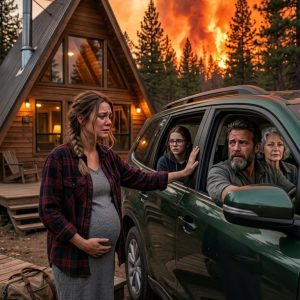
Chapter One: The Descent
The brake pedal went soft exactly halfway down the treacherous, serpentine spine of Miller’s Ridge Road.
At first, my brain refused to process the mechanical failure. I convinced myself that the sole of my wet leather boot had simply slipped. A torrential summer downpour was aggressively glazing the blacktop, and the Smoky Mountains crouched all around us like massive, predatory animals. Their steep slopes were packed thick with ancient pine, suffocating fog, and slick, jagged stone.
But when I pumped my foot again, pressing down with a frantic, desperate weight, the pedal sank entirely to the floorboards with a sickening lack of resistance. There was no pressure. No friction. Just the terrifying sensation of a heavy machine hurtling into an abyss.
“Evan,” I whispered, the word scraping out of my throat, thin and hollow. “Something is wrong.”
My seventeen-year-old stepson was slouched in the passenger seat. One hand was casually braced against the dashboard, while the other held his glowing smartphone. He possessed his late father’s sharply carved, square jaw and his biological mother’s piercing, ice-blue eyes. Yet, as he slowly turned his head to look at me, there was absolutely nothing youthful or frightened in his expression. The dashboard lights cast a pallid, ghostly illumination across his features, revealing a mask of absolute, chilling indifference.
“I know,” he replied, his voice as smooth as polished glass.
The hairpin curve materialized out of the fog with terrifying speed.
Panic seized my chest. I yanked the emergency brake lever upward with both hands, praying for friction. The rear tires instantly locked, unleashing a deafening, high-pitched scream against the wet asphalt. Our rusted, ten-year-old Subaru violently fishtailed. The back quarter-panel clipped the steel guardrail, tearing it away as if the reinforced metal were nothing more than wet tissue paper.
For one agonizing, weightless second, the entire mountain opened up beneath us. Gravity vanished. The rain seemed to hang suspended in the air.
Then, we hit the embankment.
The vehicle violently rolled. Once. Twice. The sound of crushing metal and shattering glass was apocalyptic. The driver’s side window exploded inward, sending a spray of sharp diamonds biting deep into my cheek. The chassis groaned, twisting under the kinetic trauma. My left leg folded entirely wrong, pinned instantly beneath the collapsing steering column with a sickening crunch of bone. The roof crushed downward, stopping just low enough to kiss my bleeding forehead.
When the violent tumbling finally ceased, the world was oriented completely sideways. It was wet, freezing, and filled with a high, sustained ringing in my ears.
I blinked against the warm blood pooling in my left eye. I slowly turned my head toward the passenger seat.
Evan was gone.
His seatbelt was not unbuckled. It was hanging from the pillar, sliced flawlessly in half.
I couldn’t draw a complete breath. Every desperate inhale felt like inhaling crushed gravel. Blood pooled in the back of my throat, tasting heavily of copper and old pennies. Somewhere above me, up on the slick, black asphalt of the ridge, boots were crunching leisurely through the loose gravel.
“Evan?” I croaked, spitting a mouthful of red onto the shattered dashboard.
A shadow eclipsed the ambient moonlight. He appeared at the jagged opening of my broken window, rain sliding effortlessly down his pale, uninjured face.
For one insane, maternal second, a wave of profound relief washed over me. He was alive. He had been thrown clear.
Then, my eyes drifted downward, locking onto the object clutched in his right hand.
It wasn’t a standard pocketknife. It was the heavy, industrial yellow box cutter I kept on the workbench in our garage. The blade was extended, gleaming maliciously under the rain.
He stared down at my broken body. He looked at me the way an annoyed homeowner studies a stubborn stain on a carpet, trying to calculate if it’s worth the effort to scrub out.
“You really should have sold the cabin, Lydia,” Evan murmured softly, leaning a few inches closer to the wreckage. “Dad promised Mom half of that property before she died. You just kept everything for yourself.”
“That’s… that’s not true,” I wheezed, the pain in my trapped leg beginning to bloom into blinding agony.
He offered a smile that contained zero warmth. “It will be true. Once the police find the note.”
He casually slipped the box cutter into his jacket pocket, raised his smartphone, and tapped the screen, snapping a high-resolution photograph of me bleeding out, pinned inside the crushed steel tomb.
Chapter Two: The Ghost in the Rain
A sudden sweep of bright, halogen headlights washed across the canopy of pines above us.
Evan’s predatory expression instantly fractured. His eyes darted toward the road. Without another word, he scrambled backward into the brush and vanished entirely into the darkness.
The heavy, rattling hum of a massive diesel engine grumbled to a halt on the shoulder of the ridge. The hiss of air brakes sliced through the rain. Heavy, purposeful boots began sliding down the muddy embankment.
A large, heavyset man clad in a blinding neon-yellow rain jacket crouched down beside my shattered windshield. His beard was a thick, wiry gray, but his eyes were sharp, calculating, and intensely focused.
“Ma’am,” the stranger whispered, his voice a low, gravelly rumble. “Do not move an inch.”
“He… he cut the brake lines,” I gasped, my fingers weakly clawing at the ripped upholstery. “My stepson… he did this.”
The trucker’s weathered face hardened into granite. He didn’t look at me; his sharp eyes scanned the dark, rain-soaked tree line directly above us.
He leaned his large frame in closer, his warm breath fogging the remaining shards of safety glass.
“Play dead,” he commanded in a harsh, barely audible whisper. “He is still up there. He is watching us.”
A cold spike of terror drove itself directly through my heart. I let my jaw go slack and allowed my eyes to roll back, staring vacantly at the deployed, torn airbag resting in my lap.
Above us, hidden in the suffocating blackness of the mountain storm, Evan stood in the freezing rain, patiently waiting to confirm if his stepmother would expire.
I began desperately counting my own heartbeats because it was the only piece of my shattered anatomy that was still obeying my will. One. Two. Three.
Rain drummed a frantic, arrhythmic beat against the crushed steel roof. The Subaru’s damaged electrical system let out one weak, dying whine, and then the headlights flickered and died. The scent of raw gasoline mixed with the metallic tang of my own blood. My trapped left leg was burning with such a fierce, white-hot intensity that every nerve ending begged me to scream, but the stranger’s dire warning clamped my mouth shut like a physical hand.
Through a narrow, jagged slit between the warped door frame and the mud-smeared window, I caught a fleeting glimpse of Evan’s white sneakers standing perfectly still at the very top of the ridge.
He did not run.
That single, chilling realization terrified me more than the shattered bones or the gasoline. A frightened, innocent boy would have sprinted down the slope to help. A guilty, panicked boy would have fled into the woods or dialed 911 in a state of manufactured hysteria.
Evan simply observed. He was collecting data.
The trucker lowered his head, positioning his broad shoulders to block Evan’s line of sight, and pretended to check my carotid artery. His thick, calloused fingers pressed against the side of my neck, finding my racing pulse.
“Good,” the man breathed, so quietly the rain almost drowned the syllable. “Keep perfectly still.”
“Is she dead?” Evan called out from the darkness above.
The trucker slowly turned his face upward. When he spoke, his voice underwent a masterful, instantaneous transformation. The quiet, calculated whisper vanished, replaced by the rough, impatient drawl of a weary blue-collar worker inconvenienced by tragedy.
“She ain’t answering me, kid!” the man shouted back over the storm. “You know her?”
“She’s my stepmother,” Evan replied. His voice cracked with absolute, flawless theatrical perfection. “She lost control on the curve. The car started hydroplaning. I tried to reach over and grab the steering wheel, but it was too fast…”
“You hurt?”
“No,” Evan yelled, his voice shaking with manufactured adrenaline. “I got thrown clear when we hit the rail.”
Thrown clear. With a seatbelt he had meticulously sliced with a box cutter. Thrown clear into the mud without a single scrape or bruise on his pale skin.
The trucker spat a thick wad of saliva into the red clay. “You call emergency services yet?”
“My phone flew somewhere in the brush during the tumble,” Evan lied smoothly.
Liar, I screamed inside my own head. He just used it to document my murder.
“I got a CB radio in my rig,” the trucker called up. “But the signal is total garbage in this hollow. You stay right up there, kid. Do not come down here. The slope is pure mud. You’ll break an ankle.”
There was a heavy, pregnant pause. I could hear the wet suction of Evan’s sneakers shifting in the mud.
“Can you check if she is really dead?” Evan asked.
The sheer, sociopathic detachment in his tone turned the blood in my veins to ice.
The trucker’s jaw tightened. “Kid, I’ve been hauling freight up and down these mountains for twenty-nine years. I’ve seen enough wrecks to know. She ain’t moving. She’s gone.”
“I need to see her.”
“No, you need to stay exactly where you are before you break your damn neck sliding down here.”
Silence stretched between them, heavier than the rain.
Then, Evan laughed. Just once.
It was not a nervous, hysterical laugh. It was a dark, amused sound of sudden, terrifying recognition.
“You’re not a trucker,” Evan stated flatly.
Chapter Three: The Ghost in the Machine
The massive man kneeling beside my window did not flinch, but I felt his fingers subtly tighten against my shoulder.
“I have seen you before,” Evan continued, his voice dropping the terrified teenager act entirely. It was now cold, calculating, and dripping with venom. “At the diner just outside of Gatlinburg. About a week ago. You were sitting in a booth, talking to her.”
My unblinking eyes remained fixed on the deflated airbag, but inside my skull, my memory violently slammed into reverse.
The diner. Six days ago.
A burly, gray-bearded man in a faded ball cap had “accidentally” bumped into our table, spilling a few drops of black coffee near my placemat. He had profusely apologized, handing me a stack of napkins. I had barely registered his existence. Evan had been sitting across from me, violently stabbing a stack of pancakes with his fork, aggressively texting someone under the table.
The man leaned his heavy torso closer to the wreckage, so close his wet beard brushed against my lacerated cheek.
“Do not react to a single word I say,” he whispered directly into my ear.
Then, he stood up to his full height, facing the top of the ridge.
The rain blurred everything into a gray wash. I listened as the man began slowly climbing the steep slope, his heavy boots digging deep into the slick, red clay.
“You are a very sharp kid,” the man called out, his voice returning to its normal, calculated cadence. “Significantly sharper than your daddy ever was.”
Those words punched the breath right out of my lungs.
Evan remained dead silent.
The man continued his ascent, his tone infuriatingly calm and terrible. “But at the end of the day, you are still just a teenager who thinks cutting brake lines is the perfect murder. It isn’t, kid. Not if the wrong people are watching from the shadows.”
A car door slammed loudly on the road above. An engine furiously roared to life.
The man immediately scrambled back down the muddy embankment, sliding the last few feet until he was crouching beside me once again.
Up on the ridge, Evan’s tires shrieked violently against the wet pavement. His pale headlights swung in a frantic arc through the dense pines, and then the vehicle accelerated, disappearing entirely into the mountain storm. He was gone.
Only then did the stranger lean through my shattered window and proceed to shatter the rest of my known universe.
“My name is not Bill Porter,” the man said, pulling a heavy canvas medical kit from his jacket. “And I did not stop on this ridge by accident.”
I blinked rapidly, clearing the blood from my eyelashes. My lungs burned.
He looked at me with a profound, heavy pity that felt deeply practiced.
“Your late husband, Daniel, hired me three years ago,” he stated gently. “Long before the cancer took him. He hired me to find out whether or not you were actively planning to murder him.”
For one suspended, impossible moment, the agonizing, blinding pain in my crushed leg entirely vanished.
It didn’t vanish because I felt safe. It vanished because the gravity of that sentence was simply too enormous, too utterly devastating, for my bruised neurological system to process.
Your husband hired me three years ago. To find out whether you were planning to kill him.
Rainwater cascaded down my forehead, stinging my eyes. I desperately tried to speak, but only a wet, rattling cough escaped my lips. The gray-bearded man reached his large hands through the jagged perimeter of the windshield and firmly pressed a thick, folded trauma dressing against a deep gash on my shoulder I hadn’t even felt.
“Breathe slow and shallow,” he instructed, his voice authoritative but kind. “You have at least three fractured ribs, potentially a punctured lung, and your left femur is trapped. I already called the wreck in on an encrypted channel before I climbed down here. Rescue teams are en route, but we have maybe ten minutes before the sirens arrive.”
“Who… who are you?” I forced the words out, tasting bile.
“Martin Vale,” he replied, securing the dressing with pressure. “Private investigator. I did fifteen years as a homicide detective with the Knoxville police before going private.”
“My husband…” I swallowed a thick mouthful of blood. “Daniel genuinely thought I wanted him dead?”
Martin’s eyes moved carefully over my battered face, as if he were actively measuring exactly how much devastating truth my fragile cardiovascular system could survive in one sitting.
“Daniel thought someone wanted him dead, Lydia,” Martin corrected softly. “And yes, at first, he was terrified it was you.”
Those words cut infinitely deeper than the broken glass embedded in my cheek.
Daniel and I had been married for nine years. We were not a flawless, cinematic romance. No marriage that sprouts from the soil of profound grief is ever perfect. Evan’s biological mother, Claire, had died of a sudden aneurysm when Evan was only eight years old. Daniel had subsequently spent a decade attempting to parent his son through a crippling lens of guilt and overcompensation. I had spent those same years exhausting myself, trying desperately not to compete with the ghost of a perfect woman.
But I had fiercely loved Daniel. I had sat upright beside his bed through endless rounds of brutal chemotherapy. I had held the plastic emesis basin while he violently vomited until his throat bled. I had slept in agonizing, vinyl hospital chairs and meticulously memorized complex medication schedules. I had held his hand in the dark when he wept because he was terrified Evan would solely remember him as a weak, dying man.
And for all those years, as I wiped the sweat from his brow, he had been staring up at me, wondering if I was the architect of his demise.
Chapter Four: The Poisoned Heir
Martin seemed to read the catastrophic emotional injury in my silence.
“He was experiencing severe symptoms long before the oncologist ever gave him the cancer diagnosis,” Martin explained, his eyes continuously scanning the dark road above us. “Violent dizzy spells. Extreme cognitive confusion. Missing massive blocks of time. Daniel firmly believed someone was systematically tampering with his daily medication.”
“He never breathed a word of that to me.”
“No,” Martin said gently. “Because whoever was doing it had unfettered, daily access to the inside of your house.”
I squeezed my eyes shut.
A memory, sharp and blindingly bright, pierced through the fog of my concussion: Daniel, standing in the middle of our kitchen at two in the morning. He was staring blankly into an open cabinet, genuinely unable to remember why he had walked into the room. And Evan, sitting silently at the marble island, watching his father deteriorate with a bowl of dry cereal completely untouched in front of him.
I had foolishly assumed Evan was simply paralyzed by the fear of losing his dad.
I never realized he was studying his own handiwork.
“What did you find when you investigated me?” I whispered, my voice trembling.
Martin checked the pressure on my shoulder. “At first? Absolutely nothing useful. You were entirely clean. No strange pharmaceutical purchases on your credit cards. No burner phones. No hidden affairs. No secret, bloated life insurance policies. You were just a deeply tired, highly stressed woman who was desperately trying to keep a dying man comfortable.”
“Then why didn’t Daniel tell me the truth when you cleared me?”
“Because by the time I definitively ruled you out, Daniel’s cognitive decline was so severe he didn’t even trust the functionality of his own mind,” Martin said grimly. “And because Evan discovered my existence.”
The boy’s name settled in the cramped, bloody cabin like a second corpse.
“Evan was only fourteen years old when Daniel got sick,” I protested, my mind rebelling against the monstrous reality.
“Fourteen is plenty old enough to lie beautifully,” Martin countered. “And it is exactly young enough that every adult in the room continually underestimates what you are capable of.”
A siren wailed in the far distance, a thin, reedy sound struggling through the torrential rain.
Martin leaned in closer, his expression hardening. “Listen to me very carefully, Lydia. Evan did not just impulsively cut your brake lines tonight. He has been planning this execution in meticulously crafted layers. That suicide note he mentioned? I guarantee you it is already planted. Probably at the cabin, or maybe tucked into your desk at the main house. It will be a beautifully forged document stating that you were severely depressed, crushed by survivor’s guilt, and that you simply couldn’t endure another holiday without Daniel. He will ensure that tonight’s ‘accident’ looks exactly like grief finally pulling you over the psychological edge.”
“He took a photograph of me,” I rasped, fresh tears mixing with the blood on my cheek.
“He’ll use it to prove to the police that he valiantly climbed down to check on you, or he’ll keep it as a private trophy. With a psychopath like Evan, it could be either.”
My hands trembled violently against the slick, red steering wheel. “Why? Just to inherit the cabin? For the trust fund money?”
“Partly.”
“Partly?”
Martin hesitated. The distant siren grew significantly louder, echoing off the canyon walls, then faded slightly as the rescue vehicles navigated a tight switchback.
“Daniel legally altered his will six months before he passed away,” Martin revealed. “He didn’t do it publicly. He drafted a quiet revision with a private attorney down in Maryville. He left you the cabin, the primary estate, and total, unyielding control of Evan’s trust fund until the boy turned twenty-five.”
“I am aware of the will, Martin.”
“What you aren’t aware of is the why.” Martin wiped a stream of muddy rainwater from his brow. “Daniel had started to violently suspect his own son.”
The crushed car suddenly seemed to shrink around me, suffocating me.
“No,” I denied it, shaking my head despite the agonizing pain it shot down my cervical spine.
“Daniel found a ziplock bag of crushed pills hidden deep inside a false bottom in Evan’s school backpack,” Martin said, his voice entirely devoid of judgment. “It was a lethal cocktail. Daniel’s prescription anti-nausea medication, heavily concentrated blood pressure tablets, and powerful sleep aids. Some were missing from the master bottles. Some had been mixed into powder. Daniel handed the bag directly to me in a diner parking lot and wept as he asked if it was scientifically possible for a child to be poisoning a parent slowly enough to mimic a terminal illness.”
I choked on a sob. “Evan worshipped him.”
“Evan loved owning him, Lydia,” Martin corrected. “There is a massive psychological difference.”
The statement was delivered flatly, without an ounce of cruelty. And that made the absolute truth of it infinitely worse.
My mind raced, reclassifying a decade of memories. I thought of Evan as a ten-year-old boy, throwing violent tantrums if Daniel tried to leave the room to take a phone call. Evan screaming until his throat was raw if Daniel dared to hold my hand in public. Evan stealing and hiding Daniel’s smartphone when the hospice nurses tried to call. Evan venomously telling his aunts that I was a gold-digger “stealing Dad’s house,” despite the fact that I had paid half the mortgage out of my own salary for seven years.
I had filed every single one of those terrifying red flags under the convenient labels of grief, childhood trauma, and adolescent acting out.
Martin continued, his eyes scanning the road again. “Daniel finally confronted him about it. Not directly, but he asked Evan if he had ever felt angry enough to physically hurt someone he loved.”
“What did Evan say?” I whispered.
“He looked his dying father dead in the eye and said, ‘Only if they were already leaving me.’“
I remembered Daniel’s final, frantic month of life. He had become utterly obsessed with paperwork, changing digital passwords, upgrading the deadbolts on the doors. He made me swear a blood oath never to let Evan sell the mountain cabin. I had foolishly assumed he was just a dying man terrified his reckless son would squander his legacy.
Now, staring into Martin’s grim face, the horrific truth settled into my bones. Daniel hadn’t been protecting the physical real estate from Evan.
Daniel had been trying to keep Evan from using the property as bait to murder me.
The sirens returned, significantly closer this time, their red and blue lights beginning to reflect weakly against the low-hanging clouds.
Martin reached into the interior pocket of his neon jacket and retrieved a small, black rectangular device no larger than a matchbox. A tiny red LED light blinked rhythmically on its side.
“What is that?” I asked.
“A high-fidelity digital audio recorder. It has been running continuously since I stepped out of my truck.”
“You recorded him?”
“I recorded enough,” Martin nodded grimly. “His unpanicked voice. His chilling question asking if you were really dead. His explicit admission that he recognized my face from the diner. It might not be enough for a slam-dunk conviction on its own, but it is more than enough to completely obliterate the first innocent victim story he tries to feed the state troopers.”
A wave of profound, intoxicating relief crashed over me.
But then, Martin’s expression violently shifted. The hardened investigator went completely rigid.
He looked up toward the ridge.
I heard it, too.
The low, steady hum of an engine.
It wasn’t the heavy, grinding diesel of Martin’s abandoned rig. And it wasn’t the roaring, multi-ton engine of an approaching fire truck.
A smaller vehicle was creeping slowly back down Miller’s Ridge Road, its tires hissing stealthily over the flooded pavement.
Martin cursed viciously under his breath. “He came back.”
Chapter Five: The Weight of Truth
Pale, wavering headlights pierced the dense tree line above us, coming to a halt directly near the shattered, gaping hole in the guardrail.
“Mrs. Mercer!” Evan’s voice echoed down the canyon.
The transformation was utterly terrifying. His voice was no longer the smooth, bored drawl of a calculating sociopath. It was pitched higher, laced with a frantic, desperate panic. It was a performance perfectly calibrated for any emergency responders arriving on the scene.
“Lydia! Where are you?! Hold on!”
Martin immediately pressed a thick finger to his lips, demanding absolute silence, and melted back into the deep shadows beside the crushed trunk of the Subaru.
I stared blindly through the shattered windshield, my heart hammering a frantic rhythm against my broken ribs.
Evan’s expensive sneakers slid rapidly down the muddy embankment. This time, he didn’t care about the mud ruining his clothes; he moved with reckless speed. In his left hand, he gripped his glowing smartphone. In his right hand, he clutched something heavy, dark, and distinctly metallic.
A heavy iron tire iron.
“I called 911!” Evan cried out loudly, his voice echoing off the rocks. “I’m coming down to get you!”
As Evan reached the flat, muddy shelf where the car rested, Martin stepped smoothly out from the darkness, blocking the boy’s path to my window.
Evan froze instantly.
For one agonizing second, the only sound was the torrential rain beating against the metal.
Then, Evan’s face relaxed. He smiled.
It was a small, incredibly private, and almost disappointed smirk. “You really should have stayed up by your truck, old man.”
Martin kept both of his hands visible, palms open but ready. “It is over, Evan. Emergency services are less than two miles away. You can hear the sirens.”
“My stepmother cut the brake lines,” Evan announced loudly, ensuring his voice carried into the woods. “She was heavily intoxicated. She’s been drinking all day. She tried to murder us both in a murder-suicide.”
Martin’s eyes narrowed into dangerous slits. “Is that right? Then why did you take the time to meticulously slice your own seat belt with a box cutter before the vehicle ever left the road?”
Evan’s arrogant smile vanished instantly.
The question landed with the precision of a sniper’s bullet. Evan instinctively glanced downward, just a fraction of an inch, toward the severed nylon belt still dangling inside the passenger cabin.
The blinking red light of the recorder in Martin’s pocket captured the damning silence.
Martin took a slow, calculated step forward. “Why did you ask me if she was really dead, Evan?”
Evan didn’t answer. He lunged.
He raised the heavy tire iron above his head, aiming a lethal, sweeping strike directly at Martin’s temple. I tried to scream a warning, but my punctured lung seized, trapping the air in my throat.
Martin was a seasoned ex-cop, but he was older, heavier, and standing in three inches of slick, unstable mountain mud. He ducked, but he wasn’t fast enough to clear the arc. The solid iron clipped his left shoulder with a sickening, wet crack. Martin grunted in pain and went down hard, splashing into the red clay.
Evan didn’t bother finishing him off. He immediately pivoted toward my broken window.
All pretense of the frightened child evaporated. His blue eyes were wide, wet with rain, but completely devoid of human empathy.
“You ruined absolutely everything, Lydia,” he hissed, gripping the tire iron with white knuckles.
My voice came out as a broken, bloody rasp. “Your father knew, Evan.”
That sentence stopped him dead in his tracks.
Rain plastered his dark hair to his forehead. His chest heaved.
“He was dying anyway,” Evan stated.
The utter calmness of the justification was the most horrifying thing I had ever heard.
I stared into the eyes of the boy I had helped raise, and a decade of inexplicable medical mysteries violently rearranged themselves into a tapestry of premeditated murder. Daniel’s missing pills. The sudden, terrifying falls down the stairs. The nights Evan practically insisted on bringing his father a glass of water before bed. The way Daniel had become utterly paranoid about locking our master bedroom door—not for intimacy, but because he was terrified of what his own flesh and blood might do if he slept too deeply.
“You poisoned him,” I whispered, tears of profound grief mixing with the blood on my face.
Evan’s lips parted. For a fleeting second, the sociopathic veneer cracked, and he simply looked like a spoiled child caught breaking a priceless vase.
Then, his face hardened into sheer malice. He raised the iron bar toward my exposed head.
“He was leaving me,” Evan sneered. “Just like Mom did. Just like everyone does. I wasn’t going to let you take what is mine.”
Before he could swing, Martin moved.
It wasn’t a cinematic, flying tackle. It was the brutal, efficient movement of a man trained to survive. Lying in the mud behind the boy, Martin reached out with his uninjured arm, grabbed Evan’s ankle with a vice-like grip, and violently yanked.
Evan shrieked as his legs were swept out from under him. He slammed backward, his skull striking the crushed hood of the Subaru with a hollow thud. The tire iron flew from his grip, clattering uselessly against the rocks near my door. Evan desperately scrambled in the mud trying to reach it, but Martin rolled his immense, heavy body weight directly over the boy’s legs, pinning him to the earth just as the blinding wash of blue and red strobe lights finally crested the ridge above us.
Men began shouting over the storm. Heavy boots thundered down the embankment.
Evan didn’t wait for them to reach us. He began screaming hysterically before a single police officer even touched him.
“She did it!” he wailed, his voice cracking with manufactured terror. “She cut the brakes! She killed my dad! She’s crazy! Help me!”
A paramedic clad in heavy turnout gear reached my window first. Her nametag read R. HOLLOWAY. She shined a blinding penlight into my eyes and grabbed my hand. “Stay with me, ma’am. We’re getting the jaws of life.”
I desperately wanted to tell her everything. I wanted to point a bloody finger at Evan, at Martin, at the blinking recorder, at the cleanly severed brake line under the chassis, at the box cutter undoubtedly hidden in the boy’s car.
But my battered body had finally spent its absolute last reserve of adrenaline.
The dark mountain tilted violently on its axis. The torrential rain faded into a soft, muted gray curtain.
And then, there was only the merciful, silent black.
Chapter Six: Echoes on the Ridge
When I finally drifted back into consciousness, I was lying in a sterile, brightly lit room at the University of Tennessee Medical Center. I had a titanium rod surgically implanted in my left femur, thirty-two stitches tracking across my cheek, a chest tube draining my punctured lung, and a grim-faced sheriff’s deputy stationed permanently outside my door.
Martin survived the ordeal with a severely fractured collarbone and a moderate concussion. He walked into my hospital room two days later, his arm strapped into a heavy black sling, carrying a thick manila folder.
“Evan is currently sitting in juvenile custody,” Martin announced without preamble, pulling up a chair beside my bed. “For now.”
“For now?” I rasped, my throat raw from the intubation tube.
“He turns eighteen in exactly five months,” Martin explained. “The district attorney is already aggressively petitioning to try him as an adult for attempted murder. The state troopers executed a search warrant on his car. They recovered the bloody box cutter, traces of your specific brake fluid on the soles of his sneakers, and three of Daniel’s old, highly restricted pill bottles hidden inside a gym bag in his trunk.”
I stared blankly at the acoustic tiles on the ceiling.
“And the suicide note?” I asked.
“They found it at the cabin, just like I predicted,” Martin nodded. “Typed out and printed from your home office laser printer. He wrote a very convincing narrative detailing how you simply couldn’t forgive yourself for Daniel’s death and couldn’t live with the grief anymore.”
“I’m assuming my fingerprints are on it?”
“On the printer itself, sure. It is your machine. But the cyber-crimes unit pulled the metadata. The document file was originally created and authored on Evan’s school-issued laptop.”
A hollow, agonizing laugh escaped my chest. It hurt my broken ribs so badly it made my eyes water.
Martin gently placed the manila folder on top of my thin hospital blanket. “There is more, Lydia.”
I didn’t want more. I wanted the nightmare to end.
Still, with trembling fingers, I opened the file.
Inside were printed copies of Daniel’s final emails to Martin. They were careful, meticulously worded, deeply frightened messages from a dying man trying desperately to sound rational while his entire world violently narrowed around him.
I do not believe Lydia is hurting me, the second paragraph read. I am terrified that my son is. But I need absolute, undeniable proof before I destroy what is left of this family.
My eyes drifted to the very last line of the final email. The ink blurred as my tears fell onto the page.
Please, Martin. Keep watching over her after I’m gone.
That was the profound, devastating truth Martin had not been able to utter while we were trapped in the wreckage. Daniel had not hired the investigator solely to vet me. Once I was cleared, he had kept Martin on a permanent retainer to act as a shadow, watching Evan after his death.
To protect me from his own son.
I pressed the crinkled paper against my chest and wept with such fierce, uncontrollable grief that the cardiac monitors blared until a nurse rushed into the room.
The trial consumed fourteen agonizing months of my life.
Evan’s defense attorneys threw everything at the wall. They cited profound childhood trauma. Unresolved grief. Psychological manipulation by the adults in his life. They attempted to paint me as a cold, calculating stepmother who had systematically stolen his inheritance and manipulated his dying father against him. They viciously cross-examined Martin, characterizing him as a failed, disgraced ex-cop hungry for relevance and a paycheck.
But digital audio recordings do not care about a teenager’s manufactured charm.
Forensic toxicology reports do not care about crocodile tears in a courtroom.
The state proved the brake line had been severed cleanly with a razor-sharp blade. The cyber unit recovered the photograph Evan had taken of me dying in the wreck, which he had quickly deleted but failed to wipe from his cloud storage. His internet search history was a damning roadmap of premeditation: “how long do brake lines leak before failure,” “mountain road accident survival rates,” and “can a stepchild inherit if the stepmother dies intestate.”
The recovered pill bottles officially tied him to Daniel’s rapid physical decline. The evidence there was older and significantly harder to prosecute as a standalone homicide, but the prosecutor brilliantly used it to show the jury exactly the kind of apex predator Evan had been practicing to become.
On the final day of the proceedings, just before the verdict was read, Evan turned in his chair and looked back at me from the defense table.
For the very first time since the day I had met him as an eight-year-old boy, he did not look angry. He did not look smug.
He just looked completely, terrifyingly empty.
The jury deliberated for less than four hours. They found him guilty of attempted first-degree murder, evidence tampering, and reckless endangerment. The homicide investigation into Daniel’s death remained officially open, but the judge sentenced Evan as an adult, ensuring he would not see the outside of a maximum-security facility until he was well into his fifties.
I sold the main house the following month.
I didn’t sell it because Evan had wanted it, or because I was afraid of ghosts. There were no supernatural entities haunting those halls, only the dark, psychological patterns I had foolishly mistaken for familial pain.
But I kept the mountain cabin.
The first spring after the trial concluded, I drove up to the property with Martin. He was no longer my paid protector. Over the course of the trial, he had become something much stranger and infinitely steadier: a true friend, and the absolute last living witness to the man Daniel had been when sheer terror had stripped him down to his most honest self.
We stood side-by-side on the newly repaired wooden deck, sipping coffee in comfortable silence as the morning mist slowly lifted off the Smokies.
“I hated him for a long time, Martin,” I admitted, looking out at the tree line. “I hated Daniel for doubting me at the beginning.”
Martin took a slow sip from his mug, nodding. “He hated himself for it, Lydia. Every single day.”
“He should have just told me what he suspected about Evan.”
“Yes,” Martin agreed quietly. “He absolutely should have.”
That was the entirety of the absolution. There were no grand, cinematic excuses made on behalf of the dead. There was no neat, tidy bow of forgiveness.
Below us, the winding asphalt of Miller’s Ridge Road curved violently through the trees, newly guarded by rows of bright, reinforced steel railings.
I stared down at that treacherous road for a very long time.
Evan had arrogant believed that the mountain storm would simply swallow the truth. He had believed that the chaotic mixture of blood, rain, and blind family loyalty would successfully wash away every violent mark he intended to leave behind.
But he had forgotten one very simple, fundamental rule of nature.
People who survive being broken do not always come back whole.
But sometimes, they come back loud enough to ensure they are finally believed.