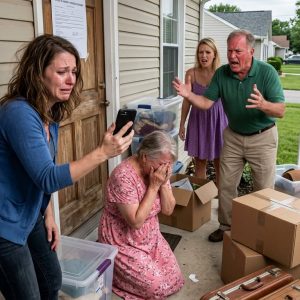
The Price of the Feast
Chapter 1: The Banquet and the Bread
“If the child is that hungry, let her eat that bread roll outside. Spoiled kids grow up weak.”
Those were the exact words, spoken with a mouthful of expensive food, that greeted me when I unlocked the door to my own home.
I had just flown in from Monterrey, arriving three hours earlier than my husband expected. For two grueling weeks, I had been working eighteen-hour days, living out of hotel rooms and conference centers to close a massive international campaign for the logistics firm where I worked as the regional sales director. I was physically hollowed out. I stood in the foyer, my rolling suitcase resting against my hip, my feet aching so badly that I held my black stilettos in my left hand.
But beneath the exhaustion, there was a quiet, desperate joy humming in my chest. I was finally home. I was finally going to see my three-year-old daughter, Camila.
For years, I had carried the financial weight of our entire extended household. Every first of the month, like clockwork, I transferred 35,000 pesos into the bank account of my mother-in-law, Carmen. That was her “salary” to look after Camila while I built the career that kept us all afloat. But the 35,000 was just the baseline. I paid the exorbitant grocery bills. I paid the utilities. I paid for the twice-a-week housekeeper so Carmen wouldn’t have to lift a finger. I paid for my father-in-law’s expensive blood pressure medications. I paid the balance on my husband Daniel’s supplementary platinum credit card, and I even funded the designer shopping habits of my sister-in-law, Valeria.
I did it all without complaint because I believed, with a foolish, desperate naivety, that my daughter was surrounded by a village that worshipped her. I thought I was paying for a fortress of family love.
I was funding my own replacement.
The moment I pushed the heavy oak door open, the overwhelming stench of garlic, melted butter, and ocean brine hit my face. It didn’t smell like my home; it smelled like the VIP dining room of a coastal resort.
I padded silently in my bare feet down the hallway and stopped at the edge of the dining room.
The sprawling mahogany table, which I had bought with my first major commission bonus, was barely visible beneath a mountain of extravagant food. There were giant scarlet lobsters, silver platters of raw oysters on ice, grilled octopus tentacles resting on beds of roasted potatoes, and oversized bowls of jumbo shrimp. Three empty bottles of imported Rioja wine stood like bowling pins near the center.
Sitting at the head of the table, cracking open a lobster claw with butter glistening on her chin and knuckles, was Carmen. She was laughing—a deep, roaring, entitled sound.
Beside her, Daniel was leaning over, dutifully pouring another glass of red wine into his mother’s glass. Across from them, Valeria and her new boyfriend were standing up, holding their smartphones with ring lights attached, filming the feast for their social media followers, posing with oysters near their mouths.
“Mom, I swear, this is even better than that place we went to in Acapulco,” Valeria giggled, tapping her screen to upload the video. “Good thing Mariana makes such good money, right? It pays to have a workaholic in the family.”
Carmen smiled, ripping a chunk of white meat from the shell. “Well, that is what she works for, isn’t it? She’s always gone. If we don’t enjoy the fruits of her labor, who will?”
A cold dread coiled in my gut. I took a step forward. The floorboard creaked.
Valeria’s boyfriend saw me first. He lowered his phone, his smile dissolving. Then Valeria turned. Then Daniel.
The dining room fell into an absolute, suffocating silence. The only sound was the bubbling of the butter warmer in the center of the table.
Daniel scrambled to his feet, nearly knocking over his heavy wooden chair. The blood drained from his face, leaving him looking sickly and pale under the chandelier.
“Mariana!” he choked out, wiping his mouth with a linen napkin. “You’re back already? Why didn’t you text me from the airport? Come… come sit down, sweetheart. There’s still plenty of—”
“Where is Camila?” I asked. My voice didn’t sound like my own. It was dangerously flat. Devoid of any warmth.
Daniel swallowed hard, his eyes darting to his mother, then to the floor. “She… she already ate. She was tired. I think she’s asleep in her room.”
I stared at him. A mother’s internal clock is infallible. It was barely seven-thirty in the evening. Camila was a ball of chaotic energy who never, ever slept before nine o’clock.
I dropped my heels onto the rug. I walked past the dining table, ignoring the smell of the feast, and went straight to the nursery.
Empty. Her bed was perfectly made.
I checked my bedroom. The master bathroom. The guest room. The study.
Empty.
Panic, sharp and metallic, tasted like copper in the back of my throat. I sprinted back into the living room, my eyes scanning the space wildly. And then, I saw the heavy glass sliding door leading out to the balcony.
It was pulled tightly shut, the latch engaged from the inside.
I rushed to the glass.
There, sitting on a tiny, faded plastic step-stool, was my three-year-old daughter. The evening air had dropped to a bitter, biting chill. Camila was wearing only a thin, short-sleeved cotton shirt and light leggings. She was shivering so violently that her teeth were chattering. Her tiny knees were pulled up to her chest, and wrapped tightly in her freezing, pale fingers was half of a hard, stale bread roll.
She wasn’t crying. She was just staring at the floor of the balcony, completely defeated.
My heart felt as if a fault line had cracked open right through the center of it.
I unlocked the glass door and threw it open so hard the pane rattled in its tracks. I dropped to my knees on the cold concrete.
Camila looked up. When she saw me, her large brown eyes flooded with tears. She didn’t reach for me immediately. She looked past me, terrified, toward the dining room.
“Mommy…” she whispered, her voice a fragile, raspy thread. “Can I come inside now? I’ll be quiet.”
I let out a ragged sob and scooped her into my arms. She felt horrifyingly light. Her skin was like ice against my collarbone. She buried her face into the crook of my neck, clinging to me with a desperate, terrified strength.
I stood up, holding my shivering child against my chest, and turned to face the dining room.
The table was still full of warm, luxurious food. Four adults sat around it, fat and content on my dime, while my baby froze outside.
“What did you do to my daughter?” I asked. I didn’t scream. I didn’t yell. The anger I felt was far beyond the volume of a shout. It was a glacial, absolute fury.
Carmen picked up a linen napkin and dabbed elegantly at the corners of her mouth. She rolled her eyes.
“Oh, don’t be so dramatic, Mariana,” she scoffed, waving a buttery hand dismissively. “You treat her like a fragile little princess. Children shouldn’t eat heavy seafood anyway, it upsets their stomachs. She was throwing a tantrum about wanting what we were eating. A little hardship teaches them character. She needed a time-out.”
Valeria let out a short, mean chuckle. “She really does treat her like royalty. That’s why girls become spoiled brats, Mariana. You need to toughen her up.”
I ignored the women. I looked directly at my husband. I looked at the man I had pledged my life to, the man who was supposed to be the shield between our daughter and the cruelty of the world. I waited for him to stand up. I waited for him to scream at his mother. I waited for even a microscopic hint of shame.
Instead, Daniel let out a long, exhausted sigh, as if I were the one ruining the evening.
“Mariana, please, just drop the bags and come eat. Don’t make this bigger than it is,” he whined. “My mother raised three kids; she knows how to handle a toddler. Camila needs to learn she can’t always have everything handed to her on a silver platter just because you feel guilty for working so much.”
I stared at him. The man I loved evaporated right in front of my eyes, leaving behind a pathetic, spineless parasite.
I pulled my jacket off and wrapped it tightly around Camila’s shivering shoulders. I kissed the top of her head.
“You’re right,” I said quietly, the words echoing in the silent room.
Daniel smiled, looking relieved. “See? Just put her to bed and—”
“You’re right,” I repeated, cutting him off. I walked toward the front door, grabbing my purse and my rolling suitcase.
They all stared at me, their forks suspended in mid-air, confusion washing over their faces.
I opened the front door. Before I crossed the threshold, I turned back to look at the lavish spread, the wine, the laughing faces of the parasites who had infested my life.
“Starting tomorrow,” I said, my voice ringing with absolute, terrifying clarity, “every single one of you is going to learn exactly what it means to go without.”
I slammed the door behind me.
None of them understood. None of them knew that the buttery lobster sitting on their plates would be the very last feast they ever enjoyed with my money.
But as I walked down the hallway to the elevator, my daughter trembling against my chest, I realized something else. I had caught them in the act, yes.
But I still hadn’t uncovered the secret that would completely obliterate the life they thought they owned.
Chapter 2: The Cold Night and the Severed Ties
That night, I didn’t waste my breath arguing. I didn’t go to a friend’s house. I ordered an Uber Black and directed the driver to a five-star hotel on Paseo de la Reforma.
During the entire forty-minute ride through the glittering lights of Mexico City, Camila didn’t cry. She didn’t throw a tantrum. She just sat in my lap, wrapped in my oversized blazer, gripping the fabric of my blouse with her tiny, icy fists. She stared out the window with a hollow, vacant expression that frightened me far more than any scream could have. It was the look of a child who had learned that crying brings punishment, not comfort.
When we checked into the suite, the first thing I did was pick up the phone and order room service. I didn’t care about the cost. I ordered a rich, steaming chicken tortilla soup, a plate of soft grilled chicken breast, a massive bowl of fresh berries, and a mug of warm milk with honey.
When the silver trolley arrived and the waiter set the food on the small dining table, Camila didn’t rush toward it. She stood a few feet away, her hands clasped nervously in front of her, staring at the tray with a mixture of ravenous hunger and deep uncertainty.
She looked up at me, her lower lip trembling. “Mommy… can I eat this? Or is this just for the grown-ups?”
The question felt like a physical blow to my ribs.
I dropped to my knees and pulled her into my arms. “Oh, my sweet girl. Of course you can eat this. It’s all for you. Every single bite is for you, and you never have to ask permission to be hungry again.”
I sat with her while she ate. She ate slowly, cautiously, looking toward the hotel room door every few minutes as if she expected Carmen to burst in and drag her away.
After she was full, I ran a warm bubble bath. As I peeled off her thin leggings to help her into the tub, the harsh bathroom lighting caught something on her skin.
I froze. My breath hitched in my throat.
There, on her fragile upper arms, were distinct, faint yellowish-purple marks. Fingerprints. The clear, undeniable evidence of someone grabbing her far too aggressively. There was a fresh, angry red scrape on the back of her calf, as if she had been shoved against a hard edge.
I touched the mark on her arm as gently as I could. “Camila… baby, who did this to your arms?”
She looked down at the suds in the water, her little shoulders hunching up to her ears. “Don’t say anything, Mommy,” she whispered, her voice filled with panic. “Please don’t tell. Grandma will get mad. She said I was a bad girl for wanting the big shrimp.”
My stomach violently turned over. It took every ounce of self-control I possessed not to scream, not to march back to the apartment and tear that woman apart with my bare hands.
Instead, I bathed my daughter, lotioned her skin, dressed her in fresh hotel pajamas, and tucked her into the massive, cloud-like king bed. Within minutes, the sheer exhaustion overtook her, and she fell into a deep, heavy sleep, her hand still clinging to the sleeve of my shirt.
I carefully untangled myself from her grip and walked out to the balcony of the hotel room. I looked out over the sprawling city, breathing in the cold night air.
My phone buzzed in my pocket. It was Daniel.
I answered it, not to speak, but because I needed to hear exactly what he would say. I needed to know how deep the rot went.
“Mariana, what the hell is wrong with you?” Daniel’s voice barked through the speaker, arrogant and annoyed. “You embarrassed my mother in front of our guests. You stormed out like a lunatic over something so incredibly small. Valeria’s boyfriend thinks you’re unstable now.”
“Small?” I repeated, my voice a deadly whisper. “Your three-year-old daughter was locked outside on a balcony in the freezing cold, eating a piece of stale bread, while you gorged yourself on crab legs. And you call that small?”
I heard a scuffle on the other end of the line, and then Carmen’s shrill, grating voice echoed in the background.
“I took care of that ungrateful brat for three years so you could go play businesswoman!” Carmen shouted into the phone. “And this is how you thank me? You’re an ungrateful, hysterical woman! Daniel, tell her if she doesn’t come back and apologize right now, she can find a new babysitter!”
I didn’t yell back. I didn’t defend myself. I just pulled the phone away from my ear and pressed the red button to end the call.
Then, I opened my settings and blocked Daniel’s number. I blocked Carmen. I blocked Valeria. I blocked every single parasite that had been feasting on my life.
I sat down at the hotel desk, opened my laptop, and logged into my banking portal.
I felt a cold, mechanical satisfaction wash over me as I began the purge.
Click. I canceled the recurring monthly deposit of 35,000 pesos to Carmen’s account.
Click. I deactivated Daniel’s supplementary Platinum card, effectively severing his access to my credit line.
Click. I canceled Valeria’s authorized user status on the shopping accounts.
Click. I stopped the automatic payments for the premium streaming services, the gourmet grocery deliveries, and the gym memberships they all used but never paid for.
By the time I was finished, I had effectively turned off the oxygen supply to their entire lifestyle.
Then, I picked up my phone and dialed the personal cell number of Mr. Herrera, the senior partner at the law firm our company retained. It was nearly midnight, but he answered on the third ring.
“Mariana? Is everything alright?” he asked, his voice thick with sleep but instantly alert.
“I need you to draw up divorce papers first thing in the morning,” I said, my voice steady and cold. “I want full, uncompromising custody of my daughter. And I want my apartment back.”
There was a brief pause on the line. Mr. Herrera knew the dynamics of my marriage. He had always warned me about Daniel’s financial habits.
“Understood,” Mr. Herrera said, shifting into full lawyer mode. “Regarding the apartment, is Daniel’s name on the deed?”
“No,” I replied. “I bought it two years before we were married. The mortgage is entirely in my name. The deed is mine. I bought the furniture. I pay the taxes. His family only lives there because I allowed it. Because I thought they loved my daughter.”
“Then they are legally classified as month-to-month tenants at best, or mere guests at worst,” Mr. Herrera said smoothly. “I will draft a formal eviction notice immediately. We will serve it by noon.”
I thanked him and hung up. I sat in the dim light of the hotel room, watching Camila breathe. The financial cutoff was satisfying, yes. The eviction would sting. But they would just spin a narrative. Carmen would play the victim. Daniel would cry to our mutual friends that I was a heartless, career-obsessed bitch who threw them onto the street over a misunderstanding.
I needed undeniable proof. I needed something that would burn their reputations to the ground.
And then, staring at my phone on the desk, I remembered.
When Camila was born, I had a security company install discrete nanny cameras in the living room, the kitchen, and the nursery. I traveled so much that I wanted to be able to see her on my phone when I was in a lonely hotel room halfway across the country.
Carmen had absolutely hated them. She constantly threw a towel over the living room lens or unplugged the router, claiming she felt “spied on.” Over the last year, I had been so exhausted, so beaten down by her constant complaining, that I had stopped checking the app entirely.
I unlocked my phone. My hands began to shake as I scrolled to the security folder.
I tapped the app icon. I synced it to the cloud storage. I set the time filter for 5:00 PM that evening.
I hit play.
And what I saw staring back at me from the screen made me realize that I hadn’t just married a weak man. I had married a monster.
Chapter 3: The Silent Witness
The video footage was in high definition, capturing the entire living and dining area in a wide, sweeping angle. The audio was crystal clear.
I sat on the edge of the hotel bed, pressing the phone close to my face, my heart hammering against my ribs like a trapped bird.
On the screen, the time stamp read 6:15 PM. The dining table was already laden with the massive seafood spread. Carmen, Valeria, and Daniel were laughing, pouring wine, completely engrossed in their luxury.
From the hallway, little Camila appeared. She was wearing her favorite yellow socks, her hair a messy tangle of curls. She walked hesitantly toward the dining table, her tiny hands clutched tightly against her chest. She stood at the edge of the room for nearly a full minute, completely ignored by the adults.
Finally, she took a step closer to Carmen’s chair.
“Grandma,” Camila said, her voice small and polite. “I’m hungry. Can I have some dinner?”
On the screen, Carmen didn’t even turn her head. She kept using a metal cracker to break open a crab leg.
“There is no food for you here, Camila. This is adult food. It’s too expensive to waste on a child who won’t appreciate it,” Carmen snapped, her tone dripping with venom. “There’s a hard roll on the kitchen counter. Go eat that.”
Camila stayed completely still, staring longingly at the hot food. “But I don’t want the hard bread, Grandma. It hurts my teeth.”
Valeria, sitting across the table, rolled her eyes and laughed coldly. “Ugh, Mom, just take her away. I hate seeing her stare at the food while I’m trying to eat. It ruins the aesthetic for my video.”
And then, Daniel appeared in the frame.
My husband. My daughter’s protector.
He had just walked in from the kitchen holding a fresh bottle of wine. He was standing less than two meters away from his daughter. He heard every single word his mother and sister said. He saw the hunger and fear in his child’s eyes.
Instead of intervening, instead of scooping his daughter up and making her a meal, Daniel sat down at the table. He popped the cork on the wine, poured himself a glass, and looked at Camila.
“Listen to your grandmother, Cami,” Daniel said, his voice flat and annoyed. “Don’t start whining. Go get the bread and go away.”
On the screen, Camila began to softly cry.
That was the moment Carmen’s patience snapped. She threw her napkin down, stood up, and grabbed Camila by the upper arm—exactly where I had found the bruises. She yanked the toddler forward so hard Camila’s feet nearly left the floor.
Carmen dragged my crying child across the living room, grabbed the stale bread off the counter, and shoved it into Camila’s hands. Then, she opened the heavy glass balcony door, pushed the three-year-old out into the biting cold night, and slammed the door shut. She flipped the latch.
Carmen walked back to the table, sat down, and picked up her wine glass. “God, finally some peace and quiet,” she muttered.
For the next forty-five minutes of footage, the camera angle showed the balcony in the background. Camila stood outside the glass. She wasn’t banging on the door. She wasn’t throwing a tantrum. She was just standing there, shivering, holding her bread, watching her family eat a feast bought with her mother’s blood, sweat, and tears.
I pressed the lock button on my phone. The screen went black.
I rushed into the hotel bathroom, dropped to my knees in front of the toilet, and violently threw up everything in my stomach.
For years, I had made excuses for Daniel. I had convinced myself that he was just a gentle soul, a man who was pathologically afraid of confronting his overbearing mother. I thought his passivity was a flaw of weakness.
That night, clutching the cold porcelain, I realized the horrifying truth. It wasn’t weakness. It was permission. As long as Daniel was comfortable, as long as his wine glass was full and his bills were paid, he could completely ignore the suffering of his own flesh and blood.
The next morning, the sun rose over Mexico City, painting the sky in bruises of purple and gray. I dressed Camila in warm clothes, ordered a car, and drove straight to a private pediatrician.
The doctor’s examination was thorough and damning. The diagnosis was documented in harsh, clinical terms: low percentile weight for her age, elevated cortisol levels indicating chronic stress, sleep deprivation, and physical contusions consistent with being grabbed forcefully by an adult.
The doctor looked at me over his glasses, his expression grave. “Mrs. Robles, I am legally obligated to report these findings to child protective services.”
“Report it,” I said, looking him dead in the eye. “Attach it to my file. I want a paper trail a mile long.”
From the clinic, I drove straight to Mr. Herrera’s law office. I sat in his leather chair and slid my phone across his mahogany desk. I played the footage.
Mr. Herrera, a man who had seen decades of ugly divorces, watched the video in complete silence. When it ended, he leaned back, his face a mask of cold professionalism.
“With this evidence, and the medical report you just handed me, full custody is a guarantee,” Mr. Herrera said quietly. “We can also petition for strictly supervised visits. He will never be alone with her again.”
“That is exactly what I want,” I said. “Daniel can see her only when Camila decides she feels safe enough, and only with a court-appointed monitor present.”
I wasn’t using my daughter as a pawn for revenge. I was building an impenetrable fortress around her. I would never, ever hand her back to people who treated her existence like an inconvenience.
While I sat in the law office, the financial bomb I had planted the night before finally detonated.
Back at the apartment, their comfortable, parasitic life began to violently unravel.
According to the frantic voicemails Daniel started leaving on my blocked number (which routed to a backup transcript service), the morning had been a disaster. Carmen had gone to the premium supermarket to buy ingredients for breakfast. When the cashier swiped her card for a 4,000-peso grocery bill, the machine flashed red. Declined. She tried again. Declined. She had been forced to leave the cart full of food in the aisle, humiliated in front of her wealthy neighbors.
An hour later, Valeria had gone to a boutique in Polanco to pick up a designer handbag she had placed on layaway using Daniel’s card. Declined.
Daniel had called the bank in a panic, screaming at the customer service representative, demanding to know why his Platinum card was frozen. The representative calmly informed him that the primary account holder—Mariana Robles—had permanently revoked his privileges and closed the credit line.
“Mariana is just throwing a massive, hysterical tantrum,” I later heard Valeria say on a voicenote she sent to a mutual friend. “Daniel just needs to go buy her some flowers and bring her back. She’ll calm down. She always caves.”
But Valeria was wrong. I was done caving.
At exactly noon, a uniformed court officer, accompanied by a locksmith and Mr. Herrera’s paralegal, knocked firmly on the door of my apartment.
Daniel opened it, looking disheveled and frantic.
The officer handed him a thick manila envelope. “Mr. Reyes, on behalf of Mrs. Mariana Robles, the sole legal owner of this property, you are hereby served with a formal notice to vacate. You and all occupants have exactly seven days to remove your personal belongings from these premises, or you will be forcibly removed by law enforcement.”
Carmen, hearing the commotion, stormed into the foyer in her silk robe. She took one look at the paperwork and began to scream.
“This is my son’s house!” she shrieked, pointing a finger at the officer. “He is the man of the house! You can’t kick us out! We have rights!”
The court officer didn’t flinch. He calmly pulled out a copy of the property deed and held it up.
“Ma’am, the deed is registered entirely under Mrs. Mariana Robles. Your son is not listed on the mortgage, the deed, or the utility accounts. You have seven days.”
That afternoon, Daniel finally managed to bypass my block by calling from a burner phone he bought at a convenience store.
I didn’t answer. Mr. Herrera answered it for me.
“Mr. Reyes,” Mr. Herrera said smoothly, leaning back in his chair. “From this moment forward, all communication regarding your marriage, your living situation, and your child will go exclusively through legal channels. The divorce petition has been officially filed with the courts as of one hour ago. Do not attempt to contact my client directly again, or I will file for a restraining order.”
There was a long, hollow silence on the other end of the line.
“Divorce?” Daniel whispered, his voice cracking, sounding like a terrified little boy realizing the adults had finally left the room.
The line went dead.
The empire they had built on my back was crumbling into dust. But Daniel and Carmen still believed they could manipulate the narrative. They still believed they could ruin me socially.
They had no idea that the worst was still to come, and that Carmen’s own pride would be the match that ignited her absolute destruction.
Chapter 4: The Lobby Confrontation
Two weeks later, the air conditioning in the family court mediation room felt like a freezer.
I sat at a long wooden table, flanked by Mr. Herrera. Across from me sat Daniel. He looked like a ghost of the man I had married. Without my credit cards to fund his weekly barber visits and dry-cleaned Italian suits, he looked rumpled, exhausted, and remarkably small. He had dark circles under his eyes, and his hands shook as he rested them on the table.
“Mariana, please,” Daniel begged, the moment the mediator stepped out of the room to fetch a document. “Please don’t destroy my family like this. You’re taking everything. You’re throwing my parents onto the street.”
I looked at him, my expression carved from stone.
“Your family was destroyed the moment you sat at a dining table, drinking wine, while you left a three-year-old girl freezing on a balcony,” I said quietly.
Daniel flinched. “My mother went too far, I know that. I admit it! But she’s old, Mariana. She grew up in a different generation. She believes in tough love. You’re overreacting.”
“Camila is three years old, Daniel,” I snapped, leaning forward, the cold fury finally bleeding into my voice. “She didn’t need character building. She didn’t need tough love. She needed food. She needed warmth. She needed a father to stand up and protect her.”
He lowered his head, staring at his shaking hands. “I didn’t know about the bruises on her arms. I swear to God, Mariana, I didn’t know my mother grabbed her that hard.”
I reached into my leather briefcase. I pulled out a manila folder and slammed it onto the table. I spread out the high-resolution photographs of Camila’s bruised arms, the detailed medical report from the pediatrician, the psychological evaluation noting her trauma responses, and a flash drive containing the camera footage.
“You didn’t know because you actively chose not to look,” I said. “You didn’t want to know.”
Daniel squeezed his eyes shut, a tear leaking down his cheek. He said nothing.
I leaned back in my chair. “Let’s test your fatherhood, Daniel. I’ll ask you three simple questions. If you can answer them, I’ll reconsider the supervised visits.”
He opened his eyes, a desperate spark of hope flashing in them. “Okay. Ask me.”
“Question one,” I said, holding up a finger. “What is Camila’s absolute favorite bedtime story right now? The one she asks for every single night?”
Daniel swallowed hard. His eyes darted around the room as if the answer were written on the walls. “Uh… The Very Hungry Caterpillar? No, wait. Goodnight Moon?”
“It’s a book about a dragon who loses his fire. She’s loved it for six months,” I said flatly. “Question two. What fruit gives her a severe rash around her mouth if she eats too much of it?”
Silence. Daniel rubbed his mouth, panicking. “Strawberries?”
“Pineapple,” I corrected. “Question three. What does she do when she’s terrified? How does she comfort herself?”
He closed his eyes. “Mariana, please…”
“She rubs her left earlobe with her thumb,” I said, my voice breaking slightly before I hardened it again. “You don’t know a single thing about her. Because you were never a father, Daniel. You were just a man who happened to sit at the table while your daughter watched your life through a pane of glass.”
That single sentence broke whatever fight he had left in him. He didn’t shout. He didn’t argue. He just broke down, weeping into his hands, drowning in the sudden, crushing realization of his own pathetic apathy.
When the mediator returned, Daniel agreed to everything. He signed away his rights to fight for primary custody. He agreed to supervised visits only. He agreed to the maximum allowable child support deduction from his salary. He surrendered completely.
But Doña Carmen, fueled by decades of unchecked narcissism and entitlement, refused to accept defeat.
She believed that if she could control the public narrative, she could force me to back down. She decided to strike where she thought I was most vulnerable: my career.
One Monday morning, during the peak rush hour, Carmen bypassed the security desk at my corporate office building. She marched into the massive, marble-floored lobby, right as hundreds of employees, executives, and clients were grabbing their morning coffee.
She dropped her purse, fell to her knees in the center of the lobby, and began to wail.
“Look at this woman!” Carmen screamed, pointing up toward the glass-walled executive offices where she knew I worked. “Mariana Robles! She got rich and threw her poor, elderly mother-in-law into the street like garbage! She stole my beautiful granddaughter from me! She accused me of abuse after I sacrificed three years of my life raising that child while she was off sleeping in hotels!”
The entire lobby ground to a halt. Baristas stopped steaming milk. Executives stopped in their tracks. Everyone stared at the weeping older woman making a spectacle on the floor.
My assistant burst into my office, panicked. I stood up, smoothed my skirt, and walked out to the elevators.
When the elevator doors chimed open on the ground floor, the crowd parted for me. I walked calmly into the center of the lobby.
Carmen saw me and her weeping grew louder, more theatrical. She pointed a trembling, accusatory finger at my chest.
“Tell them the truth, Mariana!” she shouted, playing to the crowd. “Tell them how your pride and your money changed you! Tell them how you ruined our family over a misunderstanding!”
I didn’t raise my voice. I didn’t defend myself to the whispering crowd. I didn’t show an ounce of the humiliation she was trying to inflict upon me.
I reached into my blazer pocket and pulled out my smartphone. I tapped the Bluetooth settings and connected to the high-powered portable speaker my assistant had grabbed from the conference room.
I turned the volume up to the absolute maximum.
I opened the video file, held the phone up, and pressed play.
The audio from that night echoed off the marble walls of the lobby, loud, crisp, and undeniable.
Camila’s tiny, polite, trembling voice filled the massive room. “Grandma, I’m hungry. Can I have some dinner?”
Then, Carmen’s voice, devoid of her current theatrical tears, dripping with cruel, venomous annoyance. “There is no food for you here, Camila. This is adult food. It’s too expensive to waste on a child. There’s a hard roll on the kitchen counter. Go eat that.”
Then came Valeria’s cold laugh. “Take her away. I hate seeing her stare at the food.”
Then Daniel’s pathetic endorsement. “Listen to your grandmother, Cami.”
The sound of the sliding glass door slamming shut echoed through the lobby. And then, the audio played thirty seconds of dead, haunting silence—the sound of a three-year-old girl standing outside in the freezing cold.
Nobody in the lobby moved. Nobody spoke. The silence that followed the recording was heavier than gravity.
I looked down at Carmen. She was still sitting on the floor, but the color had completely drained from her face. She looked like a deflated balloon.
“That’s… that’s edited,” Carmen stammered, looking around at the crowd, her voice barely a whisper. “She altered it with a computer.”
I didn’t argue. I simply pressed play on the next clip.
It was audio of Carmen screaming at Daniel on the phone, calling Camila an “ungrateful brat.”
By the time the second clip ended, the murmurs in the lobby had shifted from shocked curiosity to absolute, visceral disgust. People weren’t looking at me with suspicion anymore; they were looking at Carmen with open revulsion. A woman standing near the coffee cart actually spat on the marble floor in Carmen’s direction.
Security guards finally broke through the crowd. They didn’t ask me what to do. They simply grabbed Carmen by the arms, hauled her roughly to her feet, and escorted her out of the revolving doors as she covered her face in shame.
I never posted the video online. My daughter’s pain and trauma did not need to become public internet entertainment.
But the damage was permanently done. People talk. The story spread like wildfire through the building, leaped to Daniel’s extended relatives, and decimated Carmen’s prestigious social circle.
The woman who had spent decades bragging at country clubs about being a respected, fiercely loving matriarch became a social pariah. She became the woman nobody wanted sitting near their children. The invitations stopped. The phone calls ended. She was excised from her own community like a tumor.
The deadline for the eviction had arrived. The empire built on my dime was entirely repossessed.
But the final severing of ties, the true end of the nightmare, still awaited me in a sterile courtroom.
Chapter 5: Two Homes
On the eighth day, I walked back into my apartment.
The air was stale, and the walls echoed with the emptiness of a rushed exit. They had taken their clothes, their cheap knick-knacks, and the electronics I hadn’t explicitly claimed on the inventory list. But the expensive furniture, the art, the life I had built—it all remained. I stood in the center of the living room, breathed in deeply, and finally felt the heavy, suffocating weight of the Whitmore family lift off my chest.
I hired a cleaning crew to scrub every inch of the place. I threw away the faded plastic stool on the balcony. I bought new locks.
Meanwhile, Daniel’s reality collapsed in on itself.
With no money, no credit, and no home, his family was forced to rent a cramped, damp two-bedroom house on the far outskirts of the city, an hour’s commute from anything familiar. Valeria’s aspiring-influencer boyfriend packed his bags and vanished the moment he realized the designer bags, the lavish dinners, and the spontaneous weekend trips had never been paid for by her family’s wealth.
My father-in-law, who had spent his entire life keeping his head down and letting Carmen rule the roost, finally snapped. Stripped of his comfortable retirement and the respect of his peers, neighbors reported hearing him screaming at Carmen through the thin walls of their new rental, blaming her cruelty for destroying the only stable, luxurious life they had ever known.
Daniel’s fall was the steepest.
For years, he had coasted in his mid-level corporate job, securing promotions and high-profile clients entirely through the networking connections I provided him at industry galas. Once the divorce became public knowledge, and the rumors of the balcony incident reached his superiors, the invitations stopped. His major clients, many of whom were personal friends of mine, suddenly transferred their accounts to other reps.
His commission dried up. His base salary was slashed. He was quietly demoted to a back-office department where he wouldn’t interact with the public. The sharp Italian suits were replaced by wrinkled shirts.
He kept sending me long, desperate emails begging for coffee, begging for five minutes to explain, begging for a chance to “fix us.”
I created an email filter that sent anything not containing the word “Camila” directly to the trash.
Six months later, we sat in a sterile courtroom to sign the final divorce decree.
Daniel sat across the mahogany table from me. He looked broken. The arrogance that had allowed him to sit at that dining table and ignore his daughter was entirely gone, replaced by a hollow, haunting regret.
The judge pushed the thick stack of papers across the desk. Daniel picked up the heavy black pen. He stared at it for a long time, as if the pen itself weighed a hundred pounds. His hand hovered over the signature line.
He looked up at me. His eyes were red-rimmed and wet.
“Did you ever actually love me, Mariana?” he asked, his voice cracking, a pathetic attempt to find some sliver of validation in the ruins of his life.
I looked at him. I didn’t feel anger anymore. I didn’t feel hatred. I just felt a profound, overwhelming pity for the smallness of his soul.
“Yes, Daniel. I did,” I said, my voice calm and steady. “I loved you so much that I completely mistook my infinite patience for love. I confused my financial sacrifice with building a family. And while I was breaking my back supporting all of you, funding your luxury, my daughter was quietly learning that she shouldn’t ask for food in her own home.”
A single tear slipped down Daniel’s cheek, splashing onto the legal document.
“Forgive me,” he whispered.
“That apology isn’t mine to give, or mine to accept,” I replied.
He swallowed hard, signing his name with a shaking hand. “Will Camila ever forgive me?”
“That will be her choice when she grows up, and she has the vocabulary to understand what you allowed to happen to her,” I said, standing up and buttoning my blazer. “But if one day, ten years from now, she decides she doesn’t want to see you… do not call her an ungrateful brat. Just remember the balcony.”
He didn’t say another word. He just lowered his head and wept quietly into his hands.
I walked out of the courthouse and stepped into the bright, warm afternoon sun. I took a deep breath of the city air. I didn’t feel the euphoric happiness they promise in the movies. I felt something much better. I felt absolute, unshakeable peace.
That afternoon, I drove to Camila’s new kindergarten.
When I walked into the brightly colored classroom, she was sitting at a small blue table, her fingers covered in washable paint. When she saw me, her face lit up with a brilliant, gap-toothed smile. She abandoned her paintbrush and ran across the room, throwing her arms around my legs.
“Mommy!”
I scooped her up, kissing her paint-smudged cheek. She felt heavier now. The hollow look in her eyes had been replaced by the bright, chaotic spark of a child who knows she is safe. The bruises were long gone. The weight had returned.
Her teacher, a kind woman with warm eyes, walked over and handed me a piece of construction paper.
“Camila wanted to make sure you saw this before we put it in her cubby,” the teacher smiled.
I looked at the drawing. It was rendered in chaotic, heavy crayon strokes. It showed a small, bright yellow house. Standing in front of the house were two stick figures, a taller one and a smaller one, holding hands tightly. Above them, covering almost the entire sky, was a massive, scribbled red heart.
“This is you, Mommy,” Camila said proudly, pointing a blue-stained finger at the taller figure. “And this is me. You told me I’m not a burden. You said I’m your treasure.”
I had to bite the inside of my cheek and breathe deeply through my nose to keep the tears from spilling over.
“You are my greatest treasure in the whole world, Cami,” I whispered, pressing my forehead against hers.
After school, I didn’t take her to a fancy restaurant. There were no white tablecloths, no oysters, no performances for social media.
We walked down the street to a small, bustling corner fonda. We ordered giant bowls of chicken noodle soup and warm, cheesy quesadillas—exactly what a three-year-old actually wants to eat. We sat at a wobbly metal table. Camila ate peacefully, her little legs swinging happily under the chair, a smudge of salsa on her chin.
She paused, holding a piece of tortilla in her hand, and looked at me thoughtfully.
“Mommy,” she asked, her big brown eyes entirely serious. “We’re never going back to Grandma Carmen’s house, right?”
“No, my love,” I said firmly, wiping her chin with a napkin. “Never again.”
“And what about Dad?”
“Dad can see you on Sundays, when you want to see him. And there will always be a nice lady named Miss Rosa there with you to make sure you have fun and stay safe. But only if you want to. Nobody will ever force you.”
Camila processed this information, nodding slowly. She took a bite of her quesadilla.
“So… where is our home now?” she asked.
I smiled. I reached across the table and gently placed my hand flat against the center of her tiny chest, right over her beating heart.
“Right here,” I said softly. “Home is wherever you feel entirely safe. Home is the place where you can say you’re hungry, or you’re cold, or you’re scared, or you’re sad, and you know that someone will drop everything to listen to you. Home is where nobody, ever, makes you feel like you are a burden for simply existing.”
Camila looked down at my hand on her chest. Then, she reached out with her own small, warm, salsa-stained hand and placed it firmly over my heart.
“So, we have two homes,” she declared with the absolute certainty only a child possesses.
A single tear finally escaped, tracking down my cheek, but my smile was wide and genuine.
“Yes, sweetheart,” I whispered, covering her little hand with mine. “And both of them belong entirely to you.”
That night, after I bathed her and tucked her into her warm bed, I stood in the doorway of her room. I watched her chest rise and fall as she slept peacefully, her arms wrapped tightly around a plush stuffed rabbit.
Standing there in the quiet sanctuary of our reclaimed life, I finally understood a truth that I believe every woman needs to learn before she allows herself to break completely for the sake of others:
Family is not proven by a shared last name on a piece of paper. It is not proven by sitting at the same lavishly set dining table, and it is certainly not proven by smiling for the cameras on a holiday trip funded by someone else’s sweat.
Family is defined by whoever stands up to protect what you love most when they think you aren’t watching.
And anyone who willfully ignores the pain of your child, even if they share your table, your blood, or your bed, ceases to be family from that exact moment until the end of time.
If you want more stories like this, or if you’d like to share your thoughts about what you would have done in my situation, I’d love to hear from you. Your perspective helps these stories reach more people, so don’t be shy about commenting or sharing.